
How to use Claude Opus 4.5 with Cursor and Claude Code — a in-depth guide

Anthropic’s Claude Opus 4.5 is the company’s newest flagship model focused on coding, agentic workflows, and advanced “computer use.” This article explains what Opus 4.5 is, how it performs on public benchmarks, and — step by step — how to use it inside two developer-focused surfaces: Cursor (an AI-powered IDE) and Claude Code (Anthropic’s command-line agentic coding tool). You’ll get practical examples, copy-and-paste snippets (Python, JS, CLI), and best practices for efficient, safe, and cost-aware usage.
I will guide you on how to obtain Claude opus 4.5 from CometAPI at a cost-effective price and use it in Cursor and Claude Code.
What is Claude Opus 4.5?
Claude Opus 4.5 (often shortened to Opus 4.5) is Anthropic’s newest “Opus” family model release in the Claude 4.5 line. Anthropic positions Opus 4.5 as a broadly capable, production-grade model meant to deliver high-quality natural language and coding outputs while being efficient with tokens and compute. The release notes and product pages emphasize its improved code quality, stronger agentic/workflow behavior, and a large context window intended for long documents and multi-step developer workflows.
What are the practical upsides of Opus 4.5?
Token efficiency and cost controls: Opus 4.5 introduces a new effort parameter that lets you trade compute/thinking budget for latency/cost . This helps tune routine vs. deep tasks without switching models.
Coding-first improvements: better pass rates on held-out coding tests and real projects, meaning improved code generation and debugging performance versus earlier Claude models.
Agentic and tool-use focus: Designed to call tools, orchestrate multi-step flows, and handle “computer use” style tasks reliably.
What are the features and performance benchmarks of Claude Opus 4.5?
headline features
- Better coding performance and refactoring — Anthropic calls out significantly improved outputs for code migration, refactors, and multi-file reasoning.
- Agentic and tool use improvements — improved ability to act as a multi-step agent (maintaining context across steps, invoking tools), useful both in Cursor (IDE agent) and terminal agent workflows like Claude Code.
- Efficiency gains — internal claims mention cutting token usage in half for certain coding tasks (early testing), improving cost/latency tradeoffs.
- Large context window — up to 200k tokens for many 4.5 variants (some specialized 4.5 models may offer different windows). That enables feeding full code repos or long transcripts.
What do the benchmarks look like in practice?
Anthropic published internal benchmarks showing Opus 4.5 outperforming previous Opus models on coding and multi-step reasoning tasks and reducing token usage in some scenarios, but third-party benchmarks will vary by workload. Opus 4.5 as “meaningfully better” at everyday tasks and coding challenges, with an emphasis on practical improvements rather than purely synthetic score gains. Expect real-world gains on code quality, reasoning consistency, and token efficiency.
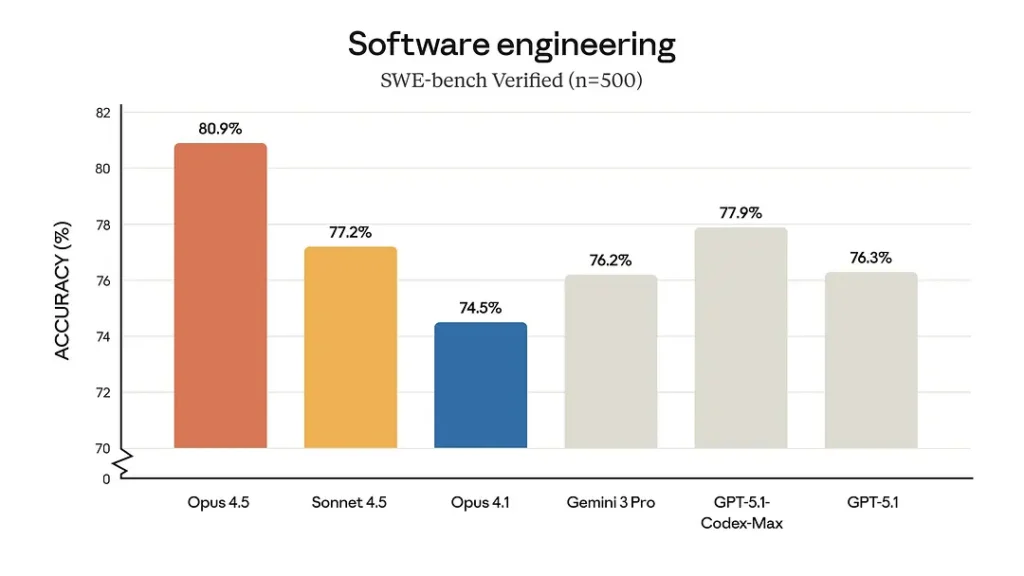
Bottom line: Opus 4.5 is built for developers and teams who want stronger coding/agent behavior and large-context capabilities with improved cost efficiency — a strong candidate for IDE integrations (Cursor) and terminal agent tools (Claude Code).
How can I call Claude Opus 4.5 through CometAPI?
CometAPI is a multi-model aggregator that exposes many LLMs (OpenAI, Anthropic/Claude series, Google, etc.) through a unified REST interface. You can use CometAPI as a proxy.
Why route through CometAPI?
- Single credential / single endpoint for many models (handy if you want to standardize across multiple providers).
- Pricing and access: CometAPI bundles access/discounts and exposes models that might otherwise be gated in your region. (Always read rate limits and pricing in your CometAPI dashboard.)
How to confirm model availability in CometAPI
For Claude Opus 4.5, The model IDs for CometAPI are claude-opus-4-5-20251101 and claude-opus-4-5-20251101-thinking. Additionally, there are custom-tuned models for Cursor: cometapi-opus-4-5-20251101-thinking and cometapi-opus-4-5-20251101. CometAPI deployments provide a /v1/models listing or a console where you can search their model catalog. (If the exact model ID differs, use the model name listed there.)
How do I configure Cursor to use CometAPI (so Cursor runs Opus 4.5 for me)?
Short plan: get a CometAPI key → discover the CometAPI model name for Opus 4.5 → point Cursor at CometAPI by overriding the OpenAI base URL or adding the CometAPI provider in Cursor’s Model settings → set model id(
cometapi-opus-4-5-20251101)/deployment and verify.
why use CometAPI with Cursor?
CometAPI provides a unified API layer for many models (Anthropic Claude, Google Gemini, OpenAI, etc.), allowing you to swap providers, centralize billing, and use an OpenAI-style interface. Cursor and similar IDEs that accept custom model providers can be pointed at CometAPI’s OpenAI-compatible endpoints so you can use Opus 4.5 without changing your tooling.
Step-by-step: set up CometAPI in Cursor
(These steps are the standard approach based on CometAPI + Cursor guides — names/menus in Cursor may differ slightly by version.)
- Get a CometAPI key: sign up at CometAPI, go to Console → API Keys, and copy a
sk-...style key. - Find the base URL: CometAPI uses an OpenAI-style base:
https://api.cometapi.com/v1/(this is the canonical base used in examples). - Open Cursor settings: go to Settings → Models → Add custom provider (or similar in Cursor). Choose an option like “OpenAI-compatible provider” or “Custom API.”
- Paste the base URL and API key: set base URL to
https://api.cometapi.com/v1/and Authorization toBearer sk-...(Cursor UI will generally ask for a key). - Set model name to Opus 4.5: when Cursor prompts for a model id, use the CometAPI/Anthropic model string such as
cometapi-opus-4-5-20251101-thinkingif you want CometAPI’s thinking budget behavior). - Test in Cursor: open the AI chat panel or ask for a code completion in an editor window and confirm the model returns responses.
Example: curl test call (calls CometAPI directly)
You can test the same integration with a curl request against CometAPI’s OpenAI-compatible messages endpoint. This is the exact same call Cursor will proxy or issue when configured:
curl -s -X POST "https://api.cometapi.com/v1/messages" \
  -H "Authorization: Bearer sk-YOUR_COMETAPI_KEY" \
  -H "Content-Type: application/json" \
  -d '{
    "model": "claude-opus-4-5-20251101",
    "max_tokens": 800,
    "thinking": { "type": "enabled", "budget_tokens": 500 },
    "messages": [
      { "role": "user", "content": "Refactor this function to be asynchronous and add tests: <paste code>" }
    ]
  }'
model— the CometAPI model identifier for Opus 4.5.thinking— optional Anthropic/CometAPI parameter that enables “thinking” budget behavior (available on some model variants).
Example: Node.js (fetch) call to CometAPI
// node 18+ or environment fetch available
const res = await fetch("https://api.cometapi.com/v1/messages", {
  method: "POST",
  headers: {
    "Authorization": "Bearer sk-YOUR_COMETAPI_KEY",
    "Content-Type": "application/json"
  },
  body: JSON.stringify({
    model: "claude-opus-4-5-20251101",
    messages: [{ role: "user", content: "Explain the bug in this snippet..." }],
    max_tokens: 500
  })
});
const data = await res.json();
console.log(data);
Notes & gotchas
- Cursor expects an OpenAI-compatible endpoint or a custom provider flow; CometAPI’s
v1endpoints are OpenAI-style so Cursor typically works with little friction. - Model names can change; always confirm the precise model string from CometAPI’s
GET /v1/modelsor their docs if amodel not founderror appears.
How do I use Claude 4.5 Opus (Claude Code)?
Claude Code is Anthropic’s terminal/agentic coding assistant (a CLI + optional editor integrations) designed to let you run agentic coding sessions from the terminal. You can route Claude Code through CometAPI so the CLI uses Opus 4.5 behind the scenes.
Why run Claude Code via CometAPI?
- Standardize access (one API key) to multiple providers.
- Use CometAPI’s pricing/usage controls or routing policies.
- Point Claude Code at a stable gateway if your network requires a proxy.
Installing and launching Claude Code
(These commands assume you have claude installed via the official packaging mechanism; check CometAPI docs for the current installer.)
# Example (pseudo) install - check official docs for exact package manager
pip install claude-code-cli   # or use the official installer

# Navigate to your repository
cd ~/projects/my-app

# Launch an interactive Claude Code session
claude
Step-by-step: configure Claude Code to use CometAPI
- Install Claude Code by following install instructions (npm/yarn/npx or installer).
- Set the CometAPI base and key environment variables in your shell. Example (macOS / Linux):
export ANTHROPIC_API_KEY="sk-YOUR_COMETAPI_KEY"
export ANTHROPIC_BASE_URL="https://api.cometapi.com/v1"
# Alternative vars you may need:
# export CLAUDE_API_KEY="sk-YOUR_COMETAPI_KEY"
# export CLAUDE_API_BASE="https://api.cometapi.com/v1"
(If Claude Code ignores the custom base by default, consult the Claude Code config command or the local ~/.claude config; proxies and community forks often document the exact env var.
- Start a Claude Code session:
# Example: run an interactive session
claude
# or to run a script-driven session
claude run ./scripts/build-and-test.yml
On startup, Claude Code should detect the _API_KEY and _BASE_URL and route requests through CometAPI. If it prompts, confirm that you want to use the provided key. requests through CometAPI. If it prompts, confirm that you want to use the provided key.
- Specify model switching:
Specify model switching: inside many Claude Code sessions you can instruct the agent which model to use or use a config flag. If you need explicit model selection via CometAPI, include a header/payload model field (or pass a config like --model "claude-opus-4-5-20251101" depending on your Claude Code version). Then you can pick a model in-session:
# Choose a model interactively
/model

# Or start with a flag to pick Opus immediately (CLI supports aliases sometimes)
claude --model claude-opus-4-5-20251101
You can also switch mid-session with /model opus. The CLI exposes planning and tool modes (see best practices).
Example: proxy + Claude Code (practical)
If you run a local proxy that forwards Anthropic calls to CometAPI — e.g., for testing — the proxy approach commonly uses ANTHROPIC_BASE_URL:
# point Claude Code to CometAPI
export ANTHROPIC_API_KEY="sk-YOUR_COMETAPI_KEY"
export ANTHROPIC_BASE_URL="https://api.cometapi.com/v1"
# launch
claude
If the CLI supports a config command:
claude config set --key ANTHROPIC_API_KEY "sk-YOUR_COMETAPI_KEY"
claude config set --key ANTHROPIC_BASE_URL "https://api.cometapi.com/v1"
Example — refactor a function using Claude Code (CLI workflow)
- In your repo:
claude(launch). - Set model:
/model opus - Tell Claude what to do:
You are an expert TypeScript engineer.
Task: Find the `calculateTotals` function in the `src/payments/` folder, add unit tests that cover rounding edge-cases, and refactor it to be pure and more testable. Explain each change in the commit message.
- Claude Code will scan the repo, propose a plan (list of steps), ask for confirmation, and then either produce patches (
git applystyle) or open an interactive edit cycle.
This agentic, sessional flow is exactly where Opus 4.5 aims to excel — planning and executing multi-step code changes reliably.
Frequently Asked Questions (FAQs)
Q: Is Opus 4.5 available via CometAPI right now?
A: Yes — CometAPI documents and community guides show that Opus 4.5 model identifiers are exposed through CometAPI and can be used via the v1/messages or OpenAI-compatible endpoints. Confirm the exact model string in CometAPI’s model list (GET /v1/models) because names can include date stamps or special variants.
Q: Do I need an Anthropic account to use Opus through CometAPI?
A: No — CometAPI acts as a gateway so you only need a CometAPI account/key. CometAPI will handle routing to Anthropic under their commercial arrangement. Check CometAPI’s terms for provider routing and billing.
Q: Which env vars should I set for Claude Code to route through CometAPI?
A: Common approaches include ANTHROPIC_API_KEY (your CometAPI key) and ANTHROPIC_BASE_URL="https://api.cometapi.com/v1". Some setups accept CLAUDE_API_KEY / CLAUDE_API_BASE.
Q: Will Cursor support the full 200k context window seamlessly?
A: Cursor can pass long contexts to the backend, but actual behavior depends on Cursor’s own UI/transport limits and CometAPI’s request size limits. When you need extremely long contexts (hundreds of thousands of tokens), validate end-to-end using a test call to CometAPI and watch for request/response truncation.
Q: Are there differences between “Opus” and “Sonnet” 4.5 variants?
A: Yes — Anthropic uses different 4.5 family labels to distinguish behavior: Opus typically prioritizes a combination of capability and practical performance; Sonnet variants are sometimes optimized for highest reasoning/coding capabilities (and may come in other context sizes).
Structure prompts and sessions for coding workflows
Good prompt engineering and session design are key to success with Opus 4.5.
Prompt templates for coding tasks (example)
SYSTEM: You are a senior software engineer. Always explain trade-offs, include unit tests, and produce minimal diffs.

USER: Repo context: <brief repo summary>. Task: <what to do>. Constraints: <tests, style, performance>.

Example:
Task: Refactor `processPayment` to remove global state and add unit tests. Files: src/payments/*.js
Constraints: must pass existing CI and support Node 18.
Session management
- Short sessions for single-file edits.
- Longer sessions for multi-step refactors or migrations; keep a manifest of actions (plan → step → run → validate → commit). Use Claude Code’s plan/execute cycle or Cursor’s multi-file context support.
Conclusion — Where to start, and what to watch
Claude Opus 4.5 is a step change for engineering workflows that require deep reasoning, planning, and robust tool orchestration. If you’re evaluating it:
- Run a small pilot on a clear, representative workflow (e.g., triage and fix three bugs). Measure pass rates, cost, and iteration counts.
- Use
effortas your first tuning knob before changing models — it often yields the right balance of latency and quality. - Integrate with Cursor for IDE-driven tasks and with Claude Code for sessional agentic execution; each surface has complementary strengths.
Finally, treat Opus 4.5 as a productivity accelerator that still requires careful engineering controls: solid testing, human approvals, cost guardrails, and observability. When used correctly, Opus 4.5 can dramatically reduce iteration cycles on complex engineering problems and elevate what teams can automate safely and reliably.
Developers can access Claude Opus 4.5 API etc through CometAPI, the latest model version is always updated with the official website. To begin, explore the model’s capabilities in the Playground and consult the API guide for detailed instructions. Before accessing, please make sure you have logged in to CometAPI and obtained the API key. CometAPI offer a price far lower than the official price to help you integrate.
Ready to Go?→ Free trial of Claude opus 4.5 !
If you want to know more tips, guides and news on AI follow us on VK, X and Discord!