
Anthropic intends to release Claude Sonnet 5 this week (reports point to February 3, 2026). The new Sonnet release is described as a meaningful jump over the Sonnet 4.5/Opus 4.5 family — promising bigger context windows, stronger multi-modal abilities, and competitive pricing.
What Is Claude Sonnet 5?(Known information)
Claude Sonnet 5 is expected to be a next-generation multimodal AI model designed for enterprise and developer workflows, building on its predecessors’ strengths in reasoning, coding, tool use, and autonomous task execution. While concrete technical specifications and benchmark results are not yet officially published, industry insiders and leak reports suggest that it will represent a substantial performance upgrade over Claude Sonnet 4.5, particularly in areas such as large-context reasoning, multi-agent orchestration, and cost-efficient inference.
A Model Positioned Between Power and Practicality
Historically, the most capable models—such as Claude Opus or GPT-4-class systems—have been expensive and computationally heavy. Sonnet-class models, by contrast, traditionally aimed for efficiency rather than dominance. Claude Sonnet 5 reportedly changes that equation.
Leaks suggest that Sonnet 5 outperforms Claude Opus 4.5 across most benchmarks while costing roughly 50% less, positioning it as both a technical and economic disruptor.
Strategic Timing in an Intensifying AI Arms Race
The reported timing is also critical. Google is expected to advance Gemini following its “Snow Bunny” internal milestone, while OpenAI continues to scale GPT-5-class systems. A Sonnet 5 release this week would allow Anthropic to preempt competitors with a model that blends frontier-level coding ability with enterprise-friendly pricing.
What Are the News Sources Behind the Claude Sonnet 5 Reports?
Infrastructure Leaks and Vertex AI Artifacts
One of the strongest indicators of an imminent launch comes from Google Vertex AI bug logs, which reportedly reference a model identifier labeled:
claude-sonnet-5@20260203
This identifier strongly suggests a February 3, 2026 activation window, aligning with claims that the model could go live this week.
Additionally, researchers and developers monitoring Vertex endpoints have encountered 404 errors tied to specific Sonnet 5 model IDs, a pattern that historically appears shortly before a model is publicly enabled. These errors indicate that the model is already provisioned within Google’s infrastructure but not yet accessible.
Internal Codename: “Fennec”
Multiple independent reports reference “Fennec” as the internal codename for Claude Sonnet 5. The codename has surfaced in internal documentation, benchmarking notes, and leaked comparisons positioning Fennec as a full generation ahead of Gemini’s Snow Bunny milestone.
While Anthropic has not confirmed the codename, the consistency across leaks lends credibility to the claim.
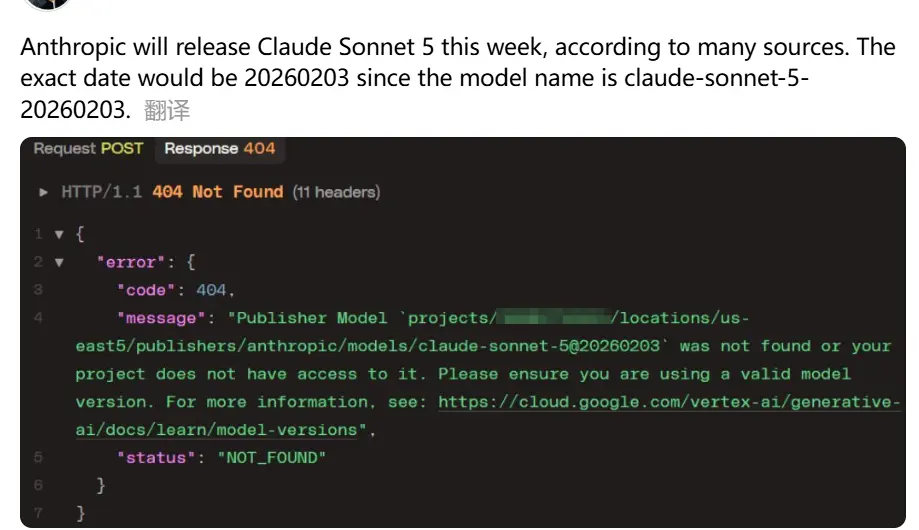
While accessing this ID returns a 404 error, it's sufficient to demonstrate that the model already exists in Google's infrastructure, just not yet activated.. If these identifiers correlate with release timing, they imply a launch date around February 3, 2026 — meaning the model could become available imminently.
Features and claimed performance improvements
What features is Sonnet 5 rumored to include?
Leaked reporting converge on the following headline capabilities for Claude Sonnet 5:
- Greatly expanded context window — rumored to jump from Sonnet 3/4-era context lengths (tens to a couple hundred thousand tokens) toward 500K–1M tokens in some reports. This would enable extremely long documents, full-book prompts, and long-running agent memory sessions without external retrieval.
- Improved reasoning and coding — Sonnet 5 is described as surpassing Sonnet 4.5 on coding benchmarks and multi-step reasoning tasks(), with leak summaries suggesting improvements in code synthesis accuracy and fewer hallucinations.
- Broader multimodality — where Sonnet 4.x typically handled images well, Sonnet 5 is rumored to extend to richer multimodal inputs (images + audio and possibly limited video understanding) and better interleaving of modalities in a single conversation.
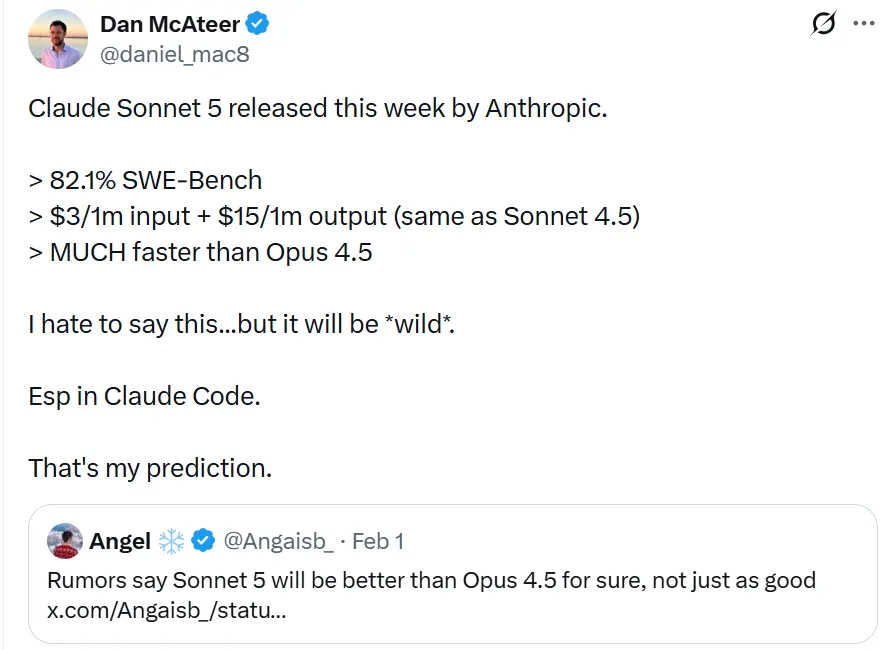
- Higher benchmark scores (SWE-Bench and others) — one public claim circulating in social channels indicates Sonnet 5 scored >82.1% on SWE-Bench (a software engineering benchmark) and outperformed earlier Sonnet/O pu s variants. Treat this as an initial leak-level claim until independent benchmark reports appear.
- Efficiency & pricing optimizations — leak commentaries suggest competitive pricing and token-efficiency improvements relative to prior Opus/Sonnet releases, making the model attractive for enterprise scale use. (More on pricing below.)
How credible are the performance claims?
Partial credibility: Partial credibility: Many of the feature claims are consistent across multiple leak reports (context window increases, emphasis on coding/agent improvements), which adds weight. However, community leaks do not replace formal published benchmarks and third-party evaluations.
What “improvements in coding and agentic use” mean in practice
If Sonnet 5 indeed improves coding and agentic capabilities, users should expect:
- Fewer iteration cycles to get working code (less back-and-forth for syntax and logic fixes).
- Better tool orchestration for agents (more reliable sequences of API calls and system interactions).
- Less brittle behavior across multi-step tasks (longer planning horizons and better contextual memory).
These are qualitative improvements that reduce friction in development and complex workflows; concrete gains will be visible in benchmark suites and user reports in the weeks after release.
How Does Claude Sonnet 5 Compare to Gemini 3 and Others?
Versus Gemini “Snow Bunny”
Claude Sonnet 5 is described as a full generation ahead of Google’s Gemini Snow Bunny milestone. While Gemini has emphasized multimodality and consumer integration, Sonnet 5 appears focused on:
- Depth over breadth
- Engineering and enterprise use cases
- Long-context reasoning
- Agentic autonomy
This divergence reflects different strategic priorities between Anthropic and Google, despite their close infrastructure relationship.
Versus Claude Opus 4.5
Perhaps the most surprising comparison is internal claims that Sonnet 5 outperforms Claude Opus 4.5 in nearly every metric—despite being positioned as a cheaper, more efficient model.
If accurate, this raises questions about whether Sonnet 5 effectively redefines the Sonnet tier or obsoletes parts of the Opus lineup.
How Does Claude Sonnet 5 Change AI-Powered Coding?
Claude Code Evolution
Claude Sonnet 5 is described as a major evolution of Claude Code, Anthropic’s developer-focused tooling.
Rather than acting as a single assistant, Sonnet 5 can spawn dedicated sub-agents from a single endpoint, including:
- Backend engineers
- Frontend specialists
- QA and testing agents
- Research and documentation agents
These agents work in parallel, dramatically reducing time-to-completion for complex engineering tasks.
“Development Team” Mode
One of the most striking features is “Development Team” mode. In this mode:
- Users provide only high-level instructions
- Agents autonomously divide work
- Tasks execute in the background
- Complete features or services are delivered end-to-end
Sources describe the experience as managing a small team of human engineers—except faster, cheaper, and continuously available.
What Will Claude Sonnet 5 Cost?
One of the most talked-about aspects of the Claude Sonnet 5 rumors is the pricing expectation.
Claude Sonnet 5 may be offered at roughly half the cost of Opus 4.5, which would represent a significant reduction relative to that model’s established pricing.
This could make the model considerably more affordable than models at the flagship tier, especially for teams or businesses where cost is a sensitive factor.
How Does This Compare With Sonnet 4.5 Pricing?
Claude Sonnet 4.5 — released in 2025 — has pricing arrangements in which input tokens are priced at approximately $3 per million and output tokens at $15 per million in the typical configuration, with higher rates for larger context usage.
If Sonnet 5 were offered at a lower price point while delivering similar or better performance, it could reshape adoption patterns for enterprise AI workloads.
Final Thoughts: Is Claude Sonnet 5 a Turning Point?
While much of the information remains unofficial, the convergence of leaks, benchmarks, and infrastructure signals makes one thing clear: Claude Sonnet 5 is poised to be one of the most consequential AI releases of 2026.
If it delivers on even a portion of the reported capabilities—especially its coding performance and agentic workflows—it could redefine expectations for what mid-tier models can achieve.
For developers, enterprises, and AI researchers alike, this week may mark the arrival of a new standard.
Developers can access Claude Sonnet/ Opus 4.5 and opus 4.5 via CometAPI now, We'll be the first to fall for Claude Sonnet 5's release.. To begin, explore the model’s capabilities in the Playground and consult the API guide for detailed instructions. Before accessing, please make sure you have logged in to CometAPI and obtained the API key. CometAPI offer a price far lower than the official price to help you integrate.
Ready to Go?→ Sign up fo Claude Sonnet 5 today !
If you want to know more tips, guides and news on AI follow us on VK, X and Discord!