Belangrijkste functies
- Natuurlijke/hoogwaardige tekstweergave in afbeeldingen — blinkt uit in het produceren van leesbare, semantisch juiste tekst in gegenereerde afbeeldingen (posters, verpakkingen, screenshots) — een gebied waar veel eerdere beeldmodellen moeite mee hadden.
- Hooggetrouwe multimodale output — produceert fotorealistische en gestileerde beelden met goede details en taalbewuste lay-out.
- Stijloverdracht en detailverbetering — kan consistente artistieke stijlen toepassen of lokale details verbeteren met behoud van scènecoherentie.
Technische details — hoe Qwen-Image werkt
Architectuur en componenten (kernwoorden: MMDiT, Qwen2.5-VL). Het model gebruikt een op MMDiT gebaseerde diffusie-transformer voor beeldsynthese, gecombineerd met een visueel-taalencoder (Qwen2.5-VL) om prompts en visuele context te interpreteren. Deze scheiding stelt het model in staat om semantische sturing en pixeluiterlijk verschillend te behandelen, wat de tekstgetrouwheid en bewerkingsconsistentie verbetert. De officiële repository en het technische rapport vermelden een backbone met 20 miljard parameters voor het belangrijkste T2I-model.
Trainingspipeline (kernwoorden: curriculum learning, gegevenspijplijn). Om moeilijke tekstrendering op te lossen, gebruikt Qwen-Image een progressief curriculum: het begint met eenvoudigere afbeeldingen zonder tekst en traint geleidelijk op complexere, tekstrijke voorbeelden tot op paragraafniveau. Het team bouwde een uitgebreide pijplijn die grootschalige verzameling, zorgvuldige filtering, synthetische augmentatie en balancering omvat om ervoor te zorgen dat het model tijdens de training veel realistische tekst/fotocomposities ziet. Dit strategische curriculum is een belangrijke reden dat het model uitblinkt in meertalige tekstrendering.
Bewerkingsmechanisme (kernwoorden: dual-encoding, VAE + VL-encoder). Voor bewerking voert het systeem de oorspronkelijke afbeelding tweemaal in: eenmaal in de Qwen2.5-VL-encoder voor semantische controle en eenmaal in een VAE-encoder voor reconstructieve uiterlijkinformatie. Het ontwerp met dubbele encodering stelt de bewerkingsmodule in staat om identiteit en visuele getrouwheid te behouden, terwijl semantische wijzigingen mogelijk blijven — bijvoorbeeld het vervangen van een object of het veranderen van tekstuele inhoud zonder ongerelateerde gebieden te degraderen.
Benchmarkprestaties
Qwen-Image behaalt SOTA of bijna SOTA-prestaties op meerdere openbare benchmarks voor zowel generatie als bewerking, met bijzonder sterke resultaten in tekstrenderingstaken en benchmarks voor composities uit de echte wereld (bijv. T2I-CoreBench en gecureerde image-editing-suites).
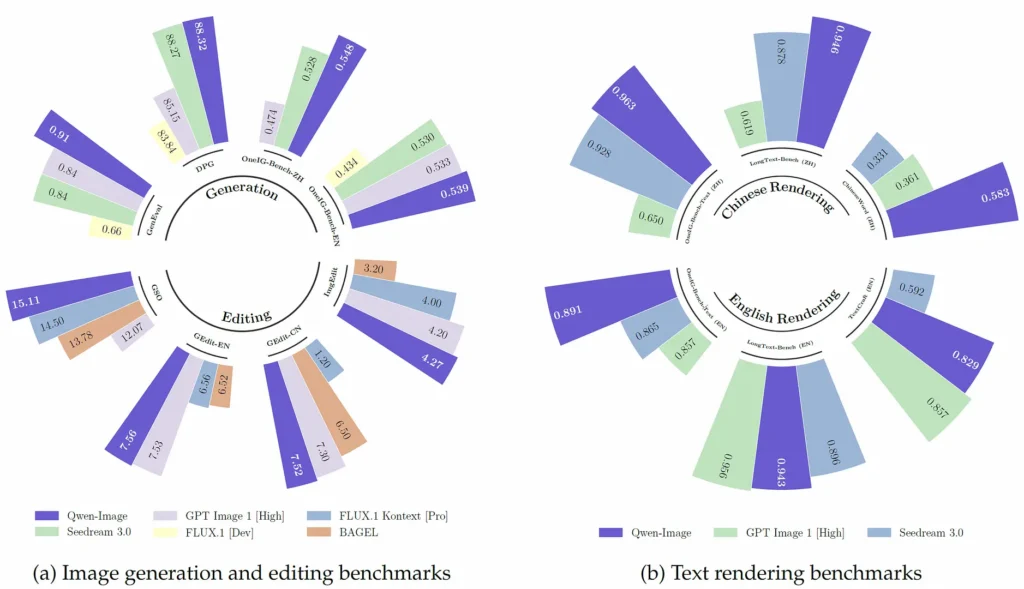
Hoe Qwen-Image zich verhoudt tot andere toonaangevende modellen
Relatieve sterke punten: tekstrendering en tweetalige tekstgetrouwheid zijn de onderscheidende voordelen van het model ten opzichte van veel generatieve concurrenten (bijv. DALL·E 3, SDXL, Midjourney), die vaak sterker zijn in puur artistieke compositie of stilistische diversiteit maar zwakker bij dichte meerregelige of Chinese tekstopmaak. Meerdere communityvergelijkingen en de benchmarktabellen van de auteurs ondersteunen deze karakterisering.
Relatieve afwegingen: vergeleken met gesloten, zwaar getunede commerciële systemen kan Qwen-Image nabehandeling of prompt-/adapterafstemming vereisen om in sommige contexten identiek realisme te bereiken (vervorming op gebogen oppervlakken, fotorealistische compositing), volgens onafhankelijke tests. Voor gebruikers die sjabloongebaseerde ontwerpen, verpakkingsmock-ups of tweetalige tekstopmaak prioriteren, is Qwen-Image doorgaans te verkiezen.
Typische en waardevolle toepassingsscenario's
- Verpakkings- en productmock-ups: nauwkeurige tekst en meerregelige lay-outs voor labels en verpakkingsproeven.
- Advertenties en ontwerpconcepten: snelle prototyping waarbij tekstgetrouwheid belangrijk is (posters, banners).
- Documentgerichte beeldgeneratie: afbeeldingen genereren die leesbare inhoud moeten bevatten (menu's, borden, interfaces).
- Beeldbewerkingspijplijnen: gerichte bewerkingen (tekstvervanging, object toevoegen/verwijderen) met behoud van stijl en perspectief.
- Hoe toegang te krijgen tot de Qwen image API
Stap 1: Meld u aan voor een API-sleutel
Log in op cometapi.com. Als u nog geen gebruiker bent, registreer u dan eerst. Meld u aan bij uw CometAPI console. Verkrijg de API-sleutel (toegangsreferentie) van de interface. Klik bij het API-token in het persoonlijke centrum op “Add Token”, verkrijg de tokensleutel: sk-xxxxx en dien in.
Stap 2: Verzoeken verzenden naar de Qwen image API
Selecteer het “qwen-image ”-endpoint om het API-verzoek te verzenden en stel de request body in. De requestmethode en de request body zijn te vinden in de API-documentatie op onze website. Onze website biedt ook Apifox-tests voor uw gemak. Vervang <YOUR_API_KEY> door uw eigen CometAPI-sleutel uit uw account. base url is Images format(https://api.cometapi.com/v1/images/generations) via CometAPI.
Voer uw vraag of verzoek in het content-veld in — daarop zal het model reageren .
Stap 3: Resultaten ophalen en verifiëren
Verwerk de API-respons om het gegenereerde antwoord te verkrijgen. Na verwerking geeft de API de taakstatus en de uitvoergegevens terug.