
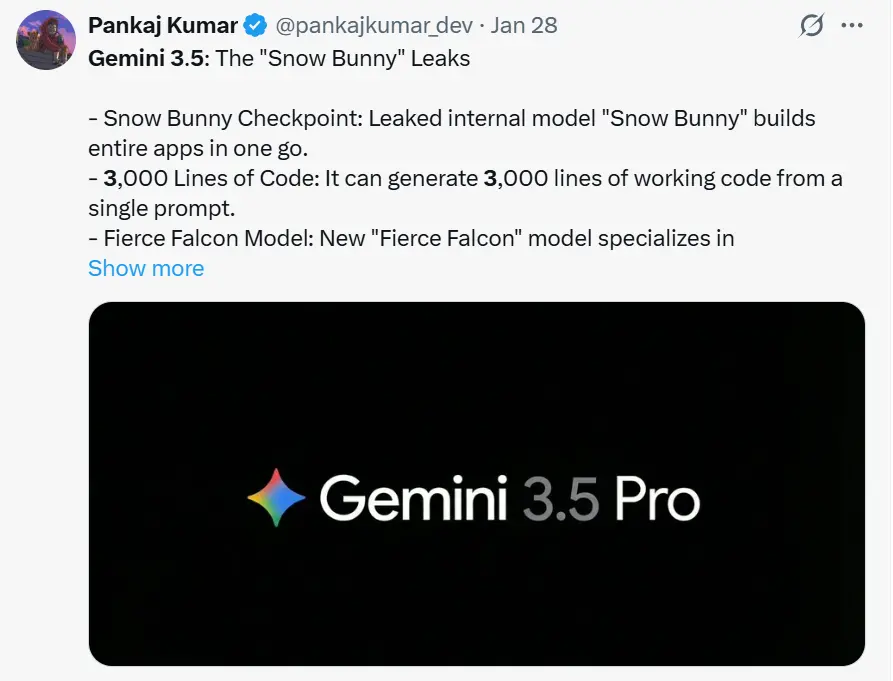
Google is quietly testing a new internal iteration of its Gemini family — reported variously as “Gemini 3.5” and by the intriguing internal codename “Snow Bunny.” Codenamed "Snow Bunny," this internal checkpoint has reportedly shattered existing benchmarks, demonstrating an unprecedented ability to generate entire software applications—up to 3,000 lines of functional code—in a single prompt.
As Silicon Valley scrambles to verify the data, early reports suggest that Google has achieved a breakthrough in "System 2" reasoning, allowing Gemini 3.5 to pause, think, and architect complex systems with a proficiency that eclipses current leaders like GPT-5.2 and Claude Opus 4.5.
What Is Gemini 3.5 "Snow Bunny"?
Gemini 3.5, referred to internally by the codename "Snow Bunny," appears to be Google's direct answer to the stagnation of model reasoning capabilities observed in late 2025. Unlike its predecessors, which focused heavily on multimodal understanding and context window size, Gemini 3.5 represents a paradigm shift toward extended cognitive horizons and autonomous software architecture.
The "Snow Bunny" Architecture
The "Snow Bunny" moniker reportedly refers to a specific, high-performance checkpoint of the model currently undergoing A/B testing on Google's Vertex AI and AI Studio platforms. The leak suggests that this is not merely a "Pro" or "Ultra" refresh but a fundamental architectural upgrade integrating "Deep Think" capabilities.
Specialized Model Variants
Leaks indicate that "Snow Bunny" may be a family of specialized models rather than a single monolith. Two specific variants have been identified in the leaked documentation:
- Fierce Falcon: A variant optimized for raw computational speed and logical deduction, likely aimed at competitive programming and rapid data analysis.
- Ghost Falcon: A creative powerhouse designed for "vibe coding," handling UI/UX design, SVG generation, audio synthesis, and visual effects with high fidelity.
System 2 Reasoning: The "Deep Think" Mode
The defining feature of Gemini 3.5 is its rumored "System 2" reasoning engine. Drawing inspiration from human cognitive psychology, this system allows the model to "pause" before responding to complex queries. Instead of predicting the next token immediately, the model engages in a hidden chain-of-thought process, evaluating multiple execution paths for code or logic puzzles. This "Deep Think" toggle has reportedly propelled its benchmark scores into uncharted territory.
Who Broke the News?
The existence of Gemini 3.5 was brought to light through a series of coordinated leaks on the social media platform X (formerly Twitter) and technical blogs in late January 2026.
- Primary Source: The initial bombshell came from tech blogger and insider Pankaj Kumar, who shared screenshots and logs of the "Snow Bunny" model in action. His posts detailed the model's ability to "one-shot" complex engineering tasks.
- Benchmark Validation: A user known as "Leo," who maintains the Hieroglyph lateral reasoning benchmark, corroborated the leaks. He posted results showing a "Snow Bunny" variant achieving an 80-88% success rate on lateral thinking tasks—a test where most models, including GPT-5.2, struggle to break past 55%.
- Technical Confirmation: Further credibility was added of "gemini-for-google-3.5" variables appearing in the backend code of Google's API services, suggesting that the infrastructure for a public launch is already in place.
What would distinguish 3.5 from 3.0 / 3 Flash?
Based on the leak reporting, the principal differentiators are:
- Large-scale, systems-level code synthesis: ability to maintain global state and architecture across thousands of lines (not just isolated function generation).
- Unified multimodal artifact generation: the same session produces code, vector graphics, and native audio in a single coherent workflow.
- Fine-grained reasoning controls: experimental toggles (e.g., “Deep Think” / “System2”) to trade latency for deeper chain-of-thought-style search internally.
These sound like iterative engineering advances rather than a radically different architecture, but if validated at scale they would change how teams prototype and ship product artifacts.
How Does the Features and Performance Compare?
The leaked metrics paint a picture of a model that is significantly more capable and faster than its contemporaries.
The 3,000-Line Coding Miracle
The most viral claim from the leak is Gemini 3.5's ability to generate 3,000 lines of executable code from a single, high-level prompt. The specific example cited involved a user asking the model to build a Nintendo Game Boy emulator.
In a standard workflow with GPT-4 or Gemini 1.5, this task would require dozens of prompts: breaking down the CPU architecture, defining the memory map, handling graphics rendering, and debugging iteratively. Gemini 3.5 "Snow Bunny" reportedly output the entire codebase—including the CPU instruction set, GPU emulation, and memory handling—in one continuous stream, requiring only minor manual fixes to boot real ROMs.
Performance Benchmarks: Gemini 3.5 vs GPT-5.2 vs Claude Opus 4.5
| Benchmark | Gemini 3.5 "Snow Bunny" | GPT-5.2 (Est.) | Claude Opus 4.5 |
|---|---|---|---|
| Hieroglyph (Lateral Reasoning) | 80% - 88% | 55% | ~50% |
| GPQA Diamond (PhD Science) | >90% | ~85% | ~80% |
| Token Generation Speed | ~218 tokens/sec | ~80 tokens/sec | ~60 tokens/sec |
The speed of 218 tokens per second is particularly alarming to competitors.
For a model of this reasoning depth to run at such high velocity implies a massive optimization in Google's TPU v6 infrastructure or a breakthrough in sparse model architecture.
Code Example: The "One-Shot" Capability
To illustrate the complexity of what "3,000 lines of code" entails, consider that the model isn't just writing a simple script. It is architecting a system.
Below is a conceptual snippet of how Gemini 3.5 might structure the Memory Management Unit (MMU) of the leaked Game Boy emulator in a single pass.
Note: The following is a representative excerpt of the type of low-level logic "Snow Bunny" generates autonomously.
python
class GameBoyMMU:
    def __init__(self, bios_path):
        self.bios = self.load_bios(bios_path)
        self.rom = bytearray(0x8000)  # 32k Cartridge
        self.vram = bytearray(0x2000) # 8k Video RAM
        self.wram = bytearray(0x2000) # 8k Working RAM
        self.zram = bytearray(0x80)   # Zero-page RAM
        self.in_bios = True

    def load_bios(self, path):
        try:
            with open(path, 'rb') as f:
                return bytearray(f.read())
        except FileNotFoundError:
            return bytearray(256)

    def read_byte(self, address):
        # BIOS Mapping
        if self.in_bios and address < 0x0100:
            return self.bios[address]
        elif address == 0x0100:
            self.in_bios = False

        # Memory Map Routing
        if 0x0000 <= address < 0x8000:
            return self.rom[address]
        elif 0x8000 <= address < 0xA000:
            return self.vram[address - 0x8000]
        elif 0xC000 <= address < 0xE000:
            return self.wram[address - 0xC000]
        elif 0xFF80 <= address < 0xFFFF:
            return self.zram[address - 0xFF80]
        # ... (Extended handling for I/O registers, Interrupts, Echo RAM)
        return 0xFF

    def write_byte(self, address, value):
        # VRAM Write (Block during rendering modes if necessary)
        if 0x8000 <= address < 0xA000:
            self.vram[address - 0x8000] = value
        # DMA Transfer Trigger
        elif address == 0xFF46:
            self.dma_transfer(value)
        # ... (Complex logic for banking, timer controls, audio registers)

    def dma_transfer(self, source_high):
        # Direct Memory Access implementation simulating 160ms cycle
        source_addr = source_high << 8
        for i in range(0xA0):
            byte = self.read_byte(source_addr + i)
            self.write_byte(0xFE00 + i, byte) # Write to OAM
In a typical interaction, a user would simply prompt: "Create a fully functional Game Boy emulator in Python that handles BIOS loading, memory mapping, and basic CPU opcodes." Gemini 3.5 then generates the class above, along with the CPU class, PPU (Pixel Processing Unit), and main execution loop, maintaining coherency across thousands of lines.
When Will It Be Released?
While Google has not officially confirmed a release date, the convergence of leaks suggests an announcement is imminent.
- Timeline: Internal testing variables and the "Snow Bunny" checkpoint appear to be in late-stage validation. Speculation points to a potential "shadow drop" or a major reveal in February 2026, possibly to preempt competitor releases.
- Current Status: The model is currently in private beta, accessible only to select trusted testers and enterprise partners via Vertex AI.
What Are the Pricing and Cost Details?
Pricing remains one of the most aggressive aspects of the Gemini strategy. Rumors indicate that Google intends to undercut the market significantly, leveraging its vertical integration of hardware (TPUs) and software.
- Gemini 3.5 Flash: Leaked pricing suggests roughly $0.50 per 1 million input tokens. This is approximately 70% cheaper than comparable "smart" models from competitors.
- Gemini 3.5 Pro/Ultra: Pricing is expected to be competitive, potentially introducing a tiered subscription model for "Deep Think" capabilities.
- Deep Think Surcharge: There is speculation that the "System 2" reasoning mode may cost more per token due to the increased compute time required for the model to "think" before generating an answer.
Conclusion
If the "Snow Bunny" leaks hold true, Google Gemini 3.5 is not just an incremental update; it is a forceful declaration of dominance. By solving the "lazy coding" problem and enabling massive, coherent code generation, Google may be on the verge of transforming developers from code writers into system architects. As we await the official keynote, one thing is clear: the AI arms race has just accelerated to hypersonic speeds.
Developers can access Gemini 3 Flash and Gemini 3 Pro CometAPI, the latest models listed are as of the article’s publication date. To begin, explore the model’s capabilities in the Playground and consult the API guide for detailed instructions. Before accessing, please make sure you have logged in to CometAPI and obtained the API key. CometAPI offer a price far lower than the official price to help you integrate.
Ready to Go?→ Sign up for Gemini 3 today !
If you want to know more tips, guides and news on AI follow us on VK, X and Discord!