
Google has sharply tightened the free tier for the Gemini API: Gemini 2.5 Pro has been removed from the free tier and Gemini 2.5 Flash’s daily free requests were cut dramatically (reports: ~250 → ~20/day). That doesn’t mean the model is permanently “dead” for experimentation — but it does mean free access has been effectively gutted for many real-world use cases.
What changes of Gemini API — and why does it matter?
What developers observed
Over the first week of December 2025 many developers noticed sudden 429 (rate-limit) errors and disappearing models in their AI Studio / API dashboards, the reason for this comes from:
gemini-2.5-prono longer appears under free-tier usage limits for many accounts (effectively 0 free requests/day for Pro).gemini-2.5-flash(the lower-latency flash tier) was reported as having its free daily request count cut from about 250 requests/day down to roughly 20 requests/day for many free accounts. That’s a reduction on the order of ~90%+.
These changes were noticed when personal projects and automation flows began failing with rate-limit errors. That combination — lower per-day call counts and fewer free Pro cycles — dramatically raises the cost of experimentation and small-scale automation that relied on the free tier.
Why it matters:
- Small developers, hobbyists and early-stage startups who built prototypes on the free tier suddenly see broken workflows or rapid downgrades from Pro to Flash mid-session.
- Tools and automations that depend on dozens or hundreds of small calls per day (CI checks, chatbots, home automation, content pipelines) are disproportionately affected.
- The change signals Google’s broader strategy: prioritize paid users under heavy load and push higher-volume usage into paid tiers or enterprise agreements. The official pricing and rate-limits pages are unchanged in their structure (token prices remain published), but independent evidence and Google discussion threads show enforcement changes at the quota layer.
What are the current quotas and costs? Why changed?
Gemini 2.5 Pro (free) was historically available as an experimental free preview for many developers. However, in early December, the free quota for Gemini 2.5 Pro was unexpectedly canceled, and the number of requests for 2.5 Flash was also significantly reduced. Developers felt this was disrespectful and caused some loss to users.

Simple comparison — previous vs currently reported free quotas
| Model | Previously reported free quota (commonly observed, mid-2025 → Nov-2025) | Current reported free quota (observed early Dec 2025) |
|---|---|---|
| gemini-2.5-pro | 50–100 requests/day (preview windows; experimental). RPM: ~2–5 ; RPD: 25–100 | Often not visible / removed from Free tier ( no longer appears under unpaid quota) |
| gemini-2.5-flash | RPM: 10 ; RPD: 250 | RPD: ~20 for many free accounts ( reduction from 250→20) |
| gemini-2.5-flash-lite | RPM: 15 ; RPD: 1000 (earlier published values) | No broad change |
Currently, developers who want to use Gemini 2.5 Pro and higher-tier Gemini 2.5 flash can only subscribe to either Pro or Ultra, and use Gemini 2.5 according to the API pricing provided by Gemini:
| Model | Paid input price (per 1M tokens) | Paid output price (per 1M tokens) | Notes |
|---|---|---|---|
| gemini-2.5-pro (Standard) | $1.25 (<=200k prompts) / $2.50 (>200k) | $10.00 (<=200k) / $15.00 (>200k) | Pro aimed at coding & complex reasoning. |
| gemini-2.5-flash (Standard) | $0.30 (text/image/video) | $2.50 (output incl. thinking tokens) | Best price–performance balance; 1M token context window. |
| gemini-2.5-flash-lite | $0.10 (text/image/video) | $0.40 | Cost-efficient, high throughput model for scale. |
The good news is that CometAPI offers a cheaper Gemini API. The good news is that CometAPI offers a cheaper Gemini API and frequently has holiday deals, such as Black Friday and the recent Christmas discounts.
Why reduced (Google’s stated reason)
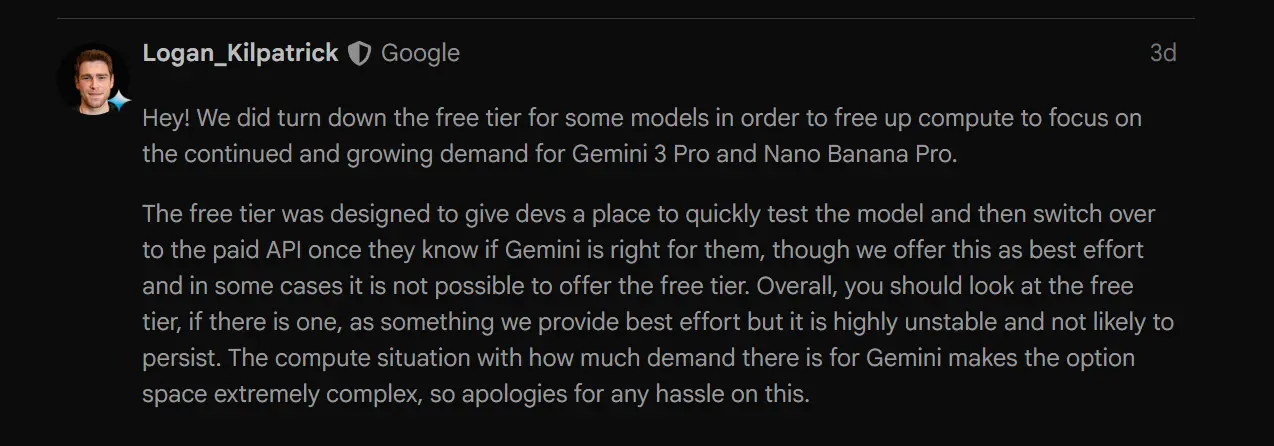
A Google staff reply in the official developer forum confirmed that 2.5 Pro free limits were dialed down because capacity was being reallocated to newer models with heavy demand. , the move was driven by capacity and demand management: new launches (Gemini 3 and Pro/Ultra variants) used a disproportionate share of compute, so Google temporarily restricted which models were available on the free tier to ensure stability and prioritize paid tiers and new launches.
Could Google restore free Pro access? — plausible scenarios
I’ll outline realistic scenarios and the probability/conditions for each (note: this is inferential analysis, not a statement of Google policy).
1) Temporary rollback and clearer interim free allowances (possible but conditional).
If the immediate capacity/abuse issues can be addressed — for example by rate-limiting per-account more precisely, throttling abusive patterns, or adding short-term compute — Google could partially restore a limited free access tier with clearer caps and guardrails. This is moderately plausible if community backlash is high and if telemetry shows most free users were legitimate. Any restored access would likely be narrower (smaller daily calls, no Pro-level SLAs). Evidence: public rate-limit systems and statements that Google can tune limits.
2) Free Pro never returns broadly; a paid gate remains (likely).
Because Google publicly signaled pricing intentions and because Pro models are higher-cost, a strong outcome is that Pro remains a paid feature for most users, with only brief promotional/free previews. Pro free-tier availability “was only supposed to be available for a single weekend” supports this possibility. This is the most plausible long-term trajectory unless Google rethinks its monetization.
3) Targeted free access for specific groups (academic, open-source, nonprofit) (plausible).
Many cloud providers maintain targeted programs: grants, credits, academic programs. Google could pivot to offering free or subsidized Pro-level access to verified researchers, educators, and open-source maintainers while keeping general access behind paid tiers. This would address reputational concerns and keep advanced models accessible for research.
So will Gemini 2.5 be free again?
Short answer: not broadly, and not in the same unconstrained way. The historical pattern (preview → paid tier) and Google’s product statements make a permanent, generous free Pro tier unlikely. That said, partial, targeted, or limited-time free access could reappear under stronger guardrails (lower daily caps, invitation formats, academic credits). Any return of free Pro in a broadly usable form would probably require substantial changes to Google’s cost/abuse controls or a different commercial model.
How can I keep using Gemini 2.5 today (alternatives and workarounds)?
If your project relied on free 2.5 Pro or higher free Flash quotas, here are practical options:
1) Use Gemini 2.5 Flash or Flash-Lite (if your use fits)
Flash and Flash-Lite have much lower paid costs and remain the recommended high-volume models. Flash still appears in the free-tier token tables (though RPDs have been cut); if you can get by with a few daily requests or batch larger prompts into fewer calls, that can reduce cost.
2) Move to paid usage (Google billable tokens)
If you need production reliability, moving to the paid token model removes the small free-RPD limits and gives higher rate limits (and potentially higher priority). Evaluate expected tokens per call to estimate monthly spend (use the token prices above).
3) Use a third-party gateway like CometAPI (what it is and benefits)
Third-party aggregators such as CometAPI offer a single unified API that exposes multiple models (OpenAI, Anthropic, Google Gemini , variants, suno) behind one endpoint. CometAPI has simplified integration, consolidated billing, per-model pricing (20% off of official), SDKs, and centralized key management. They also provide free trials and token credits for new users.
Benefits of CometAPI (typical):
- Unified endpoint & SDKs — one integration for multiple providers.
- Simpler billing — one bill and one quota to manage vs. separate provider accounts.
- Occasional discounted model rates — resellers sometimes offer model access at slightly different price points. CometAPI pages list their own model prices (e.g., they advertise “official price minus ~20%” for some models). Check the site for current offers.
- Developer-friendly tools — playgrounds, sample code, multi-model testing.
Cost-saving tactics you should implement
- Cache responses for identical prompts and recent context.
- Batch requests (combine many small prompts into one call).
- Use smaller/specialized models for frequent, low-complexity calls (embed + retrieval + small model for generation).
- Quantize / compress models if you self-host (4/8-bit quantization) to reduce GPU memory and cost.
- Monitor & set hard limits so you don’t overspend when switching providers.
These techniques substantially reduce token/GPU costs and extend quota life.
Final verdict: Is free Gemini 2.5 Pro “fried”?
“Fried” is dramatic—but accurate in practical terms for many teams. Google’s published quota and pricing changes show a deliberate tightening: free Pro access has been largely curtailed in many accounts and free Flash quotas were drastically cut in reported cases. That makes relying on the old free behavior risky for production or sustained development.
That said, you have options:
- Move to paid tiers if you need consistent Pro capabilities and enterprise-grade data protections.
- Use model selection, caching, batching, and gateway services like CometAPI to dramatically lower per-unit cost while preserving access to Gemini-quality outputs.
To begin, explore Gemini 2.5 models(Gemini 2.5 Flash Image API , Gemini 2.5 pro, gemini 2.5 flash)’s capabilities in the Playground and consult the API guide for detailed instructions. Before accessing, please make sure you have logged in to CometAPI and obtained the API key. CometAPI offer a price far lower than the official price to help you integrate.
Ready to Go?→ Free trial of gemini models !