
Google has once again disrupted the generative AI landscape with the Nano Banana 2 Flash Coming soon, the latest addition to its widely acclaimed "Nano Banana" image generation family. Following the massive success of Nano Banana Pro (Gemini 3 Pro Image) late last year, this new iteration promises to democratize professional-grade visual synthesis by combining the frontier intelligence of the Gemini 3 architecture with unprecedented speed and efficiency.
CometAPI now integrates the Nano Banana series APIs, and the pricing is affordable and transparent.
What is Nano Banana 2 Flash?
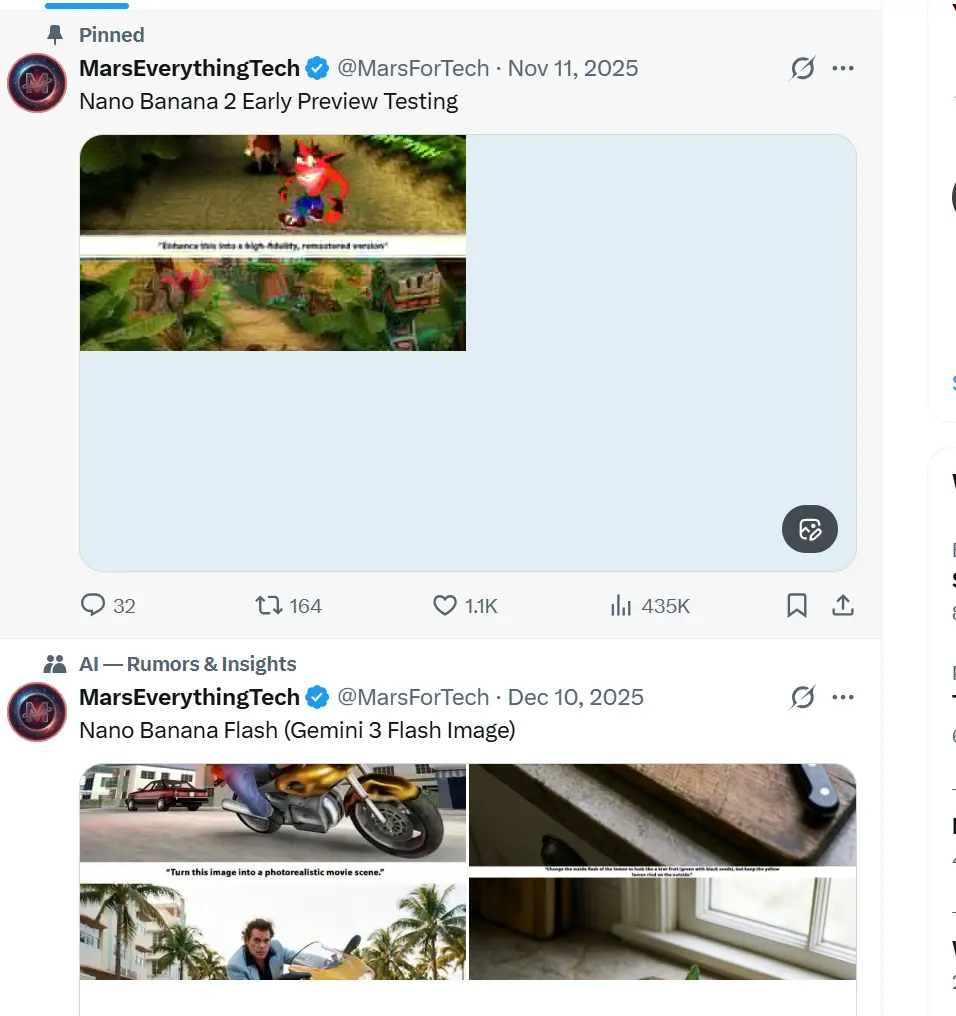
Nano Banana 2 Flash — Also referenced in an X post from the user @fAIkout as “coming soon,” with support for 1K, 2K, and 4K versions currently in testing — refers to an upcoming generative image model in the Google Gemini ecosystem, built on the Gemini 3 Flash architecture.
The model was first revealed on the X platform by well-known tech blogger MarsForTech. As Google's fastest generative AI image model to date, it aims to provide users with a more affordable and efficient visual generation experience.
Nano Banana 2 Flash, technically known as the Gemini 3 Flash Image model, is Google's newest lightweight, high-performance AI image generator. It serves as the direct successor to the original Nano Banana (Gemini 2.5 Flash Image) and the efficient counterpart to the flagship Nano Banana Pro. Designed for speed without compromising visual fidelity, Nano Banana 3 Flash is built on Google’s efficient "Flash" architecture. It is engineered to deliver near-instantaneous image generation and complex editing capabilities, making it the ideal engine for interactive applications, real-time prototyping, and mobile-first experiences.
In short: Nano Banana 2 Flash refers to a Flash-optimized Nano Banana image model built on Gemini 3 Flash — a lower-latency, lower-cost but still capable image generator that sits between the original Nano Banana (Gemini 2.5 Flash Image) and the premium Nano Banana Pro (Gemini 3 Pro Image).
Key Design Philosophy:
- Latency-First Architecture: Capable of generating high-quality previews in under 2 seconds.
- Multimodal Fluency: Natively understands complex text prompts and reference images for seamless editing.
- Cost Efficiency: Priced significantly lower than the Pro model, enabling high-volume API usage.
- For models like Nano Banana Pro, Google integrated real-world data and factual reasoning into images — enabling uses like infographics, scripts or diagrams anchored in real knowledge.
What are the key features?
Nano Banana 2 Flash retains the core DNA of the "Nano Banana" brand—playfulness mixed with serious power—while introducing several enhancements tailored for efficiency.
1. Lightning-Fast Generation & Editing
The defining feature of Nano Banana 2 Flash is its speed. It utilizes a distilled version of the Gemini 3 diffusion transformer, allowing it to process prompts and render pixels roughly 3x faster than Nano Banana Pro. This low latency unlocks new use cases, such as "live" image generation where the visual evolves in near real-time as the user types.
2. Advanced Text Rendering (Flash-Optimized)
One of the historical weaknesses of smaller models was text rendering. Nano Banana 2 Flash defies this trend by inheriting the TextCore v3 engine from its bigger sibling. It achieves a verified 92% accuracy in rendering English text (logos, signs, posters), a massive leap from the 70% accuracy of the previous Gemini 2.5 Flash generation.
3. Context-Aware Object Editing
The model excels at "in-context" editing. Users can upload an image and issue natural language commands like "change the sunny day to a cyberpunk rainy night" or "replace the apple with a futuristic glowing orb." The model understands lighting, shadows, and reflections, ensuring the edited object sits naturally in the scene.
4. Native 2K Resolution
While it doesn't default to the native 4K of the Pro model, Nano Banana 3 Flash supports native 2K (2048x2048) generation. This is more than sufficient for most digital marketing, web content, and social media needs.
What is new in Nano Banana 2 Flash?
The shift from Gemini 2.5 to Gemini 3 architecture brings fundamental changes to the "Nano Banana" line.
The "Thinking Level" for Images
For the first time in a "Flash" class image model, Google has introduced a simplified version of its "Thinking" parameter.
- Standard Mode: Instant generation based on surface-level prompt interpretation.
- Reasoning Mode: The model takes an extra second to "think" about the composition, physics, and logical consistency of the prompt before generating. This is particularly useful for complex multi-subject scenes (e.g., "A cat playing chess with a robot in zero gravity").
Adaptive Style Transfer
Nano Banana 2 Flash introduces Adaptive Style Transfer, allowing it to mimic the style of a reference image with high fidelity while adhering strictly to a new text prompt. This feature is critical for brand consistency, allowing companies to generate hundreds of unique assets that all share the same corporate visual identity.
Expanded "SynthID" Integration
Security remains a priority. Every image generated by Nano Banana 2 Flash is embedded with the latest version of SynthID, Google’s invisible watermarking technology. This ensures that content created by this high-speed model can be reliably identified as AI-generated, combating misinformation.
Nano Banana 2 Flash vs Nano Banana vs Nano Banana Pro
How Does It Compare to Nano Banana (Original)?
| Feature | Nano Banana | Nano Banana 2 Flash(Upcoming) |
|---|---|---|
| Underlying model | Gemini 2.5 Flash Image | Gemini 3 Flash |
| Speed | Very fast | Faster with stronger reasoning |
| Output quality | Standard flash-level | Higher resolution & improved quality |
| Use case | Casual editing & generation | Scalable content for creators & enterprise |
| Cost | Low | Lower, optimized for efficiency |
Nano Banana (Gemini 2.5 Flash Image) was optimized primarily for low-latency casual creation, achieving viral popularity for simple edits and 3D figurine-style results on social platforms.
Nano Banana 2 Flash will build upon that legacy with deeper reasoning, higher resolution options, and more robust prompt understanding — bridging a gap between hobbyist-friendly tools and professional workflows.
How Is It Different From Nano Banana Pro?
Nano Banana Pro — officially Gemini 3 Pro Image — is the current state-of-the-art image model in Google’s AI lineup, offering studio-level control, multi-image fusion, advanced text rendering, and world knowledge grounding.
| Capability | Nano Banana Pro (Gemini 3 Pro Image) | Nano Banana 2 Flash |
|---|---|---|
| Model base | Gemini 3 Pro | Gemini 3 Flash |
| Creative control | Studio-level features | Flash-optimized enhancements |
| Complex reasoning | High | Moderate to high |
| Resolution | Up to 4K | 1K, 2K, 4K with optimized speed |
| Cost | Higher | Lower (flash-tier optimized) |
| Best suited for | Professional creators, detailed work | Faster workflows with balanced quality |
Nano Banana Pro integrates tightly with Google’s ecosystem, even supporting real-world data grounding via search integration — ideal for technical content, business graphics, or complex infographics.
Nano Banana 2 Flash appears to target fast, high-quality generation with many of the strengths of the Pro models but tailored for scenarios where speed and cost-effectiveness are prioritized.
Practical recommendation matrix
- Creative prototyping / high cadence → Nano Banana3Flash (fast iterations, lower spend).
- Final assets for print / very high fidelity → Nano Banana Pro.
- Exploration / casual users → Nano Banana (2.5 Flash) or the in-app Fast model.
What Use Cases Will Nano Banana 2 Flash Enable?
Professional Content Creation
Because of its multi-resolution support (including 4K) and flash-tier speed, Nano Banana3Flash is poised to assist professional teams in producing:
- Marketing visuals and campaign assets
- Editorial and creative illustrations
- Storyboards for media and advertising
- UI/UX concept imagery
Developer Integration
Developers building image-rich applications can integrate this model using APIs — ideal for scenarios such as:
- Automated generation of product visuals or stills in apps
- Social media tools with custom image generation
- Rapid image prototyping for creativity platforms
Creative and Consumer Applications
For individual users and hobbyists, possible applications include:
- Rapid custom artwork generation for social posts
- Quick photo edits with text-guided transformations
- Affordable high-resolution content creation
Because Gemini models (including Nano Banana and Pro) are integrated across Google products like Gemini app, Google AI Studio, and third-party tools (e.g., Adobe Firefly), Nano Banana3Flash outputs are likely to appear broadly once officially released.
Conclusion
Nano Banana3Flash represents an important upcoming entry in Google’s generative image AI portfolio. Built upon the Gemini 3 Flash architecture, the model aims to deliver fast, cost-efficient, high-resolution image generation while maintaining many strengths of earlier Nano Banana models. Nano Banana3Flash is positioned for both consumer creativity and enterprise utility.
Until then, developers and creators can prepare by reviewing the existing Nano Banana / Nano Banana Pro APIs and planning workflows that can take advantage of multi-resolution image generation — a promising frontier in AI creativity.
To begin, explore Nano Banana / Nano Banana Pro API’s capabilities in the Playground and consult the API guide for detailed instructions. Before accessing, please make sure you have logged in to CometAPI and obtained the API key. CometAPI offer a price far lower than the official price to help you integrate.
Ready to Go?→ Free trial of Nano Banana models !