

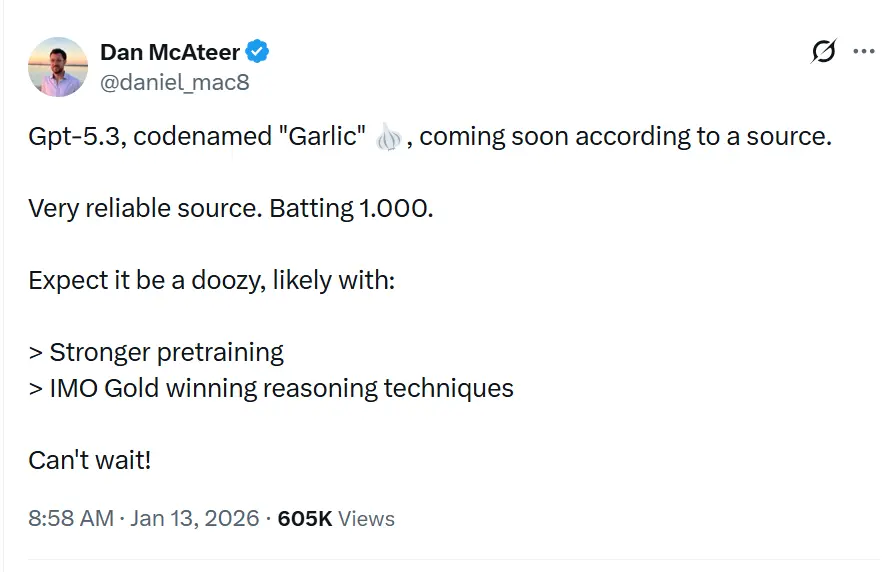
The codename GPT-5.3“Garlic”, is described in leaks and reporting as a next incremental/iterative GPT-5.x release intended to close gaps in reasoning, coding, and product performance for OpenAI is in response to competitive pressure from Google’s Gemini and Anthropic’s Claude.
OpenAI is experimenting with a denser, more efficient GPT-5.x iteration focused on stronger reasoning, faster inference and longer-context workflows rather than purely ever-larger parameter counts. This is not merely another iteration of the Generative Pre-trained Transformer series; it is a strategic counter-offensive. Born from an internal "Code Red" declared by CEO Sam Altman in December 2025, "Garlic" represents a rejection of the "bigger is better" dogma that has governed LLM development for half a decade. Instead, it bets everything on a new metric: cognitive density.
What is GPT-5.3 “Garlic”?
GPT-5.3 — codenamed “Garlic” — is being described as the next iterative step in OpenAI’s GPT-5 family. Sources framing the leak position Garlic not as a simple checkpoint or token tweak, but as a targeted architecture and training refinement: the aim is to extract higher reasoning performance, better multi-step planning and improved long-context behavior from a more compact, inference-efficient model rather than relying solely on raw scale. That framing aligns with broader industry trends toward “dense” or “high-efficiency” model designs.
The moniker "Garlic"—a stark departure from the celestial (Orion) or botanical-sweet (Strawberry) codenames of the past—is reportedly a deliberate internal metaphor. Just as a single clove of garlic can flavor an entire dish more potently than larger, blander ingredients, this model is designed to provide concentrated intelligence without the massive computational overhead of the industry's giants.
The "Code Red" Genesis
The existence of Garlic cannot be decoupled from the existential crisis that birthed it. In late 2025, OpenAI found itself in a "defensive position" for the first time since the launch of ChatGPT. Google’s Gemini 3 had seized the crown for multimodal benchmarks, and Anthropic’s Claude Opus 4.5 had become the de-facto standard for complex coding and agentic workflows. In response, OpenAI leadership paused peripheral projects—including ad-platform experiments and consumer agent expansions—to focus entirely on a model that could execute a "tactical strike" on these competitors.
Garlic is that strike. It is not designed to be the largest model in the world; it is designed to be the smartest per parameter. It merges the research lines of previous internal projects, most notably "Shallotpeat," incorporating bug fixes and pre-training efficiencies that allow it to punch far above its weight class.
What is the current status of the GPT-5.3 model’s observed iterations?
As of mid-January 2026, GPT-5.3 is in the final stages of internal validation, a phase often described in Silicon Valley as "hardening." The model is currently visible in internal logs and has been spot-tested by select enterprise partners under strict non-disclosure agreements.
Observed Iterations and "Shallotpeat" Integration
The road to Garlic was not linear. Leaked internal memos from Chief Research Officer Mark Chen suggest that Garlic is actually a composite of two distinct research tracks. Initially, OpenAI was developing a model codenamed "Shallotpeat," which was intended as a direct incremental update. However, during the pre-training of Shallotpeat, researchers discovered a novel method for "compressing" reasoning patterns—essentially teaching the model to discard redundant neural pathways earlier in the training process.
This discovery led to the scrapping of the standalone Shallotpeat release. Its architecture was merged with the more experimental "Garlic" branch. The result is a hybrid iteration that possesses the stability of a mature GPT-5 variant but the explosive reasoning efficiency of a new architecture.
When can we infer the release time will occur?
Predicting OpenAI release dates is notoriously difficult, but the "Code Red" status accelerates standard timelines. Based on the convergence of leaks, vendor updates, and competitor cycles, we can triangulate a release window.
Primary Window: Q1 2026 (January - March)
The consensus among insiders is a Q1 2026 launch. The "Code Red" was declared in December 2025, with an directive to release "as soon as possible." Given that the model is already in checking/validation (the "Shallotpeat" merger having accelerated the timeline), a late January or early February release seems most plausible.
The "Beta" Rollout
We may see a staggered release:
- Late January 2026: A "preview" release to select partners and ChatGPT Pro users (possibly under a "GPT-5.3 (Preview)" label).
- February 2026: Full API availability.
- March 2026: Integration into the free tier of ChatGPT (limited queries) to counter Gemini's free accessibility.
3 defining features of GPT-5.3?
If the rumors hold true, GPT-5.3 will introduce a suite of features that prioritize utility and integration over raw generative creativity. The feature set reads like a wish list for systems architects and enterprise developers.
1. High-Density Pre-Training (EPTE)
The crown jewel of Garlic is its Enhanced Pre-Training Efficiency (EPTE).
Traditional models learn by seeing massive amounts of data and creating a sprawling network of associations. Garlic’s training process reportedly involves a "pruning" phase where the model actively condenses information.
- The Result: A model that is physically smaller (in terms of VRAM requirements) but retains the "World Knowledge" of a much larger system.
- The Benefit: Faster inference speeds and significantly lower API costs, addressing the "intelligence-to-cost" ratio that has prevented mass adoption of models like Claude Opus.
2. Native Agentic Reasoning
Unlike previous models that required "wrappers" or complex prompt engineering to function as agents, Garlic has native tool-calling capabilities.
The model treats API calls, code execution, and database queries as "first-class citizens" in its vocabulary.
- Deep Integration: It doesn't just "know how to code"; it understands the environment of code. It can reportedly navigate a file directory, edit multiple files simultaneously, and run its own unit tests without external orchestration scripts.
3. Massive Context and Output Windows
To compete with Gemini’s million-token window, Garlic is rumored to ship with a 400,000-token context window. While smaller than Google's offering, the key differentiator is "Perfect Recall" over that window, utilizing a new attention mechanism that prevents the "middle-of-the-context" loss common in 2025 models.
- 128k Output Limit: Perhaps more exciting for developers is the rumored expansion of the output limit to 128,000 tokens. This would allow the model to generate entire software libraries, comprehensive legal briefs, or full-length novellas in a single pass, eliminating the need for "chunking."
4. Drastically Reduced Hallucination
Garlic utilizes a post-training reinforcement technique focused on "epistemic humility"—the model is rigorously trained to know what it doesn't know. Internal tests show a hallucination rate significantly lower than GPT-5.0, making it viable for high-stakes industries like biomedicine and law.
How does it compare to competitors like Gemini and Claude 4.5?
The success of Garlic will not be measured in isolation, but in direct comparison to the two titans currently ruling the arena: Google’s Gemini 3 and Anthropic’s Claude Opus 4.5.
GPT-5.3 “Garlic” vs. Google Gemini 3
The Battle of Scale vs. Density.
- Gemini 3: Currently the "kitchen sink" model. It dominates in multimodal understanding (video, audio, native image generation) and has an effectively infinite context window. It is the best model for "messy" real-world data.
- GPT-5.3 Garlic: Cannot compete with Gemini's raw multimodal breadth. Instead, it attacks Gemini on Reasoning Purity. For pure text generation, code logic, and complex instruction following, Garlic aims to be sharper and less prone to "refusal" or wandering.
- The Verdict: If you need to analyze a 3-hour video, you use Gemini. If you need to write the backend for a banking app, you use Garlic.
GPT-5.3 “Garlic” vs. Claude Opus 4.5
The Battle for the Developer's Soul.
- Claude Opus 4.5: Released in late 2025, this model won over developers with its "warmth" and "vibes." It is famous for writing clean, human-readable code and following system instructions with military precision. However, it is expensive and slow.
- GPT-5.3 Garlic: This is the direct target. Garlic aims to match Opus 4.5's coding proficiency but at 2x the speed and 0.5x the cost. By using "High-Density Pre-Training," OpenAI wants to offer Opus-level intelligence on a Sonnet-level budget.
- The Verdict: The "Code Red" was specifically triggered by Opus 4.5's dominance in coding. Garlic’s success depends entirely on whether it can convince developers to switch their API keys back to OpenAI. If Garlic can code as well as Opus but run faster, the market will shift overnight.
Takeway
Early internal builds of Garlic are already outperforming Google’s Gemini 3 and Anthropic’s Opus 4.5 in specific, high-value domains:
- Coding Proficiency: In internal "hard" benchmarks (beyond the standard HumanEval), Garlic has shown a reduced tendency to get stuck in "logic loops" compared to GPT-4.5.
- Reasoning Density: The model requires fewer tokens of "thinking" to arrive at correct conclusions, a direct contrast to the "chain-of-thought" heaviness of the o1 (Strawberry) series.
| Metric | GPT-5.3 (Garlic) | Google Gemini 3 | Claude 4.5 |
|---|---|---|---|
| Reasoning (GDP-Val) | 70.9% | 53.3% | 59.6% |
| Coding (HumanEval+) | 94.2% | 89.1% | 91.5% |
| Context Window | 400K Tokens | 2M Tokens | 200K Tokens |
| Inference Speed | Ultra-Fast | Moderate | Fast |
Conclusion
“Garlic” is an active and plausible rumor: a targeted OpenAI engineering track that prioritizes reasoning density, efficiency and real-world tooling. Its emergence is best viewed in the context of an accelerating arms race among model providers (OpenAI, Google, Anthropic) — one in which the strategic prize is not only raw capability but usable capability per dollar and per millisecond of latency.
If you are interested in this new model, please follow CometAPI. It always updates with the latest and best AI models at an affordable price.
Developers can access GPT-5.2 ,Gemini 3, Claude 4.5 through CometAPI Now. To begin, explore the model capabilities of CometAPI in the Playground and consult API guide for detailed instructions. Before accessing, please make sure you have logged in to CometAPI and obtained the API key. CometAPI offer a price far lower than the official price to help you integrate.
Ready to Go?→ Sign up for CometAPI today !
If you want to know more tips, guides and news on AI follow us on VK, X and Discord!