ModelsSupportEnterpriseBlog
500+ AI Model API, All In One API.Just In CometAPI
Models API
Developer
Quick StartDocumentationAPI Dashboard
Resources
AI ModelsBlogEnterpriseChangelogAbout
2025 CometAPI. All right reserved.Privacy PolicyTerms of Service
Home/Models/OpenAI/GPT-5.2
O

GPT-5.2

Input:$1.4/M
Output:$11.2/M
Context:400,000
Max Output:128,000
GPT-5.2 is a multi-flavored model suite (Instant, Thinking, Pro) engineered for better long-context understanding, stronger coding and tool use, and materially higher performance on professional “knowledge-work” benchmarks.
New
Commercial Use
Playground
Overview
Features
Pricing
API

What is GPT-5.2 API

GPT-5.2 API is the same as GPT-5.2 Thinking in ChatGPT. GPT-5.2 Thinking is the mid-tier flavor of OpenAI’s GPT-5.2 family designed for deeper work: multi-step reasoning, long-document summarization, quality code generation, and professional knowledge-work where accuracy and usable structure matter more than raw throughput. In the API it’s exposed as the model gpt-5.2 (Responses API / Chat Completions), and it sits between the low-latency Instant variant and the higher-quality but more expensive Pro variant.

Main features

  • Very long context & compaction: 400K effective window and compaction tools to manage relevance across long conversations and documents.
  • Configurable reasoning effort: none | medium | high | xhigh (xhigh enables maximum internal compute for tough reasoning). xhigh is exposed to Thinking/Pro variants.
  • Stronger tool and function support: first-class tool calling, grammars (CFG/Lark) to constrain structured outputs, and improved agentic behaviors that simplify complex multi-step automation.
  • Multimodal understanding: richer image + text comprehension and integration into multi-step tasks.
  • Improved safety / sensitive-content handling: targeted interventions to reduce undesirable responses in areas like self-harm and other sensitive contexts.

Technical capabilities & specifications (developer view)

  • API endpoints & model IDs: gpt-5.2 for Thinking (Responses API), gpt-5.2-chat-latest for chat/instant workflows, and gpt-5.2-pro for the Pro tier; available via Responses API and Chat Completions where indicated.
  • Reasoning tokens & effort management: the API supports explicit parameters to allocate compute (reasoning effort) per request; higher effort increases latency and cost but improves output quality for complex tasks.
  • Structured output tools: support for grammars (Lark / CFG) to constrain model output to a DSL or exact syntax (useful for SQL, JSON, DSL generation).
  • Parallel tool calling & agentic coordination: improved parallelism and cleaner tool orchestration reduce the need for elaborate system prompts and multi-agent scaffolding.

Benchmark performance & supporting data

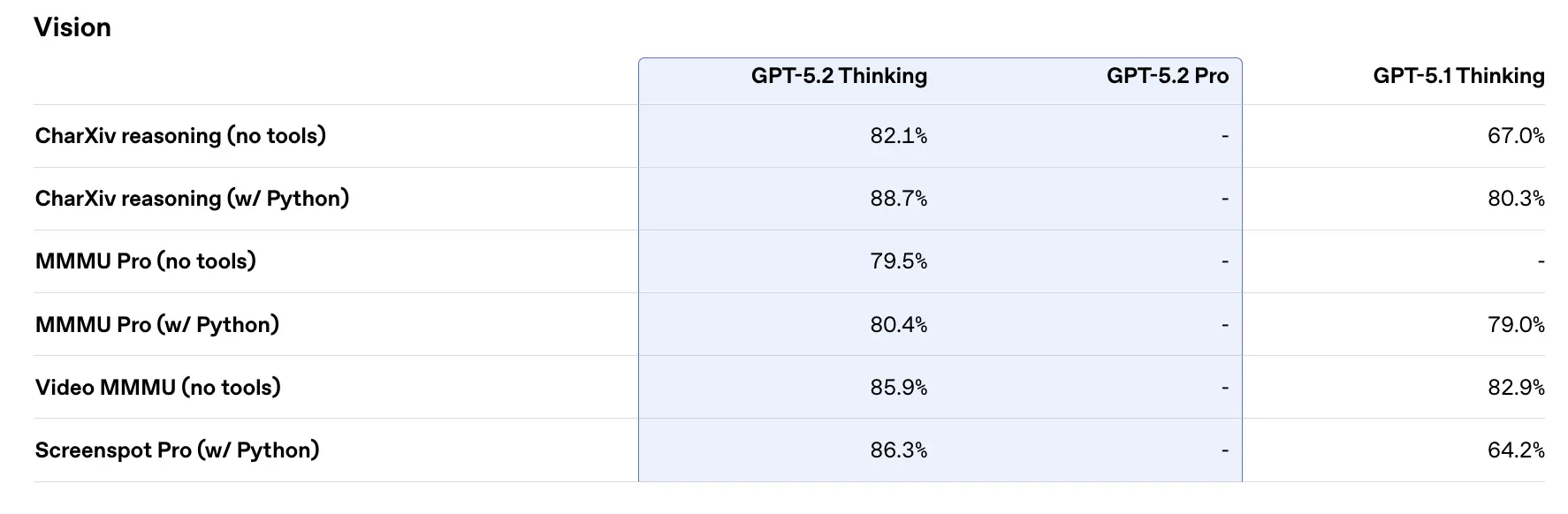
OpenAI published a variety of internal and external benchmark results for GPT-5.2. Selected highlights (OpenAI’s reported numbers):

  • GDPval (44 occupations, knowledge work) — GPT-5.2 Thinking “beats or ties top industry professionals on 70.9% of comparisons”; OpenAI reports outputs were produced at >11× the speed and <1% the cost of expert professionals on their GDPval tasks (speed and cost estimates are historical-based). These tasks include spreadsheet models, presentations and short videos.
  • SWE-Bench Pro (coding) — GPT-5.2 Thinking achieves ≈55.6% on SWE-Bench Pro and ~80% on SWE-Bench Verified (Python only) per OpenAI, establishing a new state of the art for code-generation / engineering evaluation in their tests. This translates to more reliable debugging and end-to-end fixes in practice, according to OpenAI’s examples.
  • GPQA Diamond (graduate-level science Q&A) — GPT-5.2 Pro: 93.2%, GPT-5.2 Thinking: 92.4% on GPQA Diamond (no tools, max reasoning).
  • ARC-AGI series — On ARC-AGI-2 (a harder fluid reasoning benchmark), GPT-5.2 Thinking scored 52.9% and GPT-5.2 Pro 54.2% (OpenAI says these are new state-of-the-art marks for chain-of-thought style models).
  • Long-context (OpenAI MRCRv2) — GPT-5.2 Thinking shows near-100% accuracy on the 4-needle MRCR variant out to 256k tokens and substantially improved scores vs GPT-5.1 across long-context settings. (OpenAI published MRCRv2 charts and tables.)
GPT-5.2

Comparison with contemporaries

  • vs Google Gemini 3 (Gemini 3 Pro / Deep Think): Gemini 3 Pro has been publicized with a ~1,048,576 (≈1M) token context window and broad multimodal inputs (text, image, audio, video, PDFs) and strong agentic integrations via Vertex AI / AI Studio. On paper, Gemini 3’s larger context window is a differentiator for extremely large single-session workloads; tradeoffs include tooling surface and ecosystem fit.
  • vs Anthropic Claude Opus 4.5: Anthropic’s Opus 4.5 emphasizes enterprise coding/agent workflows and reports strong SWE-bench results and robustness for long agentic sessions; Anthropic positions Opus for automation and code generation with a 200k context window and specialized agent/Excel integrations. Opus 4.5 is a strong competitor in enterprise automation and code tasks.

Practical takeaway: GPT-5.2 targets a balanced set of improvements (400k context, high token outputs, improved reasoning/coding). Gemini 3 targets the absolute largest single-session contexts (≈1M), while Claude Opus focuses on enterprise engineering and agentic robustness. Choose by matching context size, modality needs, feature/tooling fit, and cost/latency tradeoffs.

How to access and use GPT-5.2 API

Step 1: Sign Up for API Key

Log in to cometapi.com. If you are not our user yet, please register first. Sign into your CometAPI console. Get the access credential API key of the interface. Click “Add Token” at the API token in the personal center, get the token key: sk-xxxxx and submit.

Step 2: Send Requests to GPT-5.2 API

Select the “gpt-5.2” endpoint to send the API request and set the request body. The request method and request body are obtained from our website API doc. Our website also provides Apifox test for your convenience. Replace <YOUR_API_KEY> with your actual CometAPI key from your account. Developers call these via the Responses API / Chat endpoints.

Insert your question or request into the content field—this is what the model will respond to . Process the API response to get the generated answer.

Step 3: Retrieve and Verify Results

Process the API response to get the generated answer. After processing, the API responds with the task status and output data.

See also Gemini 3 Pro Preview API

FAQ

What makes GPT-5.2 OpenAI's flagship model for developers?

GPT-5.2 is OpenAI's best model for coding and agentic tasks, combining a 400K context window with support for code interpreter, web search, file search, image generation, and MCP—making it the most versatile choice for complex workflows.

Does GPT-5.2 support model distillation?

Yes, GPT-5.2 uniquely supports distillation, allowing developers to use its outputs to train smaller, more efficient models for specific tasks while maintaining performance.

What is the knowledge cutoff date for GPT-5.2?

GPT-5.2 has a knowledge cutoff of August 31, 2025. For more recent information, you can enable web search through the Responses API to ground responses in current data.

Can GPT-5.2 process images and generate code simultaneously?

Yes, GPT-5.2 accepts image inputs and supports code interpreter, allowing it to analyze visual content and execute Python code in the same conversation—ideal for data visualization and analysis workflows.

How does GPT-5.2 compare to GPT-5 in pricing and performance?

GPT-5.2 costs $1.75/$14 per million tokens (input/output) compared to GPT-5's $1.25, but delivers materially higher performance on professional benchmarks including coding, long-context understanding, and tool use.

What endpoints does GPT-5.2 support?

GPT-5.2 supports Chat Completions, Responses API, Batch processing, and Assistants API—but does not support fine-tuning, Realtime API, or audio modalities.

Features for GPT-5.2

Explore the key features of GPT-5.2, designed to enhance performance and usability. Discover how these capabilities can benefit your projects and improve user experience.

Pricing for GPT-5.2

Explore competitive pricing for GPT-5.2, designed to fit various budgets and usage needs. Our flexible plans ensure you only pay for what you use, making it easy to scale as your requirements grow. Discover how GPT-5.2 can enhance your projects while keeping costs manageable.
Comet Price (USD / M Tokens)Official Price (USD / M Tokens)Discount
Input:$1.4/M
Output:$11.2/M
Input:$1.75/M
Output:$14/M
-20%

Sample code and API for GPT-5.2

Access comprehensive sample code and API resources for GPT-5.2 to streamline your integration process. Our detailed documentation provides step-by-step guidance, helping you leverage the full potential of GPT-5.2 in your projects.
POST
/v1/chat/completions
POST
/v1/responses
Python
JavaScript
Curl
from openai import OpenAI
import os

# Get your CometAPI key from https://api.cometapi.com/console/token, and paste it here
COMETAPI_KEY = os.environ.get("COMETAPI_KEY") or "<YOUR_COMETAPI_KEY>"
BASE_URL = "https://api.cometapi.com/v1"

client = OpenAI(base_url=BASE_URL, api_key=COMETAPI_KEY)

response = client.responses.create(
    model="gpt-5.2",
    input="How much gold would it take to coat the Statue of Liberty in a 1mm layer?",
    reasoning={"effort": "none"},
)

print(response.output_text)

Python Code Example

from openai import OpenAI
import os

# Get your CometAPI key from https://api.cometapi.com/console/token, and paste it here
COMETAPI_KEY = os.environ.get("COMETAPI_KEY") or "<YOUR_COMETAPI_KEY>"
BASE_URL = "https://api.cometapi.com/v1"

client = OpenAI(base_url=BASE_URL, api_key=COMETAPI_KEY)

response = client.responses.create(
    model="gpt-5.2",
    input="How much gold would it take to coat the Statue of Liberty in a 1mm layer?",
    reasoning={"effort": "none"},
)

print(response.output_text)

JavaScript Code Example

import OpenAI from "openai";

// Get your CometAPI key from https://api.cometapi.com/console/token, and paste it here
const COMETAPI_KEY = process.env.COMETAPI_KEY || "<YOUR_COMETAPI_KEY>";
const BASE_URL = "https://api.cometapi.com/v1";

const client = new OpenAI({
  apiKey: COMETAPI_KEY,
  baseURL: BASE_URL,
});

async function main() {
  const response = await openai.responses.create({
  model: "gpt-5.2",
  input: "How much gold would it take to coat the Statue of Liberty in a 1mm layer?",
  reasoning: {
    effort: "none"
  }
  });

  console.log(response.output_text);
}

main();

Curl Code Example

curl https://api.cometapi.com/v1/responses \
     --header "Authorization: Bearer $COMETAPI_KEY" \
     --header "content-type: application/json" \
     --data \
'{
    "model": "gpt-5.2",
    "input": "Hello!",
    "reasoning": {
                "effort": "none"
    }
}'

More Models

A

Claude Opus 4.6

Input:$4/M
Output:$20/M
Claude Opus 4.6 is Anthropic’s “Opus”-class large language model, released February 2026. It is positioned as a workhorse for knowledge-work and research workflows — improving long-context reasoning, multi-step planning, tool use (including agentic software workflows), and computer-use tasks such as automated slide and spreadsheet generation.
A

Claude Sonnet 4.6

Input:$2.4/M
Output:$12/M
Claude Sonnet 4.6 es nuestro modelo Sonnet más capaz hasta la fecha. Es una actualización completa de las capacidades del modelo en programación, uso de computadoras, razonamiento con contexto largo, planificación de agentes, trabajo del conocimiento y diseño. Sonnet 4.6 también ofrece una ventana de contexto de 1M de tokens en beta.
O

GPT-5.4 nano

Input:$0.16/M
Output:$1/M
GPT-5.4 nano is designed for tasks where speed and cost matter most like classification, data extraction, ranking, and sub-agents.
O

GPT-5.4 mini

Input:$0.6/M
Output:$3.6/M
GPT-5.4 mini brings the strengths of GPT-5.4 to a faster, more efficient model designed for high-volume workloads.
A

Claude Opus 4.7

A

Claude Opus 4.7

Input:$4/M
Output:$20/M
Most intelligent model for agents and coding
Q

Qwen3.6-Plus

Q

Qwen3.6-Plus

Input:$0.32/M
Output:$1.92/M
Qwen 3.6-Plus is now available, featuring enhanced code development capabilities and improved efficiency in multimodal recognition and inference, making the Vibe Coding experience even better.

Related Blog

Can ChatGPT make PowerPoints
Mar 26, 2026
chat-gpt

Can ChatGPT make PowerPoints

Over the past two years AI tools have moved from “help me write slide text” to “assemble and export a full .pptx,” and both OpenAI and Microsoft have added features that make one-click or near–one-click PowerPoint creation possible., the question is no longer "Can AI help me work?" but "How much of my work can AI do?" Among the most requested tasks is the creation of slide decks—the ubiquitous currency of business communication. For years, users have dreamt of a simple command: "Hey ChatGPT, make me a presentation." In 2026, that dream is closer than ever to reality, though it comes with nuances that every professional must understand.
OpenAI’s Codex App for macOS Guide: How to Use it
Mar 2, 2026
codex

OpenAI’s Codex App for macOS Guide: How to Use it

OpenAI released a native macOS application called the Codex app — a purpose-built "agent command center" for building software with multiple AI agents working in parallel. To set up the Codex app on macOS, download it from the official website by OpenAI. Launch the app, sign in with your ChatGPT account, and when prompted choose a local folder or Git repository as your workspace so Codex can read and write code. After this initial setup, the app is ready to use for coding tasks.
Five-minute tutorial on configuring OpenClaw with CometAPI
Feb 24, 2026
openclaw

Five-minute tutorial on configuring OpenClaw with CometAPI

In early 2026, OpenClaw — the open-source agent runtime and AI assistant platform — continues to be widely adopted by developers, research teams, and enterprises who want multi-model orchestration across channels like Slack, Telegram, WhatsApp, and local command-line execution. Meanwhile, CometAPI has emerged as a powerful OpenAI-compatible LLM gateway, aggregating hundreds of models (e.g., Kimi-K2.5, GPT variants, Claude) under a single API endpoint.
Qwen-3.5 on Lunar New Year — does it beat the closed-source top tier in 2026
Feb 16, 2026
qwen-3-5

Qwen-3.5 on Lunar New Year — does it beat the closed-source top tier in 2026

Alibaba’s new Qwen3.5 is a major step forward — it closes the gap with, and in some agentic / multimodal workloads claims parity or advantage over, certain frontier closed-source models on a number of public benchmarks and internal tests. However, “outperform” depends on the workload: on agentic tool-use, multimodal document/video understanding, and cost-per-inference Qwen3.5 is reported to be extremely competitive (and in some vendor charts ahead). The practical takeaway: Qwen3.5 appears to be a genuine frontier contender in early 2026 — for many enterprise agentic and multimodal use cases it is now viable as a primary option.
Claude Opus 4.6 vs GPT-5.3 Codex: Which is Better for Developers
Feb 9, 2026
gpt-5-3-codex
claude-opus-4-6

Claude Opus 4.6 vs GPT-5.3 Codex: Which is Better for Developers

Both launches (Anthropic’s Claude Opus 4.6 and OpenAI’s GPT-5.3-Codex) advance agentic coding and long-context reasoning, but they pull in slightly different directions. Opus 4.6 leans into very large context windows, safety/analysis workflows, and a new “fast” mode; GPT-5.3-Codex doubles down on agentic software engineering benchmarks and tighter IDE/CLI integrations. The “better” model depends on what you need: huge-context, safety-first code review and long-running agents (Opus 4.6) — or marginally stronger raw coding benchmark performance, speed and immediate Codex integrations (GPT-5.3-Codex). See the deep dive below.