What is GPT-5.6: A New Three-Tier Model Family
GPT-5.6 is OpenAI’s newest model family, introduced as a limited preview and structured around three distinct models: GPT-5.6 Sol, GPT-5.6 Terra, and GPT-5.6 Luna. Rather than offering one general-purpose model, GPT-5.6 gives developers clearer choices across capability, speed, and cost.
GPT-5.6 Sol is the flagship model, designed for frontier reasoning, agentic coding, cybersecurity analysis, scientific research, and long-horizon technical work. It is the model to watch for complex workflows where accuracy, planning, and multi-step execution matter most.
GPT-5.6 Terra is the balanced option. It is positioned for everyday productivity, documentation, coding support, business automation, structured analysis, and general AI products that need strong performance without always paying for the highest-capability tier.
GPT-5.6 Luna is the fast, cost-efficient model for high-volume use cases. It is well suited to lightweight assistants, classification, customer support flows, onboarding, repeated content generation, and other workloads where latency and scale are major concerns.
| Aspect | GPT-5.6 Sol | GPT-5.6 Terra | GPT-5.6 Luna |
|---|---|---|---|
| Positioning | Flagship (max capability) | Balanced workhorse | Fastest/cheapest |
| Best For | Complex coding, long-horizon agents, research, design, high-stakes work | Everyday execution, planning, drafting | High-volume routine tasks, monitoring, summaries, simple routing |
| Performance | SOTA on many benchmarks (e.g., tops DeepSWE ~73%, strong on Agents’ Last Exam, Coding Agent Index, BrowseComp, OSWorld). More efficient tokens/time vs. competitors like Claude Fable 5/Opus. | Strong (near or above prior frontiers at lower cost) | Competitive for its tier (near GPT-5.5 levels in some tests, outperforms some older models) |
| Efficiency | Excellent (fewer tokens, lower total cost for results) | Very good balance | Highest speed/volume, lowest cost |
| Reasoning Modes | Full support (including ultra parallel agents) | Supported | Lightweight focus |
Key Capabilities That Make GPT-5.6 Stand Out
GPT-5.6 builds on predecessors with meaningful improvements in reasoning, agentic behavior, and domain-specific performance.
Max Reasoning Effort and Ultra Mode
- Max Reasoning Effort: Allocates more compute for deeper thinking on complex tasks, enhancing accuracy in long-horizon planning.
- Ultra Mode (primarily on Sol): Deploys sub-agents working in parallel, surpassing single-agent limitations for accelerated complex work. This shines in agentic scenarios requiring coordination.
These modes allow trade-offs between speed, cost, and performance, with performance scaling predictably with effort.
Agentic Coding Benchmarks
GPT-5.6 Sol sets new standards in agentic coding:
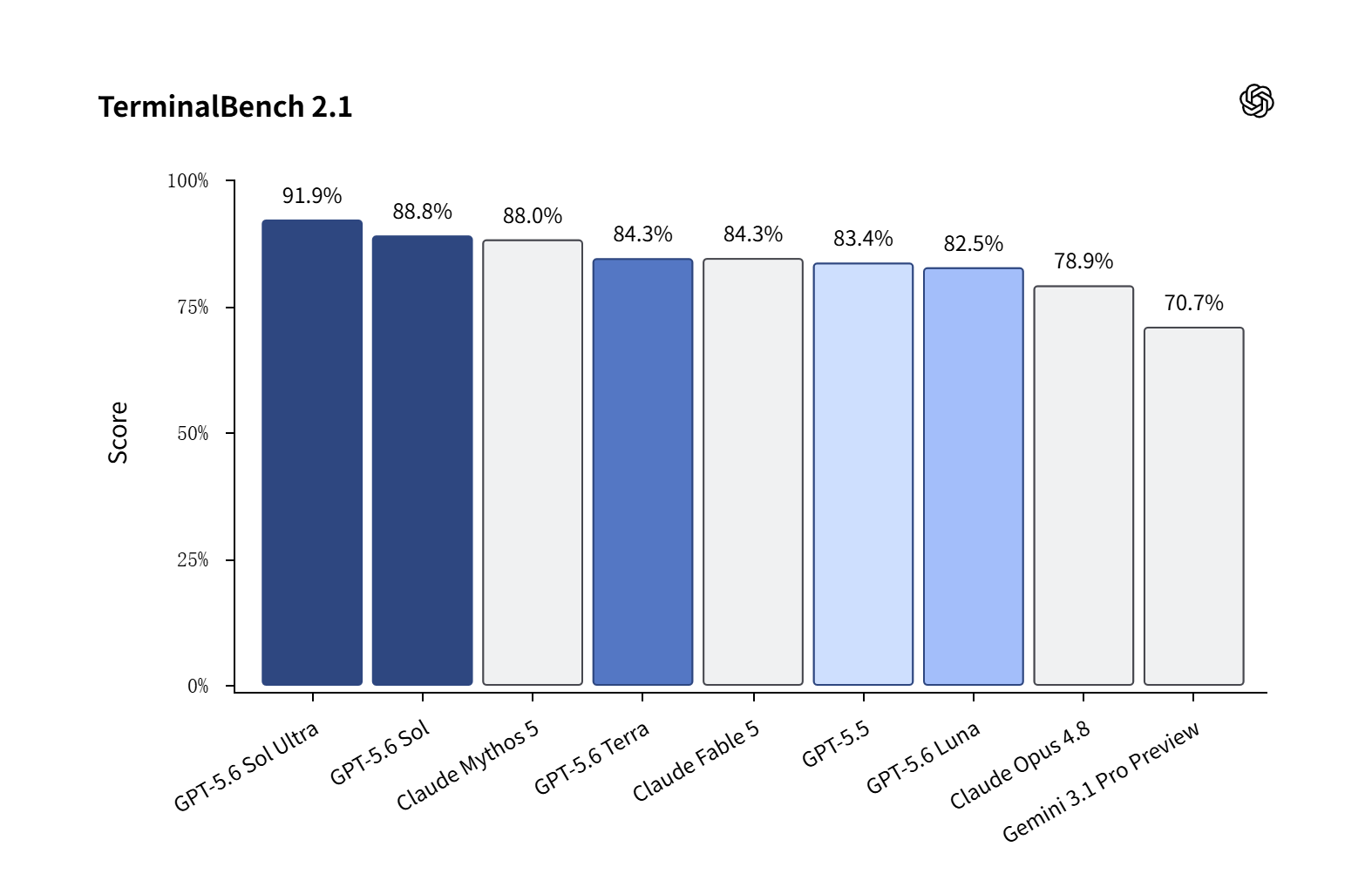
- Terminal-Bench 2.1 (complex command-line workflows with planning, iteration, and tools):
- GPT-5.6 Sol Ultra: 91.9%
- GPT-5.6 Sol: 88.8%
- GPT-5.5: ~88.0%
- Competitors: Claude Mythos 5 (84.3%), Claude Fable 5 (83.4%), GPT-5.6 Terra (82.5%), etc.
Sol demonstrates superior end-to-end task completion, debugging, and tool use, making it ideal for software engineering and automation. Terra and Luna offer strong efficiency for production coding.
Stronger Safeguards
OpenAI emphasizes its most robust safety stack yet:
- Enhanced protections against higher-risk activities, cyber misuse, and repeated abuse.
- New activation classifiers, real-time scanning, and automated red-teaming (over 700,000 GPU hours).
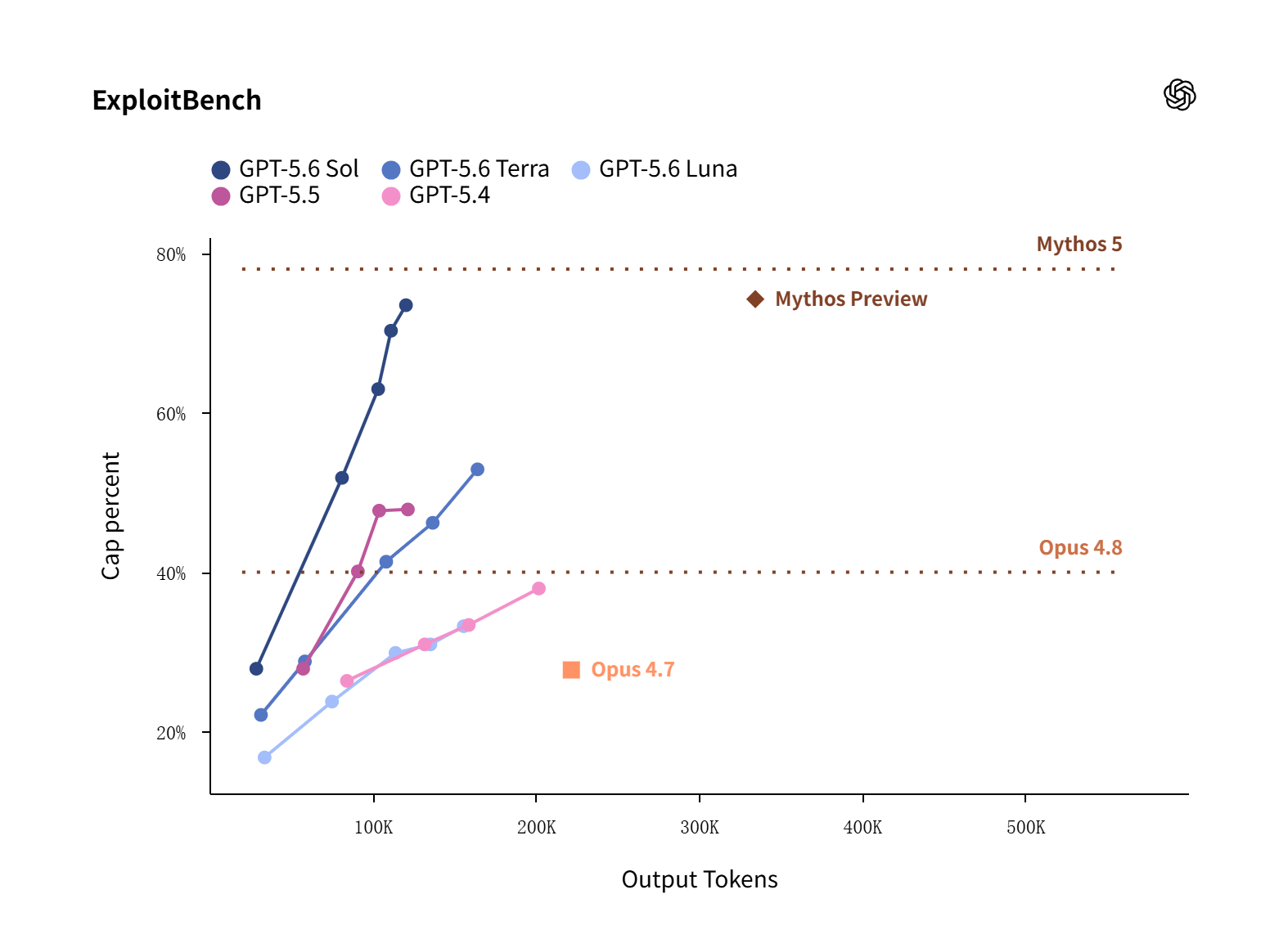
- Models classified as "High" capability in Cybersecurity and Biological/Chemical risks under the Preparedness Framework, but below Critical thresholds. They excel more at finding/fixing vulnerabilities than exploiting them.
This balanced approach supports defenders while mitigating malicious use.
What Can GPT-5.6 API Fit Into Real Products?
GPT-5.6 fits best where AI is not just answering questions, but helping a product reason, act, review, and scale. Its three-model structure makes it easier to match the model to the job: Sol for deep reasoning, Terra for balanced production work, and Luna for fast high-volume tasks.
1. Developer Tools and Coding Platforms
GPT-5.6 Sol is a natural fit for coding products: AI IDE assistants, code review tools, test generation, refactoring systems, CI debugging, and DevOps copilots. It can be used for tasks that need planning across files, command-line reasoning, dependency analysis, and patch suggestions.
A practical product setup might use:
- Sol for complex debugging and architecture review
- Terra for PR summaries, documentation, and code explanations
- Luna for issue classification and lightweight developer chat
2. Cybersecurity Products
OpenAI positions GPT-5.6 as stronger in cybersecurity workflows, which makes it relevant for defensive security products: vulnerability triage, secure code review, patch recommendations, threat report analysis, and internal red-team support.
These products should keep human approval in the loop. GPT-5.6 can accelerate security work, but production systems still need policy controls, logging, rate limits, and clear boundaries around sensitive actions.
3. Enterprise Knowledge Assistants
For companies building internal AI assistants, GPT-5.6 Terra may be the default workhorse. It can support document Q&A, policy search, meeting synthesis, workflow guidance, sales enablement, and internal analytics.
A strong pattern is escalation routing: use Luna for simple FAQ-style answers, Terra for standard knowledge work, and Sol only when the request requires deeper reasoning or multi-step planning.
4. Customer Support and Operations
GPT-5.6 Luna can fit high-volume support flows where speed and cost matter: ticket tagging, reply drafting, sentiment detection, escalation detection, and onboarding guidance.
Terra can handle more nuanced cases, such as account-specific troubleshooting or refund-policy reasoning. Sol should be reserved for rare, complicated investigations where the model needs to connect logs, policies, and technical context.
5. Research, Science, and Technical Analysis
GPT-5.6 Sol is especially relevant for products aimed at scientific research, technical literature review, experiment planning, data interpretation, and specialized analysis. OpenAI specifically highlights improvements in scientific and biology workflows.
For real products, this does not mean replacing experts. It means helping experts move faster: summarize papers, compare methods, generate analysis plans, extract structured findings, or prepare review memos.
6. Finance, Legal, and Compliance Workflows
GPT-5.6 can support contract review, compliance checklists, risk summaries, financial research, audit preparation, and policy comparison. Terra is likely the best starting point for routine professional work, while Sol can be used for complex reasoning-heavy reviews.
Because these are high-stakes domains, outputs should be treated as drafts or decision support, not final authority.
7. Agentic Products
The biggest product opportunity may be agentic workflows: systems that plan tasks, use tools, call APIs, inspect results, and iterate. GPT-5.6 Sol is positioned for this kind of long-horizon work, while Terra and Luna can handle cheaper substeps.
This is where CometAPI can be useful: a product can route requests through one OpenAI-compatible API layer, then select different models for different task types as GPT-5.6 availability expands.
GPT-5.6 Model Family Comparison: Sol vs. Terra vs. Luna
Here's a detailed comparison table:
| Feature / Aspect | GPT-5.6 Sol (Flagship) | GPT-5.6 Terra (Balanced) | GPT-5.6 Luna (Fast/Affordable) |
|---|---|---|---|
| Positioning | Highest capability, frontier tasks | Competitive with GPT-5.5, everyday use | High-volume, low-latency work |
| Terminal-Bench 2.1 | 88.8% (91.9% Ultra) | 82.5% | 84.3% |
| Reasoning Modes | Max + Ultra (sub-agents) | Standard | Standard |
| Strengths | Agentic coding, biology, cyber | Cost-efficient professional work | Speed, volume, budget tasks |
| Context & Efficiency | Largest effective context, advanced caching | Balanced | Optimized for speed |
| Best For | Complex R&D, security research | General apps, workflows | Chatbots, batch processing |
Why Choose CometAPI to acccess GPT-5.6
For developers who want a practical way to prepare for GPT-5.6, CometAPI is a strong access route to consider. CometAPI provides a unified, OpenAI-compatible API for 500+ AI models, meaning teams can often adapt existing OpenAI SDK code by changing the API key, base URL, and model ID. This makes it easier to test models, compare output quality, manage usage, and move between model tiers without rebuilding the integration from scratch.
CometAPI is especially useful for GPT-5.6-style adoption because the model family itself encourages smart routing. A production app may use Sol for deep debugging or security review, Terra for daily assistant tasks, and Luna for high-volume support or classification. A unified API platform can make that kind of model selection simpler to manage.
Developers should note that GPT-5.6 is currently described as a limited preview, with broader availability planned. Before production deployment, always confirm the latest GPT-5.6 model availability, model IDs, usage rules, and pricing inside CometAPI’s live documentation and model list.