Technical Specifications of Claude Fable 5
| Item | Specification |
|---|---|
| Model Name | Claude Fable 5 |
| Provider | Anthropic |
| API Model ID | claude-fable-5 |
| Model Class | Mythos-class (public safeguarded version) |
| Input Types | Text, Images |
| Output Types | Text |
| Context Window | 1,000,000 tokens |
| Maximum Output Tokens | Up to 128,000 tokens |
| Core Strengths | Long-horizon reasoning, agentic workflows, coding, scientific research, vision |
| Availability | Anthropic API, Claude apps, Amazon Bedrock, major cloud partners |
| Safety Architecture | Automatic fallback to Claude Opus 4.8 for certain high-risk domains |
| Companion Model | Claude Mythos 5 (restricted-access variant) |
Technical specifications are based on Anthropic's official model documentation and launch materials.
What Is Claude Fable 5?
Claude Fable 5 is Anthropic's most capable generally available AI model and the first public release built on its new Mythos-class architecture. It is designed for demanding reasoning tasks, autonomous multi-step workflows, large-scale software engineering, scientific research assistance, and extended agentic operations.
Fable 5 shares its underlying architecture with the restricted-access Claude Mythos 5, but includes additional safety classifiers. If requests enter certain high-risk domains—such as offensive cybersecurity, hazardous biology, chemistry, or model distillation—the system automatically routes the interaction to the safer Claude Opus 4.8 model. Anthropic states these safeguards activate in fewer than 5% of average sessions.
Key Features of Claude Fable 5 API
Claude Fable 5 shines in scenarios where previous models falter on complexity or duration.
1. Long-Horizon Autonomy and Agentic Workflows
Fable 5 maintains coherence across multi-stage tasks, planning, delegating to sub-agents, tracking dependencies, and self-verifying. It outperforms priors in sustained agentic coding and computer-use benchmarks like OSWorld-Verified (85.0%).
Developers report it handling day-long codebase migrations in massive repos with minimal intervention.
2. Superior Coding and Software Engineering
Headline strength: State-of-the-art on agentic coding evals. It understands project context, reasons through dependencies, generates production-grade code, debugs, refactors, and tests iteratively.
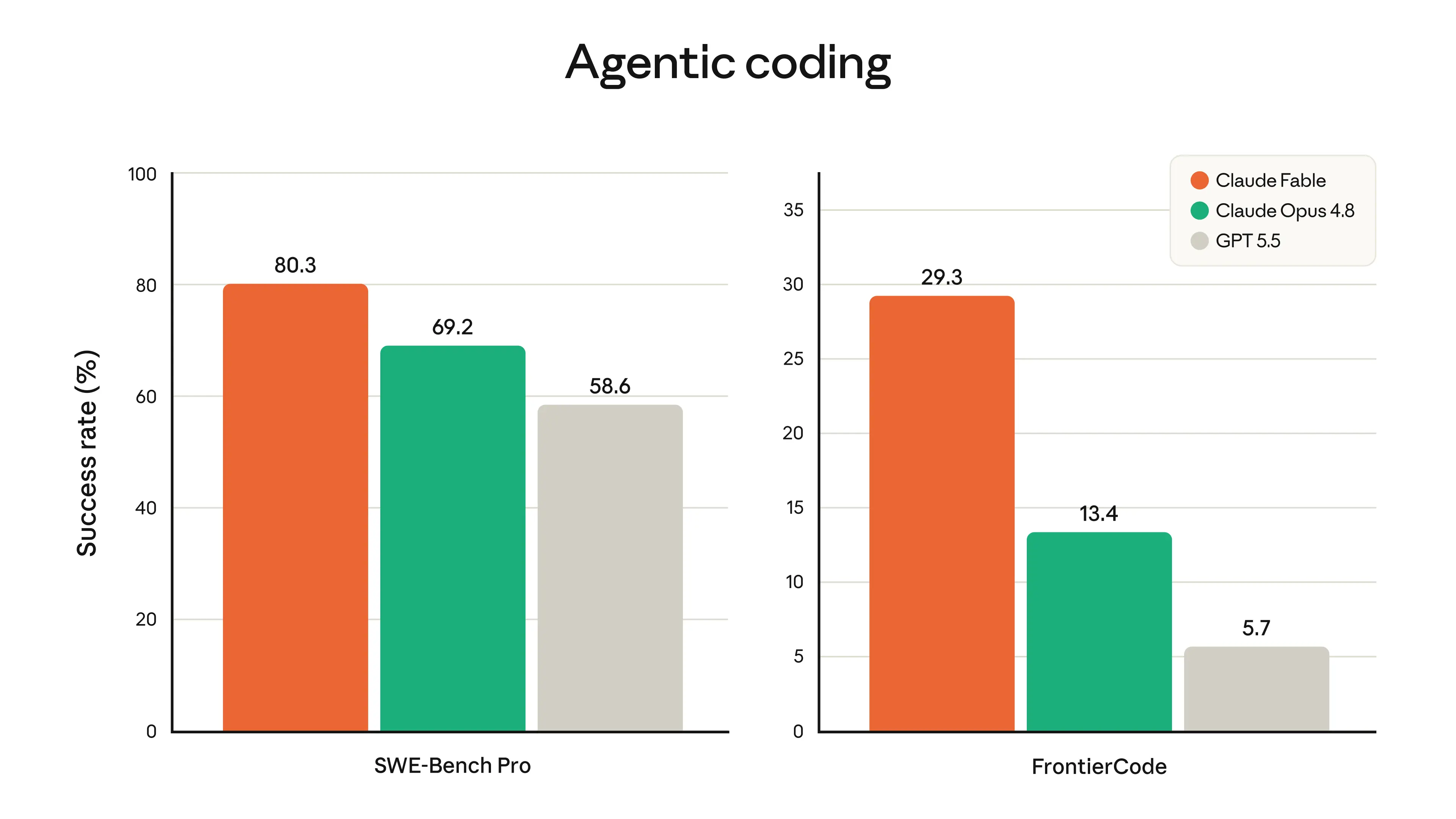
3. Multimodal Vision and Document Reasoning
Excels at interpreting diagrams, charts, screenshots, scientific figures, and PDFs. Leads on GDP.pdf (29.8%) and spatial reasoning benchmarks.
4. Large-Context Knowledge Work
Handles massive inputs (codebases, research corpora, financial docs) while preserving nuance. Strong on knowledge work evals like GDPval-AA.
5. Enhanced Safety and Reliability
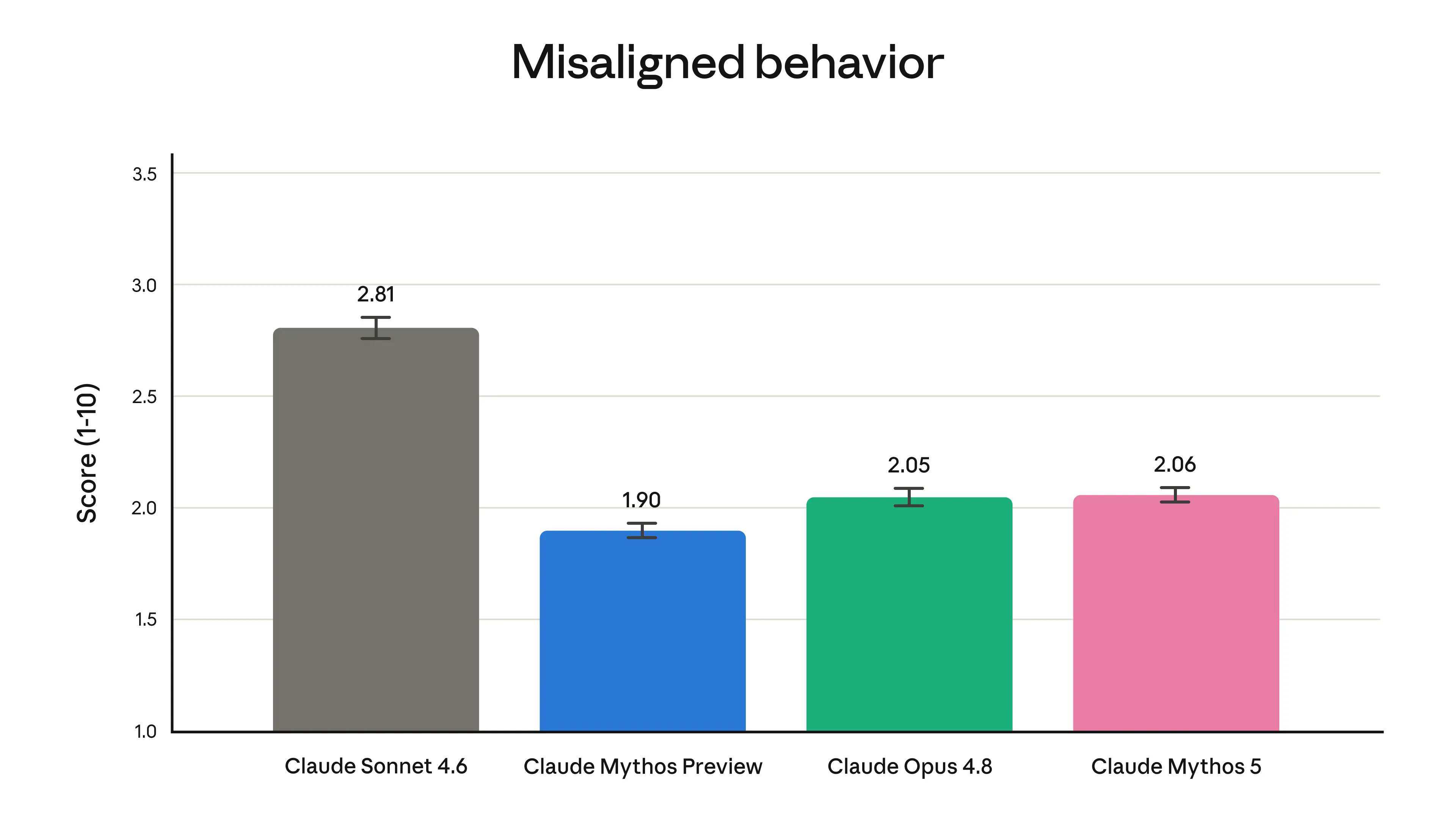
Safety is central to Fable 5's design. As a "safe for general use" version of the more powerful Mythos 5, it incorporates classifier-based safeguards that detect and reroute sensitive queries—particularly those involving cybersecurity, biology, chemistry, or model distillation—to Claude Opus 4.8 or equivalent safer behaviors.
This hybrid approach allows Fable 5 to deliver Mythos-level intelligence for most tasks while mitigating risks. False positive rates are low (~5% in some reports), ensuring minimal disruption for legitimate use.
Benchmark Performance of Claude Fable 5
Anthropic describes Claude Fable 5 as "state of the art on nearly all tested benchmarks" and reports that its advantage becomes more pronounced as tasks grow longer and more complex. Public launch materials highlight exceptional performance in:
- Software engineering and large codebase reasoning.
- Autonomous knowledge work and document analysis.
- Scientific research and technical problem solving.
- Vision and multimodal understanding.
- Long-running agent workflows requiring sustained planning.
While Anthropic has not publicly released a full benchmark table for every evaluation suite, it positions Fable 5 above previous Claude generations, including Claude Opus 4.8, particularly for long-duration autonomous tasks.
Claude Fable 5 vs Claude Opus 4.8 vs Claude Mythos 5
| Feature | Claude Fable 5 | Claude Opus 4.8 | Claude Mythos 5 |
|---|---|---|---|
| Public Availability | Yes | Yes | Limited access |
| Context Window | 1M tokens | Large context | 1M tokens |
| Long-Horizon Agent Work | Excellent | Strong | Excellent |
| Software Engineering | State-of-the-art | Advanced | State-of-the-art |
| Safety Guardrails | Yes | Standard | Reduced |
| High-Risk Cyber/Bio Tasks | Falls back to Opus 4.8 | Supported within standard policies | Greater capability for trusted partners |
| Primary Audience | General developers & enterprises | General-purpose AI users | Approved cybersecurity and research organizations |
Limitations
- Some cybersecurity, biology, chemistry, and model-distillation requests are automatically redirected to Claude Opus 4.8.
- The conservative safeguard system can occasionally trigger on benign requests.
- Access to the unrestricted Mythos-level capabilities remains limited to trusted organizations through Project Glasswing.
Typical Use Cases
- Repository-scale software development and code migration.
- Enterprise document analysis and knowledge management.
- Long-form research and technical writing.
- Scientific literature review and hypothesis generation.
- AI agents that require persistent multi-step planning.
- Legal, financial, and consulting workflows involving very large datasets.
How to Build with Claude Fable 5 API on CometAPI
Step 1: Get Your Claude Fable 5 API Key
Sign up or log in to CometAPI, then generate an API key from your dashboard. Use this key to authenticate Claude Fable 5 API requests from your application or backend service. Before you start building, check the latest API documentation for the current endpoint, model name, and supported parameters.
CometAPI’s playground lets you experiment instantly. For production, leverage their docs for rate limits, streaming, and tool use.
Step 2: Test Claude Fable 5 API with Real Tasks
Use realistic prompts instead of simple test messages. Try tasks such as coding, document analysis, structured data extraction, research summarization, or agent-style planning. During testing, evaluate response quality, instruction following, output formatting, and long-context performance.
Step 3: Integrate Claude Fable 5 API into Your Workflow
After testing, integrate Claude Fable 5 into your target use case, such as coding assistants, document review, research tools, or business automation. Use structured outputs, logging, and human review where needed, especially for important or production-facing workflows.
What Makes CometAPI Practical for Claude Fable 5 API Integration
Multi-Model Flexibility: Experiment with Fable 5 vs. GPT-5.5, Grok, or open-source options in one platform—optimize for cost/performance per task.
Cost Efficiency and Predictability: Credit-based usage, potential discounts, and no surprise vendor bills. Perfect for variable workloads where Fable 5’s higher output pricing benefits from optimization.
Seamless Production Readiness: OpenAI compatibility means drop-in replacement in existing LangChain, LlamaIndex, or custom agents. Robust handling of long contexts and fallbacks.
Support and Ecosystem: 24/7 resources, community, and enterprise features (security, compliance). Continuous addition of new models keeps your stack future-proof.
Real-World Wins: Developers use CometAPI to route Fable 5 for heavy reasoning/coding while using lighter models for simple queries—maximizing ROI.
By choosing CometAPI, teams focus on building innovative applications rather than infrastructure.