
In just 48 hours since its April 16, 2026 release, Anthropic’s Claude Opus 4.7 has become the go-to frontier model for developers building agentic coding systems, complex multimodal workflows, and long-horizon enterprise applications. Whether you’re refactoring massive codebases, analyzing high-resolution screenshots, or orchestrating multi-tool agents, Opus 4.7 delivers measurable gains in reliability, instruction-following, and visual acuity—while CometAPI makes it 20-40% more affordable with a single unified API key.
What Is Claude Opus 4.7?
Claude Opus 4.7 is Anthropic’s most capable generally available model as of April 16, 2026. It builds directly on Opus 4.6 with a step-change improvement in software engineering, agentic workflows, and multimodal understanding. Key specs include:
- Context window: 1 million tokens
- Max output tokens: 128k (300k with beta header)
- Input modalities: Text + high-resolution images (up to 2,576 px long edge / ~3.75 MP)
- API model ID:
claude-opus-4-7 - Pricing (official): $5 / million input tokens, $25 / million output tokens (unchanged from 4.6)
Anthropic calls it a “hybrid reasoning model” optimized for long-running, asynchronous agents. It thinks more thoroughly at higher effort levels, verifies its own outputs, and follows instructions literally—eliminating the “silent generalization” that sometimes plagued 4.6.
Real-world impact (per Anthropic internal evals and early benchmarks):
- 13% lift in resolution rate on a 93-task coding benchmark (4 tasks that 4.6 couldn’t solve)
- 3× more production tasks resolved on Rakuten-SWE-Bench
- CursorBench: 70% clearance (vs. 58% for 4.6)
- Visual-acuity benchmark (computer-use screenshots): 98.5% vs. 54.5% for 4.6
- OfficeQA Pro document reasoning: 21% fewer errors
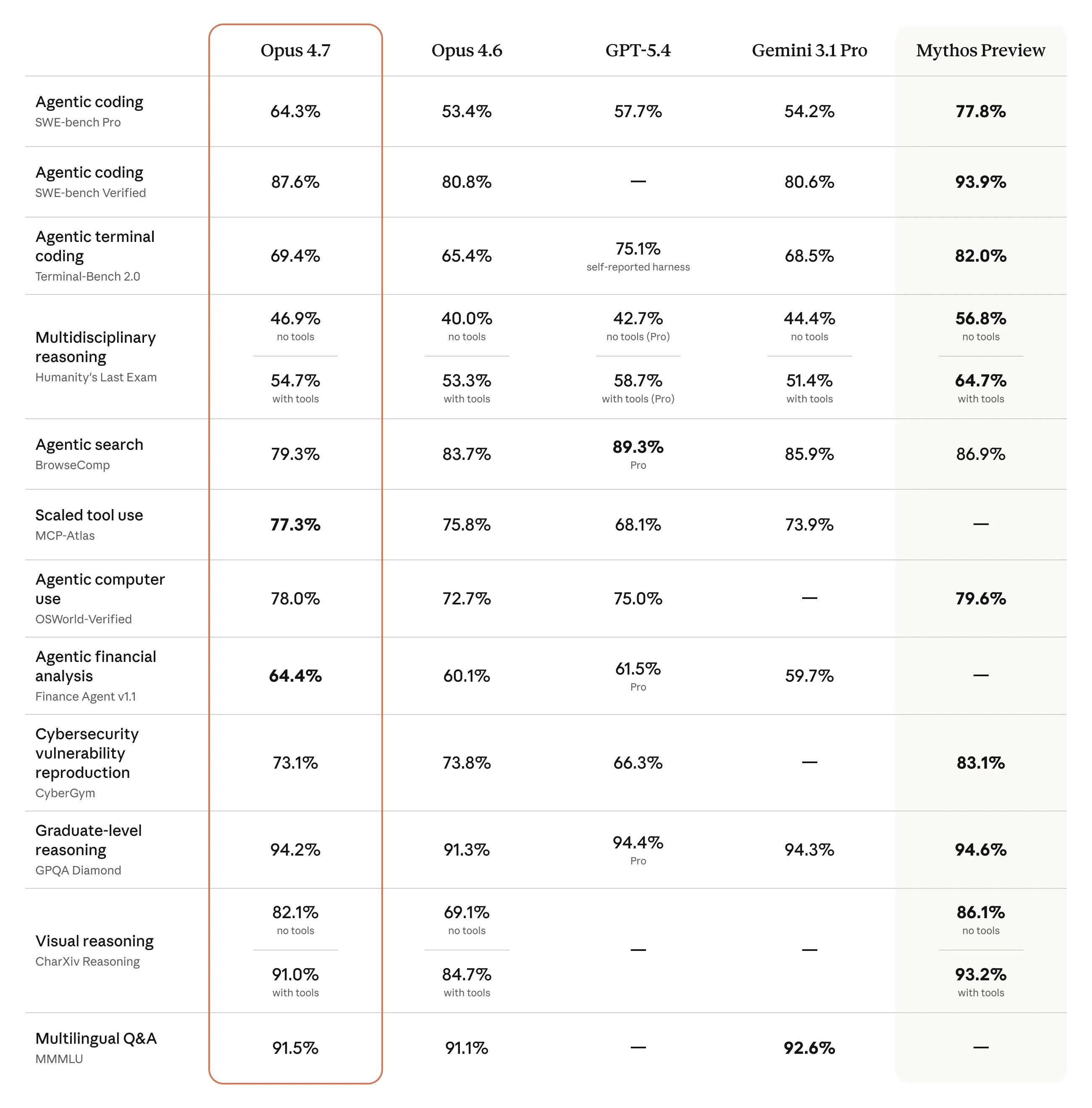
Opus 4.7 is deliberately positioned below the gated Claude Mythos Preview (for cybersecurity) but above every other publicly available model for agentic coding and professional knowledge work.
Key New Features in Opus 4.7 (With Supporting Data)
1. Adaptive Thinking (Replaces Extended Thinking Budgets)
Opus 4.7 introduces Adaptive Thinking—the model dynamically decides when and how much to “think” based on task complexity. No more manual budget_tokens; it outperforms the old fixed-budget approach in internal evals.
Why it matters: Longer-horizon agents stay on track, catch logical errors early, and self-verify outputs. Token efficiency improves at equivalent quality levels.
2. Multimodal High-Resolution Vision
Maximum image resolution jumps to 2,576 px on the long edge (3×+ previous 1,568 px limit). Coordinates are now 1:1 with pixels—no scale math required. Perfect for dense screenshots, diagrams, UI mockups, or pixel-perfect code screenshots.
Token cost increases with resolution, but you can downsample client-side if needed. Early users report dramatic gains in low-level perception, bounding-box detection, and chart/data extraction.
3. Enhanced Tool Use & Agentic Capabilities
Tool-calling accuracy and planning improved with double-digit gains. The model:
- Passes implicit-need tests more reliably
- Continues execution through tool failures
- Shows higher quality-per-tool-call ratio
- Excels at multi-session file-system memory (scratchpads, notes)
Combined with Adaptive Thinking and Task Budgets, Opus 4.7 is built for true autonomous agents.
4. New xhigh Effort Level + Task Budgets (Beta)
- Effort levels now include low, medium, high, xhigh, max. xhigh sits between high and max—ideal for coding/agentic work.
- Task Budgets (beta header task-budgets-2026-03-13): Give the model a target token budget for the entire agentic loop. It self-monitors and prioritizes gracefully.
Low-effort 4.7 ≈ medium-effort 4.6, with net token savings on many internal coding evals.
API Parameter Changes: What’s New (and What’s Broken) in Opus 4.7
Opus 4.7 introduces breaking changes for the Messages API. Here’s the comparison table:
| Parameter / Feature | Opus 4.6 | Opus 4.7 | Migration Action |
|---|---|---|---|
| Model ID | claude-opus-4-6 | claude-opus-4-7 | Update model name |
| Thinking | Extended budgets supported | Only adaptive thinking; extended = 400 error | Switch to {"type": "adaptive"} |
| Effort Level | low/medium/high/max | New xhigh added (between high & max) | Use output_config.effort |
| Sampling (temperature, top_p, top_k) | Supported | Non-default = 400 error | Omit entirely; use prompting |
| Task Budgets | Not available | Public beta (task-budgets-2026-03-13) | Add beta header + output_config.task_budget |
| Tokenizer | Previous version | Updated (1.0–1.35× more tokens) | Add headroom to max_tokens |
| Thinking Display | Always visible | Default omitted; opt-in "summarized" | Update streaming logic |
New parameters in detail:
Beta header for task budgets: task-budgets-2026-03-13.-tuning is often needed because 4.7 follows instructions more literally.
output_config: Now includes effort ("low", "medium", "high", "xhigh", "max") and task_budget (beta).
How to Use Claude Opus 4.7 API via CometAPI: Step-by-Step Tutorial
Why CometAPI?
CometAPI provides unified access to 500+ models (including all Claude variants) with one API key, OpenAI-compatible endpoints, 20-40% lower pricing than direct Anthropic rates, real-time analytics, and no vendor lock-in. Switch between Opus 4.7, GPT-5.4, Gemini, or Qwen instantly.
Step 1: Sign Up and Get Your API Key
- Visit cometapi.com and create a free account (no credit card required; instant test credits).
- Go to the dashboard → API Keys → Create new key. Copy it.
Step 2: Install the SDK
Use Anthropic’s official Python SDK (recommended for full feature support) or OpenAI-compatible client:
pip install anthropic
# or for OpenAI-compatible: pip install openai
Step 3: Configure the Client with CometAPI
CometAPI supports both native Anthropic Messages API and OpenAI chat.completions format. For full Opus 4.7 features (adaptive thinking, task budgets, high-res vision), use the Anthropic SDK with custom base URL:
import anthropic
from anthropic import NOT_GIVEN

client = anthropic.Anthropic(
    api_key="your_cometapi_key_here",
    base_url="https://api.cometapi.com/v1"  # CometAPI proxy endpoint
)
Step 4: Make Your First Opus 4.7 Call
You’re ready. All code examples below work with your CometAPI key—simply swap the key and enjoy the savings. (See code examples below for advanced features.)
Step 5: Monitor Usage
CometAPI dashboard provides real-time spend tracking, latency metrics, and budget alerts—perfect for production agentic workloads.
Pro Tip: CometAPI’s pricing for Opus 4.7 is significantly lower than Anthropic direct (20-40% savings) while delivering identical performance and full feature parity.
Code Examples for New Features in Opus 4.7
1. Basic Call with Adaptive Thinking + xhigh Effort
response = client.messages.create(
    model="claude-opus-4-7",
    max_tokens=128000,
    thinking={"type": "adaptive", "display": "summarized"},  # Show summarized reasoning
    output_config={
        "effort": "xhigh",          # New level for coding/agentic tasks
        "task_budget": {"type": "tokens", "total": 128000}  # Beta: full-loop budget
    },
    messages=[{"role": "user", "content": "Refactor this large codebase for performance."}],
    betas=["task-budgets-2026-03-13"]
)
print(response.content[0].text)
2. Multimodal High-Resolution Vision Example
message = client.messages.create(
    model="claude-opus-4-7",
    max_tokens=4096,
    output_config={"effort": "high"},
    messages=[{
        "role": "user",
        "content": [
            {"type": "text", "text": "Analyze this high-res UI screenshot and suggest improvements."},
            {
                "type": "image",
                "source": {
                    "type": "base64",
                    "media_type": "image/png",
                    "data": "iVBORw0KGgoAAAANSUhEUg..."  # Your 2576px image base64
                }
            }
        ]
    }]
)
3. Advanced Tool Use with Adaptive Thinking
Opus 4.7’s improved tool calling shines in agent loops. Here’s a simple parallel tool example:
tools = [
    {"name": "web_search", "description": "...", "input_schema": {...}},
    {"name": "code_execution", "description": "...", "input_schema": {...}}
]

response = client.messages.create(
    model="claude-opus-4-7",
    max_tokens=8192,
    thinking={"type": "adaptive"},
    output_config={"effort": "xhigh"},
    tools=tools,
    messages=[{"role": "user", "content": "Research latest AI benchmarks and run a quick code test."}]
)
The model will autonomously decide tool calls, self-verify outputs, and continue through failures—far more reliable than 4.6.
4. Full Agentic Loop with Task Budget (Production-Ready)
Use task budgets to prevent runaway costs in long-running agents:
# Inside a while-loop for multi-turn agents
response = client.beta.messages.create(
    model="claude-opus-4-7",
    max_tokens=64000,
    output_config={
        "effort": "xhigh",
        "task_budget": {"type": "tokens", "total": 200000}  # Model sees countdown
    },
    messages=conversation_history,
    betas=["task-budgets-2026-03-13"]
)
Comparison Table: Opus 4.7 vs. Opus 4.6 vs. Leading Competitors
| Metric | Opus 4.7 | Opus 4.6 | GPT-5.4 (approx.) | Sonnet 4.6 |
|---|---|---|---|---|
| SWE-Bench Pro | 64.3% | 53.4% | 57.7% | Lower |
| CursorBench | 70% | 58% | N/A | N/A |
| Visual Acuity | 98.5% | 54.5% | Lower | Lower |
| Pricing (Input/Output) | $5 / $25 | $5 / $25 | Higher | $3 / $15 |
| Context Window | 1M | 1M | 1M | 1M |
| Adaptive Thinking | Yes | Partial | Yes | Yes |
| Max Image Resolution | 3.75MP | 1.15MP | Lower | Lower |
Why CometAPI Is the Smart Choice for Opus 4.7 Production
Beyond cost savings (20-40% lower than direct Anthropic), CometAPI eliminates key pain points:
- One integration: Swap models without code changes.
- Enterprise reliability: <400ms latency, 99.9% uptime, encrypted transit.
- Observability: Centralized dashboards for spend, latency, and model comparison.
- Future-proof: New models (including Opus 4.7 on day one) appear instantly.
For teams running agentic workflows or high-volume vision tasks, the savings on Opus 4.7 alone can exceed thousands per month while maintaining full feature support.
Real-world use cases where Opus 4.7 + CometAPI wins:
- Autonomous code review + refactor agents
- UI/UX design from natural language + high-res mockups
- Financial document analysis with charts
- Multi-session research agents with file-system memory
Best Practices, Cost Optimization & Recommendations
- Start with
xhigheffort for coding/agentic work—default in Claude Code. - Use Task Budgets for production agents to prevent runaway costs.
- Downsample images unless pixel-level detail is required.
- Prompt literally—remove fluff that 4.6 ignored.
- Leverage CometAPI savings: Official $5/$25 becomes ~$3–$4 / $15–$20 per million with CometAPI. For high-volume teams, that’s tens of thousands saved monthly.
- Monitor with CometAPI dashboard—set budget alerts and compare latency across models.
Conclusion: Get Started with Opus 4.7 Today
Claude Opus 4.7 raises the bar for frontier AI with adaptive intelligence, breakthrough vision, and production-ready agentic capabilities—all at the same price as its predecessor. By routing through CometAPI, you get immediate access, substantial cost savings, and the flexibility every serious AI builder needs in 2026.
Ready to build? Head to CometAPI, grab your free API key, and start calling claude-opus-4-7 in minutes. Your next agentic workflow, vision-powered tool, or enterprise automation is just one API call away.