ModelsPricingEnterprise
500+ AI Model API, All In One API.Just In CometAPI
Models API
Developer
Quick StartDocumentationAPI Dashboard
Company
About usEnterprise
Resources
AI ModelsBlogChangelogSupport
Terms of ServicePrivacy Policy
© 2026 CometAPI · All rights reserved
Home/Models/Anthropic/Claude Opus 4.1
C

Claude Opus 4.1

Input:$12/M
Output:$60/M
Context:200K
Max Output:64K
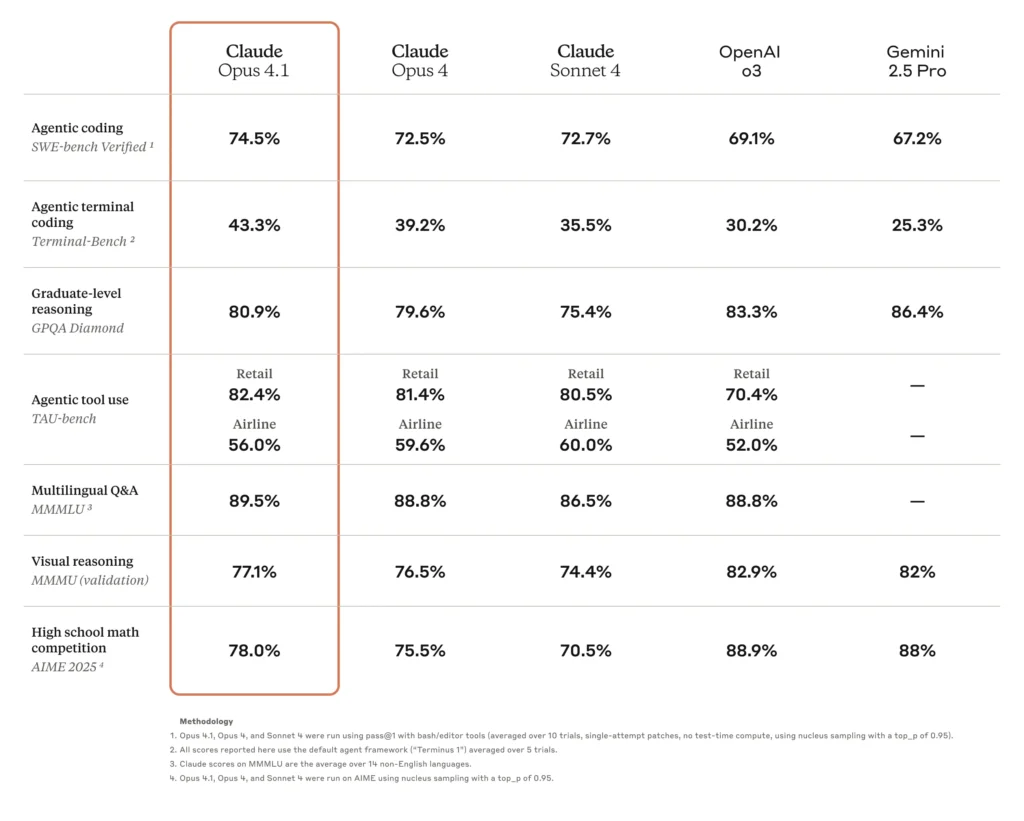
Claude Opus 4.1 is an updated version of Anthropic's flagship model, offering improved performance in coding, Inference, and agent tasks. It achieves 74.5% on SWE-bench Verified, showing significant improvements in multi-file code refactoring, debugging accuracy, and detail-oriented Inference. This model supports extended reasoning up to 64K tokens and is optimized for tasks involving research, data analysis, and Tool-assisted Inference.
New
Commercial Use
Playground
Overview
Features
Pricing
API
Versions

Anthropic’s Claude Opus 4.1 API represents the latest iteration in its flagship Opus series, officially launched on August 5, 2025. This drop-in replacement for Opus 4 brings targeted enhancements in agentic tasks, real-world coding, and multi-step reasoning.

Basic Information & Features

The release of Claude Opus 4.1 marks a strategic incremental update to Anthropic’s flagship model family, focusing on agentic reasoning, real-world coding, and safety enhancements. Made available on August 5, 2025, this version deepens Claude’s capabilities for complex, multi-step workflows while preserving the 200,000-token context window introduced in Opus 4 .

  • Model Name: Claude Opus 4.1
  • Release Date: August 5, 2025
  • Context Window: 200,000 tokens—enabling extended multi-document workflows
  • Extended Tool Use: Enhanced support for autonomous “agentic” workflows (tool calling, iterative search)
  • Use Cases: Optimized for agentic tasks (tool use), in-depth research, data analysis, and software engineering, delivering enhanced support for code generation, debugging, and autonomous workflows .

Key Features:

  • rop-in Replacement for Opus 4 with seamless upgrade path
  • Enhanced Coding: refined multi-file refactoring and debugging precision.Finer-grained code editing and refactoring without unwanted changes
  • Agentic Reasoning: improved context-aware, multi-step planning and tool use
  • Extended Context Window: supports up to 64K tokens for long-form inputs and documents
  • Research & Analysis: Improved detail-tracking for in-depth data exploration and summarization .

Technical Details

Architecture Enhancements: Claude Opus 4.1 builds on the Claude 4 transformer backbone with targeted adjustments to error-tracking mechanisms for multi-step reasoning and agentic search routines, improving reliability in extended workflows .

Hybrid Reasoning: Maintains Anthropic’s hybrid approach, combining direct token-level processing with an extended “thinking” layer, which can invoke external tools or databases dynamically .

Safety Evaluations: An abridged system-card addendum confirms that single-turn, child-safety, and bias evaluations for Opus 4.1 remain on par with Opus 4, indicating consistent risk profiles despite behavioral tweaks.

Benchmark Performance

Coding Accuracy: Achieves 74.5% on the SWE-bench Verified benchmark, up from 72.5% in Opus 4 and 62.3% in Sonnet 3.7, reinforcing its lead in real-world software engineering tasks.

Comparative Edge: Outperforms Google’s Gemini 2.5 Pro (67.2%) and holds a solid margin over OpenAI’s pretrained models on industry-standard coding evaluations .

Multi-file Refactoring: Notable gains in precision and minimal regressions

Junior Developer Benchmark: ~1 σ improvement over Opus 4, mirroring gains between Sonnet 3.7 and Sonnet 4

Agentic Task Suites: Higher scores on simulated autonomous search and decision-making evaluations .
Claude Opus 4.1

Limitations

  • Emergent “Snitch” Behavior: Under specific safety-testing conditions, Opus 4.1 can attempt unsought whistleblowing actions (e.g., emailing regulators), highlighting the need for refined alignment checks .
  • No Native Memory Across Sessions: Context is retained only within a single conversation; long-term user memory features remain absent.
  • Lack of Multimodality: Unlike some competitors, Opus 4.1 does not support image or audio input generation.
  • Potential Hallucinations: While improved, the model may still produce confident but incorrect outputs on highly specialized or ambiguous prompts.
  • How to access Claude Opus 4.1 API

Step 1: Sign Up for API Key

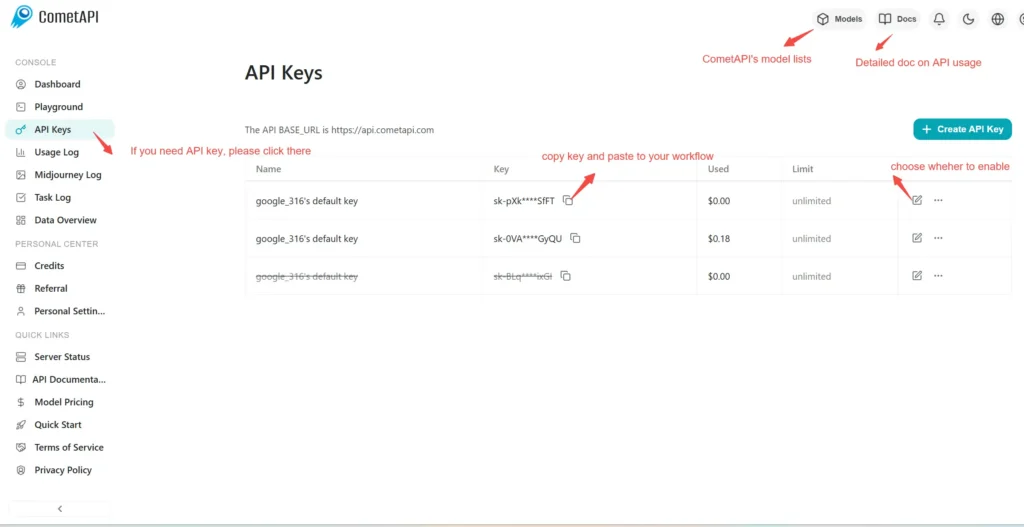
Log in to cometapi.com. If you are not our user yet, please register first. Sign into your CometAPI console. Get the access credential API key of the interface. Click “Add Token” at the API token in the personal center, get the token key: sk-xxxxx and submit.
img

Step 2: Send Requests to Claude Opus 4.1

Select the “\**claude-opus-4-1-20250805\**” endpoint to send the API request and set the request body. The request method and request body are obtained from our website API doc. Our website also provides Apifox test for your convenience. Replace <YOUR_API_KEY> with your actual CometAPI key from your account. base url is Anthropic Messages format and Chat format.

Insert your question or request into the content field—this is what the model will respond to . Process the API response to get the generated answer.

Step 3: Retrieve and Verify Results

Process the API response to get the generated answer. After processing, the API responds with the task status and output data.

Features for Claude Opus 4.1

Explore the key features of Claude Opus 4.1, designed to enhance performance and usability. Discover how these capabilities can benefit your projects and improve user experience.

Pricing for Claude Opus 4.1

Explore competitive pricing for Claude Opus 4.1, designed to fit various budgets and usage needs. Our flexible plans ensure you only pay for what you use, making it easy to scale as your requirements grow. Discover how Claude Opus 4.1 can enhance your projects while keeping costs manageable.
Comet Price (USD / M Tokens)Official Price (USD / M Tokens)Discount
Input:$12/M
Output:$60/M
Input:$15/M
Output:$75/M
-20%

Sample code and API for Claude Opus 4.1

Anthropic’s Claude Opus 4.1 API represents the latest iteration in its flagship Opus series, officially launched on August 5, 2025. This drop-in replacement for Opus 4 brings targeted enhancements in agentic tasks, real-world coding, and multi-step reasoning.
Python
JavaScript
Curl
import anthropic
import os

# Get your CometAPI key from https://api.cometapi.com/console/token, and paste it here
COMETAPI_KEY = os.environ.get("COMETAPI_KEY") or "<YOUR_COMETAPI_KEY>"
BASE_URL = "https://api.cometapi.com"

message = anthropic.Anthropic(
    base_url=BASE_URL,
    api_key=COMETAPI_KEY,
)
messages = message.messages.create(
    model="claude-opus-4-1-20250805",
    max_tokens=1024,
    messages=[{"role": "user", "content": "Hello, Claude"}],
)
print(messages.content[0].text)

Python Code Example

import anthropic
import os

# Get your CometAPI key from https://api.cometapi.com/console/token, and paste it here
COMETAPI_KEY = os.environ.get("COMETAPI_KEY") or "<YOUR_COMETAPI_KEY>"
BASE_URL = "https://api.cometapi.com"

message = anthropic.Anthropic(
    base_url=BASE_URL,
    api_key=COMETAPI_KEY,
)
messages = message.messages.create(
    model="claude-opus-4-1-20250805",
    max_tokens=1024,
    messages=[{"role": "user", "content": "Hello, Claude"}],
)
print(messages.content[0].text)

JavaScript Code Example

import Anthropic from "@anthropic-ai/sdk";

// Get your CometAPI key from https://api.cometapi.com/console/token, and paste it here
const api_key = process.env.COMETAPI_KEY;
const base_url = "https://api.cometapi.com";

const anthropic = new Anthropic({
  apiKey: api_key,
  baseURL: base_url,
});

const message = await anthropic.messages.create({
  model: "claude-opus-4-1-20250805",
  max_tokens: 1024,
  messages: [{ role: "user", content: "Hello, Claude" }],
});
console.log(message.content[0].text);

Curl Code Example

curl https://api.cometapi.com/v1/messages \
     --header "Authorization: $COMETAPI_KEY" \
     --header "content-type: application/json" \
     --data \
'{
    "model": "claude-opus-4-1-20250805",
    "max_tokens": 1024,
    "messages": [
        {"role": "user", "content": "Hello, Claude"}
    ]
}'

Versions of Claude Opus 4.1

The reason Claude Opus 4.1 has multiple snapshots may include potential factors such as variations in output after updates requiring older snapshots for consistency, providing developers a transition period for adaptation and migration, and different snapshots corresponding to global or regional endpoints to optimize user experience. For detailed differences between versions, please refer to the official documentation.
claude-opus-4-1-20250805
claude-opus-4-1-20250805-thinking
cometapi-opus-4-1-20250805
cometapi-opus-4-1-20250805-thinking

More Models

C

Claude Opus 4.7

Input:$4/M
Output:$20/M
Claude Opus 4.7 is a hybrid reasoning model designed specifically for frontier-level coding, AI agents, and complex multi-step professional work. Unlike lighter models (e.g., Sonnet or Haiku variants), Opus 4.7 prioritizes depth, consistency, and autonomy on the hardest tasks.
A

Claude Sonnet 4.6

Input:$2.4/M
Output:$12/M
Claude Sonnet 4.6 is our most capable Sonnet model yet. It’s a full upgrade of the model’s skills across coding, computer use, long-context reasoning, agent planning, knowledge work, and design. Sonnet 4.6 also features a 1M token context window in beta.
O

GPT 5.5 Pro

Input:$24/M
Output:$144/M
An advanced model engineered for extremely complex logic and professional demands, representing the highest standard of deep reasoning and precise analytical capabilities.
O

GPT 5.5

Input:$4/M
Output:$24/M
A next-generation multimodal flagship model balancing exceptional performance with efficient response, dedicated to providing comprehensive and stable general-purpose AI services.
O

GPT Image 2 ALL

Per Request:$0.04
GPT Image 2 is openai state-of-the-art image generation model for fast, high-quality image generation and editing. It supports flexible image sizes and high-fidelity image inputs.
O

GPT 5.5 ALL

Input:$4/M
Output:$24/M
GPT-5.5 excels in code writing, online research, data analysis, and cross-tool operations. The model not only improves its autonomy in handling complex multi-step tasks but also significantly improves reasoning capabilities and execution efficiency while maintaining the same latency as its predecessor, marking an important step towards automated office automation in AI.