
TLDR Recent community leaks of Anthropic model identifiers claude-marshmallow-eap and claude-melon-eap point to early-access previews of potential Claude Opus 5.1 and Sonnet 5.1 updates. Marshmallow is widely speculated to be the Opus-tier successor, with early tester feedback claiming smoother conversation, stronger consistency, solid performance below Fable 5 level, and advantages in areas like spatial/3D reasoning.
At the time of this review, Anthropic’s official model overview lists Claude Opus 5.5 and Claude Fable 5.1 among its current models. It does not list Claude Opus 5.1 in the current lineup. Claude Fable 5.1 is a separate model name and should not be confused with an Opus 5.1 release. Information checked: October 16, 2026.
The earlier preview identifiers and launch estimates discussed in this article do not establish a confirmed Opus 5.1 release date, price, or API identifier. Any retained discussion of those signals should be read as historical, unverified reporting.
If your goal is to use an Opus model for coding or professional work, evaluate the CometAPI documented models available to you. Anthropic currently positions Opus 5.5 for long-running agentic coding and knowledge work, while Fable 5.1 targets demanding reasoning and long-horizon agentic tasks. Select between them using your workload requirements and evaluation results.
Key Takeaways
- Leaked identifiers:
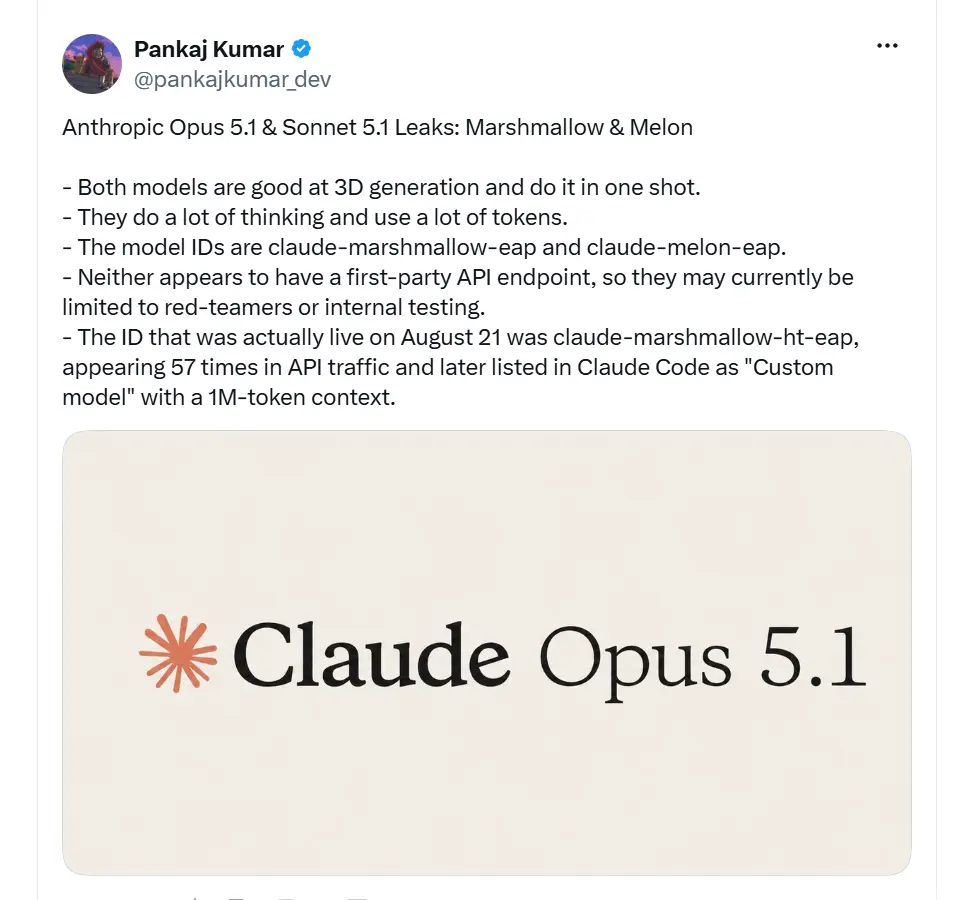
claude-marshmallow-eap(stronger, often mapped to Opus 5.1) andclaude-melon-eap(mapped to Sonnet 5.1 or possibly Haiku-class by some) appeared in developer apps and Discord; the “-eap” suffix matches Anthropic’s early-access preview pattern used for Honeycomb before Opus 5. - Performance signals: Early anecdotal reports say neither reaches Fable 5, Marshmallow outperforms Melon and may feel better than current Opus 5 in conversation and consistency; both show heavy thinking-token use and strength in 3D/spatial tasks.
- Context: Opus 5 launched July 24, 2026, delivering near-Fable intelligence at half the price ($5/$25). Anthropic has publicly noted Opus 5 can feel “spiky,” creating demand for a more consistent follow-up.
- Release window: Unconfirmed; Honeycomb precedent suggests weeks rather than months. No pricing or exact specs confirmed.
- Practical advice: Continue using Opus 5 (or Sonnet 5) productively now. Platforms such as CometAPI offer single-key, OpenAI-compatible access to Claude models (often at discounted rates) plus hundreds of others, simplifying testing and multi-model routing while you wait.
What Do We Know About Claude Opus 5.1 (Leaks, Signals, and Sources)
As of late August 2026, the public record on Claude Opus 5.1 is entirely unofficial. Here is a clear separation of confirmed history versus circulating signals:
Confirmed baseline (Claude Opus 5)
- Released July 24, 2026.
- Pricing: $5 per million input tokens / $25 per million output tokens (identical to Opus 4.8).
- Strong results on Frontier-Bench v0.1 (reported ~43.3% vs. lower scores for prior Opus and competitive with or ahead of Fable 5 on several coding and knowledge-work evals), ARC-AGI-3, OSWorld, CursorBench proximity to Fable 5 at lower cost, and GDPval-style professional-task rankings.
- Improvements emphasized by Anthropic and early users: better self-verification and iteration, more reliable long-running agent behavior, production-quality code in large codebases, and higher efficiency (fewer tokens for comparable work in many cases).
- Available across Claude apps, the Claude API, Amazon Bedrock, Google Cloud, and Microsoft platforms.
Leak and community signals for 5.1-class models
Mid-to-late August 2026: Early-access identifiers claude-marshmallow-eap and claude-melon-eap appeared in third-party developer tools and Discord communities. Community consensus has largely mapped Marshmallow to an Opus-tier update (possible Opus 5.1) and Melon to a Sonnet-tier
July 2026: Early discussion of a Fable 5.1 refresh focused on long-horizon reasoning and agents, with speculation that Anthropic might time it against competitor releases.update. Testers described Marshmallow as stronger overall than Melon, with conversational quality sometimes preferred over current Opus 5; neither was claimed to reach full Fable 5 level. Heavy “thinking token” usage was also noted in some informal tests.
Additional context: Anthropic has a pattern of rapid iteration in 2026 (Opus 4.8 in May, Fable/Mythos 5 and Sonnet 5 in June, Opus 5 in July). Point releases and silent or phased rollouts have occurred before.
Late August reports : Expectations of an August 28 window for Fable 5.1 / Opus 5.1 slipped. One widely circulated view placed Fable 5.1 around August 31 and Opus 5.1 around September 5, with some users allegedly already seeing updated checkpoints or grayscale routing on Claude Web. These remain unverified.
Source: x
What Is Claude Opus 5.1?
Claude Opus 5.1 is the community name for an anticipated incremental upgrade to Claude Opus 5, Anthropic’s current high-capability Opus-class model. It sits in the established Claude hierarchy (Haiku → Sonnet → Opus → Fable/Mythos), positioned for complex agentic coding, enterprise knowledge work, long-running tasks, and production-grade reliability at a more accessible price point than the top-tier Fable models.
Claude Opus 5 itself, released July 24, 2026, was marketed by Anthropic as “a thoughtful and proactive model that comes close to the frontier intelligence of Claude Fable 5 at half the price.” It features a 1-million-token context window, up to 128k tokens of output (with higher limits available via batch APIs), adaptive thinking (on by default), effort controls (low through max), and strong performance on software engineering and professional workflows. It became the default model on Claude Max and the strongest option on Claude Pro.
A “.1” designation typically signals targeted improvements—better consistency, reduced failure modes, efficiency gains, or domain-specific refinements—rather than a full generational leap.
When Will Claude Opus 5.1 Be Released?
No official date exists. Community estimates draw from two main signals:
- The Honeycomb EAP → Opus 5 timeline of approximately two to two-and-a-half weeks.
- Anthropic’s rapid 2026 cadence (multiple major releases between February and July, including Opus 4.8 in May, Fable/Mythos in June, Sonnet 5 at the end of June, and Opus 5 in late July).
Sightings began concentrating around August 21–24, 2026. Applying the prior EAP-to-launch gap yields a plausible window of late August into September 2026.
One widely circulated view placed Fable 5.1 around August 31 and Opus 5.1 around September 5, with some users allegedly already seeing updated checkpoints or grayscale routing on Claude Web. These remain unverified.
Claude Opus 5.1 Price
No pricing has been leaked or confirmed. The most reasonable expectation, based on Anthropic’s pattern of keeping Opus-tier pricing stable across minor updates, is continuity with Claude Opus 5: $5 per million input tokens and $25 per million output tokens.
For reference, current confirmed rates (as of the Opus 5 launch) are:
- Claude Opus 5: $5 / $25
- Claude Fable 5 / Mythos 5: $10 / $50
- Claude Sonnet 5: roughly $2–$3 / $10–$15 (with promotional adjustments)
- Fast mode (where available) typically doubles the rate for substantially higher speed.
A 5.1 release is unlikely to jump to Fable pricing unless it delivers a clear capability step that justifies it. Cache pricing, batch discounts, and any new effort or thinking controls would likely follow the existing Opus structure. Always verify final numbers on Anthropic’s official pricing page or aggregator dashboards once the model ships.
What Could Actually Improve? (Compared with Opus 5)
Opus 5 already delivered large gains over Opus 4.8 (e.g., more than doubling Frontier-Bench performance in some reports, strong results on ARC-AGI-style novel problem solving, and near-Fable scores on several coding and knowledge-work evals at half the cost). A 5.1 release is more likely to target remaining pain points than to chase new state-of-the-art headlines.
Consistency and Reduced “Spikiness”
Anthropic has acknowledged that Opus 5 can feel variable depending on effort settings or prompts. Early Marshmallow feedback emphasizes more natural, reliable conversational behavior even at medium effort. This would be a high-value quality-of-life upgrade for daily use and agent workflows.
Conversational Quality and Warmth
Testers have described Marshmallow dialogue as preferable to current Opus 5. Closing the gap between peak capability and everyday pleasantness aligns with Anthropic’s stated desire for models that “feel like Claude.”
Spatial, 3D, and Multimodal Reasoning
Multiple reports highlight strong one-shot 3D generation and architectural/spatial layout performance. If carried into the public model, this would expand usefulness for design, simulation, and visual-reasoning tasks.
Thinking Efficiency and Token Behavior
Both leaked models appear to use substantial thinking tokens. Refinements could improve the quality-per-token of internal reasoning or give users finer control, reducing the frequency of hitting output limits while preserving depth.
Agentic Reliability and Long-Horizon Work
Opus 5 already improved verification and iterative success. A 5.1 could further reduce error recovery needs and strengthen sustained multi-step performance—the exact areas where Fable retains an edge for the most ambitious agent projects.
Safety and Classifier Behavior
Opus 5 already has lighter safeguards than Fable in many domains. Incremental improvements in false-positive rates or smoother fallbacks would improve production reliability without sacrificing alignment.
None of the above is confirmed; they are reasoned extrapolations from the limited leak signals and Anthropic’s public comments on Opus 5.
What to Do While You Wait
Find an Available Claude Model for Your Project
If you arrived here looking for Claude Opus 5.1 access, start by checking the exact model names available for integration. A community nickname or preview identifier is not enough to identify a production API model.
Use the CometAPI model catalog to review supported Claude models, their listed capabilities, and current pricing. CometAPI’s unified API also lets you compare available Claude models with supported alternatives from other providers.
For coding workloads, test repository understanding, multi-file edits, and whether generated changes pass your existing checks. For document workflows, compare factual accuracy, instruction following, and revision quality. Measure latency and total task cost alongside output quality.
Once you have selected a listed model, follow the CometAPI documentation to configure access and verify the features your application needs.