
TL;DR: As of mid-September 2026, Claude Opus 5.2 has not been officially announced by Anthropic, but strong routing and gray-scale testing signals in Claude Code point to an imminent release—possibly as early as September 17–18 or by the end of the month. Early reports describe faster responses and reduced “laziness” compared with Claude Opus 5 (released July 24, 2026). Pricing is expected to stay near the Opus 5 baseline of $5 per million input tokens and $25 per million output tokens.
For developers who want frontier models today without waiting, platforms like CometAPI already provide discounted access to Claude Opus 5, Claude Fable 5.1, GPT-6 Astra, and hundreds of other models through a single OpenAI-compatible API.
Key Takeaways About Claude Opus 5.2
- Claude Opus 5.2 remains unannounced; the strongest evidence is backend routing in Claude Code reported on September 14–15, 2026.
- Expected improvements center on speed, cleaner output, better coding reliability, and reduced tendency to produce unnecessary content.
- No official pricing exists; historical pattern suggests continuity with Opus 5 rates ($5/$25 per million tokens).
- Polymarket and community estimates place a high probability of a new Opus by September 30, 2026.
- CometAPI offers immediate access to current Claude flagships (including Opus 5 and Fable 5.1) plus GPT-6 Astra and other frontier models at competitive rates, with one key and OpenAI-compatible endpoints.
What Is Claude Opus 5.2?
Claude Opus 5.2 is expected to be the next iterative upgrade in Anthropic’s Opus tier—the workhorse premium class designed for complex coding, agentic workflows, long-horizon knowledge work, and enterprise use cases. It sits below the higher-capability (and more restricted or expensive) Fable/Mythos models while aiming to deliver the best price-performance balance for daily professional use.
Opus models have historically emphasized:
- Strong performance on real-world software engineering (SWE-bench family)
- Reliable multi-step agentic behavior and tool use
- Thoughtful, lower-hallucination reasoning
- Large context windows (1M tokens in the Claude 5 generation)
- Adaptive thinking / effort controls
If the early routing reports hold, Opus 5.2 appears focused on practical refinements rather than a full generating already highlight speed, output cleanliness, and willingness to tackle longer tasks—areas frequently cited as remaining friction points after the Opus 5 launch.
Is Claude Opus 5.2 Live in Claude Code?
The careful answer is: it may be serving a limited share of Claude Code traffic, but it is not documented as a generally available model.
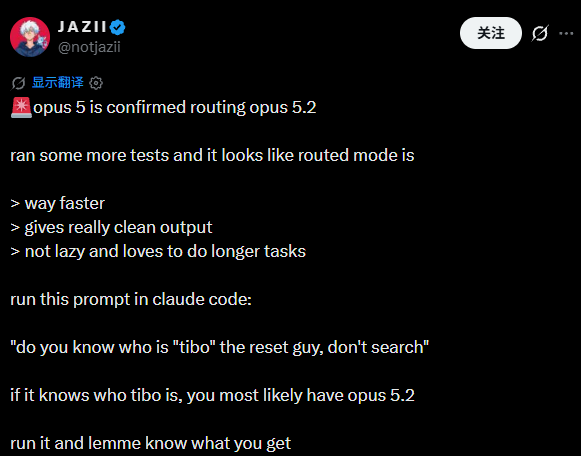
- The September 15 report describes developers inspecting request traffic and Claude Code status information. They reportedly found a backend slug referring to Opus 5.2 while the product interface continued to show Opus. Developers observed clear behavioral differences: noticeably faster generation speed and cleaner, more concise outputs with less “laziness” (unnecessary padding or incomplete reasoning).
- A separate developer report describes a route that appeared faster, cleaner, and more persistent on long coding tasks.
- A commonly shared knowledge probe (asking about a recent cultural figure with search disabled) yielded confident answers on some Claude Code sessions and uncertainty on others, consistent with a newer checkpoint or different weights.
These signals fit Anthropic’s recent pattern of relatively short cycles between Opus updates (Opus 4.8 in late May → Opus 5 in late July) and parallel progress on the Fable/Mythos line (Fable 5.1 and Mythos 5.1 launched September 1, 2026).
These observations have different evidentiary value. A routing identifier is implementation evidence, although an internal slug can still represent an experiment, alias, or checkpoint that never becomes a public product. Perceived speed and quality are weaker because effort settings, inference infrastructure, system prompts, repository state, and the Claude Code harness can all affect behavior.
| Signal | Reported observation | What it can support | Strength |
|---|---|---|---|
| Routing/status metadata | Visible Opus selection; reported backend reference to 5.2 | A different checkpoint may be serving some traffic | Strongest community signal |
| Repeated behavior reports | Faster, more concise, and more persistent execution | The served configuration may differ materially | Medium |
| Controlled A/B runs | Different results under matched tasks and settings | Weights, routing, or system configuration may differ | Medium when controls are documented |
| “Tibo” knowledge probe | Some suspected sessions answer a niche question differently | A reproducible fingerprint, not model identity proof | Weak |
| Official model catalog | No public 5.2 model ID or model card | No normal API release is documented | High |
Verification status — September 15, 2026: treat Claude Opus 5.2 as an unannounced routing experiment. The checkpoint label is evidence of testing, not proof of final naming, specifications, or general availability.
When Is the Expected Release Date Of Claude Opus 5.2?
Anthropic has not published any official timeline. Based purely on the September 14–15 routing and gray-scale reports plus historical cadence:
- Near-term possibility: September 17–18, 2026 (Thursday/Friday following the initial leak posts)
- More conservative community consensus: by end of September 2026
- Prediction market signal: ~80% chance of a next Opus by September 30, 2026
Previous Opus updates arrived without long public teases, often appearing first in limited surfaces (Claude Code, Cursor, Vertex) before broader API availability. The current gray-scale activity in Claude Code matches that pattern.
Developers should monitor Anthropic’s official channels, Claude Code behavior, and CometAPI for the first official model ID (likely something in the form of claude-opus-5-2 or similar).
Claude Opus 5.2 Pricing (Rumors and Reasonable Predictions)
No official pricing has been disclosed. Anthropic has kept the Opus tier price stable across recent upgrades:
- Claude Opus 4.8 and Claude Opus 5: $5 per million input tokens / $25 per million output tokens
- Fast mode (research preview on Opus 5): roughly double the base rate for significantly higher speed
Given this pattern and the positioning of Opus as the everyday premium tier (half the list price of Fable 5 / Fable 5.1), the most likely outcome is that Claude Opus 5.2 launches at the same $5 / $25 baseline, with possible Fast-mode or effort-tier variations. Any meaningful price increase would be surprising given competitive pressure from GPT-series models and Chinese open-weight alternatives.
Third-party aggregators often offer discounted rates. Once available, platforms such as CometAPI historically list Claude models 20% or more below official Anthropic list prices while providing a unified billing and OpenAI-compatible interface.
How Was Claude Opus 5.2 Detected?
Why is routing metadata more useful than model self-identification?
A model may not know its deployment identity. Aliases, system prompts, routing layers, and missing runtime metadata can all produce an incorrect self-description. The better method is to inspect the client’s status output and request metadata, then compare the observed route across repeated runs.
/status
The relevant evidence is the metadata returned around the request—not a conversational answer to “Which model are you?”
What can the Claude Opus 5.2 “Tibo” probe establish?
The community also used a niche knowledge prompt as an informal fingerprint:
Do you know who "Tibo," the reset guy, is?Do not search the web.
Reports suggest that some suspected 5.2 sessions recognized the reference while public sessions did not. This result is useful only as corroboration. A different answer could come from weights, hidden context, caching, retrieval, or system configuration. The original community discussion should therefore be presented as a source for the observation, not as cryptographic proof.
What Could Actually Claude Opus 5.2 Improve?
Claude Opus 5 already delivered substantial gains over Opus 4.8, including more than doubling scores on certain frontier coding evaluations, large jumps on ARC-AGI-style novel reasoning, and near-parity with the more expensive Fable 5 on several agentic and knowledge-work benchmarks while remaining at the lower Opus price point.
Based on the early Opus 5.2 routing observations and typical mid-cycle Anthropic refinements, the following areas are the most plausible improvements. Each is framed as a reasonable expectation rather than confirmed fact.
Higher Generation Speed and Lower Latency
Early testers reported a clear leap in response speed when the backend switched. Faster token generation improves interactive coding sessions, agent loops, and real-time collaboration tools without necessarily requiring a full Fast-mode price premium.
Cleaner, More Concise Outputs and Reduced “Laziness”
Multiple reports highlight shorter, higher-signal responses with fewer filler paragraphs or incomplete attempts. This directly addresses a practical usability complaint and can lower effective cost per successful task by reducing wasted tokens.
Stronger Agentic Coding Reliability and Tool Use
Opus 5 already excelled at multi-step coding and computer-use tasks. An incremental model often tightens failure modes, improves recovery from errors, and produces more consistent tool-calling behavior—critical for long-running agents in Claude Code or external frameworks.
Better Long-Context Consistency and Reduced Drift
With 1M-token windows now standard in the Claude 5 family, later iterations typically improve coherence over very long sessions, better instruction following across large codebases, and fewer context-loss issues.
Improved Alignment and Safety Properties Without Capability Regression
Anthropic has repeatedly emphasized progressive alignment gains. Opus 5 was described as one of the most aligned Opus models to date. A 5.2 release would be expected to continue that trajectory while preserving or enhancing useful capabilities.
Efficiency Gains (Tokens per Quality Point)
Even at identical list prices, models that solve tasks with fewer tokens or fewer retries deliver lower real-world cost. Early speed and cleanliness reports suggest this direction.
These points remain speculative until Anthropic publishes a model card and independent benchmarks appear. Historical precedent shows Anthropic often ships measurable improvements in coding, agentic reliability, and practical efficiency even in smaller point releases.
Claude Opus Lineage and Related Models (Approximate as of September 2026)
| Model | Approx. Release | Input / Output Price (list) | Context | Notable Strengths | Status |
|---|---|---|---|---|---|
| Claude Opus 4.8 | May 28, 2026 | $5 / $25 | 1M | Solid coding baseline | Legacy |
| Claude Opus 5 | July 24, 2026 | $5 / $25 | 1M | Near-Fable coding & knowledge work | Current public Opus |
| Claude Opus 5.2 | Expected ~Sep 2026 | Expected ~$5 / $25 | Likely 1M | Faster, cleaner outputs (early signals) | Rumored / gray-scale |
| Claude Fable 5.1 | Sep 1, 2026 | $10 / $50 | 1M | Highest capability long-horizon agents | Current higher tier |
| GPT-6 Astra (via aggregators) | 2026 | Competitive / discounted | Large | Strong reasoning & coding alternative | Available on platforms |
Prices and specs are subject to change; always verify official sources.
What Can You Use While Waiting Claude Opus 5.2? Alternatives
Until any Opus 5.2 (or further update) is officially available, strong production options already exist:
- Claude Opus 5 — the practical daily driver for complex coding agents and knowledge work at the $5/$25 price point.
- Claude Fable 5.1 — when maximum long-horizon or research capability is required.
- GPT-6 Astra — particularly strong on computer-use, browser agents, and certain mathematical/scientific suites.
- Claude Sonnet 5, other frontier models from xAI, Google, and specialized coding or multimodal systems.
What Assistance Can CometAPI Provide?
While waiting for the official Claude Opus 5.2 launch, developers do not need to pause productivity. CometAPI (https://www.cometapi.com/) aggregates 500+ models—including the full current Claude lineup and leading OpenAI models—behind a single API key and OpenAI-compatible endpoint (https://api.cometapi.com/v1).
Key advantages for teams tracking the Opus series:
- Immediate access to Claude Opus 5 (
claude-opus-5), Claude Fable 5.1 (claude-fable-5-1), Claude Sonnet 5, and earlier Opus variants at rates typically 20% below official list prices. - Access to cutting-edge alternatives such as GPT-6 Astra (
gpt-6-astra) for complex reasoning and coding workloads, alongside GPT-5.6 variants, Gemini models, Grok, DeepSeek, and many others. - Unified billing, usage monitoring, and the ability to switch models with a single parameter change—no multiple vendor accounts or SDKs required.
- Support for both OpenAI-style chat completions and Anthropic-native Messages formats, making migration seamless.
Relevant model pages and documentation:
- Anthropic models catalog: https://www.cometapi.com/models/anthropic/
- Overall models directory: https://www.cometapi.com/models/
- CometAPI home and quick-start: https://www.cometapi.com/
- API documentation: https://apidoc.cometapi.com/
Once Claude Opus 5.2 appears on the official Anthropic API, CometAPI’s historical pattern of rapid addition of new Claude models means it is likely to become available quickly, often with the same discounted pricing structure. Teams can therefore prototype on current Opus 5 or Fable 5.1 today and migrate with minimal code changes later.
This multi-model approach also provides natural fallbacks and A/B testing opportunities—valuable while the industry waits for confirmation and independent benchmarks of any new Opus release. Visit the CometAPI models page for live pricing and the quick-start documentation for integration examples.
Conclusion and Next Steps
Claude Opus 5.2 appears to be in active gray-scale testing as of mid-September 2026, with early user reports highlighting meaningful practical gains in speed and output quality. While official confirmation, benchmarks, and pricing are still pending, the signals align with Anthropic’s established rapid iteration style.
Developers who need frontier capability immediately can leverage platforms such as CometAPI to access Claude Opus 5, Claude Fable 5.1, GPT-6 Astra, and a broad portfolio of other models through a single, cost-competitive, OpenAI-compatible interface. This approach minimizes lock-in and keeps teams productive regardless of the exact timing of the next Anthropic release.
Stay tuned to Anthropic’s official channels and reputable AI news sources for the formal announcement. In the meantime, the combination of confirmed high-performance models already available and the expected refinements in Opus 5.2 positions the Claude family as a continuing strong choice for serious coding, agentic, and knowledge-work applications in 2026.