
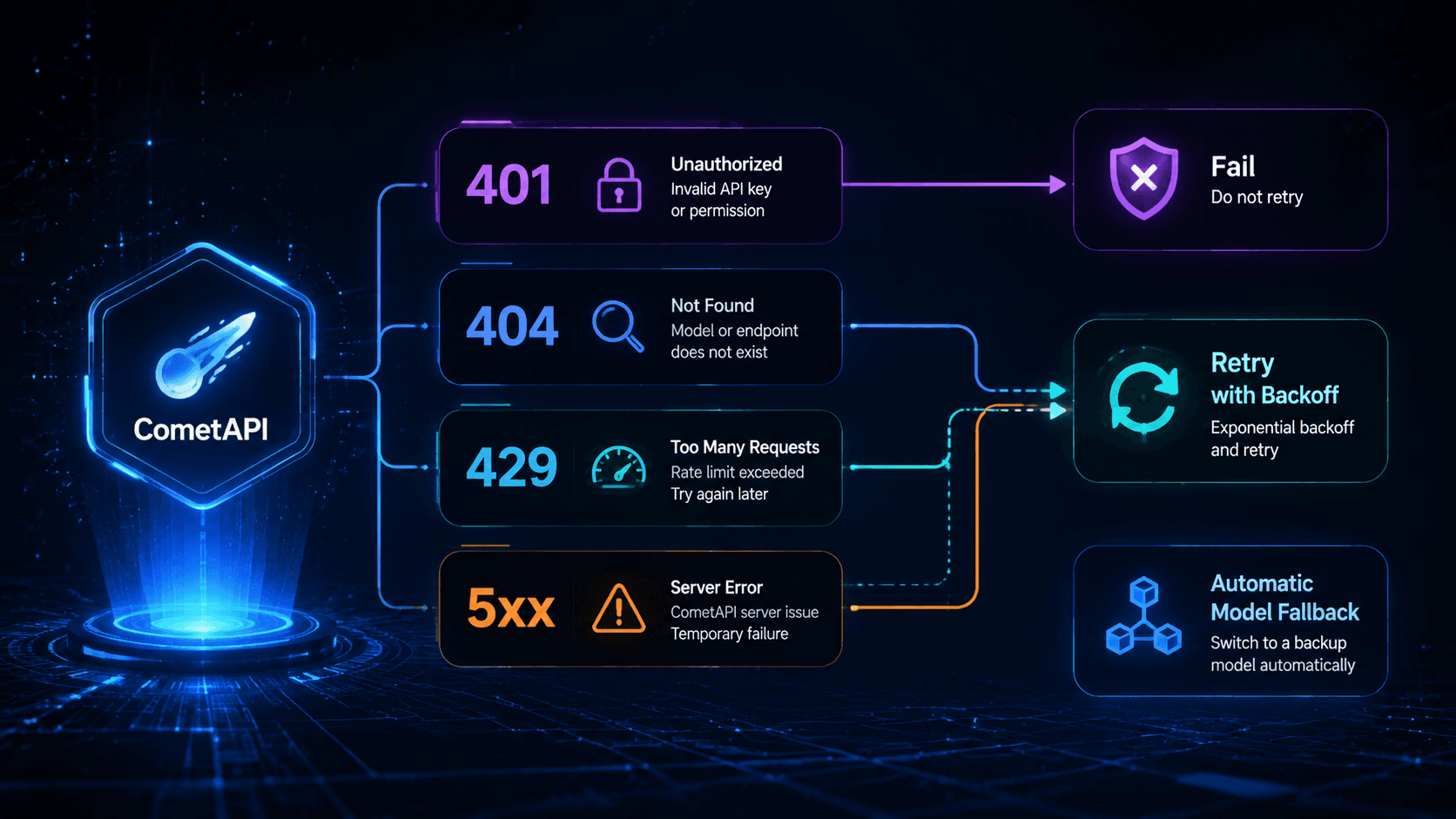
Short answer: do not switch from Claude to GPT for every failed request. A 401 means the authentication must be fixed, and a path-related 404 means the URL or endpoint must be corrected. A 429 or temporary 5xx can be retried with backoff; if bounded retries still fail, a compatible fallback model may take over.
There is one important exception: a 500 response with error.code: invalid_request is still a request problem. Retrying it—or sending the same broken payload to another model—only hides the bug.
This article was verified on August 20, 2026 against CometAPI's error, retry, base URL, rate-limit, and model-fallback documentation. It covers error classification only. For route design, provider credentials, and multi-layer failover, use the complete model fallback tutorial and the technical fallback guide.
Start With the Retry-or-Fail Decision
| Status | Usually means | Retry? | Fallback? | First action |
|---|---|---|---|---|
| 401 | Missing or invalid key | No | No | Fix the bearer token |
| 404 | Wrong path or endpoint | No | No | Check base URL and route |
| 429 | Rate limit or saturation | Yes | After bounded retries | Back off with jitter |
| 500 + invalid_request | Malformed request | No | No | Fix the payload |
| 500/503/504/524 | Temporary platform or provider failure | Yes | After bounded retries | Keep the request ID |
The practical question is not “Did Claude fail?” It is “Could a different model succeed without changing the invalid part of this request?” Authentication and path errors affect the connection itself, so changing the model cannot solve them. Temporary capacity and server failures may be route-specific, so a fallback can help.
Read the Error Before You Switch Models
Use the HTTP status together with error.code and error.message. Many CometAPI failures use an envelope like this:
{
  "error": {
    "message": "human-readable detail and request id",
    "type": "comet_api_error",
    "param": "problematic_parameter_or_empty",
    "code": "error_code_or_empty"
  }
}
Do not classify only by the first digit of the status code. A 500 can still carry invalid_request, while a wrong CometAPI path may return a redirect or HTML instead of a clean JSON 404.
401 Unauthorized: Stop and Fix Authentication
A 401 usually means the API key is missing, malformed, expired, or loaded from the wrong environment. The header must be:
Authorization: Bearer $COMETAPI_KEY
Do not retry and do not switch models. Both routes use the same broken authentication. Check whether the deployed service loaded an old secret, whether whitespace was added to the key, and whether the request is reaching the intended environment. Rotate or reload the key only through your secret-management process.
404 Not Found: Fix the URL Before Fallback
For OpenAI-compatible requests, use this base URL exactly:
https://api.cometapi.com/v1
A missing /v1, a duplicated path segment, or the wrong endpoint can produce 404, a redirect, an HTML response, or an SDK parsing error. Disable automatic redirect following while debugging and confirm the final request path against the API reference.
If the response explicitly says a model is unavailable or not found, verify the model ID in the current CometAPI Models API. Do not treat every 404 as model unavailability. Add a model-specific fallback only after you have captured and tested that exact signal.
429 Too Many Requests: Back Off Before You Fail Over
A 429 is retryable. Use exponential backoff with jitter, lower burst concurrency, and measure which route is saturating. An immediate retry from every worker can turn a short rate limit into a larger traffic spike.
After a small, bounded number of retries, fallback can be appropriate when the next model supports the same input, output contract, and required capabilities. The fallback is not free: it adds latency and may change cost or behavior, so record how often it is used.
5xx Errors: Check the Code, Then Retry
500, 503, 504, and 524 commonly represent platform, provider, or timeout-class failures. Keep the request ID, endpoint, model, and timestamp, then retry with backoff. If the same transient failure survives the retry budget, move to the next compatible route.
But inspect the body first. When a 500 contains error.code: invalid_request or invalid_request_error, fix the request body and retry only after it changes. Common causes include a missing messages field or a provider-specific parameter that the selected endpoint does not accept.
Use One Small Policy in Code
This Python example keeps retries and fallback in the application. It uses one CometAPI key, the OpenAI-compatible base URL, and environment variables for the current Claude and GPT model IDs. It retries only transient failures, then changes models after the retry budget is exhausted.
import os, random, time
from openai import APIError, OpenAI

client = OpenAI(
    api_key=os.environ["COMETAPI_KEY"],
    base_url="https://api.cometapi.com/v1",
    max_retries=0,
)
MODELS = [os.environ["CLAUDE_MODEL"], os.environ["GPT_MODEL"]]
RETRYABLE = {429, 500, 503, 504, 524}

def complete(messages):
    for model in MODELS:
        for attempt in range(3):
            try:
                response = client.chat.completions.create(model=model, messages=messages)
                return response.choices[0].message.content
            except APIError as error:
                status = getattr(error, "status_code", None)
                code = getattr(error, "code", None)
                if status in {401, 404} or code in {
                    "invalid_request", "invalid_request_error"
                }:
                    raise
                if status not in RETRYABLE:
                    raise
                if attempt < 2:
                    time.sleep(2**attempt + random.random())
                    continue
                break
    raise RuntimeError("No configured route completed.")

print(complete([{"role": "user", "content": "Summarize this ticket."}]))
The SDK's automatic retries are disabled so the application owns the total retry and fallback budget. Without that control, SDK retries plus application retries can multiply calls and delay the final response.
Test the Policy Without Guessing
| Simulated signal | Expected result | What must not happen |
|---|---|---|
| 401 | Raise immediately | No retry and no GPT call |
| 404 | Raise immediately | No fallback hiding a bad path |
| 429 | Back off, then fallback | No immediate retry storm |
| 500 + invalid_request | Raise immediately | No duplicate broken request |
| 503/504/524 | Back off, then fallback | No unbounded route chain |
These are policy tests, not claims about live provider reliability. In staging, inject the status and error body into the classifier, verify the number and order of calls, and confirm that your final error still includes the original request context.
When Claude-to-GPT Fallback Is Actually Safe
Switching model families is safe only when both routes can satisfy the same application contract. Normalize the request and response fields, test structured output or tool behavior on both models, and verify any required image, document, context, or reasoning capability before enabling the route.
Fallback should also respect side effects. If the first route already triggered a tool, wrote data, or streamed a partial response, blindly repeating the entire request may duplicate actions or confuse the user. Resume from a checkpoint or return a controlled failure instead.
Production Checks That Keep Retries Bounded
- Set one total latency budget. Count every retry and fallback attempt against the same deadline.
- Cap retries. Use backoff with jitter and stop after a small configured limit.
- Control concurrency. Reduce bursts before requests leave the application.
- Add a circuit breaker. Temporarily stop calling a repeatedly failing route.
- Log decisions. Capture status, error code, request ID, model, attempt, delay, and fallback reason without storing secrets.
- Track fallback rate. A sustained increase is an operational signal, not a normal success metric.
Frequently Asked Questions
Should a 401 ever trigger a model fallback?
No. Fix or reload the API key. A different model called through the same invalid credential will fail for the same reason.
Should a 404 trigger fallback?
Not by default. First fix the base URL or endpoint. Only a separately verified model-unavailable signal should enter the fallback classifier.
How many times should I retry a 429?
Use a small application-defined limit that fits the user-facing latency budget. Back off with jitter and reduce concurrency; do not retry immediately or indefinitely.
Are all 5xx errors retryable?
No. Temporary 500, 503, 504, and 524 responses are retry candidates, but 500 with invalid_request should hard fail until the payload is fixed.
Can Claude and GPT use the same request unchanged?
Only for the shared fields your application has tested. Provider-specific parameters, tool formats, structured outputs, and multimodal inputs may require adapters. A model ID change alone does not prove compatibility.
Where is the full fallback implementation?
See How to Build Robust LLM Model Fallback Strategies for the broader architecture, and the CometAPI model fallback guide for implementation details.
Make the Error Classifier the Gatekeeper
Automatic fallback is useful when it is narrow and observable. Let authentication, path, and malformed-request errors fail loudly. Retry rate limits and temporary server failures with backoff, then move to a compatible route only after the retry budget is spent. That policy turns fallback into a reliability control instead of a way to conceal configuration bugs.