
TLDR: DeepSeek-V4.1-Flash-1017 is a minor but highly impactful October 17, 2026 update to DeepSeek’s V4.1-Flash model. It delivers stronger results across reasoning, coding, agentic, and visual benchmarks while producing shorter outputs and completing tasks faster—advancing the performance-cost Pareto frontier.
Key Takeaways
- DeepSeek-V4.1-Flash-1017 Released October 17, 2026 as a free upgrade to the existing
deepseek-flashAPI endpoint—no code changes required for existing users. - Vendor-reported gains on all 11 listed benchmarks vs. the September V4.1-Flash, with largest jumps in agentic and coding tasks.
- Architecture: 552B-parameter Mixture-of-Experts with Causal Encoder-Decoder design (≈8B active parameters on input/prefill, 16B on decode/output); 1M-token context window; up to 384K output tokens; native vision support.
- Pricing unchanged: Off-peak $0.15 / $0.60 per 1M input (cache miss) / output tokens (peak doubles these rates); cache hits as low as $0.003. CometAPI is priced at 20% off the official rate.
- New Search & Fetch APIs opened to all developers ($0.75 per 1,000 calls; free via certain server-side tools until Oct 31, 2026).
- Strong “wish-driven programming” capabilities for end-to-end project generation (games, 3D scenes, full repos). Competitive against larger closed models on agent/coding benchmarks while remaining far cheaper and faster for many production workloads.
- Open-source MIT weights on Hugging Face and ModelScope enable self-hosting and fine-tuning.
- For production use, platforms like CometAPI provide convenient OpenAI-compatible access to DeepSeek models alongside 500+ others, often with competitive pricing and simplified switching.
DeepSeek continues to push the boundaries of efficient, high-performance open AI models. On October 17, 2026, the company released DeepSeek-V4.1-Flash-1017, a targeted update to its V4.1-Flash model (originally launched September 10, 2026). Marketed as delivering substantial improvements in reasoning, coding, agentic capabilities, and visual understanding—while reducing task execution time and output length—this checkpoint is positioned as DeepSeek’s most powerful efficient model to date for real-world agent and coding workloads.
The model is live across DeepSeek’s website, mobile app, and API (still called simply deepseek-flash). Weights are openly released under the MIT license, making it one of the strongest open-weight options available for developers who want frontier-level agent performance without frontier-level costs.
What Exactly Is DeepSeek V4.1-Flash-1017?
DeepSeek-V4.1-Flash-1017 is a dated checkpoint (“1017” referring to the October 17 release) of the V4.1-Flash family. DeepSeek describes it as a “minor update,” yet the improvements are broad and meaningful: higher scores across every reported benchmark category, faster task completion, and shorter outputs. The company frames this as a true Pareto improvement—better performance and better cost efficiency simultaneously.
It inherits the innovative architecture introduced with V4.1-Flash:
- Mixture-of-Experts (MoE) design with approximately 552B total backbone parameters (plus additional Engram parameters in some reports). New Causal Encoder-Decoder architecture that activates only ~8B parameters per token during prefill/input processing and ~16B during decode/output generation.
- Highly compressed KV cache (claimed reductions of 1/4 HBM and 1/8 SSD storage needs versus prior generations), which dramatically lowers the cost of long-context and multi-turn agent interactions.
- Native multimodal support (text + image input → text output). 1 million token context window and maximum output length of 384K tokens (recommended sampling often uses ≥256K max tokens).
- Support for thinking / non-thinking modes, tool calling, JSON output, and adjustable reasoning effort.
The model was trained with enhanced reinforcement learning techniques, including self-feedback loops specifically aimed at improving end-to-end project development. This enables more reliable “wish-driven programming”—turning high-level natural language goals into complete, functional projects such as web games, 3D scenes, or full code repositories.
For an application developer, this shifts the evaluation question. Instead of checking whether the model can produce a plausible function, test whether it can understand an existing codebase, make coordinated edits, run checks, and repair mistakes. A convincing demonstration establishes a capability worth testing; it does not establish reliability across arbitrary repositories.
The update also makes output efficiency worth measuring separately from answer quality. A shorter response can reduce generation cost, but only if it preserves the implementation, explanation, or evidence the task requires. Removing useful validation would be a regression even if the token bill falls.
DeepSeek V4.1-Flash-1017 API Specifications
| Specification | DeepSeek V4.1-Flash-1017 |
|---|---|
| Native API identifier | deepseek-flash |
| Context window | 1M tokens |
| Maximum output | 384K tokens |
| Input support | Text and images |
| Reasoning modes | Thinking and non-thinking |
| Developer features | Tool calls, JSON output, Responses API |
| Architecture | Causal Encoder–Decoder MoE |
| Announced family parameter count | 552B |
| Active parameters | 8B for input; 16B for output |
How Does DeepSeek V4.1-Flash-1017 Perform in Benchmarks?
Independent early tests (e.g., side-by-side with DeepSeek V4 Pro) have shown 1017 matching quality on practical tasks while being significantly faster and cheaper, plus adding vision support that Pro lacked in some configurations.
The selected vendor-reported results compare the September release with the October 17 update.
| Official benchmark results | September release | October 17 update | Absolute score change (points) |
|---|---|---|---|
| HLE without tools | 36.8 | 42.6 | +5.8 |
| Terminal-Bench 4.0 | 31.2 | 42.3 | +11.1 |
| DeepSWE v1.1 | 74.2 | 77.0 | +2.8 |
| ProgramBench | 20.3 | 29.1 | +8.8 |
| NL2Repo-Bench | 65.4 | 68.2 | +2.8 |
| Automation-Bench v1.0.6 | 54.8 | 60.5 | +5.7 |
| Agents’ Last Exam | 31.8 | 35.4 | +3.6 |
| Apex Bench v1.1 | 64.6 | 72.1 | +7.5 |
| Chartography with tools | 78.9 | 83.0 | +4.1 |
These are vendor-reported results, not independent replications. DeepSeek used Claude Code for Terminal-Bench 4.0 and Mini-SWE-V2 for DeepSWE v1.1. HLE is reported without tools and uses the main scores rather than the separately marked text-only subset; Chartography uses tools. The cited release table does not provide a complete per-row configuration for every other benchmark, so equivalent reasoning budgets, hardware, and stopping conditions cannot be assumed. Changes above are simple score differences, not relative percentage improvements.
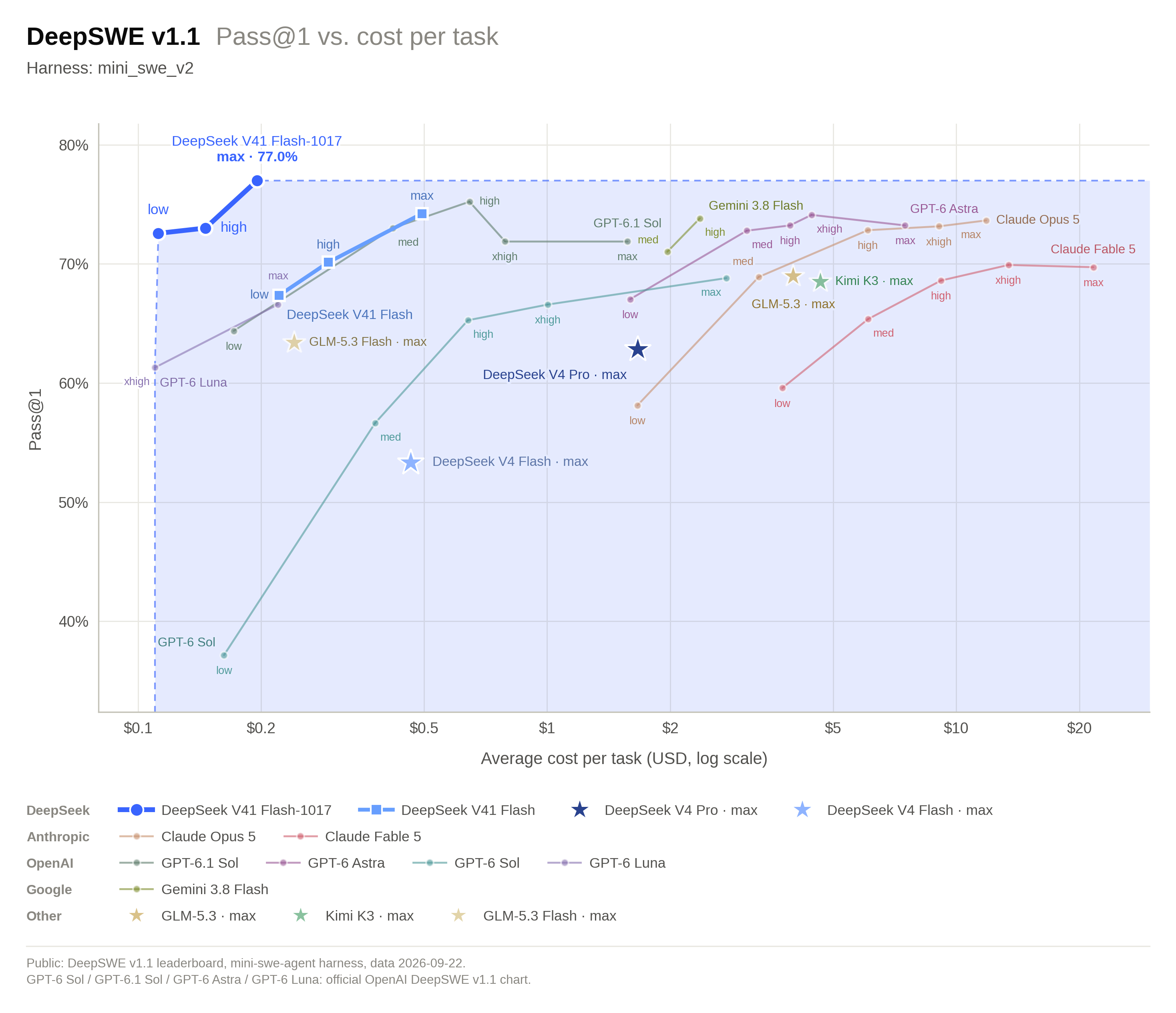
DeepSeek's DeepSWE v1.1 performance-versus-cost chart plots Pass@1 against average task cost in USD on a logarithmic axis, using the Mini-SWE-V2 harness. Different reasoning settings appear as separate points; compare a suitable success rate and configuration before drawing a cost conclusion.
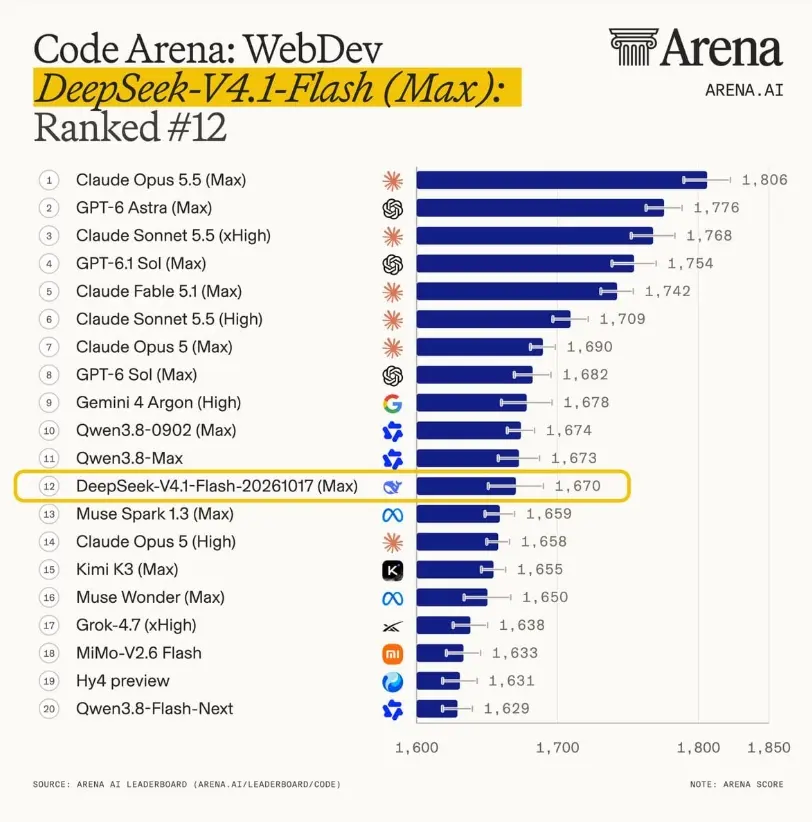
Code Arena: WebDev Leaderboard – Top Open-Source Model
In the latest WebDev frontier coding and web development benchmark evaluation, DeepSeek-V4.1-Flash-1017 has not only surpassed the highly regarded Kimi K3 (Max) but has also achieved an order-of-magnitude improvement in inference cost-efficiency—with an operational expense roughly one-tenth that of its counterpart. DeepSeek-V4.1-Flash-20261017 (Max) has officially claimed the top spot on the Code Arena: WebDev leaderboard, earning the title of the "number one open-source model."
On the overall leaderboard, the model secured 12th place with a score of 1670. At this high-ranking level, it outperforms the leading closed-source model, Claude Opus5 (High), and has narrowed the gap with the top-tier model, GPT-6Sol (Max), to within 10 points.
How Does the October Update Compare with the September Release?
Compared with the September release, the October 17 update shows its clearest gains in the selected coding benchmarks: Terminal-Bench 4.0 rises from 31.2 to 42.3 (+11.1 points), while ProgramBench increases from 20.3 to 29.1 (+8.8 points). DeepSWE v1.1 improves from 74.2 to 77.0 (+2.8 points). These vendor-reported results support evaluating the update for terminal workflows and broader programming tasks; they do not imply equivalent productivity gains in every codebase.
The release also places greater emphasis on complete project development through self-feedback reinforcement learning. Speed and token savings remain task-dependent, as the two examples in the next section show. For existing native API integrations, the model identifier remains deepseek-flash. The practical upgrade decision should therefore rest on accepted task completion, total cost, and end-to-end time measured on representative work.
How Much Does DeepSeek V4.1-Flash-1017 Cost?
Its cost advantage is enormous: Flash is typically 10–40× cheaper per token than top closed models, and shorter outputs further amplify the savings on multi-step agents. Against its predecessor, 1017 is strictly better on reported metrics while maintaining the same price—making it a pure upgrade.
USD per million tokens, as recorded in the source article on October 19, 2026. CometAPI peak rates apply its published 2× multiplier.
| Token category | DeepSeek native: off-peak | DeepSeek native: peak | DeepSeek V4.1 Flash API in CometAPI: base | CometAPI: 2× window |
|---|---|---|---|---|
| Input, cache hit | $0.003 | $0.006 | $0.0024 | $0.0048 |
| Input, cache miss | $0.15 | $0.30 | $0.12 | $0.24 |
| Output | $0.60 | $1.20 | $0.48 | $0.96 |
Both providers list weekday peak windows of 01:00–04:00 and 06:00–10:00 UTC. DeepSeek excludes Chinese public holidays; CometAPI’s displayed conditions do not specify that exemption. Other hours use off-peak/base rates. CometAPI’s 2× column is calculated from its published base prices.
For the native DeepSeek API, 10 million uncached input tokens plus 2 million output tokens cost:
- Off-peak: (10 × $0.15) + (2 × $0.60) = $2.70.
- Peak: (10 × $0.30) + (2 × $1.20) = $5.40.
For a pilot budget, divide all token and tool charges across all attempts by accepted tasks. Include cache reuse and peak windows; report infrastructure and human review costs separately. The examples above cover model tokens only.
Search and Fetch charges
DeepSeek’s Search and Fetch APIs each cost $0.75 per 1,000 successful requests. Their billing is separate from model-token usage; failed requests, empty search results, and timeouts are not charged under the documented rules.
For DeepSeek API users, server-side Search and Fetch calls through DeepSeek Harness, Claude Code, and Codex are temporarily free under the official billing policy. Billing for those calls begins October 31, 2026, at 16:00 UTC, equivalent to November 1 at midnight in Beijing. This limited waiver does not make all standalone Search and Fetch API requests free.
Is DeepSeek V4.1-Flash-1017 Always Faster and Cheaper?
No. EmpirioLabs’ two-task test found lower time and output-token use for an aquarium animation, but higher values for a skyline animation:
| EmpirioLabs’ first-hand coding tests | September release | October 17 update | Observed result |
|---|---|---|---|
| Aquarium completion time | 162 seconds | 124 seconds | October update faster |
| Aquarium output tokens | 41,833 | 33,149 | October update used fewer |
| Skyline completion time | 163 seconds | 177 seconds | October update slower |
| Skyline output tokens | 37,928 | 42,907 | October update used more |
Both versions produced working animations in these tests on EmpirioLabs' API platform on October 18, 2026. Each task used the same prompt and requested one self-contained HTML file with inline CSS and JavaScript, without external libraries or assets. Both models ran with default settings, thinking enabled at its default budget, and a 65,536-token output limit. They ran concurrently for each task, with one attempt per model. Times cover the entire request; output-token counts, including reasoning tokens, come from API usage reports. Screenshots were rendered in a headless browser after six seconds. These two examples illustrate workload variation rather than establish a general ranking.
How Can You Access DeepSeek V4.1-Flash-1017?
- Official DeepSeek API — Use model name
deepseek-flashat https://api.deepseek.com. - Open weights — Download from Hugging Face or ModelScope for self-hosting.
- CometAPI — CometAPI Adds DeepSeek-V4.1-Flash-1017 View model details Model ID: deepseek-v4.1-flash-1017
Use the native DeepSeek API
DeepSeek’s API quick start and CometAPI confirms that deepseek-flash now serves the October 17 version, with the calling method unchanged.
Send a project-planning request through the API with Python. Install the OpenAI Python package and set API_KEY in your environment before running the example.
import os
from openai import OpenAI
client = OpenAI(
    api_key=os.environ["API_KEY"],
    base_url="https://api.deepseek.com",# https://api.cometapi.com/v1
)
response = client.chat.completions.create(
    model="deepseek-v4.1-flash-1017",
    messages=[
        {
            "role": "user",
            "content": (
                "Design a small issue-tracking application. "
                "Give the data model, implementation plan, "
                "and acceptance tests."
            ),
        }
    ],
)
print(response.choices[0].message.content)
This produces a model response. To build and validate a project automatically, an agent environment must additionally provide file access, command execution, test feedback, and appropriate permissions.
CometAPI Recommendation: CometAPI already lists various DeepSeek models and is an excellent way to try V4.1-Flash-1017 alongside Claude, GPT, Gemini, Grok, and specialized coding/vision models without vendor lock-in. Sign up and obtain an API key, and point your existing OpenAI SDK at the CometAPI base URL. This approach is especially powerful for agent frameworks that benefit from routing different subtasks to the most cost-effective or highest-performing model available.
Conclusion
DeepSeek-V4.1-Flash-1017 represents a smart, efficient leap forward in open AI capabilities. By improving performance across critical agentic and coding benchmarks while simultaneously reducing output length and task time—all at unchanged low prices—it strengthens DeepSeek’s position as a leader in the performance-per-dollar race. Whether you are building autonomous software agents, multimodal applications, or cost-optimized production systems, this model deserves serious evaluation.
Combined with convenient access layers such as CometAPI, developers can integrate cutting-edge models like V4.1-Flash-1017 into robust, multi-provider workflows with minimal friction. As independent evaluations continue to emerge and the ecosystem of tools (Harness, CodeBuddy, etc.) matures, expect this checkpoint to become a default choice for many high-volume, high-intelligence workloads in late 2026 and beyond.