
DeepSeek V4.1 Flash replaces the short-lived beta story with a production release built around asymmetric computation, native multimodality, stronger agent benchmarks, and sharply lower API prices.
TL;DR
DeepSeek V4.1 Flash is now an official API and open-weight model, not an expiring beta endpoint. DeepSeek says it is a 552B-parameter Mixture-of-Experts model that uses a new Causal-Encoder-Decoder architecture. Only 8B parameters are activated while processing input, while 16B are activated during output generation. That asymmetric design is intended to spend less compute on long prompts without weakening the autoregressive generation stage.
The production API model name is deepseek-flash. It supports a 1M-token context window, up to 384K output tokens, thinking and non-thinking modes, JSON output, tool calls, the Responses API, the Anthropic-compatible API, and native vision input. DeepSeek's official benchmark table shows material gains over both V4 Flash 0731 and V4 Pro 0813 on coding, agent, cybersecurity, and multimodal tasks.
The pricing change is equally important. At peak time, V4.1 Flash costs $0.006 per million cache-hit input tokens, $0.30 per million cache-miss input tokens, and $1.20 per million output tokens. Off-peak rates are half of those amounts.
Key Takeaways
- DeepSeek V4.1 Flash is a released model with open weights; the temporary
deepseek-v4.1-flash-expires-on-0910identifier is no longer the correct production reference. - Its 552B MoE design activates 8B parameters for input and 16B for output, creating a different efficiency profile from V4 Flash's 284B-total/13B-active architecture.
- Native multimodality is part of the main model instead of a separate Vision Exp branch.
- The official comparison shows V4.1 Flash ahead of V4 Pro 0813 on most selected agent and coding benchmarks, although it does not lead every knowledge or terminal benchmark against every frontier competitor.
- Global KV cache falls to 890 bytes per token, about 3.9 times smaller than V4 Flash and roughly one quarter of its previous footprint.
- Peak API prices are $0.006 for cache-hit input, $0.30 for cache-miss input, and $1.20 for output per million tokens; off-peak prices are 50% lower.
What Is DeepSeek V4.1 Flash?
DeepSeek V4.1 Flash is DeepSeek's September 2026 efficiency-focused foundation model for reasoning, coding, agents, and multimodal understanding. The official announcement describes it as a 552B-parameter MoE model that improves capability while reducing the amount of computation and memory required for input processing.
The key change is architectural. Earlier V4 Flash used one active-parameter budget throughout inference. V4.1 Flash separates the input and output workloads: 8B parameters are active when encoding the prompt and 16B are active while generating the answer. DeepSeek calls this design Causal-Encoder-Decoder.
| Date | Status | Model ID |
|---|---|---|
| Sep 8 | Limited beta | deepseek-v4.1-flash-expires-on-0910 |
| Sep 10 | Production release | deepseek-flash |
DeepSeek V4.1 Flash Specification:
| Specification | DeepSeek V4.1 Flash |
|---|---|
| Release status | Official API release and open-weight model |
| Architecture | Mixture-of-Experts with Causal-Encoder-Decoder structure |
| Total parameters | 552B |
| Activated parameters | 8B for input; 16B for output |
| Context window | 1M tokens |
| Maximum output | 384K tokens |
| Input modalities | Text and images |
| Output modality | Text |
| Production API model name | deepseek-flash |
| Thinking modes | Thinking and non-thinking |
| API features | JSON output, tool calls, Responses API, Anthropic API, prefix completion, FIM completion |
| Open weights | Released on Hugging Face |
How Does the DeepSeek V4.1 Flash Work: Causal-Encoder-Decoder
Traditional decoder-only language models use essentially the same large stack for prompt processing and token generation. DeepSeek V4.1 Flash assigns different active capacity to those stages.
During the input stage, the model processes the prompt with an 8B active footprint. This stage can examine the supplied text or image context efficiently because the full answer has not yet been generated. During the output stage, the model activates 16B parameters and continues causal token-by-token generation. The design therefore saves compute on prompt encoding while retaining more active capacity for reasoning and response generation.
DeepSeek has not published every implementation detail in the announcement, so the safest description is functional: the architecture is asymmetric, the input and output stages use different active-parameter budgets, and the resulting system reduces inference memory and cost.
KV Cache Reduction
The memory result is measurable. DeepSeek reports 890 bytes of global KV cache per token for V4.1 Flash, compared with 3,514 bytes for V4 Flash, 48,068 bytes for V3.2, and 389,120 bytes for V1. The V4.1 figure is approximately 3.9 times smaller than V4 Flash.
For long-context agents, this matters beyond a single benchmark. Smaller KV cache reduces high-bandwidth-memory pressure while a request is active and lowers the amount of state that must be moved to slower storage. DeepSeek says V4.1 Flash needs roughly one quarter of the HBM and one eighth of the SSD capacity required by the preceding model for comparable cache workloads.
DeepSeek V4.1 Flash Features
Native Multimodal Input
V4.1 Flash accepts images as part of the main model API. This replaces the earlier split between text-only V4 Flash and the experimental V4 Flash Vision endpoint. Developers can now build document understanding, chart analysis, screenshot interpretation, and visual-agent workflows against the same production model family.
Long-Context Reasoning
The official API specification retains a 1M-token context window and allows up to 384K output tokens. That makes the model suitable for repository-scale coding, multi-document analysis, long-running agent sessions, and workflows that need to preserve a large tool history.
Production API Features
The model supports thinking and non-thinking modes, structured JSON output, tool calls, the Responses API, an Anthropic-compatible interface, chat-prefix completion, and FIM completion in non-thinking mode. These capabilities make V4.1 Flash a direct production replacement for many V4 Flash agent and coding workloads.
Open Weights
DeepSeek has released the V4.1 Flash weights and a technical report. The release improves reproducibility, but the model remains extremely large: DeepSeek's announcement asks organizations interested in large deployments to plan for approximately 2,000 GPUs plus a storage cluster.
DeepSeek V4.1 Flash Benchmark Performance
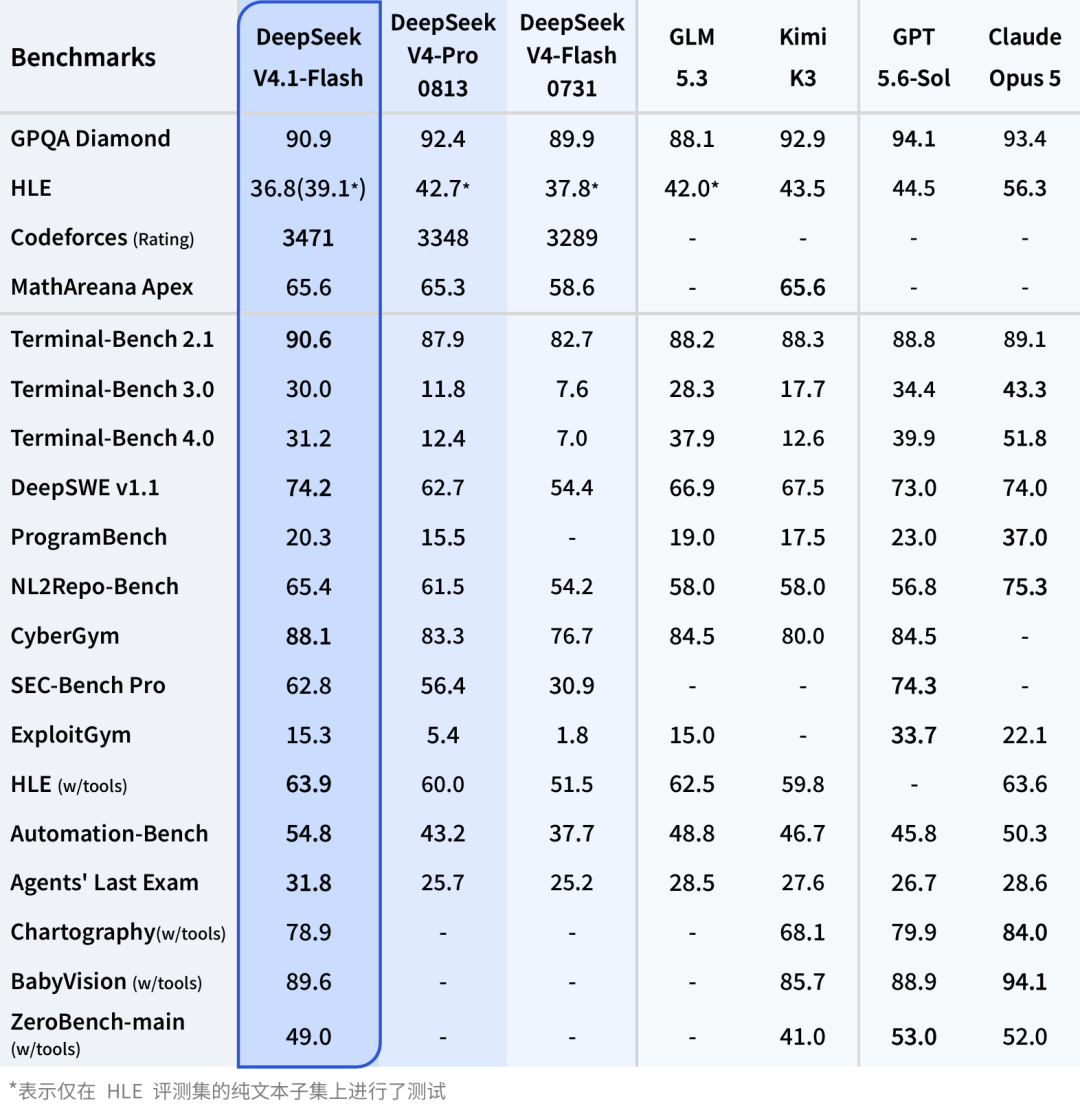
The official results change the earlier assessment that V4.1 had no benchmark evidence. DeepSeek now provides a broad table covering knowledge, mathematics, coding, terminal agents, cybersecurity, automation, and multimodal agent tasks.
| Benchmark | DeepSeek V4.1 Flash | V4 Pro 0813 | V4 Flash 0731 |
|---|---|---|---|
| GPQA Diamond | 90.9 | 92.4 | 89.9 |
| Codeforces rating | 3471 | 3348 | 3289 |
| MathArena Apex | 65.6 | 65.3 | 58.6 |
| Terminal-Bench 2.1 | 90.6 | 87.9 | 82.7 |
| DeepSWE v1.1 | 74.2 | 62.7 | 54.4 |
| NL2Repo-Bench | 65.4 | 61.5 | 54.2 |
| CyberGym | 88.1 | 83.3 | 76.7 |
| Automation-Bench | 54.8 | 43.2 | 37.7 |
Across this selected eight-benchmark view, V4.1 Flash beats V4 Pro 0813 on seven tests and beats V4 Flash 0731 on all eight. The largest gains appear in software engineering and agents: DeepSWE rises by 11.5 points over V4 Pro and 19.8 over V4 Flash, while Automation-Bench improves by 11.6 and 17.1 points respectively.
The results still need careful interpretation. V4.1 Flash scores below V4 Pro on GPQA Diamond, and the full official chart shows that Claude Opus 5 and GPT-5.6 Sol remain ahead on Terminal-Bench 3.0. A useful conclusion is that V4.1 Flash materially improves DeepSeek's efficiency-capability balance; the benchmark table does not prove universal leadership across every task.
DeepSeek V4.1 Flash API Pricing
DeepSeek uses peak and off-peak billing. Peak hours are 01:00–04:00 and 06:00–10:00 UTC, Monday through Friday; all other periods, including weekends, use the off-peak rate. The current pricing documentation states that off-peak prices are half of peak prices.
| Price per 1M tokens | V4.1 Flash off-peak | V4.1 Flash peak | V4 Pro 0813 off-peak | V4 Pro 0813 peak |
|---|---|---|---|---|
| Cache-hit input | $0.003 | $0.006 | $0.022 | $0.044 |
| Cache-miss input | $0.15 | $0.30 | $0.66 | $1.32 |
| Output | $0.60 | $1.20 | $1.98 | $3.96 |
The savings are substantial. For a workload using 100 million cache-miss input tokens and 10 million output tokens, V4.1 Flash costs approximately $21 off-peak or $42 at peak time. The same token mix at the published V4 Pro 0813 rates costs approximately $85.80 off-peak or $171.60 at peak time. V4.1 Flash is about 75.5% less expensive in this example.
Prompt caching strengthens the advantage for agents that repeatedly reuse system instructions, repository context, or documents. The V4.1 cache-hit rate is 50 times lower than its cache-miss rate at both billing periods.
DeepSeek V4.1 Flash vs V4 Flash vs V4 Pro
| Dimension | DeepSeek V4.1 Flash | DeepSeek V4 Flash | DeepSeek V4 Pro |
|---|---|---|---|
| Total parameters | 552B | 284B | 1.6T |
| Activated parameters | 8B input / 16B output | 13B | 49B |
| Architecture focus | Asymmetric input/output efficiency | Lightweight V4 MoE | Maximum V4 capacity |
| Native vision | Yes | Separate Vision Exp variant | No |
| Context window | 1M | 1M | 1M |
| Maximum output | 384K | 384K | 384K |
| API status on DeepSeek | Current production model | Retired; legacy name routes to V4.1 Flash | Scheduled to route to V4.1 Flash from September 14, 2026 |
| Best fit | General agents, coding, vision, high throughput | Migration compatibility only | Existing Pro workloads during transition |
V4.1 Flash is larger in total parameters than V4 Flash but can be cheaper to serve because its input stage activates only 8B parameters and uses a much smaller KV cache. Compared with V4 Pro, it activates far fewer parameters while outperforming Pro on most of the agent and coding benchmarks selected above.
API Access and Migration
DeepSeek's production model name is deepseek-flash. Existing applications can keep the OpenAI-compatible base URL https://api.deepseek.com or the Anthropic-compatible base URL https://api.deepseek.com/anthropic.
- Update the model name to
deepseek-flash. - Keep the existing DeepSeek base URL and authentication method.
- Re-test thinking mode, tool calls, vision inputs, latency, and token usage with production prompts.
- Monitor legacy aliases:
deepseek-v4-flashanddeepseek-v4-flash-vision-expnow route to V4.1 Flash, whiledeepseek-v4-prois scheduled to route to V4.1 Flash from September 14 until a future V4.1 Pro release.
For CometAPI users, the DeepSeek V4.1 API in CometAPI is now live alongside the existing DeepSeek V4 Flash API. Before switching production traffic, confirm the final model name, pricing, and alias mapping in the CometAPI dashboard, as third-party providers may differ from DeepSeek's official API naming and billing rates.
Who Should Use DeepSeek V4.1 Flash?
V4.1 Flash is a strong fit for coding agents, repository analysis, terminal automation, multimodal document workflows, long-context assistants, and high-volume tool-using systems. Its benchmark gains are concentrated in the same workloads that benefit most from lower cache memory and lower token prices.
Teams already using V4 Flash should treat it as a direct migration candidate. Teams using V4 Pro should test carefully, but DeepSeek's own benchmark and pricing data now make V4.1 Flash the more economical default for many Pro-class workloads.
Self-hosting is a different decision. Open weights do not make a 552B model lightweight. Organizations should compare the cost of a large GPU and storage deployment with hosted API usage before committing to local inference.
Limitations and Open Questions
- The benchmark results come from DeepSeek's official evaluation setup; independent replications will be needed to measure performance across different harnesses and tool environments.
- Native multimodal support is confirmed, but application teams should validate supported image formats, token accounting, and vision behavior against the live API.
- Legacy model aliases now change the model behind an existing name, which can alter outputs without an application code change.
- V4.1 Flash reduces infrastructure requirements relative to earlier DeepSeek models, but its open-weight deployment still requires substantial compute and storage.
- CometAPI's dedicated V4.1 endpoint and final pricing should be confirmed in the live console before production use.
Final Verdict
DeepSeek V4.1 Flash is a major architecture and product update. The 552B MoE model combines an 8B-active input stage, a 16B-active output stage, native vision, a 1M-token context window, and a sharply compressed KV cache. Those design choices translate into stronger official coding and agent benchmarks at much lower API prices than V4 Pro 0813.
The most practical change is consolidation. V4.1 Flash brings text, vision, reasoning, tool use, and long-context operation into one production model name. For most new DeepSeek integrations, deepseek-flash is now the logical starting point; V4 Pro becomes a migration comparison rather than the automatic choice for difficult work.
FAQ
Is DeepSeek V4.1 Flash officially released?
Yes. It is available through DeepSeek's API under the model name deepseek-flash, and DeepSeek has released open weights and a technical report.
Is the temporary V4.1 beta model ID still required?
No. deepseek-v4.1-flash-expires-on-0910 was a short-lived beta identifier. Production applications should use deepseek-flash.
How many parameters does DeepSeek V4.1 Flash have?
The model has 552B total parameters. It activates 8B parameters during input processing and 16B during output generation.
Does DeepSeek V4.1 Flash support images?
Yes. Vision input is native to the production model, so a separate V4 Flash Vision Exp endpoint is no longer required.
Is V4.1 Flash better than V4 Pro?
It leads V4 Pro 0813 on most of DeepSeek's published coding, agent, automation, and cybersecurity comparisons, but V4 Pro remains ahead on GPQA Diamond. Teams should evaluate both against their own prompts before migration.
How much does the API cost?
At peak time, the per-million-token rates are $0.006 for cache-hit input, $0.30 for cache-miss input, and $1.20 for output. Off-peak rates are half of those prices.
What happens to the old V4 model names?
The legacy deepseek-v4-flash and deepseek-v4-flash-vision-exp names route to V4.1 Flash. DeepSeek says deepseek-v4-pro will also route to V4.1 Flash from September 14, 2026 until V4.1 Pro is released.
Can I use DeepSeek V4.1 Flash through CometAPI?
Yes. CometAPI now offers a live DeepSeek V4.1 API endpoint. Before sending production traffic, confirm the exact model name, pricing, and supported features in the CometAPI console, as third-party providers may use different naming conventions or billing rates than DeepSeek's official API.