
TL;DR
DeepSeek V4.1 Pro is a referenced future successor to V4 Pro, with no release date established by the official sources reviewed on October 14, 2026. The September 10 Flash announcement provides the clearest release clue. Available Flash specifications and evaluations help developers prepare, but they do not establish Pro capabilities. DeepSeek has clarified that V4 Pro remains available in response to user demand. Benchmark figures below describe the original Flash release, not the October 17 Flash-1017 update; integrations should verify provider-specific model versions before deployment.
Key Takeaways
- Release status: V4.1 Pro has been referenced officially, but no specific launch date is confirmed.
- Most important clue: The V4.1 Flash announcement connected a future V4.1 Pro to an API transition plan.
- API status: DeepSeek confirmed continued V4 Pro service with unchanged billing in response to user demand; the earlier plan to redirect Pro requests to Flash is superseded.
- Technical foundation: V4.1 Flash discloses a 552B-parameter backbone, asymmetric processing and a 1M-token context.
- Preparation: Benchmark existing models and keep API model identifiers configurable.
When Will DeepSeek V4.1 Pro Be Released?
As of October 14, 2026, the official sources reviewed for this article do not establish a release date for DeepSeek V4.1 Pro. Its name appears in DeepSeek’s product communication, but a future-product reference is not a launch schedule.
On September 10, 2026, DeepSeek introduced V4.1 Flash as the smallest member of a new architecture family. Its official launch announcement described an initial plan to redirect the older V4 Pro API to V4.1 Flash until the future V4.1 Pro release. The statement ties the successor to a concrete migration policy, but does not establish a launch date, training status or final specifications.
DeepSeek V4.1 Pro Release Timeline
| Date | Development | Implication |
|---|---|---|
| April 24, 2026 | V4 preview family released | Previous generation baseline |
| August 13, 2026 | V4 Pro general-availability update | Known flagship baseline |
| September 10, 2026 | V4.1 Flash announced; V4.1 Pro referenced | New architecture family introduced, with a future Pro successor referenced but no release date confirmed |
| September 14, 2026 | Original V4 Pro migration target | Subsequently revised |
| V4.1 Pro release | No announced date | Timing remains unconfirmed |
The official news archive dates the V4 preview release to April 24 and the V4 Pro general release to August 13. The September migration date was a service-transition target, not a V4.1 Pro release date.
The September announcement proposed redirecting V4 Pro requests to Flash from September 14 until a future Pro release. However, the current API documentation lists V4 Pro as a separate model with its own rates. DeepSeek subsequently clarified in its official September 10 changelog entry that it would continue providing V4 Pro API service after September 14 in response to user demand, with billing unchanged. The earlier redirection proposal should therefore be treated as a superseded plan, not the current V4 Pro routing policy. The current model table lists deepseek-v4-pro as V4-Pro-0813 and deepseek-flash as V4.1-Flash-1017; verify each provider’s model mapping before deployment.
Future confirmation should come from a dedicated DeepSeek announcement, a supported API identifier, and published Pro evaluations and pricing.
What Has DeepSeek Officially Confirmed About V4.1 Pro?
Confirmed Information
The distinction between official statements and technical speculation is essential before launch. V4.1 Flash disclosures provide substantial evidence about the architecture family, but do not automatically become V4.1 Pro specifications.
DeepSeek has referenced V4.1 Pro as a future member of the V4.1 family, but the sources reviewed do not establish its release date, public model identifier, parameter count, context window, vision support, reasoning controls, benchmark results or API pricing. The available V4.1 Flash specifications provide context for the architecture family, not confirmed V4.1 Pro specifications.
DeepSeek describes V4.1 Flash as the smallest member of a new family designed for scaling. This supports a larger future architecture but does not prove V4.1 Pro will simply be a bigger copy. Training, active parameter budgets, attention schemes and post-training methods remain unconfirmed.
Community Reports / Leaks
In a September 27, 2026 X post, @NFT_Chen claimed that DeepSeek V4.1 Pro had appeared in internal testing with account-gated early access.

@NFT_Chen’s post is an unverified community report, not an official DeepSeek announcement. The screenshot visibly shows the V4.1 Pro name, an early-access label and several configuration fields, but it does not establish the screenshot’s source, deployment environment, connection to a live model, public API availability or final product specifications. Treat it as a lead for further verification rather than as evidence of a confirmed release.
The attached configuration screenshot displays the name DeepSeek V4.1 Pro, an Early access tagline, high reasoning effort, and flags for training data use, non-premium access and no multimodal support. It also contains a FREEBUFF_AI_TRAINING_NOTICE identifier.
If authentic and tied to an active integration, the entry could be an early-access clue. An availability flag is not a service guarantee, and the near-launch prediction by the author is not a confirmed release window. Treat the screenshot as a lead for further verification, not as a Pro specification.
What Is Known About DeepSeek V4.1 Pro?
V4.1 Flash offers the clearest technical foundation for the upcoming family. V4.1 Flash uses a Causal Encoder-Decoder architecture with different computation paths for prefill and decoding.
According to the technical model card, the released model contains 40 Transformer layers across a 20-layer encoder and 20-layer decoder.
| Specification | DeepSeek V4 Pro | V4.1 Flash | V4.1 Pro |
|---|---|---|---|
| Backbone parameters | 1.6T | 552B | Unannounced |
| Activated parameters | 49B | 8B input / 16B output | Unannounced |
| Architecture | MoE | Causal Encoder-Decoder MoE | Unannounced |
| Context window | 1M | 1M | Unannounced |
| Max output | 384K | 384K | Unannounced |
| Native image input | Not in listed configuration | Supported | Unannounced |
| KV cache footprint | Not directly comparable | ~890 bytes/token | Unannounced |
| Reasoning control | Low / high / max | Continuous 1–100 | Unannounced |
| Availability | API | API and open weights | Not announced |
Although V4.1 Flash contains 552B backbone parameters, only about 8B parameters are activated per input token and 16B during output.
Causal Encoder-Decoder Scaling Potential
The separation between prefill and decoding may make it possible for future family members to increase representation capacity while managing inference costs. V4.1 Flash also features Compressed Sparse Attention 2 and FP4 KV caching. Whether and how V4.1 Pro inherits these characteristics remains unknown.
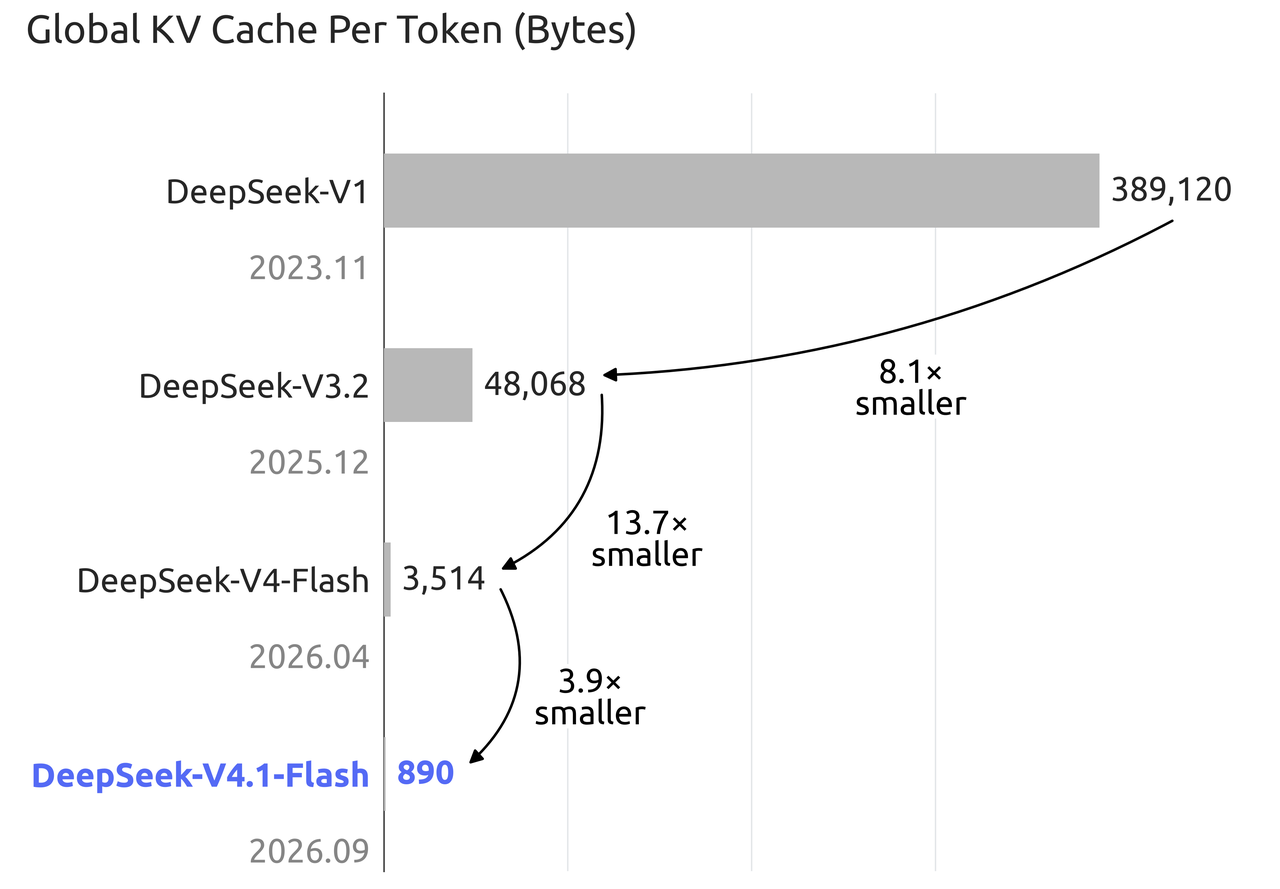
DeepSeek reports a global KV-cache footprint of approximately 890 bytes per token for V4.1 Flash, compared with 3,514 bytes for V4 Flash. This is a global KV-cache comparison, not a measure of total serving memory.
The two original graphics reproduced in this article are published in DeepSeek’s official model card; neither graphic is a V4.1 Pro result.
DeepSeek V4.1 Pro vs V4 Pro vs V4.1 Flash
A useful starting point is the observed difference between existing models, not an invented Pro benchmark. The table below compares the released V4 Pro 0813 model with the initial September V4.1 Flash release.
DeepSeek benchmark comparison
| Benchmark (metric) | V4 Pro 0813 | V4.1 Flash | Flash − Pro (percentage points) |
|---|---|---|---|
| GPQA Diamond (Pass@1) | 92.4 | 90.9 | −1.5 |
| HLE, text-only (Pass@1) | 42.7 | 39.1 | −3.6 |
| Terminal-Bench 2.1 (Pass@1) | 87.9 | 90.6 | +2.7 |
| Terminal-Bench 3.0 (Pass@1) | 11.8 | 30.0 | +18.2 |
| DeepSWE v1.1 (Resolved) | 62.7 | 74.2 | +11.5 |
| CyberGym (Pass@1) | 83.3 | 88.1 | +4.8 |
| HLE with tools (Pass@1) | 60.0 | 63.9 | +3.9 |
| Agents’ Last Exam (Pass@1) | 25.7 | 31.8 | +6.1 |
Version note (October 19, 2026):
They are not V4.1-Flash-1017 results. DeepSeek’s
confirms that its website, app and API switched to Flash-1017. The table is retained as a historical comparison with V4 Pro 0813. Do not interpret its score differences as a comparison against the latest Flash version; rerun matched evaluations before making a current model-selection decision.
The official instruct-model evaluation table is the source of the vendor-reported benchmark results above. For a consistent comparison, HLE scores are based on the text-only subset for both models. All score differences are expressed in percentage points rather than relative percentage gains.
Benchmark Conditions and Limits
Flash instruct evaluations use reasoning_effort=100, temperature=1.0 and top_p=0.95. Terminal-Bench uses DeepSeek Harness Minimal with a 1M-token context; DeepSWE v1.1 uses mini-SWE. These settings describe the reported Flash runs and should not be assumed to reproduce every comparison model’s setup.
The accompanying cross-scaffold study specifies Linux containers, max_steps=500, eight samples per task for DeepSWE and three for Terminal-Bench 2.1, with no network access for the latter. These details belong to that study, not automatically to every row in the headline table. The model card does not provide one shared hardware configuration for all listed scores; no hardware-normalized throughput claim is made here.
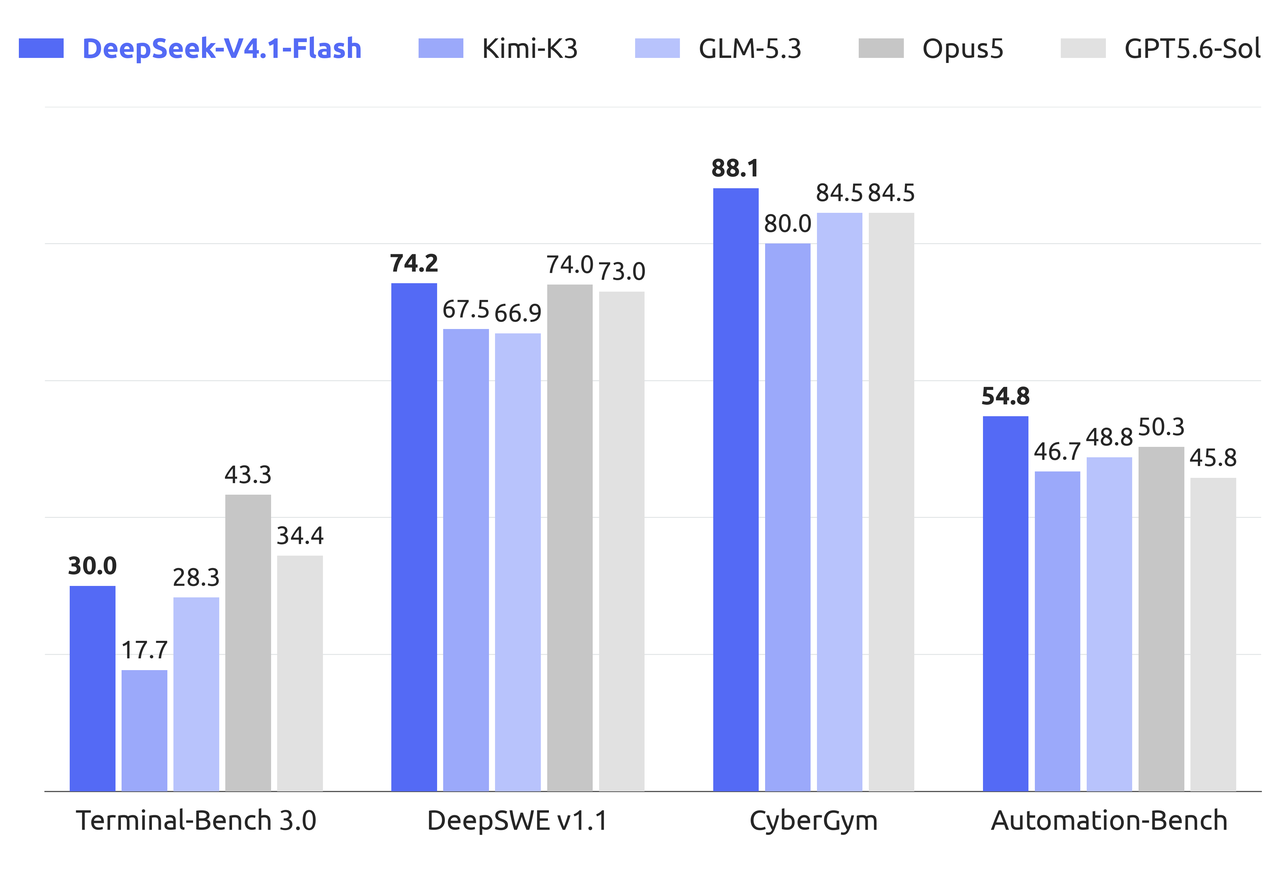
DeepSeek’s original agentic-performance chart compares Flash with selected frontier models. Its Terminal-Bench 3.0 value of 17.7 belongs to Kimi K3, not V4 Pro. The table above provides the separate V4 Pro comparison.
This historical comparison shows why a smaller model need not be worse at every task. Against the original September Flash release, V4 Pro led selected reasoning tests while Flash led several terminal, coding and tool-based evaluations. These rankings should not be carried forward to Flash-1017 without updated, comparable testing.
How Much Could DeepSeek V4.1 Pro Cost?
DeepSeek has not announced V4.1 Pro pricing. Current first-party pricing provides a reference, not a forecast. Rates distinguish peak and off-peak periods, cache-hit and cache-miss input, and generated output.
The following figures come from DeepSeek pricing documentation; rates can change.
Pricing and limits checked on October 14, 2026. Peak periods are 01:00–04:00 and 06:00–10:00 UTC, Monday through Friday, excluding Chinese public holidays. All other times are off-peak. These are DeepSeek first-party rates, not a CometAPI quotation; provider-specific billing must be checked separately.
| Price per 1M tokens | Flash off-peak | Flash peak | V4 Pro off-peak | V4 Pro peak |
|---|---|---|---|---|
| Cache-hit input | $0.003 | $0.006 | $0.022 | $0.044 |
| Cache-miss input | $0.15 | $0.30 | $0.66 | $1.32 |
| Output | $0.60 | $1.20 | $1.98 | $3.96 |
In the October 14 pricing and limits snapshot, both V4.1 Flash and V4 Pro support a 1M-token context window. Listed concurrency is 2,500 for Flash and 500 for V4 Pro, with the same limits shown for peak and off-peak periods. These are first-party limits; confirm the limits of your chosen provider before deployment.
At published off-peak rates, Flash uncached input is about 77% cheaper than V4 Pro and generated output about 70% cheaper. Its lower pricing can be particularly relevant to repeated agent actions and document-heavy workflows.
Quality and Cost Trade-offs for V4.1 Pro
For illustration only, a model costing $0.01 per attempt with a 60% success rate has an expected API cost of $0.0167 per successful task, while a $0.03 model with a 95% success rate costs approximately $0.0316. These figures are not measured DeepSeek performance; they assume independent attempts with a constant success probability. The higher-success model may still be preferable if it reduces review, rework or other business costs.
How Should Developers Prepare for the DeepSeek V4.1 Pro API?
Developers can validate existing compatible interfaces, current models and reusable testing protocols without assuming a V4.1 Pro identifier. The key is to separate the choice of model from application logic.
Start with an available DeepSeek model
Developers can access DeepSeek V4 Pro API in CometAPI and DeepSeek V4.1 Flash API in CometAPI to build a current baseline. The example uses CometAPI’s deepseek-v4.1-flash identifier. DeepSeek’s own API uses deepseek-flash; identifiers and keys are provider-specific and should not be interchanged.
Install the openai package and set COMETAPI_KEY before running. This is a minimal integration example; validate it in your own account before production use.
import os
from openai import OpenAI

client = OpenAI(
    api_key=os.environ["COMETAPI_KEY"],
    base_url="https://api.cometapi.com/v1"
)

model = os.getenv("DEEPSEEK_MODEL", "deepseek-v4.1-flash")

response = client.chat.completions.create(
    model=model,
    messages=[
        {"role": "system", "content": "You are a careful coding assistant."},
        {"role": "user", "content": "Explain how to optimize Python API latency."}
    ]
)

print(response.choices[0].message.content)
The model identifier in this example refers to Flash, not an unannounced Pro variant. A future official model ID may be substituted only after it is confirmed and tested.
Build a repeatable DeepSeek evaluation suite
| Test area | Suggested task | Primary metric |
|---|---|---|
| Reasoning | Verified scientific questions | Accuracy |
| Coding | Multi-file repository changes | Tests passed |
| Agents | Tool-assisted research | Completion rate |
| Structured output | Schema-constrained JSON | Validity |
| Long context | Document retrieval | Recall |
| Vision | Chart/document understanding | Extraction accuracy |
| Latency | Controlled repeated requests | P50 / P95 |
| Cost | Full workflow evaluation | Cost per success |
Use these existing-model results to choose a baseline, not to predict V4.1 Pro performance. The benchmark evidence above predates Flash-1017. For terminal and tool workflows, also test long-horizon completion and redundant tool calls; measure latency under a controlled load. These are evaluation objectives, not official V4.1 Pro promises.
Use consistent prompts, tools, data and reasoning budgets wherever possible. Different harness settings can produce apparent model gains unrelated to the underlying model.
Prepare a gradual deployment strategy
- Compatibility: test authentication, streaming, schemas, tool calls and token limits.
- Shadow evaluation: process real task samples without changing production outputs.
- Controlled rollout: route a small share of eligible requests to the new model.
- Rollback: retain the previous verified route until reliability and budget targets are met.
Should You Wait for DeepSeek V4.1 Pro or Use V4.1 Flash Now?
If an available model meets your requirements, start with it and keep the model route configurable for a future Pro evaluation. Keep the model route configurable and reassess when a release date, supported API identifier and evaluation results are published.
| Requirement | Practical option | Reason |
|---|---|---|
| Low token cost | Evaluate V4.1 Flash | Lower published rates |
| Large-scale agents | Test Flash first | Agent scores and concurrency |
| Difficult reasoning | Compare V4 Pro and Flash | Different task strengths |
| Existing V4 Pro system | Keep verified integration | Avoid regressions |
| Native visual input | Test Flash | Official vision support |
| Critical workflows | Task-specific evaluation | Real accuracy over leaderboard |
Keep the model identifier configurable if you may evaluate V4.1 Pro later.
Conclusion
DeepSeek V4.1 Pro has been officially referenced, but its release date, public API identifier, pricing and benchmark results remain unconfirmed in the sources reviewed. Developers can use the available V4 Pro and V4.1 Flash routes now, while keeping model selection configurable and rerunning matched evaluations before adopting any future Pro release.