
TL;DR: Choose DeepSeek-V4-Flash for rapid, low-latency text automation; choose GLM-5.3-Flash for multimodal capabilities, superior agent benchmarking, and highly efficient long-context private server hosting. Both models provide open weights under the MIT License**** and released under the permissive MIT License.
DeepSeek-V4-Flash**** is a better choice if you want an ultra-fast, high-throughput text-only API for traditional coding loops and massive batch processing. It scores 50 on the Artificial Analysis Intelligence Index, generates up to 122+ tokens/sec using its integrated DSpark speculative decoding engine, and offers off-peak API rates as low as $0.22/$0.66 per million input/output tokens.
GLM-5.3-Flash is the more versatile choice when native multi-modality, visual-in-the-loop programming, and highly efficient self-managed scaling are required. It scores 57 on the Artificial Analysis Intelligence Index, leverages a hybrid linear-and-sparse attention mechanism (KDA + NoPE Sparse MLA) to reduce KV Cache memory by 4.44× at 1M context, and features native visual reasoning. Its API is priced highly competitively at $0.15/$0.50 per million input/output tokens (promotional rates dropping to $0.075/$0.25).
Key Takeaways
- DeepSeek-V4-Flash transitioned from its initial preview on the DeepSeek API News Announcement to its official release on Hugging Face, incorporating Token-wise Compression, DeepSeek Sparse Attention (DSA), and DSpark speculative decoding to boost generation speeds.
- GLM-5.3-Flash was released on August 26, 2026, after achieving widespread popularity during its anonymous test phase on OpenRouter under the codename "Ox Alpha."
- GLM-5.3-Flash leads on the overall Artificial Analysis Intelligence Index with 57 points compared to 50 points for DeepSeek-V4-Flash-0731, reflecting stronger overall capability on complex reasoning and agent tasks.
- Both architectures are Mixture-of-Experts (MoE) models with extremely lean compute footprints during inference: DeepSeek activates 13B out of 284B total parameters per token, while GLM activates 18B out of 320B.
- Both models are fully open weights and distributed under the MIT License, offering maximum freedom for enterprise commercialization, custom fine-tuning, and on-premise deployment.
DeepSeek-V4-Flash vs GLM-5.3-Flash: Quick Comparison
| Specification | DeepSeek-V4-Flash-0731 | GLM-5.3-Flash |
|---|---|---|
| Developer | DeepSeek-ai | Z.ai (Zhipu AI) |
| Release date | July 31, 2026 | August 26, 2026 |
| Model ID | deepseek-v4-flash | glm-5.3-flash |
| Hugging Face Repository | deepseek-ai/DeepSeek-V4-Flash | zai-org/GLM-5.3-Flash |
| Architecture | MoE; DSA + Token-wise Compression | MoE; KDA + NoPE Sparse MLA + mHC |
| Total parameters | 284B (304B with DSpark module) | 320B |
| Active parameters | 13B per token | 18B per token |
| Context window | 1,000,000 tokens | 1,048,576 / about 1M tokens |
| Input / output | Text → Text | Text + Image + Video + File → Text |
| Reasoning | Configurable (Thinking / Non-Thinking) | Three-level (Low / High / Max) |
| Function / tool use | JSON Schema / Tool Calls | ToolCalls, constraints, dynamic tool loading |
| Open weights | Yes (MIT License) | Yes (MIT License) |
| AA Intelligence Index | 50 | 57 |
| Official Price (1M Tokens) | Peak: $0.44 / $1.32 <br> Off-peak: $0.22 / $0.66 | List: $0.15 / $0.50 <br> Promo: $0.075 / $0.25 |
| Best fit | High-throughput agents, fast text generation | Visual programming, custom on-prem deployments |
What Is DeepSeek-V4-Flash?
DeepSeek-V4-Flash is a lightweight, hyper-fast MoE model engineered to support autonomous developer agents and massive text processing pipelines. Originally previewed on the DeepSeek API News Announcement, the model received a major post-training upgrade in its official release as DeepSeek-V4-Flash-0731 on Hugging Face.
The model is optimized for pure text throughput, structured API calling, and fast program code execution. It minimizes both latency and token-to-token inference costs, targeting multi-turn software development loops where speed and execution cost are paramount.
What Changed From the Preview?
The official 0731 version includes an optional co-trained speculative drafting model that brings the total local parameter count to 304B. When hosted, this speculative decoding framework (DSpark) operates alongside the active 13B path to accelerate generation speeds to 122.7 tokens per second.
Additionally, the alignment process was extensively retrained with reinforcement learning (RL) in sandboxed execution environments, yielding much higher reliability on multi-step terminal work, shell scripting, and structured tool use.
DeepSeek-V4-Flash Specifications
| Property | DeepSeek-V4-Flash-0731 |
|---|---|
| Context | 1,000,000 tokens |
| Modalities | Text input; text output (standard model) |
| Reasoning | Supports Non-thinking and Thinking modes |
| Native API capabilities | JSON Output, Tool Calls, Responses API |
| Knowledge cutoff | Undisclosed |
| Standard Pricing (per MTok) | Peak: $0.44 Input / $0.014 Cached / $1.32 Output <br> Off-peak: $0.22 Input / $0.007 Cached / $0.66 Output |
What Is GLM-5.3-Flash?
GLM-5.3-Flash is Z.ai's flagship open-weights multimodal MoE model. Officially introduced on the Z.ai Blog on August 26, 2026, the model was designed to perform highly complex agent execution, automated web navigation, and visual document reasoning at standard "Flash" tier costs. The weights are publicly accessible on Hugging Face.
The model is pre-trained on a massive 30-trillion token multimodal dataset, making visual inputs a native modality rather than an afterthought. It targets software engineering, robotic process automation, and multimodal database querying.
Hybrid Attention, mHC and Sparse MoE Scaling
GLM-5.3-Flash differentiates itself through three architectural pillars:
- Hybrid Attention: As outlined on the Z.ai Blog, the model combines Kimi Delta Attention (KDA) with NoPE Sparse MLA (Multi-head Latent Attention with No Positional Encoding). This hybrid attention layer compresses the projection sizes of keys and values, cutting KV Cache storage by 4.44× and reducing attention calculations by 3.01× during 1M-context evaluations.
- Stable LatentMoE: Operating 896 total experts with exactly 16 activated per token, the model avoids expert routing collapse and remains stable during long, multi-step inference traces.
- Manifold-Constrained Hyper-Connections (mHC): This technique stabilizes deep gradients across its 45-layer structure, optimizing hardware performance when run on distributed GPU clusters or local AI chips.
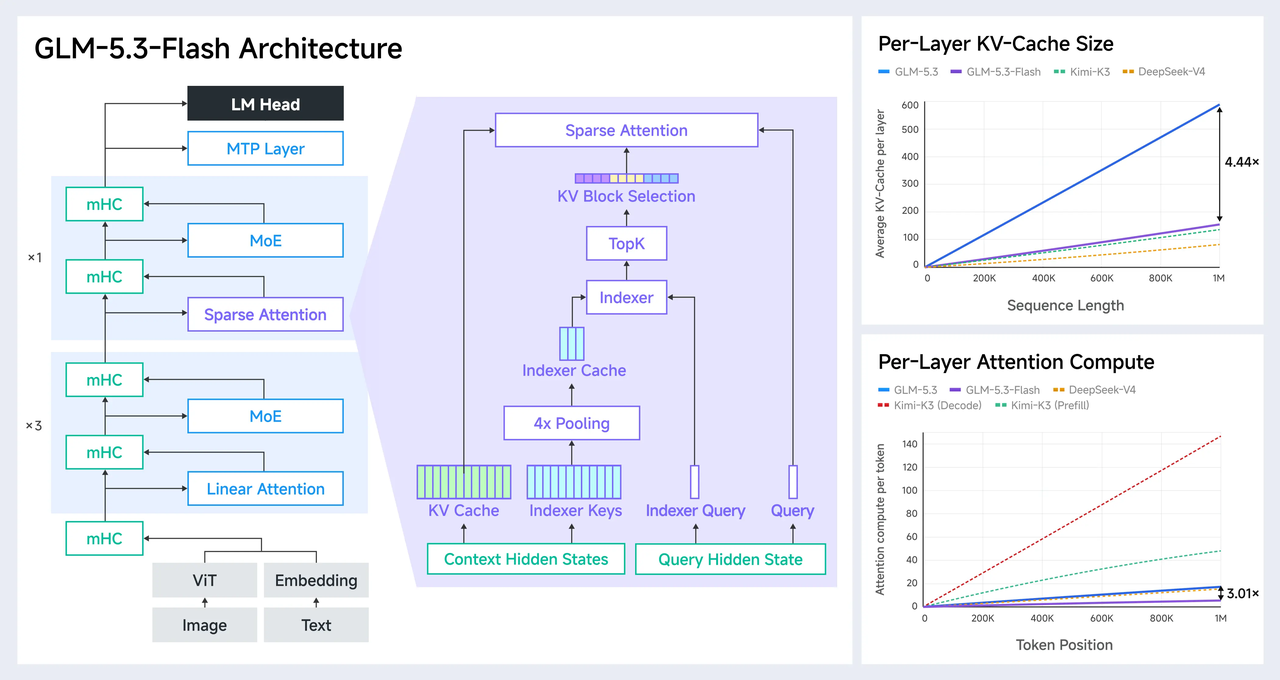
GLM-5.3-Flash: Architecture for Extreme Efficacy Sourcing: z.ai
GLM-5.3-Flash Specifications
| Property | GLM-5.3-Flash |
|---|---|
| Total / active parameters | 320B / 18B |
| Architecture | MoE with Hybrid Sparse & Linear Attention |
| Experts | 896 total; 16 activated per token |
| Context | 1,048,576 tokens (~1M) |
| Vision | Native Multimodal (Text, Image, Video, Doc File) |
| Reasoning | Supports Low, High, Max thinking modes |
| Tools | ToolCalls, constraints, dynamic tool loading |
| Open weights | Available on Hugging Face (MIT License) |
| Official Pricing (per MTok) | List: $0.15 Input / $0.03 Cached / $0.50 Output <br> Promo (ends Sept 9): $0.075 Input / $0.015 Cached / $0.25 Output |
DeepSeek-V4-Flash vs GLM-5.3-Flash: Feature Comparison
Architecture and Parameter Efficiency
DeepSeek-V4-Flash operates a 284B total parameter architecture (13B active) with a co-trained speculative drafting model (boosting local deployment sizes to 304B). GLM-5.3-Flash uses 320B total parameters (18B active) across a highly sparse 45-layer layout. Both models activate very few parameters per token, allowing them to perform at high speeds typical of much smaller models while retaining the rich knowledge representation of a massive model.
Attention Mechanism and Memory Optimization
DeepSeek-V4-Flash employs DeepSeek Sparse Attention (DSA) and Token-wise Compression. It dynamically analyzes sequence structures and compresses redundant tokens (e.g., boilerplate code structures or repetitive system headers) during long prompt processing.
GLM-5.3-Flash combines linear KDA with latent projection (NoPE Sparse MLA). This removes explicit positional encodings from the key/value compression block, reducing the memory footprint of the physical KV cache to just 22.5% of traditional layouts. This allows memory-constrained clusters to support significantly higher concurrency during long-context workloads.
Modality and Multimodal Depth
DeepSeek-V4-Flash-0731 is a text-only model. It excels at parsing technical files, JSON schemas, and structural markdown. For visual parsing tasks, developers must utilize a separate multimodal experimental model (deepseek-v4-flash-vision-exp).
GLM-5.3-Flash is natively multimodal. It accepts high-resolution images, videos, and complex office document files (PDFs, PPTXs, spreadsheets) directly. This native multi-modality supports "visual-in-the-loop" software development, where the model can inspect a rendered UI layout, spot alignment issues, and iteratively correct its own code without manual developer intervention.
Licensing and Openness
Both models are released under the highly permissive MIT License. This gives enterprise developers complete freedom to modify, distribute, sublicense, and commercially deploy the model weights locally, within a private VPC, or inside air-gapped on-premise cloud infrastructures.
DeepSeek-V4-Flash vs GLM-5.3-Flash: Benchmark Comparison
When evaluated on the same datasets under identical testing harnesses, both models perform competitively on software engineering and agent automation tasks.
Coding & Agentic Performance
| Benchmark | GLM-5.3-Flash (Z.ai) | DeepSeek-V4-Flash-0731 |
|---|---|---|
| Artificial Analysis Index v4.1.1 | 57 | 50 |
| Terminal Bench 2.1 (Acc) | 84.3 | 82.7 |
| DeepSWE v1.1 (GitHub Issues) | 63.4 | 54.4 |
| Toolathlon (Verified / Pass@1) | 78.4 | 70.3 |
| NL2Repo (Acc) | 56.3 | 54.2 |
| Automation Bench (Acc) | 48.8 | 25.1 |
| GDPval-AA v2 (Agent Elo) | 1773 | 1554 |
GLM-5.3-Flash maintains an edge across most agentic and software engineering benchmarks, scoring 63.4% on DeepSWE v1.1 and 84.3 on Terminal Bench 2.1. Its 18B active parameter pathway and multi-turn post-training alignment help it handle complex repository tracking and operating system interactions.
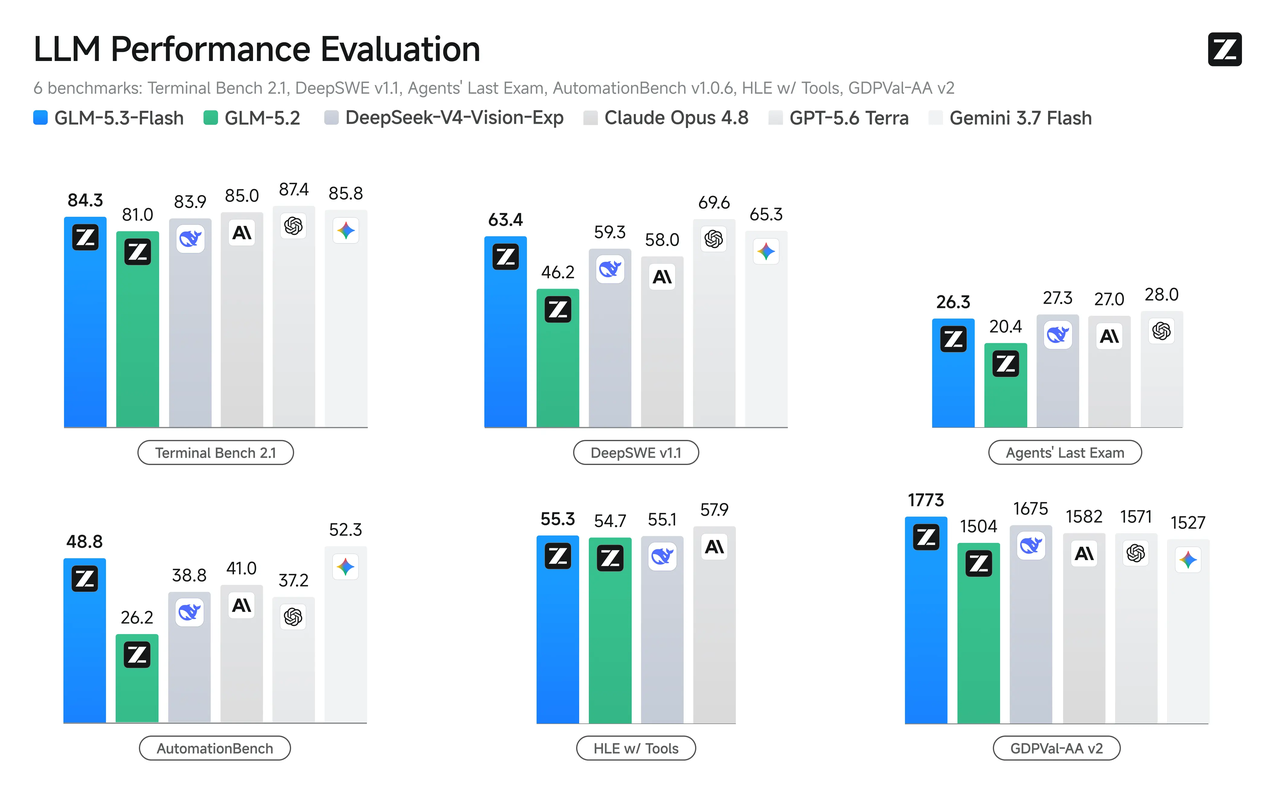
GLM-5.3-Flash Benchmark: scoring 84.3 on Terminal Bench 2.1 Sourcing: z.ai
DeepSeek-V4-Flash-0731 is also highly competent, scoring 82.7 on Terminal Bench 2.1 and 70.3 on Toolathlon. It delivers reliable performance on deterministic API structures and strict function calling.
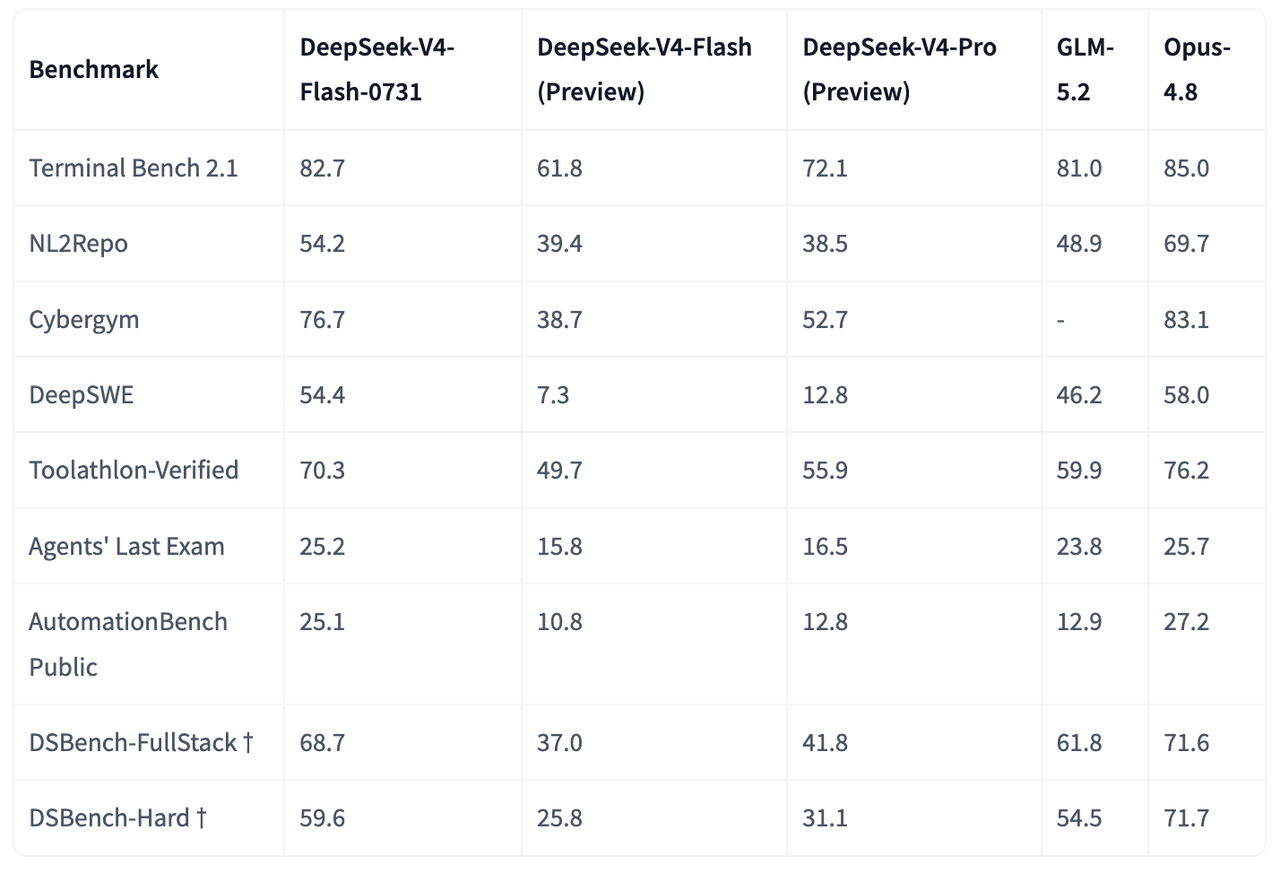
DeepSeek-V4-Flash Benchmark 0731: scoring 82.7 on Terminal Bench 2.1 Sourcing: Hugging Face
Multimodal and Visual Reasoning
GLM-5.3-Flash's native multimodal training gives it a distinct advantage on visual reasoning tasks:
- OfficeQA Pro: 62.4 (GLM-5.3-Flash) vs 57.9 (DeepSeek-V4-Vision experimental branch). GLM demonstrates superior native parsing of embedded images, structured PDF tables, and slide decks.
- Chartography with Tools: 78.0 (GLM-5.3-Flash). The model demonstrates an excellent ability to ingest system flowcharts, wireframe diagrams, and billing scans, translating them directly into executable system logic.
Speed and Latency
- Generation Speed: DeepSeek-V4-Flash-0731 is faster, achieving an average output speed of 122.7 tokens/sec on standard enterprise cloud endpoints, assisted by its speculative decoding framework.
- Time to First Token (TTFT): GLM-5.3-Flash features a lower TTFT of 1.21 seconds, compared to over 3.0 seconds for DeepSeek-V4-Flash, making it feel more responsive in real-time user-facing chat applications.
DeepSeek-V4-Flash vs GLM-5.3-Flash: API Pricing
Both models offer extremely cost-effective pricing models, making them highly competitive with traditional dense architectures.
Official API List Prices (per 1 Million Tokens)
| Price Layer | DeepSeek-V4-Flash-0731 (Peak) | DeepSeek-V4-Flash-0731 (Off-Peak) | GLM-5.3-Flash (Standard) | GLM-5.3-Flash (Promo - to Sep 9) |
|---|---|---|---|---|
| Input Price (Cache Miss) | $0.44 | $0.22 | $0.15 | $0.075 |
| Input Price (Cache Hit) | $0.014 | $0.007 | $0.03 | $0.015 |
| Output Price | $1.32 | $0.66 | $0.50 | $0.25 |
At off-peak hours, DeepSeek-V4-Flash-0731 is highly economical, dropping input costs to $0.22/MTok and output to $0.66/MTok, with a cached input cost of $0.007/MTok.
GLM-5.3-Flash provides competitive standard flat rates ($0.15 input / $0.50 output) with no peak-hour surcharges. Its promotional rate (available through September 9, 2026) drops input and output costs to $0.075 and $0.25 respectively, making it an excellent option for large-scale migrations and bulk processing.
Strengths and Weaknesses
DeepSeek-V4-Flash-0731
- Strengths:
- Exceptional Generation Speed: Generates up to 122.7 tokens per second using its co-trained speculative drafting model (DSpark).
- Off-Peak Economics: Offers an exceptionally cheap off-peak entry rate of $0.22 input and $0.66 output per million tokens.
- Strong CPU Quantization Support: Possesses a mature GGUF integration path, making it highly optimized for CPU-based local runtimes and personal system memory constraints.
- Trade-offs:
- Peak-Hour Rate Volatility: API prices double during peak hours (0.44/1.32 per MTok).
- Text-Only Core Weights: Standard weights do not natively support visual reasoning, images, or video.
- TTFT Overhead: Exhibits a longer measured Time to First Token (TTFT) compared to GLM.
GLM-5.3-Flash
- Strengths:
- Top-Tier Intelligence: Achieves a highly competitive 57 points on the Artificial Analysis Index.
- Native Vision-in-the-Loop: Integrates image and video handling directly into its post-training alignment, allowing visual evaluation of front-end web code.
- Exceptional Cache Reduction: Hybrid linear KDA and NoPE MLA layers cut memory usage by 4.44×, unlocking higher local concurrency.
- Flat Long-Context Rates: Standard pricing remains flat up to 1M tokens with an industry-low cache-hit rate ($0.03 standard, $0.015 promo).
- Trade-offs:
- Slower Token Output: Raw generation speeds are slower than DeepSeek’s dedicated speculative decoding engine.
- Hardware Requirements: Hosting the full 320B parameter MoE structure locally requires a multi-node GPU environment despite high sparsity.
| Model | Strengths | Trade-offs |
|---|---|---|
| DeepSeek-V4-Flash | Fast generation (122.7 tok/s in Artificial Analysis”); very cheap off-peak pricing; mature text quantization ecosystem; highly optimized for CPU-based local GGUF. | Peak hour rate variance; text-only base model (no native vision); slower TTFT. |
| GLM-5.3-Flash | 57 points on AA Intelligence; native multimodal parsing; 4.44× KV cache compression; flat pricing; fast TTFT (1.21s); MIT license. | Slightly slower raw token generation speed than DeepSeek; local multi-node deployments are hardware-intensive. |
DeepSeek-V4-Flash vs GLM-5.3-Flash: Which Should You Choose?
| Use case | Recommended | Why |
|---|---|---|
| Default frontier API | GLM-5.3-Flash | Scores higher on the intelligence index (57) and dominates multi-step agent benchmarks. |
| Long-running text agent | DeepSeek-V4-Flash | Blazing generation speed (122+ tok/s) makes it highly efficient for massive text/code generation. |
| Visual coding / UI workflows | GLM-5.3-Flash | Native multimodal design supports visual-in-the-loop debugging and UI rendering analysis. |
| Private/self-managed VPC | GLM-5.3-Flash | MIT licensed with KDA + NoPE MLA compression, which cuts hardware VRAM requirements by 4.44×. |
| Local CPU-only run | DeepSeek-V4-Flash | Stronger local GGUF quant support (92GB Unified Memory for extreme 1-bit or 3-bit runs). |
| Lower peak output cost | GLM-5.3-Flash | Standard output price of $0.50/MTok remains flat and is cheaper than DeepSeek's $1.32 peak output rate. |
| Heavy Prompt Caching | DeepSeek-V4-Flash | Off-peak cache hits cost an exceptionally low $0.007 per million tokens. |
Why Use Cometapi to Access DeepSeek-V4-Flash and GLM-5.3-Flash
Both models are fully integrated into CometAPI. Developers can accessDeepSeek-V4-Flash, and support for Chat Completions / Responses-style access and GLM-5.3-Flash model page exposes GLM-5.3-Flash through the unified CometAPI endpoint. That makes A/B testing easier because you can switch model IDs while keeping authentication and most application plumbing constant.
Conclusion
The introduction of DeepSeek-V4-Flash-0731 and GLM-5.3-Flash has transformed the economics of long-context, sparse MoE model deployment. Both architectures deliver high intelligence at extremely low price points.
DeepSeek-V4-Flash-0731 is a highly optimized text and code engine that excels at raw generation throughput, speculative decoding, and local CPU-based quantization. GLM-5.3-Flash represents a major step forward for multimodal and agent-based workflows, combining low-latency visual reasoning with a hybrid attention mechanism that makes on-premise hosting highly efficient.
FAQs
What was GLM-5.3-Flash's anonymous test name?
Before its official launch, GLM-5.3-Flash was tested anonymously on OpenRouter and OpenCode under the codename "Ox Alpha," where it quickly became a popular model for developers.
Can I run these models locally on a standard personal computer?
Yes, both models are open-weights and available on Hugging Face. However, due to their parameter sizes, local hosting requires significant unified memory:
- DeepSeek-V4-Flash-0731: Extreme 1-bit quantization requires ~92GB RAM; a 3-bit quantization run is highly recommended and requires between 110–135GB RAM.
- GLM-5.3-Flash: Extreme 1-bit quantization requires ~100GB RAM, while 3-bit runs perform best with 128GB–150GB of unified system memory.
Does DeepSeek-V4-Flash support visual or video processing?
No, the standard DeepSeek-V4-Flash-0731 is a text-only model. For visual tasks, you must use their separate multimodal experimental model (deepseek-v4-flash-vision-exp).
How does "visual-in-the-loop" programming work on GLM-5.3-Flash?
Because the model has native visual and image understanding, it can write frontend code, review the rendered visual output, spot layout or styling errors, and rewrite the code to fix those bugs without needing a human to describe the layout issues in text.
How does Prompt Caching save money with these models?
If you are sending the same large context (like a codebase or document collection) in multiple API calls, both models can cache this prompt. On subsequent calls, they only bill for the "cache-hit" rate, which drops to $0.007/MTok for DeepSeek-V4-Flash (off-peak) and $0.015/MTok for GLM-5.3-Flash (promo), reducing API costs significantly.