
TL;DR
Gemini 4 Argon is not included in the Gemini API Free tier, and a Google AI Pro subscription alone does not provide Argon API access. Google AI Ultra may provide access through selected Gemini products, while paid API usage remains separately billed. CometAPI offers an independent API route without requiring each end user to hold a Google AI Pro or Ultra subscription. Its published uncached input and output rates are $1.60 and $8 per million tokens, compared with Google’s introductory Standard rates of $2 and $10.
Access and headline provider rates checked on October 16, 2026.
Key Takeaways
- Introductory price: $2 / 1M input tokens and $10 / 1M output tokens; from December 1, rates double.
- Cached input: 95% implicit-cache discount on eligible hits; cache minimum is 4,096 prompt tokens.
- Output billing includes thinking tokens; input, thinking, and visible output share a 1,048,576-token budget.
- Separate Gemini app subscriptions from Antigravity entitlements and paid API access. A missing model in one product does not establish that every access route is unavailable.
- CometAPI provides an independent API route with lower published uncached input and output rates. Applications can serve multiple end users through one CometAPI account without requiring each user to maintain a Google AI Pro or Ultra subscription; account-level quota, balance, rate, and concurrency limits still apply.
What Are Google’s Current Gemini 4 Argon Access Limits?
The first decision is where you need Argon: an interactive app, a local coding environment, or an API integration. Google’s developer-access announcement distinguishes paid Gemini API access from Ultra subscriber access in AI Studio and Antigravity. Do not interpret an Antigravity subscription restriction as a requirement to buy Ultra for every paid API workflow.
For an API application, CometAPI provides an alternative account and billing route. This can be useful when you want to evaluate Argon alongside other models without buying a Google consumer subscription for that purpose. It does not change access rights inside Google’s own apps, and it should not be described as unlimited usage.
How Much Does Gemini 4 Argon API Cost?
Google’s Standard Gemini 4 Argon rates apply through November 30, 2026, with higher rates starting December 1. All amounts below are USD per million tokens unless otherwise stated. Batch, Flex, and Priority have separate rates.
| Billing category (USD / 1M tokens) | Google Standard: through Nov 30, 2026 | Google Standard: from Dec 1, 2026 | Gemini 4 Argon API in CometAPI |
|---|---|---|---|
| Input | $2.00 | $4.00 | $1.60 |
| Cached input | $0.10 | $0.20 | $0.16 |
| Output, including thinking | $10.00 | $20.00 | $8.00 |
CometAPI rates were checked on October 14, 2026. Its published input and output prices are 20% below Google's introductory Standard rates. The cached-input figure comes from CometAPI's cost calculator; confirm the active account rate and cache eligibility before relying on it. Google’s December price change does not determine CometAPI’s future rates; check the rates shown in your CometAPI account when budgeting.
At these rates, 200,000 uncached input tokens plus 60,000 billable output tokens cost $0.80 through CometAPI, compared with $1.00 through Google during the introductory period. This calculated example excludes tools and retries.
What Does Gemini 4 Argon Cost Across Realistic Workloads?
The following scenarios are calculated examples, not measured model usage. Input is uncached; output includes both thinking and visible text. A coding-agent request with 200,000 input tokens and 60,000 billable output tokens costs $1.00 during the introductory period and $2.00 afterward. The same workload repeated 1,000 times costs $1,000 or $2,000 before retries, tools, and taxes.
| Example request | Uncached input tokens | Billable output tokens | Intro price | Standard price |
|---|---|---|---|---|
| Short assistant answer | 5K | 1K | $0.02 | $0.04 |
| Document analysis | 100K | 10K | $0.30 | $0.60 |
| Complex coding agent | 200K | 60K | $1.00 | $2.00 |
| Research workflow | 500K | 100K | $2.00 | $4.00 |
| Long-decode request | 100K | 500K | $5.20 | $10.40 |
Formula: Cost = (uncached input tokens × input rate + cached input tokens × cached rate + billable output tokens × output rate) / 1,000,000. The examples above are illustrative and assume no caching.
How Can You Reduce Gemini 4 Argon API Costs?
Implicit Caching and Reused Prompt Prefixes
Caching reduces reused-input spending, not the entire request price. For the 200K-input / 60K-output example, a complete eligible input-cache hit reduces introductory input cost from $0.40 to $0.02. Total token cost becomes $0.62 rather than $1.00: a 38% reduction, even though the input discount is 95%. If 50% of the input tokens are served from cache, the same request costs $0.81: 100,000 cached input tokens × $0.10 / 1M + 100,000 uncached input tokens × $2 / 1M + 60,000 billable output tokens × $10 / 1M = $0.01 + $0.20 + $0.60. Here, 50% refers specifically to input-token volume. Treat these as scenarios and use observed cached-token usage for forecasting.
Google enables implicit caching for prompts of at least 4,096 tokens and does not support explicit cache creation for Argon. Preserve reusable prompt prefixes, but budget for uncached input until observed cache hits justify a lower estimate.
Thinking Levels and Output Spending
A short visible answer can still carry substantial output cost because thinking is billable. Start with medium thinking, then test lower and higher levels on representative tasks. Track both quality and total output usage; choose the lowest reasoning level that meets your acceptance criteria.
Because thinking and visible output share the response limit, a low max_output_tokens value can leave insufficient room for the final answer. Compare successful task completion at each thinking level before reducing the output cap.
Operational Controls for Gemini 4 Argon Costs
- Use realistic output limits and avoid unnecessary long generations.
- Reuse shared prompt prefixes when eligible for implicit caching.
- Route straightforward tasks to less expensive models, preserving Argon for hard cases.
- Log total billable tokens, failures, retries, and cost per successful task.
- Evaluate economics at post-promotional rates before committing to a large deployment.
How Can You Access Gemini 4 Argon?
Choose Gemini app access for personal interactive work and a paid API route for applications and automated agents. Argon is excluded from the Gemini API Free tier; a Google AI Pro subscription alone does not grant Argon API access. Pro and Ultra app entitlements are separate from API token billing, and Ultra is not required for the paid Gemini API.
| Access route | Argon access | Billing / entitlement |
|---|---|---|
| Gemini app | Eligible Pro and Ultra subscribers | Subscription and app limits |
| Google AI Studio | Eligible Ultra subscribers or paid API users | Depends on access route |
| Gemini API | Eligible paid projects | Usage-based API billing |
| Google Antigravity | Eligible Ultra subscribers | Product-specific entitlement |
| CometAPI | Supported CometAPI accounts | CometAPI rates and conditions |
Direct Gemini 4 Argon API Integration
Developers can integrate Gemini 4 Argon directly through an eligible paid Gemini API project. The model ID is gemini-4-argon. This route is intended for applications, automated agents, and production workflows that require direct access to Google’s API, usage-based billing, and official API features.
The Gemini API Free tier does not include Argon. Google AI Pro app access also does not automatically provide API access or API credits. Developers should configure billing and eligibility for the project associated with their API credentials.
Authentication, billing, or eligibility errors must be resolved for the project that owns the key before retrying; changing a consumer subscription alone does not configure API billing.
CometAPI Access for Gemini 4 Argon
Developers can access Gemini 4 Argon API in CometAPI through a separate account and API key. The practical advantages are independent API billing, access to multiple models through one provider, and the published input/output rates compared above. This route does not require purchasing Google AI Pro or Ultra as a consumer subscription.
Account-based access is not a promise of unrestricted capacity. Confirm model availability, balance, rate and concurrency limits, supported regions, caching, thinking controls, and usage reporting for your CometAPI account. API access also does not unlock Argon inside the Gemini app or Antigravity.
Start with a small request through the chosen provider, verify the returned model and usage fields, then set a spending limit before increasing traffic.
Is Gemini 4 Argon Worth the Cost?
Gemini 4 Argon is a candidate for demanding reasoning, coding, research, and long-context work. Its value depends on whether it improves successful task completion or reduces retries enough to justify the token spending. Use the specifications and published benchmarks below to identify workloads to test, then evaluate quality and cost with your own prompts, tools, and access route.
Gemini 4 Argon Specifications
| Specification | Gemini 4 Argon |
|---|---|
| Model ID | gemini-4-argon |
| Developer | Google DeepMind |
| Model type | Reasoning-oriented multimodal model |
| Unified input + thinking + output window | Up to 1,048,576 tokens combined |
| Thinking levels | Low / medium / high |
| Default thinking level | Medium |
| Long-output support | Background execution; maximum subject to shared budget |
| Context cache | Implicit; eligible prompts ≥ 4,096 tokens |
| Explicit cache | Not supported |
The million-token limit is shared across input, thinking, and generated output. On the Interactions API, generating more than 65,536 tokens requires both background=True and generation_config.max_output_tokens above 65,536. Setting background=True alone does not raise the default output limit. The GenerateContent API also supports client-side continuation for long decode
Gemini 4 Argon vs GPT-6 Astra vs Claude Opus 5.5: Published Benchmarks
The following values match Google’s published evaluation results. They are vendor-published results compiled from multiple evaluation sources, rather than a new controlled comparison run for this article.
| Published benchmark | Gemini 4 Argon | GPT-6 Astra | Claude Opus 5.5 |
|---|---|---|---|
| Vals Index | 68.9% | 63.1% | 67.0% |
| AutomationBench | 51.3% | 41.4% | 42.5% |
| Vals Finance Agent v2 | 65.4% | 53.5% | 58.6% |
| DeepSWE v1.1 | 77.9% | 74.1% | 74.2% |
| FrontierSWE v2 | 55.0% | 65.5% | 62.3% |
| Terminal-bench 4.0 | 57.4% | 58.2% | 66.4% |
| GraphWalks 256K–1M, BFS F1 | 84.2% | 71.8% | 66.8% |
| LVBench | 91.7% | 87.5% | 83.7% |
Evaluation Conditions and Comparability
Google’s evaluation methodology uses the Gemini API at the highest thinking setting unless specified otherwise, generally with pass@1. DeepSWE uses mini-swe for Argon; competitor figures come from leaderboards or system cards. GraphWalks 256K–1M uses 200 problems. LVBench runs without tools, with 1 FPS for Gemini, 800 frames for GPT-6 Astra, and 600 for Opus 5.5. Vals results come from Vals AI; AutomationBench uses Zapier’s private-set leaderboard. These differences limit direct comparability.
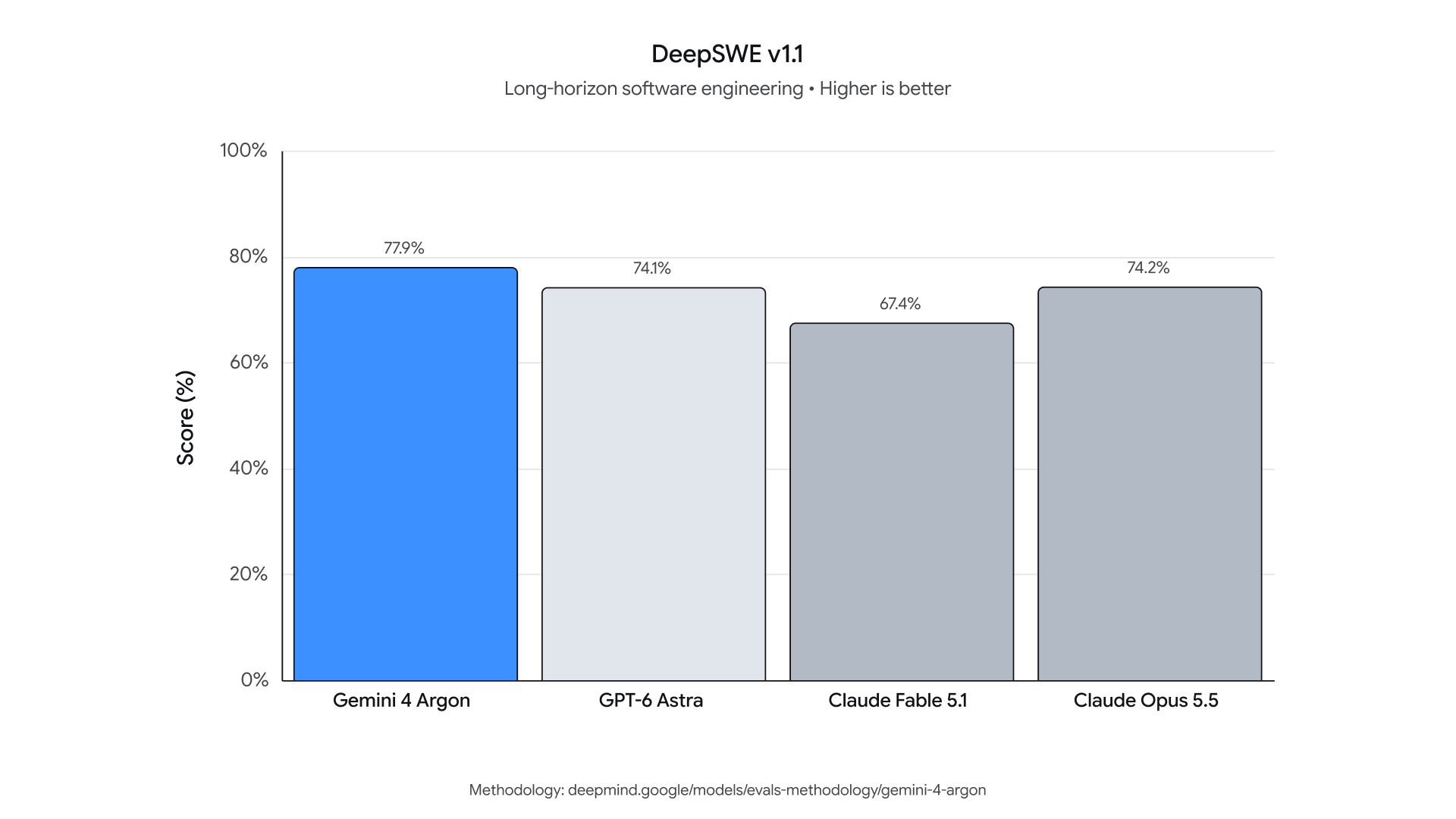
Google’s original DeepSWE v1.1 chart shows Gemini 4 Argon (77.9%), GPT-6 Astra (74.1%), Claude Fable 5.1 (67.4%), and Claude Opus 5.5 (74.2%), from left to right. The table above selects three of these models; the official image includes all four.
Performance Implications for Gemini 4 Argon Users
Interpretation: Argon leads in the selected Vals Index, AutomationBench, financial-agent, and long-context rows; it does not lead in FrontierSWE or Terminal-bench. Because evaluation harnesses and prompts may vary, use these results as directional evidence and run workload-specific tests.
For procurement, measure the cost of a successful task alongside accuracy, latency, retries, and token use. A higher published score does not establish lower production cost under your prompts, tools, or access route.
Choose Gemini 4 Argon or Cheaper Model
Test Argon on difficult reasoning, coding, and long-context tasks where fewer retries or a higher completion rate could justify greater token spending. For routine classification, extraction, and high-volume summarization, test lower-cost models first.
Compare total cost per successful task, including thinking tokens, cache use, tool calls, and retries. Choose the model and access route that meet your quality requirements at an acceptable cost.
FAQ
Are Gemini 4 Argon Batch and Flex cheaper than Standard?
Google’s Argon Batch and Flex token rates are $1 input and $5 output per million tokens through November 30, 2026, rising to $2 and $10 afterward. Cached input is $0.05, rising to $0.10. These are separate processing options, so validate their operational constraints against your workload before replacing a Standard integration.
Estimate Standard, Batch, and Flex usage separately using each option’s applicable rates, then add the subtotals for a mixed-workload budget.
Do Gemini 4 Argon token estimates include search charges?
No. Token arithmetic alone excludes separately billed services. Google’s Search grounding charge is $14 per 1,000 queries after the shared 5,000-request monthly allowance for Gemini 3 and newer models. A submitted request may issue more than one search query, so track actual grounding usage separately rather than assuming one user prompt equals one billable query.
How should I budget Gemini 4 Argon across the price change?
Split forecast token usage into the introductory and standard periods, then apply each period’s rates. For example, 10 million uncached input tokens plus 1 million output tokens cost $30 at introductory Standard rates or $60 afterward. If half of that volume falls in each period, the token estimate is $45. Add tools and retry costs separately, and use post-promotion rates for a steady-state budget.
Why can a Gemini 4 Argon answer stop before it is complete?
The output cap includes thinking as well as visible text. A demanding prompt can exhaust that allowance before the final answer is complete. For long responses, background execution continues generation in hops until completion or the configured limit; it still needs an adequate max_output_tokens value. Check completion status and usage, then adjust reasoning depth or the cap instead of repeatedly sending the same under-budgeted request.
Conclusion
Choose Gemini 4 Argon access by workflow, then compare the cost of completing a useful task. Google’s app and Antigravity entitlements differ from paid API access. CometAPI offers a separate API route with published input/output prices 20% below Google’s introductory Standard rates, making it a practical option for a small, budgeted evaluation. Validate account limits and required features, track thinking tokens and retries, and scale only when the quality and total cost meet your needs.