Google announced Gemini 4 Carbon on October 28, 2026, with stronger published results than Gemini 4 Argon across coding, long-context reasoning, and cybersecurity. For developers, the immediate choice depends on access: Argon is available through the paid Gemini API, while Carbon remains in a restricted rollout. This comparison reviews their benchmarks, API specifications, speed, and pricing to help you decide what to deploy now and when to evaluate Carbon.
Key Takeaways
Performance: Carbon scores 59 versus Argon’s 50 on Artificial Analysis Intelligence Index v5.0. Gains vary by benchmark: SWE-sweep improves by 5.3 percentage points, while GraphWalks BFS F1 improves by 12.0 points.
Argon documents a unified 1,048,576-token window shared by input, thinking, and output. Carbon’s public API limits and tool support have not been announced.
Reviewed for clarity, source attribution and current API terminology.
API specifications:
Pricing: Both models have announced introductory rates of $2 per million input tokens and $10 per million output tokens. Argon’s offer runs through November 30, 2026; Carbon’s introductory end date has not been announced.
Upgrade decision: Compare task acceptance rate, end-to-end latency, and cost per accepted result when evaluating Carbon. Higher benchmark scores alone do not show whether switching will improve your application.
Gemini 4 Carbon vs Gemini 4 Argon: Overview and Specifications
Start with the deployment decision: Argon has a documented API you can use now, while Carbon offers stronger published results with restricted initial access.
Gemini 4 Carbon focuses on demanding engineering and defensive cybersecurity workflows, with initial access limited to selected partners. Gemini 4 Argon is available through the paid Gemini API for reasoning, coding, scientific problem-solving, and agent workflows. The table below compares their API specifications and announced capabilities.
Context, Reasoning, and API Specifications
Argon has a published developer specification. Carbon has published evaluation results, but those results do not establish the exact limits or tool support of a future public API. Neither shared family branding nor higher scores establish that the models use an identical architecture.
1M tokens reported by Artificial Analysis; official API limit not documented
1,048,576 tokens shared by input, thinking, and output
Maximum output
Not officially documented
65,536 default synchronous limit; long decode up to the remaining unified window
Input modalities
Multimodal capability demonstrated; complete API specification pending
Text, image, audio, video, PDF
Output modalities
Public API specification pending
Text
Reasoning levels
Not officially documented
Low, medium, high
Function calling and code execution
Public API support not confirmed
Supported
Computer use
Public API support not confirmed
Preview
Context caching
Announced pricing discount; implementation details pending
Implicit caching
Public developer access
Not yet broadly available
Available
Argon’s 1,048,576-token window is shared by input, thinking, and generated output, so a larger input leaves less room for generation. Its default generation budget is 65,536 tokens, including thinking and output. Longer generations use long decode, which reprocesses prior context across continuation steps and adds input-token charges; repeated context may qualify for implicit caching discounts.
With the Interactions API, longer generations require background mode and a higher max_output_tokens setting. With GenerateContent, the client must manage continuation requests.
Gemini 4 Carbon vs Gemini 4 Argon: Performance
Carbon leads Argon across the reported comparison, but the size and meaning of the gains differ by task.
Official Benchmark Results and Test Conditions
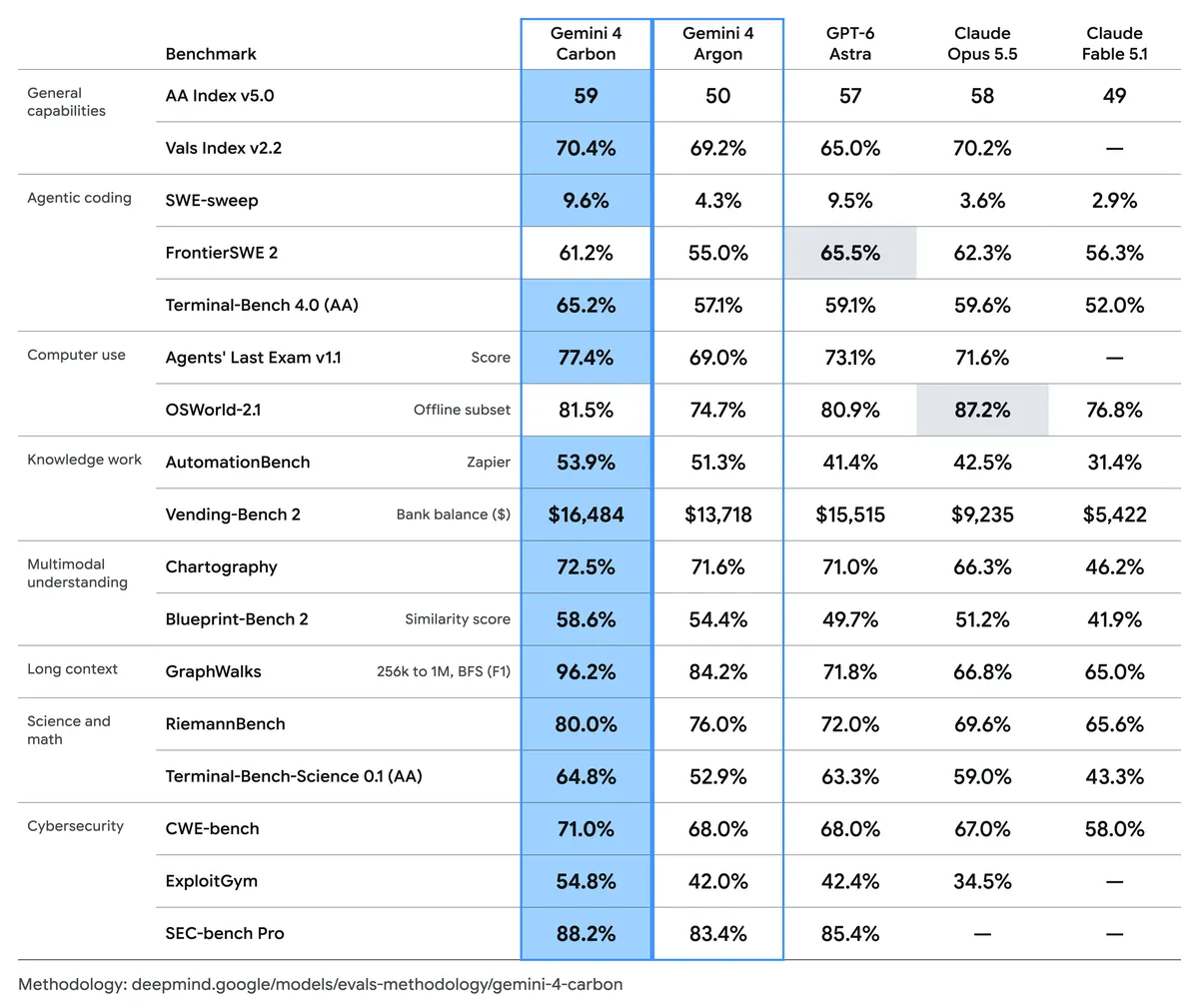
Google's published comparison shows Carbon ahead in all 17 rows below. It combines Google-run evaluations with scores from external evaluators and benchmark leaderboards; it is not a claim that Google independently ran every test.
The evaluation methodology generally uses the highest thinking setting and pass@1 unless a benchmark specifies otherwise. Agent scaffolding, task subsets, and score definitions vary, so percentages across different benchmarks are not interchangeable.
Benchmark and metric
Gemini 4 Carbon
Gemini 4 Argon
Carbon advantage
Artificial Analysis Intelligence Index v5.0
59
50
+9 points
Vals Index v2.2
70.4%
69.2%
+1.2 pp
SWE-sweep
9.6%
4.3%
+5.3 pp
FrontierSWE 2
61.2%
55.0%
+6.2 pp
Terminal-Bench 4.0 (AA)
65.2%
57.1%
+8.1 pp
Agents' Last Exam v1.1
77.4%
69.0%
+8.4 pp
OSWorld-2.1 (offline subset)
81.5%
74.7%
+6.8 pp
AutomationBench (Zapier)
53.9%
51.3%
+2.6 pp
Vending-Bench 2 (bank balance)
$16,484
$13,718
+$2,766
Chartography
72.5%
71.6%
+0.9 pp
Blueprint-Bench 2
58.6%
54.4%
pp = percentage points. Vending-Bench 2 reports a simulated bank balance rather than accuracy.
GraphWalks: The 256K–1M subset contains 200 problems and reports BFS F1, rather than a generic accuracy rate.
Agents' Last Exam: Google uses a 122-task v1.1 set, the ALE-Claw harness, a five-hour window, and enabled safety filters.
OSWorld: The reported figure uses the 82-task offline subset, 1080p screenshots, a 500-step limit, and the maximum over three single-attempt runs. It does not represent the full online benchmark.
Coding Performance and Repository Work
On Terminal-Bench 4.0, Carbon scores 65.2%, compared with 57.1% for Argon, a lead of 8.1 percentage points. The benchmark tests command-line work and multi-step technical problem-solving.
On SWE-sweep, Carbon scores 9.6% versus 4.3% for Argon, a lead of 5.3 percentage points and more than twice the score.
That relative improvement is striking, but the absolute result remains below 10%. Carbon is stronger, not universally reliable on every difficult software engineering task.
The practical candidates for evaluation are repository-wide debugging, code migrations, and tasks involving repeated tool use and verification. For a production codebase, passing your own tests remains more useful than extrapolating a success rate from a different benchmark.
Multimodal and Long-Context Performance
On the GraphWalks 256K-1M BFS F1 evaluation, Carbon scores 96.2% versus 84.2% for Argon, a 12-percentage-point lead. This makes long-document synthesis and repository analysis useful candidates for evaluation. Retrieval quality, document structure, and each endpoint’s actual limits still affect the result.
On Chartography, Carbon scores 72.5% versus 71.6% for Argon, a 0.9-percentage-point lead. On Blueprint-Bench 2, Carbon scores 58.6% versus 54.4% for Argon, a 4.2-percentage-point lead. These visual-understanding results support testing document and chart workflows, while the supported input formats of Carbon’s future public API still require confirmation.
Cybersecurity and Agent Reliability
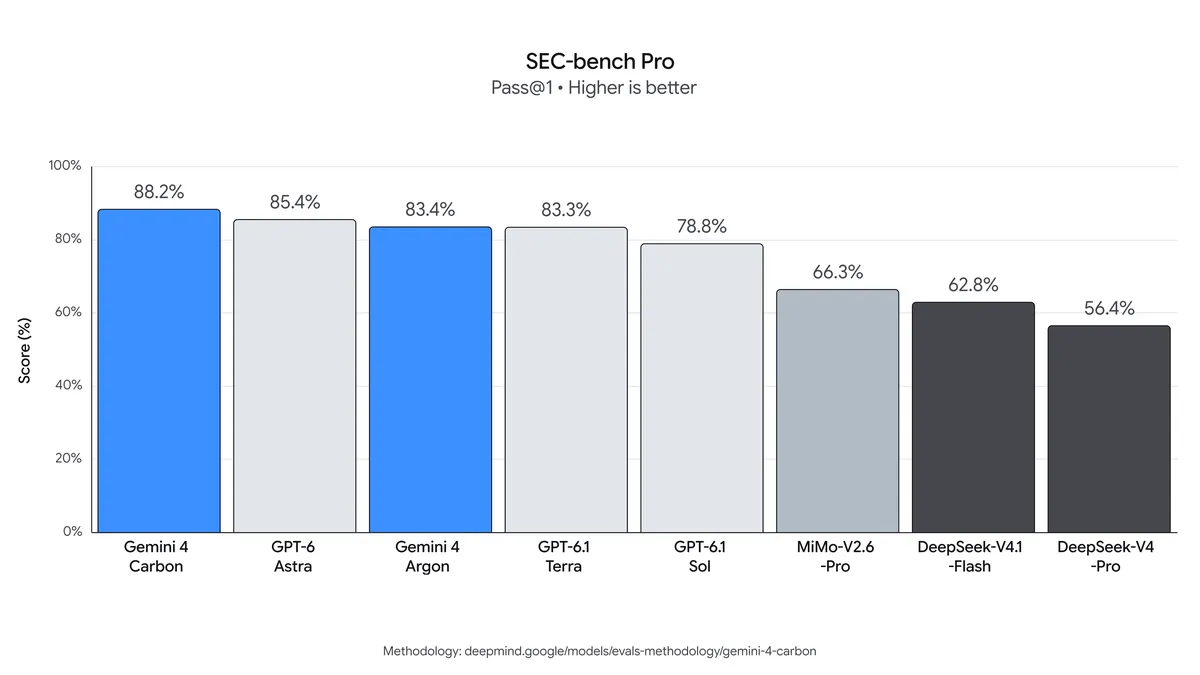
The security results cover discovery, exploit validation, and remediation: Carbon scores 88.2% on SEC-bench Pro, 54.8% on ExploitGym, and 71.0% on CWE-bench. Its largest advantage over Argon is on ExploitGym, at 12.8 percentage points.
The security evaluation conditions matter: SEC-bench Pro uses the 183-task May 2026 JavaScript-engine split, while ExploitGym uses an offline, single-attempt agent setup with mitigations off. Google reports the external security evaluations without deployment guardrails; these scores do not establish unrestricted API behavior.
For long-running agents, a useful model must also report failures honestly and stay within the authorized task. Google reports a 0.0% observed successful-cheating rate on Terminal-Bench 4.0, while cheating attempts remained at 0.4%. Its internal evaluations also found fewer unsupported claims and lower rates of overreach and under-service than Argon. These are evaluation-specific observations, rather than guarantees for every application.
In practice, retain permission checks, isolated execution, patch review, and independent validation when evaluating either model on defensive security work.
Speed and Latency
Performance metric
Gemini 4 Carbon
Gemini 4 Argon
Output throughput
Approximately 102 tokens/s
Approximately 82 tokens/s
Time to first token
Approximately 100 s
Approximately 47 s
Output tokens per evaluated task
Approximately 123K
Approximately 116K
Reasoning tokens per evaluated task
Approximately 72K
Approximately 68K
These third-party measurements describe the evaluator’s test configuration and are not a latency or throughput guarantee for your API deployment. The comparison may change as the evaluator updates its results and Google expands Carbon access.
Carbon's higher token-generation rate and longer first-token delay describe different parts of a request. For a chat interface, the wait before output begins can dominate the experience; for an autonomous job, evaluate end-to-end completion time together with success rate. Throughput alone does not determine which model finishes a useful task sooner.
Gemini 4 Carbon vs Gemini 4 Argon: Cost
Compare official token rates and provider billing separately, then calculate the cost of an accepted result. Identical published token prices can still produce different bills when reasoning, failed attempts, and tool use vary.
API Pricing by Provider
Both models have the same announced Google introductory token rates. CometAPI lists separate Argon rates; it has no confirmed Carbon price in this comparison. All provider prices below reflect the article’s October 29, 2026 snapshot.
Provider
Pricing category
Gemini 4 Carbon
Gemini 4 Argon
Google
Introductory input / 1M tokens
$2.00
$2.00
Google
Introductory output, including thinking / 1M tokens
$10.00
$10.00
Google
Introductory cached input / 1M tokens
$0.10
$0.10
Google
Subsequent input / 1M tokens
$4.00
$4.00
Google
Subsequent output, including thinking / 1M tokens
$20.00
$20.00
Google
Subsequent cached input / 1M tokens
$0.20
$0.20
Google
Introductory period
End date not announced
Through November 30, 2026
Google
Public production access
Restricted rollout
Available
CometAPI
Ordinary input / 1M tokens
Not confirmed
$1.60
CometAPI
Ordinary output / 1M tokens
Not confirmed
$8.00
Argon’s Google introductory period ends on November 30, 2026, with subsequent rates starting December 1. Carbon has no announced introductory end date. Its cached-input figures are calculated from the announced 95% discount; implementation and eligibility details remain pending.
Before estimating a bill, confirm the rates, caching rules, long-context charges, and tool support for your chosen provider and account. Google’s announced Carbon rates do not establish a CometAPI Carbon price.
Cost Example: 1,000 Requests
For a request with 100,000 input tokens and 25,000 total billable output tokens, including thinking tokens, introductory standard pricing gives:
Input: 100,000 × $2 / 1,000,000 = $0.20.
Output, including thinking: 25,000 × $10 / 1,000,000 = $0.25.
Total: $0.45 per request, or $450 for 1,000 identical requests.
At the subsequent rates, the same task costs $0.90. If 25,000 describes only the final visible answer, add any separately counted thinking tokens before estimating the bill. The example excludes grounding, external tools, and other service charges.
At the displayed CometAPI Argon rates, the same 100,000-input and 25,000-billable-output request costs $0.16 + $0.20 = $0.36, or $360 for 1,000 identical requests. This estimate excludes cache effects, retries, and separate service charges; it does not estimate a Carbon deployment through CometAPI.
Cost per accepted task = total model and tool spending ÷ accepted task completions. Define acceptance criteria before testing, include failed attempts and retries in spending, and record human review time separately.
Where Can You Access Gemini 4 Carbon and Gemini 4 Argon?
Official Provider Access
As of October 29, 2026, Argon is available through the Gemini API and Google AI Studio. Carbon is initially limited to selected cybersecurity defenders and trusted partners; a generally available developer endpoint and broader release date have not been confirmed. Start with the route enabled for your account and check its model identifier and supported features.
CometAPI Access
Gemini 4 Argon API in CometAPI provides an additional integration route for developers using a compatible chat interface.
To get started, create a CometAPI API key, select the gemini-4-argon model, and configure your application to use the provider’s documented chat endpoint. Begin with a representative text request, review the response, and check usage and charges before expanding the workload.
CometAPI applies its own billing rates. Confirm support for tools, reasoning controls, and long responses on the route you plan to use. A compatible chat interface does not establish support for every native Gemini feature.
Carbon’s CometAPI availability and production model identifier are not confirmed as of October 29, 2026. Keep Argon operational and switch only after the provider documents Carbon access and your integration passes the relevant checks.
Should You Choose Gemini 4 Carbon or Argon?
Workload
Practical starting point
What to validate
An application shipping now
Argon
Task acceptance rate, endpoint behavior, and operating cost
Complex debugging or code migrations
Evaluate Carbon when access is available
Repository tests, review quality, and retries
Authorized vulnerability research
Evaluate Carbon within the permitted access program
Security controls, finding validity, and patch correctness
Large-document or codebase analysis
Argon baseline; Carbon candidate
Evidence accuracy and omissions across identical source inputs
An interactive user interface
Benchmark the available Argon endpoint first
First-token delay and total time under real traffic
Choosing a Starting Point and an Upgrade Candidate
Choose Argon when you need to deploy now. Its accessible API and documented context, modalities, and tools let you test the complete application, including latency and cost.
Evaluate Carbon when access is available and the work justifies it. Prioritize difficult repository changes, long-context synthesis, or authorized defensive security tasks. Upgrade when it delivers more accepted patches or findings, fewer retries, or less review effort within your latency and budget limits.
An Argon Baseline and Carbon Upgrade Path
Keep the Argon workflow operational while building a fixed set of representative tasks. When Carbon becomes accessible through a supported route, run the same tasks with comparable tool permissions and acceptance criteria. Do not build automatic failover to a restricted or undocumented endpoint; make routing decisions only after compatibility and workload results are established.
Production Evaluation
Keep the evaluation set fixed when comparing models. Record the model version, reasoning setting, prompt, tool permissions, token use, first-token delay, total duration, and whether the result passed review. A higher benchmark score is useful evidence for choosing what to test; the release decision should follow the results on your workload.
Include routine requests and difficult cases where failure would be expensive.
Repeat tasks and alternate model order to reduce the influence of one-off results.
Measure median and tail latency, token use, retries, and accepted outcomes across the full workflow.
Set retry limits and escalation conditions based on observable validation results.
Conclusion
The useful upgrade is the one that improves your completed work. Pick a small set of representative tasks, define what counts as an acceptable result, and measure the model and review cost together. When Carbon becomes available to your account, those same tasks will show whether its benchmark gains translate into enough value to justify a switch.
FAQ
Can an Argon prompt be reused unchanged with Carbon?
It can be a starting point for evaluation, but it is not evidence of compatible API behavior. Keep the task and acceptance criteria consistent, then verify Carbon's documented model identifier, request schema, tool format, and limits when access is available. Prompt reuse and integration compatibility are separate questions.
Should reasoning settings be matched when comparing the models?
Match them where the endpoints expose comparable controls, and record any differences. Google's highest-thinking benchmark results describe a particular evaluation setup; they do not predict the quality or latency of an Argon deployment running at its default medium setting. The Argon thinking controls provide low, medium, and high levels, so compare the lowest setting that meets your application's acceptance threshold as well as a maximum-quality configuration.
Can a benchmark lead establish a production service guarantee?
No. Benchmark performance does not establish an endpoint's uptime commitment, regional availability, data-handling terms, or support arrangements. Review those conditions with your chosen provider separately, and test expected request sizes and traffic patterns before relying on either model for a critical workflow.