
ANSWER FIRST Gemini 4 has not been officially announced, and Google has not published a model card, API identifier, pricing table, or benchmark report for it. Google's current model catalog remains centered on Gemini 3.x. The most defensible outlook is therefore not a list of invented specifications, but an evidence-based view of what Google's next generation would need to improve: reliable long-horizon agents, adaptive reasoning, stronger computer use, more unified multimodality, and better effective use of very large contexts.
What Is Gemini 4?
Gemini 4 is the working name used in this article for a possible next major generation of Google's Gemini models. Google has not announced it, so the term does not yet refer to a verified model, model family, API identifier, or release plan. Here, Gemini 4 is an evidence-based forecast built from the official Gemini model catalog and the capabilities of Gemini 3.7 Flash.
Gemini 4 is structured as a three-tier family, balancing capability, speed, and cost:
- Gemini 4 Pro — Flagship model. Highest scores across almost every benchmark, especially long-horizon agentic tasks. Best choice when maximum reliability and complex multi-step performance are required.
- Gemini 4 Flash — High-performance mid-tier. Closely follows Pro on shorter or moderately agentic tasks while offering substantially lower latency and cost. Suitable for most production workloads that do not demand peak long-horizon capability.
- Gemini 4 Flash-Lite — Efficiency-focused tier. Noticeable drop in long-horizon and hard reasoning scores, but still competitive on many shorter tasks. Designed for high-volume, cost-sensitive applications.
The hierarchy mirrors Google’s previous Gemini strategy: Pro for frontier capability, Flash for the best balance, and Lite for maximum throughput at minimal cost.
Has Google Officially Announced Gemini 4?
No official Gemini 4 announcement can be found in Google's developer model directory or Google DeepMind's current Gemini lineup. The official Gemini API catalog lists stable and preview Gemini 3 models, while Google DeepMind still identifies Gemini 3.5 Pro as coming soon. That makes it unsafe to describe Gemini 4 as a confirmed near-term launch.
There is also no public Gemini 4 model card, API model ID, context limit, pricing schedule, safety report, or benchmark table. Gemini 4 should be treated as a working name for a possible next generation until Google publishes primary documentation. The final name and the sequence of intervening Gemini 3.x releases may still change.
An In-Depth Analysis of Gemini 4 Pro Performance Benchmarks
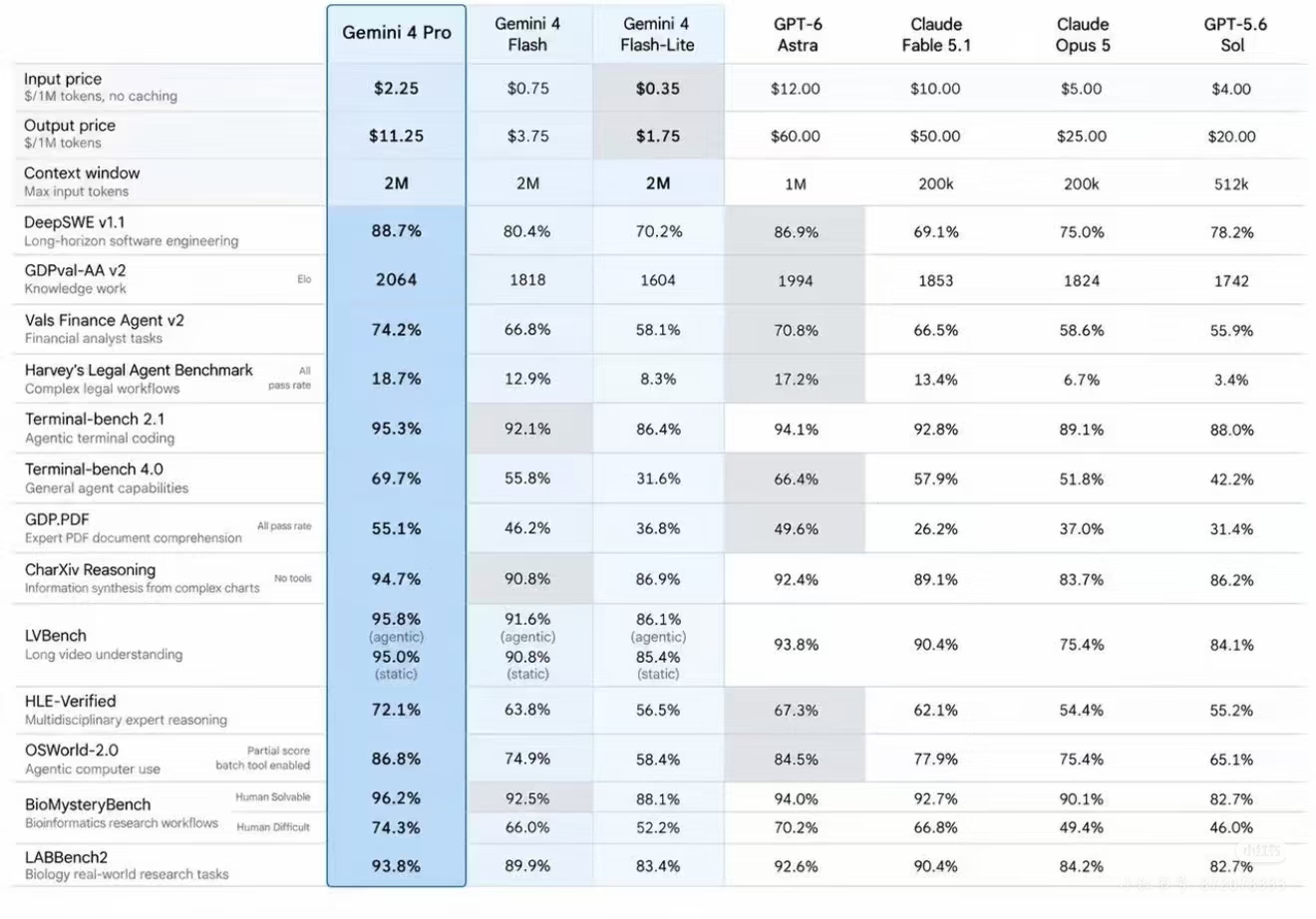
This is leaked community benchmark information that has not been officially verified.
Category Insights
- Long-horizon Agentic & Coding: Gemini 4 Pro shows its clearest advantage on tasks that require sustained state tracking, multi-step planning, and tool use (Terminal-bench 4.0, OSWorld-2.0, DeepSWE). The gap widens as task length and complexity increase, suggesting slower performance degradation over long trajectories.
- Professional Knowledge Work: On GDPval-AA v2, Vals Finance, and Harvey’s Legal Agent, Gemini 4 Pro again leads. Absolute scores on legal workflows remain low across all models, but the relative ranking is consistent.
- Multimodal & Document Understanding: Strong results on CharXiv, GDP.PDF, and LVBench highlight robust chart reasoning and long-video comprehension, supported by the 2M-token context window.
- Hard Reasoning & Scientific Tasks: HLE-Verified (72.1%), BioMysteryBench, and LABBench2 place Gemini 4 Pro at the top of current community evaluations in expert-level multidisciplinary and biology research workflows.
Positioning Relative to Competitors
- Vs. GPT-6 Astra: Gemini 4 Pro holds a slight lead across the vast majority of metrics while costing only about one-fifth as much, offering a clear advantage in cost-performance ratio.
- Vs. Claude Series: It establishes a significant lead in long-horizon agent capabilities, computer use, and scientific tasks; while Claude remains competitive in certain short-horizon or preference-based tasks, it has fallen behind overall.
- Internal Comparison: Gemini 4 Flash maintains high performance in most scenarios, making it suitable for cost- and latency-sensitive applications; Flash-Lite trades off further performance to achieve an extremely low price point.
Summary and Caveats
Based on currently leaked data, Gemini 4 Pro leads in agent capabilities, stability in long-horizon tasks, multimodal understanding, and performance in specialized domains, while also offering significant advantages in pricing and context window size. If these figures are officially confirmed, the model is poised to redefine the landscape of frontier models for the second half of 2026.
It is important to note the following:
- All the above are community-sourced test results and have not yet been confirmed by Google.
- Final scores can be influenced by variations in evaluation frameworks, tool-calling environments, and temperature settings.
- Model capabilities, pricing, and context window specifications are subject to change upon official release.
Data will be updated as official model cards or independent replication results become available.
Price of Gemini 4
| Model | Input Price ($$/1M tokens) | Output Price ($$/1M tokens) | Context Window |
|---|---|---|---|
| Gemini 4 Pro | $2.25 | $11.25 | 2M |
| Gemini 4 Flash | $0.75 | $3.75 | 2M |
| Gemini 4 Flash-Lite | $0.35 | $1.75 | 2M |
| GPT-6 Astra | $12.00 | $60.00 | 1M |
| Claude Fable 5.1 | $10.00 | $50.00 | 200k |
| Claude Opus 5 | $5.00 | $25.00 | 200k |
| GPT-5.6 Sol | $4.00 | $20.00 | 512k |
Gemini 4 Pro is priced at roughly one-fifth the cost of GPT-6 Astra while delivering higher benchmark scores and a larger context window. The Flash and Flash-Lite tiers further widen the cost-performance gap for less demanding use cases.
When is Gemini 4 expected to be released?
Independent analysts and coverage commonly project a late-2026 launch, most often in the November–December 2026 window, based on Google’s historical release cadence (roughly 6–9 months between major generations) and the time needed after pre-training for post-training, safety evaluation, and rollout.
- Some reports and leaks have mentioned an October 2026 possibility (or even late September), tied to unverified claims of checkpoints or internal progress, but these remain unconfirmed by Google.
- Prediction-market signals (as of mid-to-late September 2026) have shown relatively high probabilities of a release before the end of 2026 (often with the bulk of probability concentrated in Q4), though these are market expectations rather than official guidance and can shift.
What Is Gemini 4 Expected to Be?
Gemini 4 is more likely to be a family of systems than a single monolithic model. Google's current portfolio separates flagship reasoning, high-throughput inference, deep reasoning, real-time interaction, and media generation into different models. The family includes Gemini 3.1 Pro for complex reasoning and agentic workflows, Gemini 3.7 Flash for efficient agentic work at scale, and a specialized Deep Think mode for science, mathematics, and engineering.
That pattern suggests a future generation could retain Pro, Flash, and efficiency-oriented tiers while coordinating them through product-level routing. The biggest change may not be raw model scale. It may be a more integrated system that chooses the right reasoning budget, invokes tools, handles multiple modalities, and maintains state across longer workflows.
What Could Be New in Gemini 4?
More Reliable Long-Horizon Agents
Google now frames Gemini around action as well as intelligence. Its current capability overview highlights long-horizon tasks, multi-step problem solving, agentic coding, and advanced tools. The next generation will be judged less by whether it can write a plan and more by whether it can finish the plan without losing state, misusing permissions, or repeatedly calling the wrong tool.
For production agents, meaningful progress would include durable task state, recovery after tool failures, better delegation to subagents, explicit approval gates, and an audit trail that explains what the system changed. These are system-level reliability problems, so a Gemini 4 product may combine model improvements with stronger orchestration and memory infrastructure.
Stronger Reasoning and Adaptive Thinking
Google describes Gemini 3.7 Flash as adding algorithmic improvements to its reasoning foundation and customizable thinking configurations that balance quality, cost, and latency. Gemini 4 could extend that approach with adaptive inference: shallow reasoning for routine requests, larger reasoning budgets for difficult tasks, and verification before consequential actions.
The important distinction is between visible settings and actual allocation. A user may still see simple speed or thinking controls, while the system dynamically routes difficult subtasks to deeper reasoning or specialized experts. No specific architecture, parameter count, or mixture-of-experts design has been confirmed.
Better Native Multimodal Intelligence
Gemini already processes text, images, audio, video, and PDFs in a shared workflow. However, Gemini 3.7 Flash still produces text output, while image, audio, and video generation are handled by specialized models. A future generation could make coordination between these components more seamless, even if Google continues to expose separate endpoints.
Useful improvements would include stronger temporal reasoning over long videos, better chart and interface comprehension, more accurate spatial reasoning, and the ability to preserve facts and identities when a task moves between text, vision, audio, and generated media. Native media output remains a plausible direction, not a confirmed Gemini 4 feature.
Improved Computer Use and Tool Execution
The Gemini 3.7 Flash tool set includes function calling, code execution, search grounding, file search, Maps grounding, URL context, structured outputs, and preview computer use. That breadth is already strong; reliability is the harder next step.
Gemini 4 would need better recognition of interface state, safer handling of high-impact actions, more robust recovery when a page changes, and tighter coordination between API tools and graphical interfaces. Computer-use benchmarks suggest that this remains an open competitive area rather than a solved capability.
More Effective Long-Context Reasoning
A larger context window is useful only when the model can retrieve the right evidence and preserve relationships across the entire working set. Google's 128K MRCR result improved from 91.8% on Gemini 3.6 Flash to 97.0% on Gemini 3.7 Flash. That is a strong result, but it does not demonstrate the same retrieval quality near the full 1M-token limit, so effective recall remains a more meaningful Gemini 4 target than a larger headline window alone.
The most valuable gains would appear in repository-scale dependency tracing, conflict detection across documents, long-video event localization, and the coordination of temporary context with persistent agent memory. Better caching and token efficiency would also reduce the cost of keeping large working sets active.
A Broader Pro, Flash, and Specialist Family
Google's catalog already separates flagship reasoning, throughput, real-time interaction, image generation, audio, video, and robotics. Gemini 4 may therefore arrive as a staged family rather than a simultaneous launch. Pro would likely prioritize accuracy and difficult reasoning, Flash would optimize production throughput, and specialist models would handle real-time or media-heavy workloads.
This family approach also enables dynamic routing. Applications could send most requests to a fast model and escalate only the difficult portions to a higher-cost reasoning model. The product experience may matter as much as the name of any single checkpoint.
Better Efficiency, Latency, and Deployment Economics
Gemini 3.7 Flash demonstrates Google's effort to bring agentic capabilities to lower-cost, high-throughput deployment. Gemini 4 will need to improve capability per dollar and capability per second, not just peak benchmark scores. Likely priorities include token efficiency, prompt caching, faster tool loops, batch inference, priority inference, and better utilization of Google infrastructure.
No Gemini 4 price should be predicted before an official pricing page appears. Pricing can also vary by input length, output tokens, caching, modality, batch mode, and service tier, so a single estimated number would create false precision.
What Could Gemini 4 Be Best At?
Repository-Scale Coding Agents
A stronger Gemini generation could inspect large repositories, trace dependencies, run tests, edit multiple files, and verify fixes through terminal tools. The highest-value improvement would be fewer partial solutions and a clearer record of what changed and why.
Enterprise Research and Knowledge Work
Gemini 4 could combine long documents, spreadsheets, PDFs, private enterprise data, and grounded web research into workflows that produce decisions rather than summaries. Enterprise adoption will depend on permissions, citations, data boundaries, and reproducible tool execution as much as raw reasoning quality.
Multimodal Operations
Potential applications include video review, interface testing, document intelligence, chart analysis, customer-support triage, and field-service workflows that mix images, audio, video, text, and structured data. Google's Search, Maps, Workspace, Cloud, and device ecosystem could make these workflows a major differentiator.
Science and Engineering
The current Deep Think direction suggests continued emphasis on mathematics, physics, materials, biology, and engineering. A future model could help researchers explore hypotheses, write and execute code, analyze experimental data, and inspect literature, provided outputs remain traceable and subject to expert validation.
Real-Time Assistants and Computer Control
Lower-latency variants could power voice-first assistants that observe a screen, interpret documents, navigate applications, and coordinate tools during a live conversation. Safety controls will be essential whenever the assistant can send messages, modify files, approve purchases, or change business systems.
When Could Gemini 4 Be Released?
There is not enough official evidence to assign Gemini 4 a reliable release window. Google is still extending the Gemini 3 family, and its current public lineup includes additional 3.x work. A Gemini 4 announcement is therefore better treated as a future-generation possibility than a confirmed near-term launch.
The strongest release signal will not be a rumor or an isolated model name. It will be the appearance of an official Google announcement, a model card, a Gemini API entry, a pricing page, and reproducible benchmark documentation. Until those elements exist, release-date predictions should remain explicitly speculative.
What Can You Use While Waiting for Gemini 4
You can already use Gemini 3.8 Flash for high-throughput agentic coding, multimodal analysis, and knowledge work, while Gemini 3.1 Pro remains useful for harder reasoning and creative tasks. Claude Sonnet 5 and GPT-5.6 Terra provide additional comparison points when provider diversity, fallback coverage, or benchmark-driven routing matters. Keep the model name outside application logic, define capability tests, log tool calls, and maintain fallbacks so a future Gemini model can be evaluated without rewriting the integration.
The following Python example uses the OpenAI-compatible chat-completions interface through CometAPI. It deliberately uses a real current model ID. Do not place a fictional gemini-4 identifier into production code.
Python
Before running the request, create a CometAPI API key and store it securely rather than hard-coding it. Review the API documentation for supported endpoints and parameters. When a future Gemini model receives an official identifier, a well-designed abstraction layer should allow the application to test and adopt it without rewriting the whole integration.
Final Thoughts
Gemini 4 is not yet a confirmed product with published specifications. What can be evaluated is the direction of travel. Google's current Gemini family combines flagship reasoning, efficient agentic inference, deep scientific thinking, multimodal input, large context windows, and broad tool support. A true next generation would need to turn those components into a more reliable and unified system.
The benchmark challenge is equally clear. Gemini already shows strength in long-context retrieval, video understanding, search, and several reasoning tasks, but computer use, desktop agents, very-long-context recall, and consistently reliable execution remain competitive. Gemini 4 will matter if it improves those real workflow outcomes, not simply because the version number changes.
Until Google publishes primary documentation, developers should treat exact Gemini 4 specifications, prices, scores, and release dates as unknown. CometAPI users can continue testing current Gemini models and build provider-neutral evaluation pipelines so that any future model is adopted on evidence rather than hype.