
TL;DR
GLM 5.4 is a community name for a possible successor in Z.ai’s GLM family. As of October 14, 2026, the official model documentation and release records reviewed for this article do not establish a GLM-5.4 launch, specification sheet, or API identifier. Union Alpha is a rumor lead, while an October launch is a cadence-based possibility. The useful question is whether a future release improves coding reliability and cost per completed task; existing GLM models provide the baseline for that evaluation.
Key Takeaways
- Release status: The official sources reviewed on October 14, 2026 do not confirm GLM-5.4; no exact launch date is established.
- Rumor evidence: Union Alpha’s association with GLM-5.4 remains unverified, and the cited roundup does not identify an original attribution post.
- Performance baseline: Existing GLM-5.3 results are useful context, but they are not GLM-5.4 measurements.
- Architecture: GLM-5.3-Flash demonstrates a different efficiency and multimodal direction; inheritance by GLM-5.4 is an open question.
- Developer action: Evaluate available models now and require verified model IDs, compatibility, and task-level measurements before upgrading.
Has GLM 5.4 Been Released?
GLM 5.4 is an unofficial name for a potential GLM successor. The official documentation index and release records reviewed on October 14, 2026 identify existing GLM models but do not establish a GLM-5.4 product release. This is a dated source check, not proof that no private development exists.
Two documented development paths explain why a possible successor attracts attention.
Z.ai confirms that GLM-5.3 reuses the GLM-5.2 base model and obtains its gains through post-training. GLM-5.3-Flash instead uses a new multimodal base and hybrid attention architecture. These facts describe existing models, not a disclosed GLM-5.4 design.
In practical terms, one path improves an existing model through additional training, while the other redesigns the architecture to reduce compute costs and support new capabilities.
A future GLM-5.4 could build on either direction, but there is not yet sufficient evidence to determine which approach Z.ai will select.
How Reliable Are the GLM-5.4 Rumors and Leaks?
Confirmed Information
The confirmed technical baseline comes from GLM-5.3 and GLM-5.3-Flash, not from GLM-5.4. The GLM-5.4 name, final specifications, release date, and benchmark results remain unconfirmed in the official sources reviewed for this article.
Community Reports / Leaks
An October 8, 2026 X post by @NFT_Chen attributes a possible GLM-5.4/5.5 development direction to comments by Tang Jie. The post describes three scaling priorities: expanding pre-training, strengthening post-training through SFT, RLHF, and RLVR, and extending reasoning and agent execution across harder, longer tasks.
The author interprets the next direction as longer autonomous agents and recursive self-improvement (RSI). This is a community account of a talk, rather than a Z.ai release announcement. The version names and development claims remain attributed to the post; they do not establish a launch date, final architecture, parameter count, or demonstrated self-improvement capability for GLM-5.4.
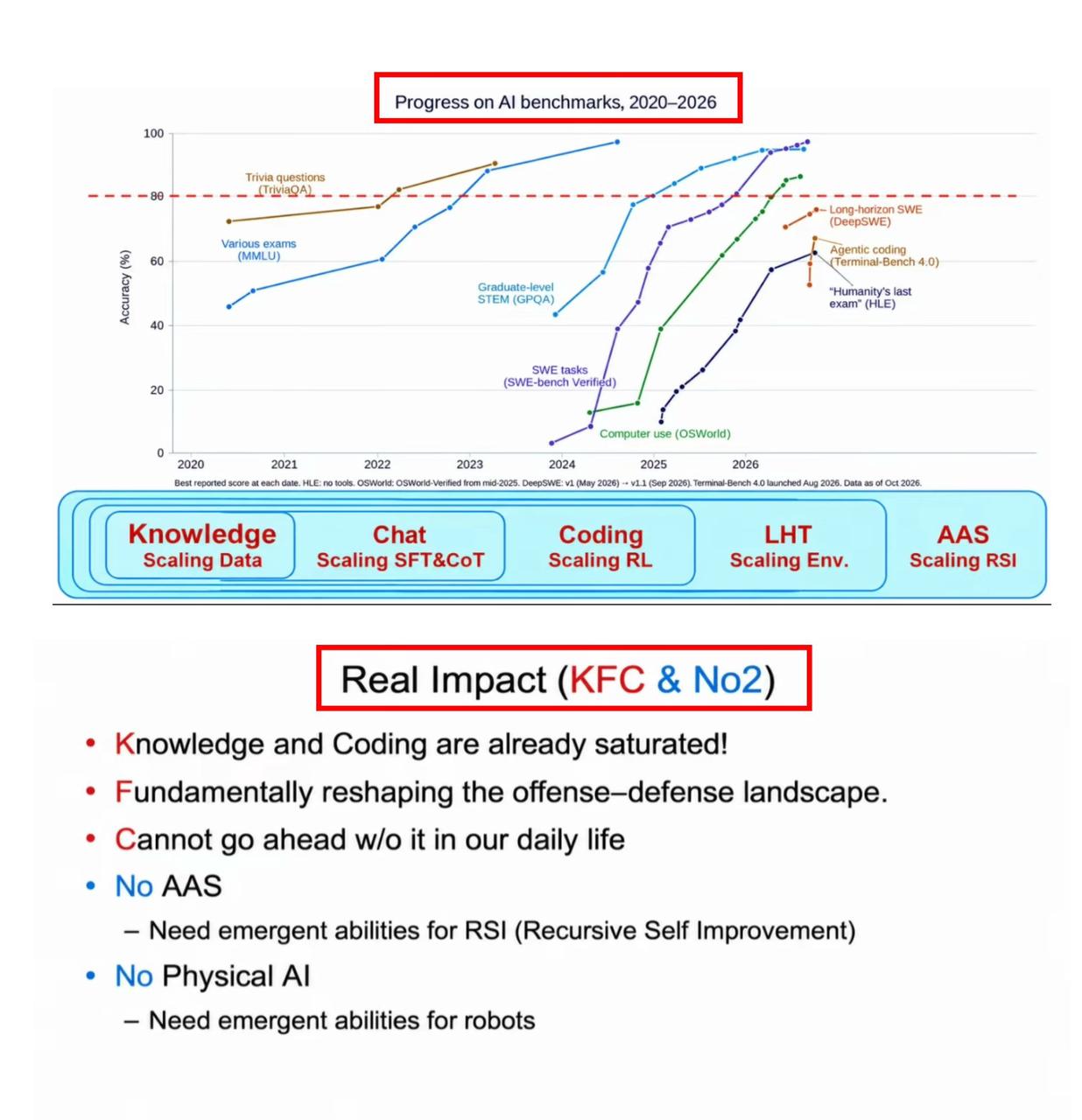
Presentation-slide image attached to @NFT_Chen’s original X post, October 8, 2026. It discusses benchmark progress and RSI as a future direction; it is not a GLM-5.4 benchmark report.

Talk photograph attached to @NFT_Chen’s original X post, October 8, 2026.
Analysis
A useful rumor analysis asks what observation would change the conclusion. An official model identifier, a release announcement, or a disclosed mapping from an anonymous alias would materially strengthen the case. A similar naming pattern or release interval alone cannot do that. Older speculation about other future GLM version numbers does not establish specifications for GLM-5.4.
When Could GLM 5.4 Be Released?
Z.ai’s release-note timeline records GLM-5 on February 12, GLM-5.1 on April 7, GLM-5.2 on June 16, GLM-5.3 on August 18, and GLM-5.3-Flash on August 26, 2026. These are dates recorded in release notes; they should not be conflated with every research announcement or provider availability date.
The approximate two-month progression of the main point versions makes October a reasonable analytical window to watch. It does not establish an October launch, a specific day, or even the next version name. Without a traceable forecast source and its methodology, an exact October 20 or October 23 prediction would imply more precision than the evidence supports.
A later launch, a different name, or a separate product variant remains possible. Developers should plan around currently available APIs rather than a calendar estimate.
What Are GLM 5.4's Expected Specs?
No reliable GLM-5.4 specification sheet is available. Rather than assign rumored hardware and model parameters to an unreleased product, it is more informative to compare the latest documented GLM models and identify what remains unknown.
| Specification | GLM-5.3 | GLM-5.3-Flash | GLM-5.4 |
|---|---|---|---|
| Release | August 18, 2026 | August 26, 2026 | Unannounced |
| Model foundation | GLM-5.2 base; further post-training | New multimodal base | Unknown |
| Architecture | MoE foundation | MoE; hybrid sparse-linear attention | Unknown |
| Context support | 1M documented API context | 1M | Unknown |
| Native multimodality | Text-only input | Text, image, video, and file inputs | Unknown |
| Primary emphasis | Coding, agents, cybersecurity | Efficiency, coding, multimodality | Unknown |
| Published benchmarks | Available | Available | Not available |
| Model weights | Released | Released | Not available |
The table reports documented capabilities of existing models. GLM-5.4 entries remain unknown rather than inheriting values from either predecessor. A model’s evaluation context, API context window, and maximum output length are distinct limits.
The GLM-5.3-Flash architecture overview reports 320B total parameters, 18B activated parameters, and hybrid sparse-linear attention. These are disclosed Flash specifications and should not be assigned to GLM-5.4.
Agentic Coding as a Potential Upgrade Direction
Agentic coding is one of the most credible areas to watch. GLM-5.3 already demonstrated that scaling post-training can substantially improve performance on multi-step engineering tasks. Its developers emphasized complex repository work, longer execution horizons, and improved tool-driven problem solving.
A future model could extend these capabilities through better environment interaction, more reliable planning, and fewer failed tool calls.
The most useful evaluation would not simply measure the percentage of coding questions answered correctly. It would measure whether an agent can complete complicated tasks end to end, including debugging, testing, revision, and recovery after failures.
Efficient Multimodal Architecture as a Possible Direction
GLM-5.3-Flash provides an architectural reference point for future development, while no reviewed official source establishes its use in GLM-5.4.
Z.ai describes a 30T-token multimodal pre-training corpus as part of GLM-5.3-Flash’s efficiency-oriented design. This describes the training data scale of an existing model and is not a roadmap commitment for GLM-5.4.
The official Flash overview reports 3.01× lower attention computation and 4.44× lower KV-cache requirements against GLM-5.3 under the stated comparison. These are component-level efficiency results, not a guaranteed application speedup or API discount.
These are meaningful engineering improvements, but there is no confirmation that GLM-5.4 will inherit the same architecture. A larger next-generation model might prioritize maximum reasoning performance, while a separate Flash variant might continue to optimize latency and cost.
GLM 5.4 vs GLM-5.3 vs GLM-5.3-Flash
GLM-5.3 Benchmark Baseline
The available benchmark data supports an analysis of GLM-5.3’s performance trajectory, not a direct measurement of GLM-5.4. The values below are Z.ai’s reported evaluations of existing models. They have not been independently reproduced for this article and do not measure GLM-5.4. Each benchmark uses its own task set and scoring method; score differences must not be interpreted as equivalent gains across tasks.
| Benchmark and methodology | GLM-5.2 | GLM-5.3 | GLM-5.3-Flash | GLM-5.3 vs GLM-5.2 difference |
|---|---|---|---|---|
| Terminal Bench 3.0 | 4.6 | 28.3 | Not reported in the cited Flash comparison | +23.7 points |
| DeepSWE v1.1 | 46.2 | 66.9 | 63.4 | +20.7 points |
| AutomationBench v1.0.6 | 26.2 | 48.2 | 48.8 | +22.0 points |
| CyberGym | 77.2 | 84.5 | Not reported in the cited Flash comparison | +7.3 points |
| ExploitBench | 24.4 | 54.4 | Not reported in the cited Flash comparison | +30.0 points |
| HLE with Tools | 54.7 | 62.5 | 55.3 | +7.8 points |
| GDPval-AA v2 | 1508 | 1769 | Not reported in the cited Flash comparison | +261 Elo |
| Toolathlon Verified | 59.9 | Not reported in the cited GLM-5.3 comparison | 78.4 | Not available |
The combined table places the existing-model results side by side; it contains no GLM-5.4 measurements. An unreported value is not a zero score. Keep each benchmark's evaluation conditions in view, and treat GDPval-AA differences as Elo rather than percentage points.
Methodology: DeepSWE v1.1 uses mini-swe-agent, temperature 0.95, top_p 1.0, a six-hour timeout, and 400K context. AutomationBench uses v1.0.6. HLE with Tools uses temperature 1.0, top_p 0.95, a 163,840-token generation limit, and a 300K context limit with context management. GDPval-AA v2 uses an Elo scale, so its difference is not a percentage-point gain.
For CyberGym and ExploitBench, Z.ai reports Claude Code 2.1.207 with max reasoning effort, no web tools, temperature 1.0, top_p 1.0, and a 128,000-token output limit. CyberGym reports single-run pass@1 across 1,507 tasks with unlimited per-task timeout. ExploitBench uses up to 300 interaction rounds and averages coverage over 41 tasks across three revisions. The model-card footnotes provide the benchmark-specific environment details.
Flash methodology: DeepSWE uses mini-swe-agent, 400K context, and a six-hour timeout; AutomationBench uses v1.0.6. Toolathlon Verified reports pass@1 averaged over three independent runs through the official evaluation service. HLE uses the sampling and context-management settings described above. See the Flash model-card methodology. These benchmark results do not establish production latency or cost.
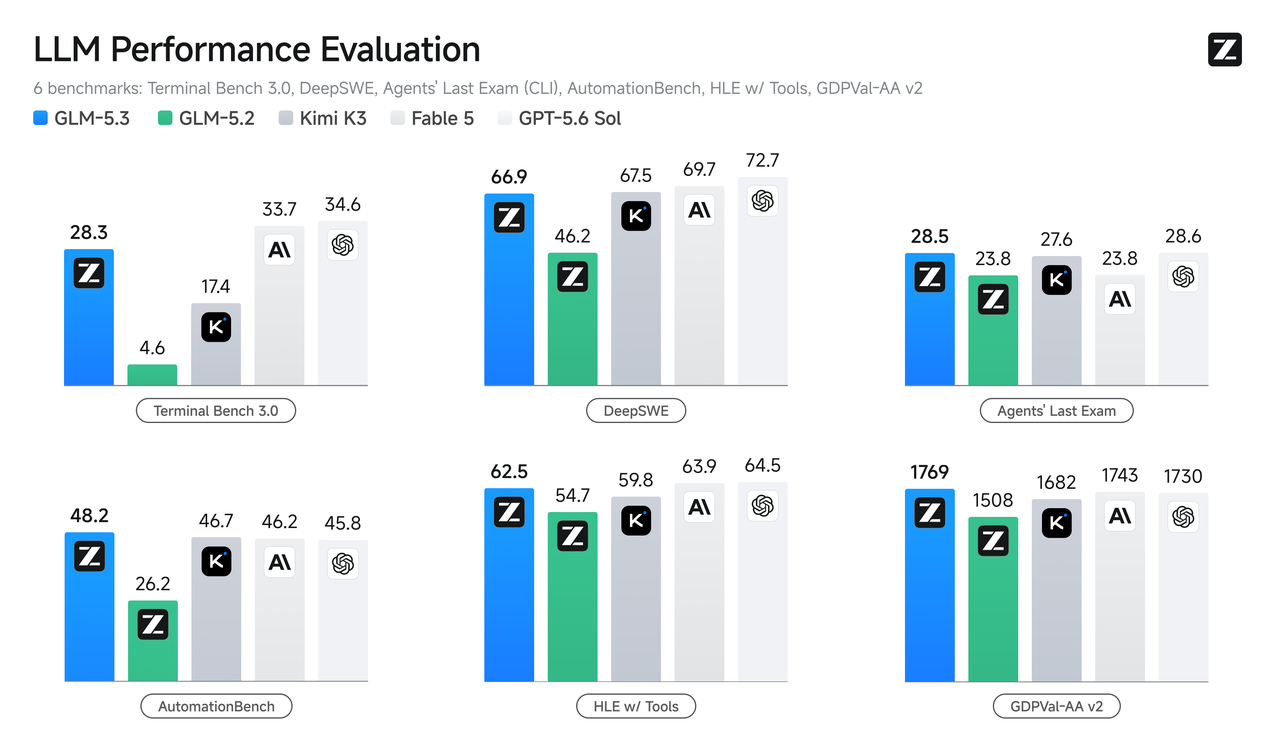
Official GLM-5.3 performance graphic, reproduced from Z.ai’s benchmark announcement. The image shows predecessor-model evaluations; it contains no GLM-5.4 results.
The greatest improvements appear in tasks requiring sustained interaction with an environment. Terminal Bench 3.0 increased from 4.6 to 28.3, while ExploitBench improved from 24.4 to 54.4.
These gains suggest that post-training and agent-oriented environments can dramatically alter how a model performs without changing its underlying base architecture. However, they should not be extrapolated into a numerical prediction for GLM-5.4.
Capabilities and Production Fit
For production, GLM-5.3 is the stronger reference for complex coding, long-horizon engineering, and cybersecurity evaluation. GLM-5.3-Flash adds native visual inputs and emphasizes efficient tool use. Existing GLM-5.2, GLM-5.3, and Flash offerings provide a baseline; no equivalent GLM-5.4 capability or availability is established in the sources reviewed for this article.
The documented models support up to 1M context, but that limit does not guarantee identical usable context or task performance on every endpoint. Choose between them using representative workloads and cost per successfully completed task.
A future GLM-5.4 would need to offer a measurable improvement to justify migration. Improving benchmark accuracy while doubling task completion costs may not be attractive for production deployments. Conversely, a modest accuracy gain and substantially fewer tool calls could be valuable at scale.
Compare task success, input and output tokens, latency, failed tool calls, and cost per successful task under the same evaluation harness. Qualitative model descriptions are not a controlled head-to-head test.
What Is the Current GLM-5.4 API Status on CometAPI?
CometAPI has created a dedicated GLM 5.4 model page with a stable model identifier entry. However, the page still labels the model as “Coming soon” and describes it as a pre-launch model. Developers should verify the actual model ID, account access, endpoint availability, supported parameters, context limits, and pricing before attempting production use.
For a currently documented integration, use an available GLM model such as GLM-5.2 or GLM-5.3. CometAPI’s GLM-5.4 page should currently be treated as a pre-launch catalog entry until the model ID and endpoint are confirmed as callable.
Preparing for GLM 5.4 API Integration
The most practical preparation is to avoid coupling application logic to a single model version. A configurable model identifier makes it easier to evaluate upgrades without rewriting the request pipeline.
Keep the model identifier configurable and use an available GLM model to establish a working baseline. Before switching to GLM-5.4, confirm a callable model ID, account access, supported request parameters, context and output limits, streaming behavior, and tool-call compatibility. Keep a rollback option ready.
When GLM-5.4 becomes officially available, verify the model ID, supported parameters, context limits, and endpoint compatibility. Run the old and new models against the same evaluation dataset, tracking success rate, latency, output tokens, tool-call failures, and cost per successful execution.
What Could GLM 5.4 API Pricing Look Like?
No official GLM-5.4 API price has been announced. It would therefore be misleading to publish a specific input or output token rate as if it were a genuine leak.
The current GLM family illustrates why model size alone is insufficient to predict pricing. GLM-5.3-Flash introduced architectural optimizations designed to deliver competitive intelligence at substantially lower inference cost.
Z.ai’s Artificial Analysis Intelligence Index v4.1.1 comparison reports a score of 57 at an estimated discounted $0.045 per task for GLM-5.3-Flash. This evaluation cost is not an input/output token tariff and does not predict GLM-5.4 pricing.
Future GLM-5.4 pricing could depend on architecture, reasoning effort, cached-token discounts, hosting infrastructure, and variants. For production planning, cost per successfully completed task is often more valuable than the lowest headline input-token rate.
Should Developers Wait for GLM 5.4?
For most developers, waiting for an unannounced model is unnecessary. Existing GLM models provide documented coding and agentic capabilities that can be tested in real applications.
Teams building coding assistants or multi-step engineering agents can establish a baseline with GLM-5.3. Applications emphasizing visual understanding, long context, and efficient repeated calls can evaluate GLM-5.3-Flash.
Build an evaluation harness now and reserve a future comparison slot for GLM-5.4. When available, its release will matter if it improves outcomes that count for a particular application.
Researchers should watch for new foundation architecture, changes in long-horizon benchmarks, and end-to-end reliability. Businesses should prioritize availability, cost, latency, compatibility, and quality on representative production data.
Conclusion
GLM 5.4 is a plausible next step in Z.ai’s rapidly evolving model family, but its current narrative remains more speculative than confirmed.
Union Alpha is an unverified identity clue, and release cadence supports only a broad timing hypothesis. Neither establishes a launch date. The official sources reviewed on October 14, 2026 provide a baseline for existing models rather than a confirmed GLM-5.4 release.
What is verifiable is the progress already made by GLM-5.3 and GLM-5.3-Flash. Significant gains in agentic coding, cybersecurity evaluation, and inference efficiency establish a demanding baseline for any successor.
The key question is whether Z.ai can deliver reliable autonomous execution, stronger reasoning, and a competitive cost per completed task. Until official specifications and benchmarks appear, GLM-5.4 should be treated as a potential release rather than an available product.
FAQ
How can I verify a GLM 5.4 API listing?
Check that the provider supplies a callable model identifier, supported endpoint, access conditions, and current pricing. Then compare the identity with an official Z.ai announcement or documentation. A provider listing can establish that provider’s offering, but does not by itself authenticate an anonymous model’s underlying developer.
Which compatibility checks matter before a GLM 5.4 migration?
Validate request parameters, reasoning settings, tool-call schema, structured output, streaming behavior, context limits, and maximum output on your actual endpoint. Include negative tests for unsupported parameters and keep the existing model available for rollback. OpenAI compatibility describes an interface; it does not guarantee identical model behavior.
How should I evaluate GLM 5.4 for coding agents?
Use a fixed set of representative repository tasks with the same tools, permissions, timeout, and harness for both models. Count successful tested changes, recovery from tool failures, token use, latency, and total cost. Record every run and repeat tasks enough to expose variability rather than promoting one favorable example.
What would justify waiting for GLM 5.4?
Waiting is reasonable only when a documented upcoming capability addresses a requirement that available models cannot meet, and the delay fits your delivery schedule. With only a rumor, build against an available model and keep the model selection configurable. Define the capability and cost thresholds that a later release must meet before it replaces your baseline.