TL;DR: GPT-6.1 Terra is the stronger starting point when reasoning quality and complex visual workflows matter most; DeepSeek V4.1 Flash is attractive when token cost, generation speed, or self-hosting takes priority. This comparison uses DeepSeek's October 17 update, Flash-1017.
DeepSeek Flash-1017 has lower token prices, but the cost of a completed task also depends on reasoning length, retries, and tool calls.
The comparison below covers architecture, context, reasoning, coding, vision, speed, pricing, and deployment. Prices and live evaluation pages were checked on October 28, 2026.
Key Takeaways
Terra leads the cited independent Intelligence Index comparison, making it a logical first candidate for demanding reasoning tasks.
DeepSeek has lower listed token prices. Compare end-to-end latency and cost per successful task, including peak-hour rates, cache usage, reasoning tokens, and retries.
Reviewed for clarity, source attribution and current API terminology.
Evaluate coding by accepted patches and visual workflows by completed tasks. Published benchmark scores provide useful evidence, but the test setups differ.
Terra is a hosted proprietary model. DeepSeek offers MIT-licensed downloadable weights for self-hosting, with hardware and operating costs to consider.
CometAPI provides a shared text interface for testing both models. Check the resolved model version and support for tools, reasoning controls, and structured output before deploying.
GPT-6.1 Terra vs DeepSeek V4.1 Flash: Overview and Specifications
The main specification differences concern output limits, reasoning controls, tool calling, and deployment. The table below summarizes the two models.
Terra uses a proprietary architecture whose parameter count is not publicly disclosed. DeepSeek-V4.1-Flash uses a Causal Encoder–Decoder MoE architecture, with different active-parameter budgets for input processing and output generation.
DeepSeek's V4.1 Flash release describes a 552B-parameter Causal Encoder–Decoder mixture-of-experts backbone, with roughly 8B parameters active during input processing and 16B during output generation. The October 17 update improves its published coding, agent, and vision results.
Throughout this article, Flash-1017 means that October checkpoint. A generic API alias can later point to another version, so an evaluation record should include the model version actually served.
KV Cache and Deployment Requirements
DeepSeek reports a global KV-cache footprint of approximately 890 bytes per token, about one-quarter that of DeepSeek-V4-Flash. This improves cache efficiency, although self-hosting still requires substantial resources for the model weights. Terra is available through hosted services, while DeepSeek’s downloadable weights provide an additional self-hosting option.
Reasoning Controls and Tool Calling
Both models support agent workflows, but reasoning controls and tool-calling requirements differ. Terra’s documented tool-calling support uses the Responses API. DeepSeek’s model card describes numeric reasoning effort from 1 to 100; hosted API controls should be checked separately. When switching models, adapt the reasoning parameters and tool definitions to the selected endpoint.
GPT-6.1 Terra vs DeepSeek V4.1 Flash: Performance
The comparison below covers reasoning, coding, vision, and long-context tasks. Independent evaluations and vendor-reported benchmarks are identified separately, with results interpreted alongside their model configurations and agent frameworks.
Reasoning and Knowledge
Artificial Analysis reports an Intelligence Index v5.0 score of 51 for GPT-6.1 Terra (Max) and 32 for DeepSeek Flash-1017 (Max) in the cited configurations, as of October 28, 2026. The index combines nine evaluations.
Terra’s higher aggregate score supports testing it first for demanding reasoning tasks. For narrower workloads, DeepSeek may still be the better choice if it meets the required accuracy at a lower cost per successful task.
Official Coding and Agent Benchmarks
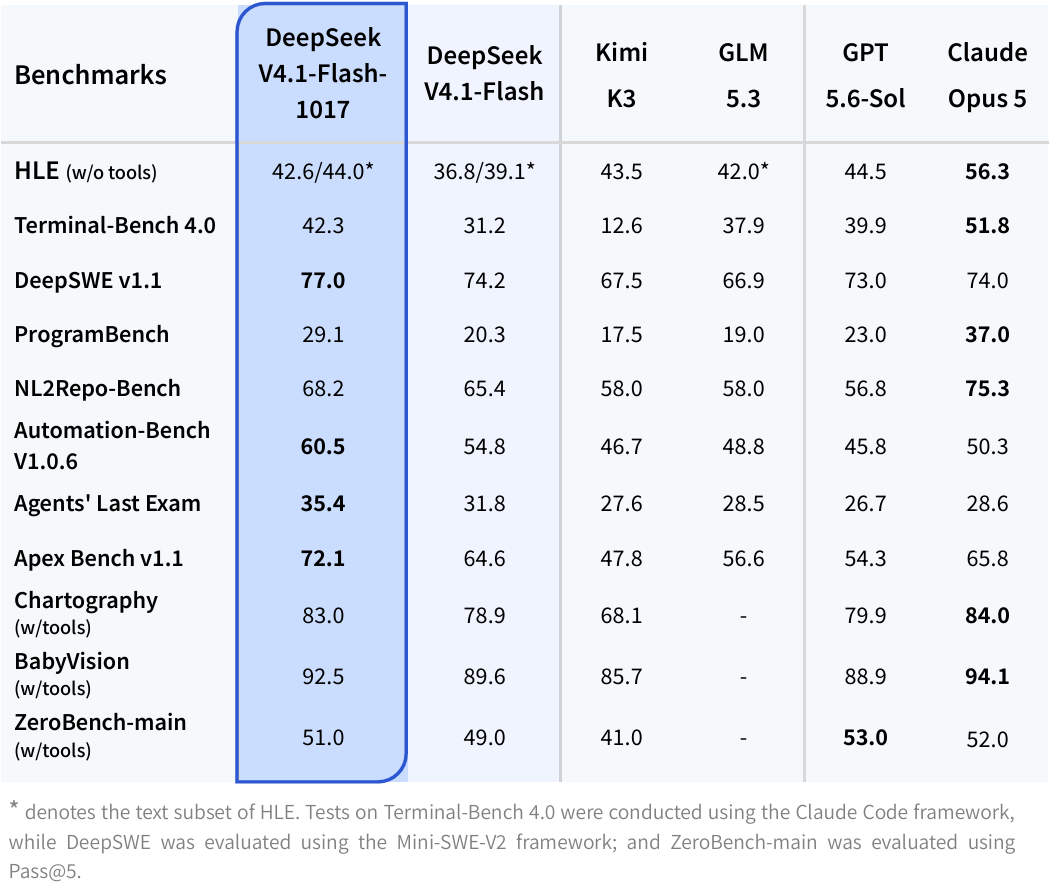
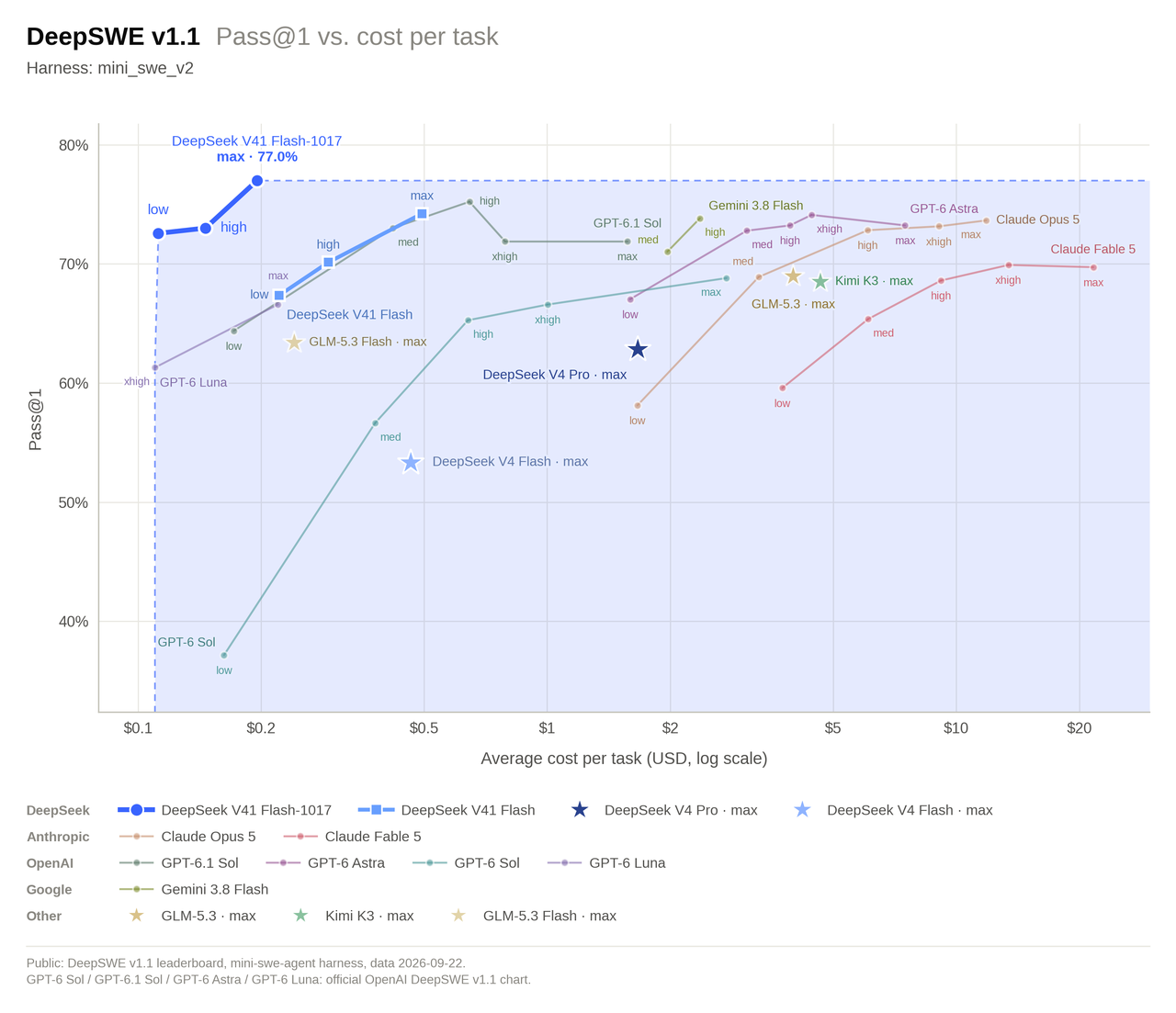
Terminal-Bench 4.0 and DeepSWE v1.1 provide evidence about coding and agent performance. When comparing vendor results, identify the exact model version, reasoning setting, agent framework, and scoring metric; differences in these settings can materially affect the scores.
For practical coding work, compare whether each model produces patches that pass existing tests, preserve public interfaces, handle edge cases, and avoid unrelated changes. Tool-call reliability and recovery from execution errors also affect how much work an agent can complete.
DeepSeek’s lower listed token prices make it a useful candidate for repetitive repository maintenance with clear acceptance criteria. For complex changes, compare both models on accepted patches, total task cost, and human correction time.
Vision and Computer Use
Both models accept image inputs, but image understanding and desktop interaction require different capabilities. OpenAI’s Terra launch material discusses MMMU-Pro and OSWorld 2.1, while DeepSeek’s model card reports visual tasks including Chartography and BabyVision, with tool-assisted settings.
For document extraction, compare field accuracy, missed text, and table structure. For desktop automation, compare completed workflows, incorrect actions, and recovery after interface changes. A model that describes a screenshot accurately may still struggle to operate the application it shows.
Choose according to the workflow: extraction accuracy matters most for document processing, while reliable actions and recovery matter more for computer-use agents. Compare cost only after both models meet the required quality threshold.
Long-Context Reasoning and Retrieval
Both models support long-document workflows, but context capacity alone does not determine retrieval quality. Compare them on the same document collection, placing important evidence near the beginning, middle, and end.
Evaluate answer accuracy, supporting passages, consistency across documents, and response completeness. For research and document analysis, prefer the model that reliably retrieves and connects the relevant evidence within your latency and cost requirements.
GPT-6.1 Terra vs DeepSeek V4.1 Flash: Speed
Output Throughput and Task Completion Time
Latency deserves separate treatment from reasoning quality.
On the October 28 Artificial Analysis pages, Flash-1017 (Max) output speed is 173.4 tokens per second, while Terra (Max) output speed is 90.9. Those measurements describe the evaluator's served configurations, not guaranteed rates on every provider.
A model that generates tokens faster may still take longer to finish if it produces more reasoning, waits for tools, or retries. Measure time to first token, total completion time, and accepted-task latency separately.
Interactive Latency on Your API Route
For an interactive product, test short and long prompts at realistic concurrency and record median and 95th-percentile latency. Keep region, API route, prompt caching, reasoning settings, and retry policy in the results. That record will tell you more about the user experience than a single tokens-per-second figure.
GPT-6.1 Terra vs DeepSeek V4.1 Flash: Cost
Pricing is one of the clearest differences between these models.
The Terra rate card and DeepSeek pricing policy give the following first-party rates as checked on October 28, 2026. All prices are US dollars per million tokens.
Official API Rates
DeepSeek peak pricing applies Monday–Friday, 01:00–04:00 and 06:00–10:00 UTC, excluding Chinese public holidays. That is 09:00–12:00 and 14:00–18:00 in China Standard Time (UTC+8). Other periods use the off-peak rates.
For Terra requests above 272,000 input tokens, OpenAI specifies 2× input and cached-input rates and 1.5× output rates for the whole request. Compare those conditions with your actual prompt sizes before treating the base price as the effective price.
CometAPI Rates
CometAPI lists DeepSeek's peak windows as Monday–Friday, 01:00–04:00 and 06:00–10:00 UTC. Its listed schedule does not establish the same holiday exception as DeepSeek's first-party policy. Check the selected route's billing terms for your intended execution time.
Fixed-Token Cost Example
Consider a request that consumes 100,000 uncached input tokens and generates 10,000 output tokens.
If those are the complete billed token totals, the token charge is $0.150 for Terra, $0.021 for DeepSeek off-peak, or $0.042 for DeepSeek at peak. The off-peak reduction is 86%. The example excludes additional tool fees, infrastructure, and retries; any separately counted reasoning tokens must also enter the calculation.
At CometAPI's listed base rates, the same 100,000 input and 10,000 output tokens cost $0.120 for Terra or $0.0168 for Flash. Applying the listed 2× peak multiplier gives $0.0336 for Flash. These are token-only calculations using the stated counts, not measurements of an actual task.
When Extra Output Erases the Token-Price Advantage
Hold uncached input at 100,000 tokens and Terra's total billed output at 10,000 tokens. Terra's standard token bill is then $0.150. Flash reaches the same bill at 225,000 billed output tokens off-peak, or 100,000 at peak rates. This arithmetic isolates output volume; caching, repeated input, tool fees, and retries change the comparison.
Cost per Successful Task
Evaluate a fixed batch of tasks and divide all billed API and tool spending by the number of tasks that pass your acceptance checks. Count the spending on failed attempts too. Report the success rate beside this cost so that a model is not rewarded simply for completing only the easiest jobs.
Cost per successful task = Total API and tool cost / Successfully completed tasks
Which Should You Choose: GPT-6.1 Terra or DeepSeek-V4.1-Flash?
Choose according to the task’s quality requirements, cost targets, and deployment needs. Use the benchmark results above to decide which model to test first.
When to Choose GPT-6.1 Terra
Prioritize Terra for evaluation when complex reasoning is central to the task. For demanding visual or computer-use workflows, include it in the test set and measure completed tasks, errors, and recovery.
The key question is whether Terra reduces failed attempts and manual correction enough to justify its higher token price.
When to Choose DeepSeek-V4.1-Flash
Start with DeepSeek-V4.1-Flash for repetitive, high-volume tasks with clear acceptance criteria and tight cost targets. Choose it if the outputs meet your quality requirements at a lower cost per successful task.
DeepSeek’s MIT-licensed weights also make it the relevant option when self-hosting is a requirement. Include hardware and operating costs in that decision.
When to Test Both Models
Test both when coding quality, tool reliability, latency, or long-document accuracy is critical. Use representative tasks with the same inputs, tools, execution limits, and acceptance criteria.
Compare successful completion rate, total cost per successful task, end-to-end latency, and human correction time. Record the model version and reasoning settings so the results can be reproduced.
A hybrid setup can start routine tasks with DeepSeek and escalate selected failures to Terra. Measure the cost and completion rate of the full workflow to confirm that the extra model call is worthwhile.
Where Can You Access GPT-6.1 Terra and DeepSeek V4.1 Flash?
Use OpenAI's hosted API for Terra or DeepSeek's hosted API for Flash. Confirm the current model identifier, account limits, and supported endpoint before integration. Flash-1017's downloadable weights provide a separate self-hosting option.
Access Through CometAPI
CometAPI provides an OpenAI-compatible interface that can simplify multi-model application development.
To try both models through one text client, use the OpenAI Python SDK with your CometAPI key and the https://api.cometapi.com/v1 endpoint. Keep the key in an environment variable, then send the same prompt to the gpt-6.1-terra and deepseek-v4.1-flash routes and compare the returned answers and token usage.
For example, ask each model to review a payment workflow that retries timed-out requests without an idempotency key and logs full request bodies. Compare how clearly the answers identify reliability and privacy risks and explain practical fixes. A shared prompt makes the responses easier to inspect, but a default text request does not equalize reasoning budgets or establish a performance ranking. Confirm the checkpoint served by each route before treating a result as evidence about Flash-1017.
Conclusion
GPT-6.1 Terra offers the stronger current aggregate reasoning result, while DeepSeek Flash-1017 combines lower token prices, faster measured output generation, and open-weight deployment. The useful choice is the model that meets your quality and latency requirements at the lowest total cost.
Start with a representative workload, hold the tool environment and acceptance criteria constant, and compare the cost of successful completions. A shared CometAPI text integration can make that evaluation easier, while model-specific features still need their own configuration.
FAQ
Why can the same task produce different token bills with Terra and Flash-1017?
A text prompt does not necessarily become the same number of tokens in two models. Generated answers and reasoning lengths can also differ. Compare the usage reported by each route for identical tasks, including cached and billable reasoning tokens where reported, rather than applying both price lists to one estimated token count.
Can GPT-6.1 Terra and DeepSeek V4.1 Flash share a prompt cache?
You can reuse the prompt text in your application, but do not assume a cache created for one model or provider reduces the other's bill. Cache eligibility and accounting are route-specific. Check each response's usage fields and test repeated requests before building savings into a forecast.
How should I validate structured output from Terra and Flash-1017?
Define the required fields and types in your application before choosing a model. If a route offers JSON or schema-constrained output, verify the exact mode it supports, then parse the response and validate it against your schema. Treat missing fields, invalid values, truncated output, and refusals as separate outcomes. Valid JSON alone does not establish that the extracted facts are correct.