
GPT-6 Astra and Claude Fable 5.1 arrived only two days apart: Astra launched on September 3, while Fable 5.1 launched on September 1. Despite the close timing, their most important differences emerge in benchmark shape, tool execution, and cache economics.
The similarity stops once the workload starts. OpenAI’s launch evaluations put Astra ahead across several coding, scientific, computer-use, and professional-work tests, while Anthropic’s published benchmarks show Fable 5.1 leading on Humanity’s Last Exam. Fable 5.1 also has a lower official cache-read price, which can materially change the economics of long-running agents.
So the useful question is not simply which model has the higher benchmark score. The practical question is which model completes your workload more reliably and economically.
Short answer: Astra is the stronger default for execution-heavy agents, coding, computer use, and tool-driven scientific workflows. Fable 5.1 is especially compelling for broad difficult reasoning, long-running asynchronous work, and applications that repeatedly reuse very large cached contexts.
GPT-6 Astra vs Claude Fable 5.1 at a Glance
| Specification | GPT-6 Astra | Claude Fable 5.1 |
|---|---|---|
| Developer | OpenAI | Anthropic |
| Release date | Sep 3, 2026 | Sep 1, 2026 |
| API model ID | gpt-6-astra | claude-fable-5-1 |
| Context window | 1,050,000 tokens | 1,000,000 tokens |
| Maximum output | 128,000 tokens | 128,000 tokens |
| Input modalities | Text, images | Text, images |
| Output modality | Text | Text |
| Knowledge cutoff | Apr 30, 2026 | Jun 2026 |
| Reasoning | low / medium / high / xhigh / max | Adaptive, always on |
| Default effort | — | high |
| Official input / output | $10 / $50 per MTok | $10 / $50 per MTok |
| Official cache read | $1 / MTok | $0.25 / MTok |
| Long-context pricing | Higher tier above 272K input | Standard model rate across 1M context |
| Primary positioning | End-to-end execution, coding, computer use | Demanding reasoning, long-horizon agents |
Information and pricing verified on September 7, 2026. Provider specifications and prices may change after publication.
Source: OpenAI official benchmark
What Is GPT-6 Astra?
OpenAI introduced GPT-6 Astra on September 3, 2026 as its most capable model for difficult, end-to-end professional work. Rather than focusing on isolated question answering, Astra is designed to complete complex workflows that combine reasoning, coding, research, computer interaction, and document creation. It can work across multiple steps, use supplied tools and context, and adapt when users revise requirements or change direction during a task. OpenAI’s release notes highlight applications such as producing documents, spreadsheets, and presentations that follow specific instructions and templates.
The model provides a 1,050,000-token context window and a maximum output of 128,000 tokens, allowing it to process large codebases, extensive document collections, or long-running agent histories in a single workflow. Its reasoning effort can be configured at low, medium, high, xhigh, or max, enabling developers to balance response speed and computational depth according to the difficulty of each task.
What Is Claude Fable 5.1?
Anthropic Anthropic released Claude Fable 5.1 on September 1, 2026 as its highest-end model for demanding reasoning and long-horizon agentic work. It builds on Claude Fable 5 with improvements in long-running coding tasks, multistep research, and the creation or analysis of documents, spreadsheets, and presentations. Anthropic recommends it for workloads in which sustained reasoning and reliable execution matter more than raw response speed—particularly when Claude Opus 5 at higher effort settings does not provide sufficient performance.
According to the official Claude Fable 5.1 specification, the model offers a 1-million-token context window and a maximum output of 128,000 tokens. This gives it enough capacity to examine large repositories, lengthy business records, research collections, or extended agent trajectories without aggressively dividing the material into separate requests. It accepts text and image inputs and produces text output, with a June 2026 knowledge cutoff.
Benchmark Comparison: Astra Wins More Rows, but Not Every Important One
A benchmark comparison between competing vendors needs more caution than a normal generation-to-generation comparison. OpenAI tested Fable 5.1 on several Astra launch evaluations, while Anthropic used its own harnesses and, in some cases, a newer task release. That makes the cleanest comparisons the tests where definitions and reported settings line up well enough to support a direct decision.
GPT-6 Astra vs Claude Fable 5.1 :which is better for Coding and Agentic Software
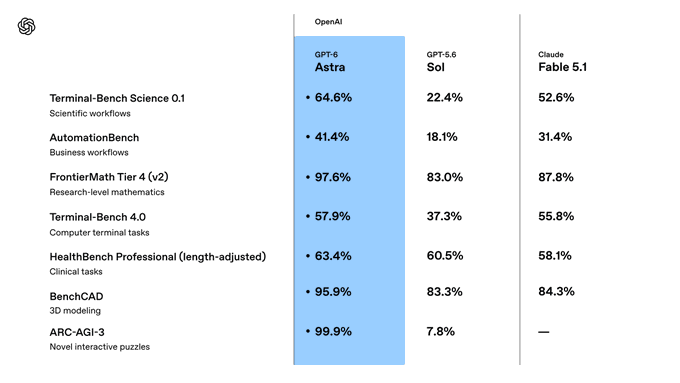
Coding is one of Astra’s clearest areas of strength. On OpenAI’s published launch table, Astra scores 57.9% versus 55.8% on Terminal-Bench 4.0, 74.1% versus 67.4% on DeepSWE v1.1, and 63.9% versus 57.8% on an internal database-migration evaluation.
| Coding benchmark | GPT-6 Astra | Claude Fable 5.1 | Result |
|---|---|---|---|
| Terminal-Bench 4.0 | 57.9% | 55.8% | Astra +2.1 pts |
| DeepSWE v1.1 | 74.1% | 67.4% | Astra +6.7 pts |
| FrontierCode 1.1 Extended | 64.5% | 63.6% | Astra +0.9 pts |
| FrontierCode 1.1 Main | 53.3% | 50.9% | Astra +2.4 pts |
| Database migration, internal | 63.9% | 57.8% | Astra +6.1 pts |
Astra represents a substantial breakthrough for execution-focused models: its published results lead Fable 5.1 on Terminal-Bench 4.0, DeepSWE v1.1, and the database-migration evaluation, reinforcing its advantage when code must be executed, tested, and verified across tools.
The conclusion is not that Fable 5.1 is weak at coding. Anthropic describes it as its most capable model for ambitious coding projects, and its own CursorBench 3.2.0 result reaches 73.4%. The difference is the shape of the workload: Astra’s advantage becomes more convincing when coding is mixed with shell execution, repository navigation, verification, and other tools.
Winner for execution-heavy software engineering: Astra. A long-running repository agent is a closer call because sustained coherence, caching behavior, and token efficiency can matter as much as one benchmark score.
GPT-6 Astra vs Fable 5.1 :which is better for Reasoning and Science
The reasoning comparison is more interesting because there is no sweep. OpenAIs published evaluations report Astra at 97.6% on FrontierMath Tier 4, 96.0% on GPQA Diamond, and 64.6% on Terminal-Bench Science 0.1. Fable 5.1 records 87.8%, 93.7%, and 52.6% respectively in the same comparison.
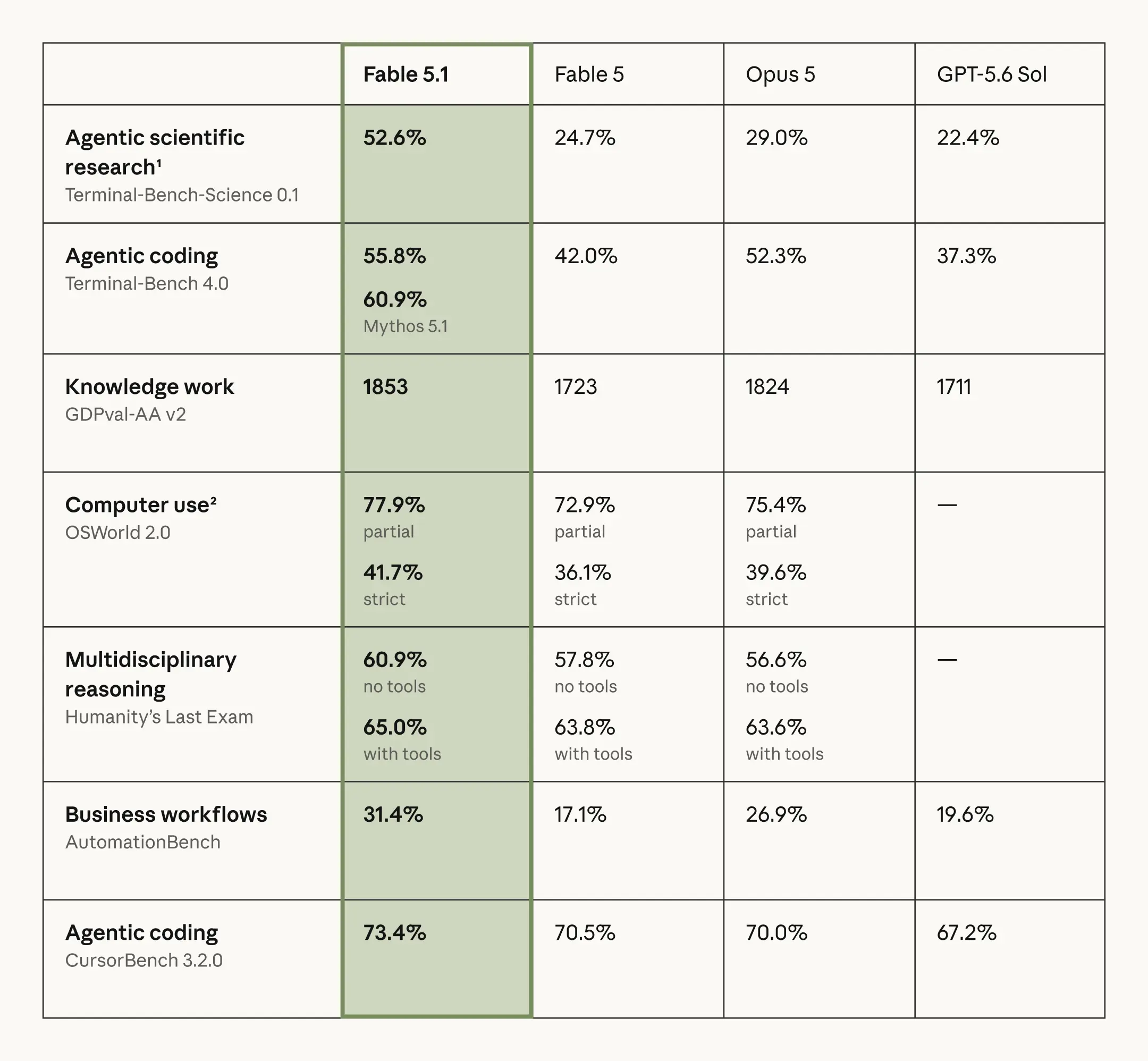
Fable 5.1 reverses the result on Humanity’s Last Exam with tools, scoring 65.0% against Astra’s 57.2%. Anthropic’s official benchmark table independently reports the same 65.0% result for Fable 5.1.
| Reasoning / science benchmark | GPT-6 Astra | Claude Fable 5.1 | Winner |
|---|---|---|---|
| FrontierMath Tier 4 v2 | 97.6% | 87.8% | Astra |
| GPQA Diamond | 96.0% | 93.7% | Astra |
| Terminal-Bench Science 0.1 | 64.6% | 52.6% | Astra |
| Humanity's Last Exam, with tools | 57.2% | 65.0% | Fable 5.1 |
| Artificial Analysis Intelligence Index | 61.2 | 65.7 | Fable 5.1 |
This distinction matters. FrontierMath and Terminal-Bench Science emphasize specialized mathematical or scientific problem solving, especially when reasoning interacts with tools and external environments. Humanity’s Last Exam is broader and multidisciplinary. A practical reading is that Astra looks stronger at deeply technical, tool-executed reasoning, while Fable 5.1 retains an edge on broader frontier-reasoning evaluations.
Source: Anthropic official benchmark
Computer Use and Professional Work Favor GPT-6 Astra
A direct Astra-versus-Fable 5.1 OSWorld comparison would be misleading. The Anthropic benchmark note says Fable 5.1 uses the authors’ August 2026 task release. Its chart reports 77.9% partial and 41.7% strict, but those figures are not equivalent to the OpenAI 72.6% result.
| Professional benchmark | GPT-6 Astra | Claude Fable 5.1 | Result |
|---|---|---|---|
| AutomationBench | 41.4% | 31.4% | Astra +10.0 pts |
| BenchCAD | 95.9% | 84.3% | Astra +11.6 pts |
| Terminal-Bench Science | 64.6% | 52.6% | Astra +12.0 pts |
OpenAI also specifically trains Astra around producing documents, spreadsheets, and presentations and says it is designed to carry out multistep professional workflows rather than merely generate the text component. Fable 5.1 is also built for long-running agents, browser operation, research, coding, and professional document workflows, but Astra currently has stronger published evidence for computer-mediated execution and artifact production.
Winner for computer-use agents and professional automation: Astra.
GPT-6 Astra vs Claude Fable 5.1 Long Context: 1.05M vs 1M Is the Wrong Comparison
Astra technically has the larger context window: 1.05 million tokens versus Fable 5.1’s 1 million. That 5% difference is unlikely to decide a production architecture. Pricing inside the context window can.
The OpenAI long-context pricing rule applies when a request contains more than 272K input tokens: input and cache rates double, while the output rate rises by 1.5 times for the full request. Astra’s effective rates therefore become $20 input, $2 cached input, and $75 output per MTok.
The Fable 5.1 specification documents a 1M context window with $10 input, $50 output, and $0.25 cache reads per MTok. For applications that routinely load 300K, 500K, or 900K tokens into a request, the nominal context-window size therefore tells only half of the story.
For very large contexts, Fable 5.1 has the cleaner rate-card economics, especially when much of the context can be cached.
GPT-6 Astra vs Claude Fable 5.1 Pricing: Same Headline Price, Very Different Agent Economics
At official Standard rates, the two models begin in an exact tie on uncached text input and output.
| Price component | GPT-6 Astra | Claude Fable 5.1 |
|---|---|---|
| Input / MTok | $10.00 | $10.00 |
| Output / MTok | $50.00 | $50.00 |
| 5-minute cache write / MTok | $12.50 | $12.50 |
| Cache read / MTok | $1.00 | $0.25 |
| Batch input/output discount | 50% | 50% |
| Long-context surcharge | Above 272K input | None across standard 1M context |
The key number is not $10 or $50. It is $0.25. Anthropic cut Fable 5.1’s cache-read rate to $0.25 per million tokens, one quarter of Astra’s standard $1 cached-input price and one eighth of Astra’s $2 long-context cache rate.
This can matter enormously for an agent loop. A long-running application may repeatedly carry a large system prompt, tool definitions, repository context, and reference documents across dozens of turns. When the stable prefix is repeatedly read from cache, cache pricing compounds in a way a single-turn benchmark never captures.
The Anthropic workload estimate says the lower cache price can reduce typical Fable 5.1 workload cost by about 25% and highly agentic workload cost by up to approximately 45%. These are vendor estimates rather than universal guarantees, but they show why cache economics deserves its own comparison dimension.
Does That Make Fable 5.1 Cheaper?
Not automatically. A model with more expensive tokens can still produce a lower bill if it solves the task with fewer tokens, fewer retries, fewer failed tool calls, or less wall-clock time. This is why cost per successful task is more informative than price per million tokens.
The practical pricing verdict is split: Fable 5.1 wins the rate card for cache-heavy and very-long-context workloads. Astra can still win cost per completed task when its execution advantage materially reduces retries, token use, or runtime.
CometAPI Pricing Narrows the Decision to Workload Quality
Both models are available through CometAPI. GPT-6 Astra API in CometAPI starts at $8 per million input tokens, while Claude Fable 5.1 API in CometAPI starts at the same $8 input rate. That is 20% below the providers’ base input rate.
| API pricing | GPT-6 Astra | Claude Fable 5.1 |
|---|---|---|
| Official input / output | $10 / $50 | $10 / $50 |
| CometAPI input / output | $8 / $40 | $8 / $40 |
| Reduction vs official base rate | 20% | 20% |
This creates a useful production setup: instead of deciding solely from public benchmark tables, developers can evaluate the same workload against both model IDs through one API environment and compare accepted-result rate, token consumption, latency, tool failures, and total spend. Prices and billing rules can change, so production budgeting should use the live API configuration rather than hard-coding the values in this article.
Tool Use and Agent Design: Similar Goal, Different Philosophy
Both models are designed for agents, but their APIs expose different philosophies. GPT-6 Astra supports a tool-rich Responses API environment. The OpenAI supported tool set includes web search, file search, image generation, code interpreter, hosted shell, Apply Patch, computer use, MCP, and tool search. Configurable reasoning effort lets an application decide how much compute to spend.
Fable 5.1’s reasoning model is different: adaptive thinking is always enabled, with effort used to steer depth. Anthropic also added per-message effort, turn-scoped system messages, and readable progress updates between tool calls, which are particularly useful in long autonomous sessions.
GPT-6 Astra therefore feels optimized around tool breadth and end-to-end environment control, while Fable 5.1 feels optimized around persistent long-horizon reasoning and agent continuity. Neither architectural style is universally superior; your orchestration layer matters as much as the raw model.
Why Safety and Deployment Constraints Matter for GPT-6 Astra and Claude Fable 5.1
OpenAI describes Astra as its first model to reach the company’s Critical cybersecurity threshold and deploys additional safeguards around high-capability workflows. The same announcement describes production monitoring and task interruption when an agent may exceed its authorized scope.
Fable 5.1 uses a different safeguard architecture. Anthropic states that some cybersecurity and biology requests identified by its safeguards can be routed to less capable models. That means a production score can reflect both the underlying model and the safeguards surrounding it.
This is another reason cross-vendor benchmark tables should not be treated as perfectly controlled laboratory comparisons. Enterprise evaluations should include refusals, fallback behavior, task interruption, audit requirements, data retention, and privacy controls rather than considering them only after model selection.
GPT-6 Astra vs Claude Fable 5.1: Which Model Should You Choose?
| Workload | Recommended model | Why |
|---|---|---|
| Autonomous computer-use agent | Astra | Stronger published computer-use and professional execution evidence |
| Agentic terminal / software engineering | Astra | Leads Terminal-Bench, DeepSWE, and database-migration results |
| Scientific tool workflows | Astra | Strong FrontierMath, GPQA, and Terminal-Bench Science results |
| Broad frontier reasoning | Fable 5.1 | Leads HLE with tools and the Intelligence Index |
| Long-running asynchronous agent | Fable 5.1 | Designed around long-horizon agentic work and progress updates |
| 300K–1M-token requests | Fable 5.1 | Avoids Astra’s 272K long-context surcharge in standard pricing |
| Heavy prompt-cache reuse | Fable 5.1 | $0.25/MTok official cache reads |
| Document / spreadsheet / presentation automation | Astra | Strong professional-work and artifact-generation positioning |
| Large repository with repeated cached context | Fable 5.1 | Cache economics can dominate repeated agent loops |
| Mixed production workloads | Test both | Different strengths make workload routing more useful than a universal winner |
If your application asks the model to act, Astra should usually be the first model to test. If the application asks the model to think for a long time over a very large and repeatedly reused context, Fable 5.1 deserves equal or greater attention.
GPT-6 Astra vs Claude Fable 5.1: Which Is Better Overall?
There is no clean 10–0 result. Astra wins more of the directly comparable vendor-published rows, with particularly consistent advantages across coding execution, scientific tooling, computer use, and professional automation. For developers building an agent that must operate software rather than merely discuss what to do, that is a substantial advantage.
Fable 5.1’s wins are narrower but strategically important. Its 65.0% Humanity’s Last Exam result and stronger Intelligence Index score show that Astra does not simply dominate general reasoning. Fable 5.1 also has a structural pricing advantage for cache-heavy agents and requests that use a large fraction of the million-token context.
The deeper shift is that frontier-model selection is moving away from “which chatbot gives the smartest answer?” toward “which system finishes this job correctly at the lowest total cost?”
How to Compare Them for Your Own Application
A public leaderboard should narrow your shortlist, not make your production decision. Build a fixed evaluation set from real tasks. Run identical input material against both models, preserve equivalent tool permissions, and measure not only whether the final answer looks good but whether the task actually succeeds.
For an agentic application, useful metrics include total task success, human acceptance rate, tool-call failures, retries, time to completion, uncached input, cache reads, output tokens, and total API spend.
A simple deployment metric is total API spend ÷ accepted completed tasks.
That number can reverse a benchmark-based decision. A model charging more per token can be cheaper if it needs fewer retries. A model with cheap caching can become dramatically cheaper across a 50-turn agent loop. A model that scores higher in isolation can lose once your tools, retrieval layer, and real acceptance criteria are introduced.
Astra and Fable 5.1 are available through CometAPI, the strongest production strategy is not necessarily to commit permanently to one provider. Keep the model configurable, evaluate both against the same acceptance criteria, and route each workload to the model that actually performs best.
FAQs
Is GPT-6 Astra better than Claude Fable 5.1?
Astra is stronger on several directly comparable coding, scientific, and professional-work benchmarks, including Terminal-Bench, DeepSWE, FrontierMath, and AutomationBench. Fable 5.1 leads on Humanity’s Last Exam with tools and the Artificial Analysis Intelligence Index. Neither model wins every dimension.
Which model is better for coding?
GPT-6 Astra is the better model for coding, especially for agentic coding and execution. OpenAI’s published comparison reports 57.9% for Astra versus 55.8% for Fable 5.1 on Terminal-Bench 4.0, with larger Astra leads on DeepSWE and the database-migration evaluation. Claude Fable 5.1 remains highly competitive for long-running repository work, but Astra has the stronger overall coding evidence.
Which model is better for long context?
Claude Fable 5.1 is the better choice for long-context workloads, especially for very large requests and repeated prompt-cache use. Both models provide roughly one million tokens of context, but GPT-6 Astra applies higher rates when input exceeds 272K tokens, while Fable 5.1 maintains a simpler rate structure and offers substantially cheaper prompt-cache reads.
Which one is cheaper?
Neither model is cheaper at the standard base rate—they are tied; Claude Fable 5.1 is cheaper for cache-heavy and very-long-context workloads. Official base pricing is $10 per million input tokens and $50 per million output tokens for both models. Through CometAPI, GPT-6 Astra and Fable 5.1 both currently start at $8 per million input tokens and $40 per million output tokens. Fable 5.1 gains the cost advantage when prompt-cache reads or Astra’s long-context surcharge become material.
Should developers use only one of them?
Not necessarily. Their strengths are complementary enough that a multi-model evaluation or routing strategy can outperform choosing one model for every request. Test real production workloads and compare cost per accepted completed task rather than relying on a single benchmark score.