
TL;DR
Grok 4.6 is the stronger default if you want a managed frontier API for agentic coding and knowledge work: it scores 61 on the Artificial Analysis Intelligence Index, generates faster in current independent measurements, and starts at $2/$6 per million input/output tokens.
Kimi K3 is the more flexible choice when context length and model openness matter. It combines 2.8 trillion parameters, 104B active parameters and a roughly 1M-token context window, plus open weights and native multimodal capabilities. Its headline hosted API pricing is higher at $3/$15 per million input/output tokens, but cache hits cost only $0.30 per million tokens.
Bottom line: choose Grok 4.6 for a cost-efficient hosted agent API; choose Kimi K3 for 1M context, open weights and infrastructure control. For coding, test both on your own repositories because the vendors publish different benchmark versions and harnesses.
Key Takeaways
- Grok 4.6 was released on August 12, 2026 with a specific emphasis on long-running agents, codebase work, knowledge work, and more ambitious interactive or visual projects.
- Kimi K3 is Moonshot AI’s 2.8T-parameter open-weight flagship with Kimi Delta Attention, Attention Residuals, native vision and a 1M-token context window.
- Independent overall intelligence is nearly tied: 61 for Grok 4.6 versus 60 for Kimi K3.
- Grok 4.6 has the lower headline token price: $2 input / $6 output versus $3 input / $15 output for Kimi K3.
- Kimi K3 offers roughly twice the context capacity and open weights; Grok 4.6 is proprietary but is more turn-and cost-efficient in several independent agent evaluations.
Grok 4.6 vs Kimi K3: Quick Comparison
| Specification | Grok 4.6 | Kimi K3 |
|---|---|---|
| Developer | SpaceXAI / xAI | Moonshot AI / Kimi |
| Release date | August 12, 2026 | July 16, 2026 |
| Model ID | grok-4.6 | kimi-k3 |
| Architecture | Not publicly disclosed | MoE; KDA + AttnRes + Stable LatentMoE |
| Total parameters | Not disclosed | 2.8T |
| Active parameters | Not disclosed | 104B |
| Experts | Not disclosed | 896 total; 16 activated/token |
| Context window | 500,000 tokens | 1,048,576 / about 1M tokens |
| Input / output | Text + image → text | Text + image → text |
| Reasoning | Configurable | Always-on; low / high / max |
| Function / tool use | Function calling + structured outputs | ToolCalls, tool_choice, dynamic tool loading |
| Open weights | No | Yes |
| AA Intelligence Index | 61 | 60 |
| Official input / output price | $2 / $6 per MTok | $3 / $15 per MTok |
| Best fit | Hosted agents, coding, knowledge work | Long context, open-weight deployment, coding + visual reasoning |
What Is Grok 4.6?
Grok 4.6 is SpaceXAI’s frontier model for coding, agentic tasks and knowledge work. The company says the release was built around long-running agents and more ambitious interactive and visual work, rather than being only a static benchmark refresh. In practice, that means the model is intended to stay on a task across many steps: researching a topic, navigating a codebase, analyzing information, calling tools, and iterating toward a finished application or work artifact.
What Changed From Grok 4.5?
SpaceXAI reports a longer supplemental training run using curated model-generated reasoning data, advanced technical concepts, high-quality engineering data, and an improved optimizer and training recipe. The team then regenerated SFT trajectories with Grok 4.5 across reasoning efforts and agent harnesses, filtered problematic traces, and applied agentic reinforcement learning in environments spanning general coding, kernel optimization, web development, CAD and knowledge work.
The practical result is a model that not only scores higher but also shows more self-testing and verification on longer trajectories. That behavior matters for agents because the cost of a small mistake compounds when a model is allowed to edit files, call tools, or execute a multi-step plan without constant human intervention.
Grok 4.6 Specifications
| Property | Grok 4.6 |
|---|---|
| Context | 500,000 tokens |
| Modalities | Text and image input; text output |
| Reasoning | Configurable reasoning |
| Native API capabilities | Function calling and structured outputs |
| Knowledge cutoff | February 1, 2026 |
| Short-context pricing | $2 input / $0.50 cached / $6 output per MTok |
| Long-context threshold | ≥200K prompt tokens; $4 / $1 / $12 |
What Is Kimi K3?
Kimi K3 is Moonshot AI’s flagship open-weight multimodal agentic model. It combines 2.8 trillion total parameters with a 1M-token context window and native vision, positioning it for long-horizon coding, end-to-end knowledge work, reasoning and visually grounded software tasks.
Unlike Grok 4.6, Kimi K3 exposes its model weights. The current official model card identifies 104B active parameters during inference, so its compute path is far smaller than the full 2.8T parameter count even though deploying the complete model still requires substantial infrastructure.
KDA, AttnRes and a More Sparse MoE
The architecture is one of K3’s biggest differentiators. Moonshot says Kimi Delta Attention (KDA) and Attention Residuals (AttnRes) are designed to improve information flow across long sequences and deep model layers. Stable LatentMoE increases sparsity so that 16 of 896 experts are activated for each token. Together with training and data-recipe changes, Moonshot reports about 2.5× better overall scaling efficiency than Kimi K2.
Kimi K3 Specifications
| Property | Kimi K3 |
|---|---|
| Total / active parameters | 2.8T / 104B |
| Architecture | MoE with KDA + AttnRes + Stable LatentMoE |
| Experts | 896; 16 activated per token |
| Context | 1M tokens |
| Vision | Native visual understanding |
| Reasoning | Always enabled; low / high / max |
| Tools | ToolCalls, tool_choice constraints, dynamic tool loading |
| Open weights | Available on Hugging Face |
| Official pricing | $0.30 cache hit / $3 input / $15 output per MTok |
Grok 4.6 vs Kimi K3: Benchmark Comparison
The cleanest direct comparison is the independent Artificial Analysis Intelligence Index because both models are evaluated under the same framework. Current scores are 61 for Grok 4.6 (high) and 60 for Kimi K3 (max). A one-point gap is too small to justify a claim that one model is categorically “a generation ahead.” The more useful question is where each model earns its score.
| Independent metric | Grok 4.6 | Kimi K3 | Edge |
|---|---|---|---|
| Artificial Analysis Intelligence Index | 61 | 60 | Grok 4.6 by 1 point |
| Output speed | 65.8 tok/s | 40.7 tok/s | Grok 4.6 |
| Time to first token | ~32.3 s | 3.27 s | Kimi K3 |
| Context window | 500K | ~1.05M | Kimi K3 |
Coding Performance
SpaceXAI publishes several coding and software-engineering results for Grok 4.6: 69.9% on CursorBench 3.2, 65.9% on DeepSWE 1.1, 61.3% on FrontierCode 1.1 Extended, 56.4% on APEX-SWE and 26.0% on Terminal-Bench 3.0. These are meaningful because they cover repository editing, agentic software engineering and terminal work rather than only code-completion trivia.
| Grok 4.6 vendor-reported coding benchmark | Score |
|---|---|
| CursorBench 3.2 | 69.9% |
| DeepSWE 1.1 | 65.9% |
| FrontierCode 1.1 Extended | 61.3% |
| APEX-SWE | 56.4% |
| Terminal-Bench 3.0 | 26.0% |
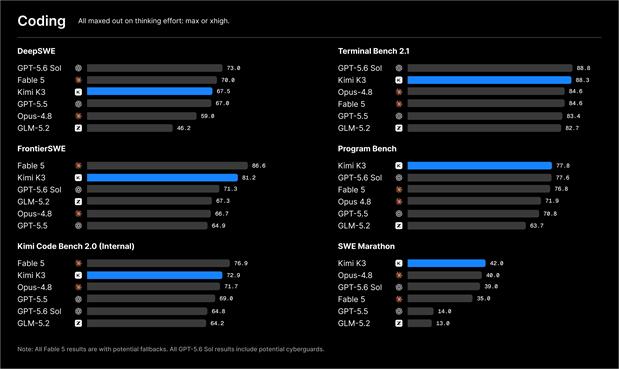
For Kimi K3, Moonshot publishes a different but broad coding suite. Its official launch material reports 67.5 on DeepSWE, 88.3 on Terminal-Bench 2.1, 81.2 on FrontierSWE, 77.8 on ProgramBench and 42.0 on SWE Marathon. The important caveat is that Terminal-Bench 2.1 and 3.0 are different versions, and FrontierSWE is not the same evaluation as FrontierCode. Those rows should not be treated as apples-to-apples wins based on the raw number alone.
Source: Moonshot AI / Kimi
Agentic and Knowledge Work
Agentic work is where Grok 4.6 looks strongest. SpaceXAI reports 1753 Elo on GDPVal-AA v2, 57.5% on APEX-Agents and 1577 Elo on AA-Briefcase. Artificial Analysis independently highlights the same pattern: Grok 4.6’s strongest gains are on long-horizon, tool-using work rather than only static reasoning.
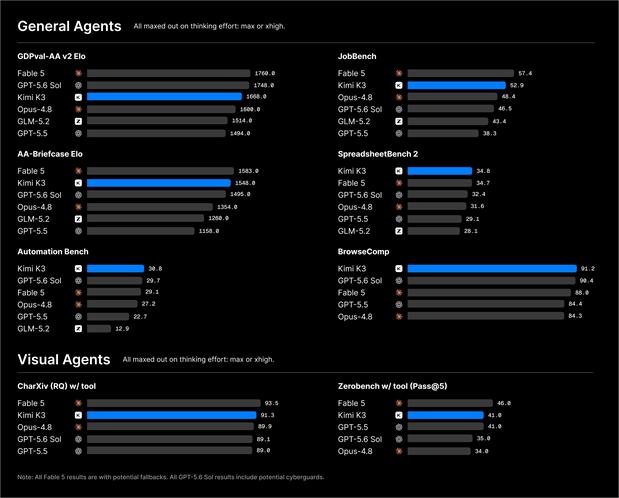
Kimi K3 also targets knowledge-work agents. Moonshot’s launch suite shows strong results on BrowseComp, GDPval-AA v2, JobBench, SpreadsheetBench 2 and visual-agent evaluations. More importantly for developers, the Kimi API exposes tool choice constraints and dynamic tool loading, which are practical controls when an agent must use enterprise systems or retrieve facts before answering.
Source: Moonshot AI / Kimi
Multimodal and Visual Reasoning
Kimi K3 has the clearer architecture-level multimodal story: Moonshot describes native vision capabilities and specifically demonstrates “vision in the loop” for game development, frontend engineering and CAD, where the model can inspect visual feedback and revise code.
Grok 4.6 also accepts text and image input and SpaceXAI says the model produces stronger first passes on visual and interactive projects than Grok 4.5. The difference is less about whether either model can see images and more about deployment philosophy: Kimi exposes an open multimodal model, while Grok packages visual understanding inside a managed frontier API and agent ecosystem.
Context Window: 500K vs 1M
Grok 4.6 supports 500,000 tokens, while Kimi K3 supports about 1 million tokens. That makes Kimi the obvious choice when the workload genuinely requires more than 500K tokens in one request—for example, very large repositories, multi-book research collections, or exceptionally long agent traces.
However, context size is capacity, not a guarantee of retrieval or reasoning quality. For production systems, test the model on your actual long-context failure modes: cross-file dependency tracking, distant fact retrieval, contradiction detection, and instruction persistence. Retrieval-augmented generation can still be cheaper and more controllable than sending a million tokens on every request.
Speed and Latency
Artificial Analysis currently measures Grok 4.6 at 65.8 output tokens per second and Kimi K3 at 40.7 tokens per second. Once generation begins, Grok is materially faster in this measurement. But the first-token pattern goes the other way: Kimi K3 has a measured TTFT of 3.27 seconds, while Grok 4.6’s current provider measurement is much slower to begin streaming.
That creates a useful product distinction. For interactive chat or IDE experiences, fast time-to-first-token can make Kimi feel responsive even if the full answer takes longer. For long generations and agent runs, Grok’s higher generation throughput can reduce the tail of the request. Provider, region, reasoning effort, cache state and request size can all change these numbers, so treat them as a current snapshot rather than a permanent property.
Grok 4.6 vs Kimi K3: API Pricing
At standard context lengths, Grok 4.6 costs $2 per million input tokens, $0.50 per million cached tokens and $6 per million output tokens. For prompts at or above 200K tokens, xAI bills the entire request at long-context rates of $4 input, $1 cached and $12 output per million tokens.
Kimi uses flat pay-as-you-go pricing across its 1M context window. The Kimi API lists $0.30 per million cache-hit tokens, $3 per million input tokens and $15 per million output tokens. That means Kimi is cheaper on cache hits but much more expensive on fresh output tokens; Grok’s pricing advantage narrows when Grok requests cross the 200K long-context threshold.
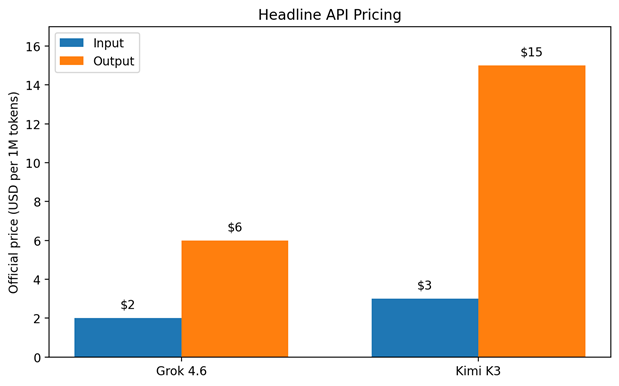
Headline official API prices per 1M tokens. Grok long-context requests (≥200K prompt tokens) use higher rates not shown in the chart. Source: SpaceXAI and Kimi API pricing
| Price / 1M tokens | Grok 4.6 | Kimi K3 |
|---|---|---|
| Official short-context input | $2.00 | $3.00 |
| Official cache hit | $0.50 | $0.30 |
| Official output | $6.00 | $15.00 |
| Long-context pricing | ≥200K: $4 / $1 / $12 | Flat pricing through 1M context |
| CometAPI input | $1.60 | $2.40 |
| CometAPI output | $4.80 | $12.00 |
On CometAPI, Grok 4.6 is currently listed at $1.60 input / $4.80 output per million tokens, while Kimi K3 is listed at $2.40 input / $12 output. Both are 20% below the providers’ headline input/output prices shown on their CometAPI model pages at the time of writing.
Open Weights vs Proprietary Model
Kimi K3 is an open-weight model with downloadable weights. That enables research, fine-grained infrastructure control, private inference architectures and deployment through third-party inference stacks. It does not mean K3 is lightweight: a 2.8T-parameter model is a serious systems project even with MoE sparsity and low-precision formats.
Grok 4.6 is proprietary. Its architecture and parameter count are not publicly disclosed, and developers access it as a managed service. The trade-off is operational simplicity: you do not have to build an inference cluster, manage model weights or optimize kernels to get frontier-level agent performance.
Strengths and Weaknesses
| Model | Strengths | Trade-offs |
|---|---|---|
| Grok 4.6 | Lower hosted API price; 61 AA Intelligence; faster measured generation; strong long-horizon agent results; integrated xAI tool stack | 500K context; closed weights; long-context pricing doubles; slower measured TTFT |
| Kimi K3 | ~1M context; open weights; 2.8T MoE; native multimodality; strong coding/agent suite; very low cache-hit price | Higher output price; slower measured token generation; full self-hosting is infrastructure-heavy |
Grok 4.6 vs Kimi K3: Which Should You Choose?
| Use case | Recommended | Why |
|---|---|---|
| Default frontier API | Grok 4.6 | Lower price with a slight independent intelligence lead |
| Long-running knowledge-work agent | Grok 4.6 | Strongest evidence from GDPVal-AA and AA-Briefcase |
| Repository-scale coding | Test both | Both are designed for long-horizon coding; benchmark suites differ |
| Prompt >500K tokens | Kimi K3 | About 1M context |
| Open-weight research | Kimi K3 | Weights and architecture are available |
| Private/self-managed inference | Kimi K3 | Open weights enable custom deployment |
| Low cache-hit cost | Kimi K3 | $0.30/MTok cache-hit pricing |
| Lower fresh output-token cost | Grok 4.6 | $6/MTok vs $15/MTok at standard context |
| Fast first visible response | Kimi K3 | Much lower measured TTFT |
| Faster long generation | Grok 4.6 | Higher measured output tokens/s |
| Visual coding / CAD / game workflows | Kimi K3 | Native vision + official vision-in-the-loop focus |
Overall recommendation: Grok 4.6 is the stronger default hosted API for most agent developers. Kimi K3 is the more flexible frontier model when 1M context, open weights and deployment control are part of the requirement rather than optional extras.
How to Access Grok 4.6 and Kimi K3 Through CometAPI
Both models are live on CometAPI. The Grok 4.6 model page lists the model ID grok-4.6 and support for Chat Completions / Responses-style access, while the Kimi K3 model page exposes kimi-k3 through the unified CometAPI endpoint. That makes A/B testing easier because you can switch model IDs while keeping authentication and most application plumbing constant.
from openai import OpenAI
 import os

 client = OpenAI(
    base_url="https://api.cometapi.com/v1",
    api_key=os.environ["COMETAPI_KEY"],
 )

 for model in ["grok-4.6", "kimi-k3"]:
    response = client.chat.completions.create(
        model=model,
        messages=[
            {"role": "user", "content": "Review this repository bug and propose a tested fix."}
        ],
    )
    print(model, response.choices[0].message.content)
For a production evaluation, keep the prompt, tools, repository snapshot and success criteria identical. Track not only answer quality but also tool-call success, number of turns, total input/output tokens, latency and recovery from failed tool calls. That is more predictive of real agent cost than a single benchmark score.
Conclusion
The most important result of the Grok 4.6 vs Kimi K3 comparison is that their top-line intelligence is much closer than their product design. Independent evaluation currently puts them at 61 versus 60, but the surrounding economics and deployment choices are very different.
Grok 4.6 is optimized as a managed frontier service: lower fresh-token pricing, strong agentic benchmarks, faster measured generation and a mature tool/API path. Kimi K3 is optimized for flexibility: a 1M context window, 2.8T MoE scale, native multimodality and open weights.
For most developers who simply need the best default hosted model for coding and long-running agents, Grok 4.6 is the safer starting point. If your system depends on >500K context, open-weight deployment, visual coding or control over the inference stack, Kimi K3 can be the better architectural choice even when its hosted token price is higher.
FAQs
Is Grok 4.6 smarter than Kimi K3?
On the current Artificial Analysis Intelligence Index, Grok 4.6 scores 61 and Kimi K3 scores 60. That is a narrow lead, not a decisive gap. Task-level performance can reverse depending on the workload.
Which is better for coding?
Both are credible coding models. Grok 4.6 has strong current agentic coding results and lower hosted pricing; Kimi K3 offers a larger context window, open weights and strong repository/visual coding results. Use your own repo benchmark because the vendors report different benchmark versions.
Which model has the larger context window?
Kimi K3 supports about 1M tokens, roughly twice the 500K-token context of Grok 4.6.
Which is cheaper?
For standard-context fresh tokens, Grok 4.6 is cheaper at $2 input / $6 output per MTok versus $3 / $15 for Kimi K3. Kimi has the cheaper cache-hit rate at $0.30/MTok, while Grok applies higher rates once the prompt reaches 200K tokens.
Can I self-host Kimi K3?
Kimi K3 has open weights available on Hugging Face, so self-managed deployment is possible. The full 2.8T model is nevertheless extremely large and requires serious multi-node or specialist inference infrastructure for practical performance.
Can I self-host Grok 4.6?
No public Grok 4.6 weights are available. Grok 4.6 is delivered as a proprietary managed model through SpaceXAI and partner APIs.
Can I access both from one API?
Yes. CometAPI currently lists both Grok 4.6 and Kimi K3, allowing developers to compare them behind a unified API and billing layer.