
Grok 4.7 Release Update: From Predictions to Official Availability
Information checked: October 16, 2026.
Grok 4.7 was officially released on September 21, 2026. Earlier references to a September 12 launch were pre-release estimates and should not be treated as the actual release date.
The official launch announcement describes improvements in coding, knowledge work, longer-running tasks, and verification of the model’s own results. It confirms availability through the Grok API, Cursor, and Grok Build. For the exact API model ID, supported features, context limits, and current pricing, consult the official Grok 4.7 documentation.
Official results show measurable progress over Grok 4.6. For example, the launch comparison reports a Terminal-Bench 4.0 score of 37.6% for Grok 4.7 at xhigh effort, compared with 20.3% for Grok 4.6 at high effort. These are provider-reported results under the stated evaluation settings; application performance will depend on prompts, tools, reasoning effort, and task difficulty.
For developers, the useful question is now whether Grok 4.7 completes their workloads more reliably and economically. Test it on repository changes, document creation, and multi-step tool workflows, measuring successful completion, latency, retries, and total task cost.
Source: Official Grok 4.7 launch announcement.
Key Takeaways
- The expected September 12 date is inferred from Musk's ten-day countdown, not a separately published xAI calendar announcement.
- The 2.1T scale and SpaceX-data statements are pre-release claims; active parameters, routing, architecture, and training methodology remain unpublished.
- Grok 4.6 already shows strong knowledge-work and agentic results, including 61.3% on FrontierCode v1.1 (Extended), but it trails the strongest comparison model on several difficult coding evaluations.
- Grok 4.7 should be judged by accepted-task rate, long-horizon reliability, token efficiency, latency, and cost per successful outcome—not parameter count alone.
- CometAPI will integrate Grok 4.7 as soon as xAI officially releases the model and production endpoint access is available; developers should still validate the live model ID, price, and response behavior before migration.
What Is Grok 4.7?
Grok 4.7 is the announced successor to Grok 4.6 and is expected to continue xAI's focus on coding, engineering, long-running agents, and professional knowledge work. The public evidence currently consists of founder statements and a release countdown rather than a complete technical launch package.
The most important distinction is between three objects: the announced Grok 4.7 model, the pre-release signals describing its possible scale and training, and the live Grok 4.6 production baseline. Developers should treat Grok 4.7 as an upcoming evaluation candidate until xAI publishes final documentation and a production request succeeds against the released endpoint.
Grok 4.7 Release Date and Timeline
When is Grok 4.7 expected to be released?
Musk's September 2 statement that the model would arrive in ten days points to approximately September 12, 2026
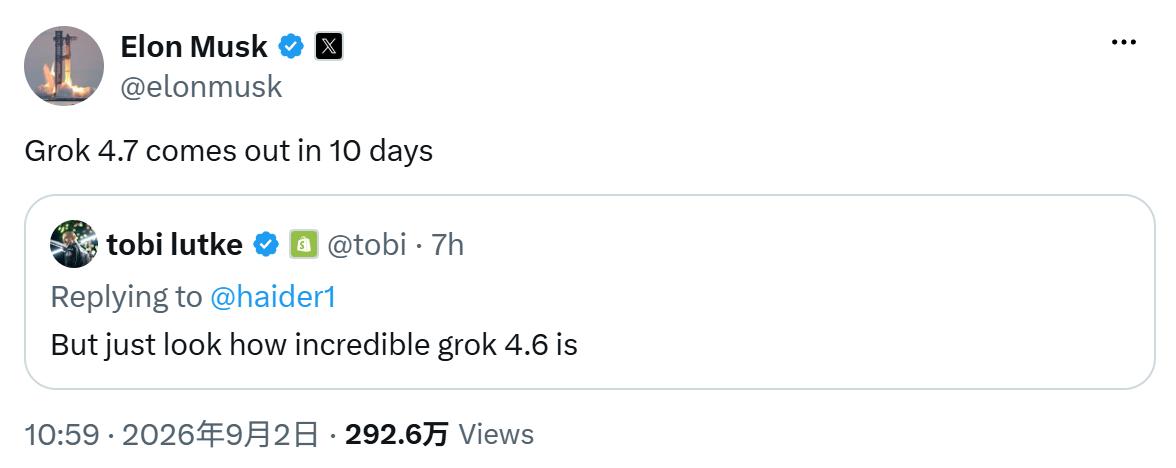
Source: Elon Musk on X, September 2, 2026
Grok 4.7 Release Timeline
| Date | Public signal | Interpretation |
|---|---|---|
| Late July 2026 | Musk described a roughly 2.1T model, improved token efficiency, and somewhat slower serving. | Founder-stated model-scale and efficiency expectations. |
| August 12, 2026 | Initial training was described as complete; supplemental training reportedly included substantial SpaceX company data. | A training-progress update, not a release confirmation. |
| September 2, 2026 | “Grok 4.7 comes out in 10 days.” | The clearest public release countdown so far. |
| September 12, 2026 | Calendar date derived from the countdown. | Expected target; final availability still requires an xAI release notice and a working endpoint. |
Grok 4.7 Specifications: Confirmed vs Unconfirmed Information
The most useful way to read current Grok 4.7 information is to separate direct founder statements from specifications that xAI has not published. The new post confirms only the model name and a release countdown; it does not add technical parameters or benchmark results.
| Specification | Current Grok 4.7 status | Evidence level |
|---|---|---|
| Release timing | Around September 12, inferred from the September 2 ten-day countdown | Founder-announced target |
| Model scale | Approximately 2.1T parameters | Founder-stated |
| Initial training | Described as complete by August 12 | Founder-stated |
| Supplemental training | Includes substantial SpaceX company data | Founder-stated |
| Relative quality | Claimed to be significantly better than Grok 4.6 | Unverified claim |
| Token efficiency | Claimed improvement over Grok 4.6 | Unverified claim |
| Serving speed | Expected to be somewhat slower | Founder-stated |
| Context window | Not published by xAI | Unknown |
| Input/output modalities | Not published by xAI | Unknown |
| Final API model ID | Not confirmed in xAI documentation | Unknown |
| Official pricing | Not published by xAI | Unknown |
| Official benchmarks | None published for Grok 4.7 | Unknown |
The roughly 2.1T parameter claim does not disclose active parameters, sparsity, expert routing, inference cost, or effective training compute. Parameter count alone cannot establish production quality.
Why the SpaceX Training Signal May Matter More Than 2.1T
The more consequential disclosure may be the SpaceX company-data supplement. A high-quality engineering corpus could improve technical reasoning, design, debugging, optimization, and long-horizon agent work, where task distribution and post-training quality often matter more than raw scale.
This direction is consistent with xAI’s released-model strategy. The Grok 4.6 training report describes a longer supplemental training run with high-quality engineering data, followed by supervised fine-tuning and reinforcement learning across coding, STEM, web development, kernel optimization, and computer-aided design.
That makes the Grok 4.7 claim technically plausible, not proven. A real advantage should become visible after release in reproducible engineering tests, task-completion rates, latency, and cost per successful outcome.
Grok 4.7 vs Grok 4.6 Performance: What the Baseline Shows
No official Grok 4.7 scores exist yet. The responsible comparison point is xAI’s released Grok 4.6 evaluation. The full model overview appears in CometAPI’s Grok 4.6 deep dive; the table below keeps only the most decision-relevant benchmark rows.
| Official evaluation | Grok 4.6 High | Grok 4.5 High | GPT-5.6 Sol Max | Claude Fable 5 Max |
|---|---|---|---|---|
| AA Intelligence Index | 61 | 56 | 61 | 62 |
| GDPVal-AA v2 | 1753 | 1526 | 1728 | 1741 |
| CursorBench v3.2 | 69.9% | 66.7% | 67.2% | 70.5% |
| DeepSWE v1.1 | 65.9% | 54.0% | 73.0% | 70.0% |
| FrontierCode v1.1 (Extended) | 61.3% | 56.6% | 60.6% | 63.6% |
| Terminal-Bench v3.0 | 26.0% | 15.7% | 34.6% | 34.1% |
Baseline result: Grok 4.6 demonstrates a real advantage over Grok 4.5 across every row shown. It matches GPT-5.6 Sol on the overall intelligence index, leads this group on GDPVal-AA v2, and edges GPT-5.6 Sol on FrontierCode. Its main published gaps remain DeepSWE and Terminal-Bench.
These results set a concrete standard for Grok 4.7. If the larger model and engineering-oriented supplemental training transfer into production, the expected breakthrough would be stronger repository-level coding and terminal-task completion without losing Grok 4.6's knowledge-work strength. A credible stretch target is to become competitive with the released Claude Fable 5.1 on coding and long-running agent workflows. That is a forecast to test, not a current benchmark claim.
Grok 4.7 vs Grok 4.6 : Expected Breakthroughs and Upgrade Guidance
The leaked and founder-stated signals suggest five areas where Grok 4.7 may improve. Because xAI has not published final evaluation data, each expectation should be converted into a measurable acceptance test.
Repository-Level Coding
Grok 4.6 is already strong on CursorBench and FrontierCode, but its DeepSWE and Terminal-Bench results leave visible room for improvement. Grok 4.7 should demonstrate higher patch acceptance, fewer regressions, and better command-line recovery on the same repositories before it replaces 4.6.
Long-Horizon Agent Reliability
The SpaceX-data signal and xAI's existing agent-training direction suggest a focus on multi-stage engineering work. Measure completed workflows, failed tool calls, retries, human interventions, and recovery after errors—not just the quality of the final prose.
Knowledge Work and Technical Reasoning
Grok 4.6 already leads the comparison set on GDPVal-AA v2. Grok 4.7 should preserve that advantage while improving transfer to design reviews, research synthesis, debugging, optimization, and other complex technical tasks.
Token Efficiency
A larger model can still be cheaper per successful task if it reaches correct outcomes in fewer steps. Compare total input, cached input, output tokens, retries, and cost for the same accepted result.
Serving Trade-Offs
If Grok 4.7 is slower, quality gains must outweigh latency. Record time to first token, sustained throughput, complete-task wall time, error rate, and cost under realistic concurrency.
Grok 4.7 Benchmarks: 5 Tests to verify a Real Upgrade Over Grok 4.6
- Software-engineering success: Measure resolved issues, passing tests, regression rate, and patch acceptance on representative repositories.
- Long-horizon agent reliability: Track completed workflows, tool-call failures, retries, recovery, and human interventions across multi-step runs.
- Real-world engineering transfer: Test design, debugging, optimization, scientific reasoning, and CAD-related tasks with disclosed grading criteria.
- Token efficiency per successful task: Compare total tokens and spend required to reach the same accepted outcome.
- Latency and cost under production load: Evaluate time to first token, throughput, wall time, error rate, and cost at realistic concurrency.
What Developers Should Do Before September 12—and How CometAPI Fits
Pre-Launch Developer Checklist
- Build a fixed evaluation set from real coding, research, engineering, and agent workflows.
- Run it against Grok 4.6 and record success rate, retries, tool calls, latency, tokens, and total cost.
- Keep model selection configurable and avoid hard-coding a provisional Grok 4.7 identifier.
- Watch xAI release notes and the CometAPI model page for confirmed availability.
- After launch, verify context, modalities, reasoning controls, pricing, rate limits, and rollout scope.
- Replay the same evaluation set before shifting production traffic.
CometAPI provides a unified API layer for accessing multiple AI-model providers through one account and integration pattern. A Grok 4.7 tracking page is already available. CometAPI will integrate Grok 4.7 as soon as xAI officially releases it and production access becomes available.
Until that point, treat any pre-release identifier, price, or capability field as provisional. Before sending production traffic, confirm that the route is live, a real request succeeds, the returned model is the intended version, and current pricing is visible in the console.
Grok 4.7 Pricing Outlook vs Grok 4.6
The published Grok 4.6 standard rate is $2 per 1 million input tokens and $6 per 1 million output tokens below the long-context threshold. xAI's release notes list higher rates for requests above 200,000 prompt tokens. Grok 4.7 pricing has not been officially announced.
| Published pricing basis | Input / 1M | Output / 1M | Status |
|---|---|---|---|
| Grok 4.6, prompt below 200K | $2 | $6 | Published |
| Grok 4.6, prompt above 200K | $4 | $12 | Published long-context tier |
| Grok 4.7 | Not announced | Not announced | Confirm after official launch |
Three pricing directions remain plausible: parity with Grok 4.6 to accelerate adoption, a premium tier if serving cost is materially higher, or separate rates by context length and speed. These are planning scenarios, not an xAI forecast.
Pre-Launch Developer Checklist
- Build a fixed evaluation set from real coding, research, engineering, and agent workflows.
- Run it against Grok 4.6 and record success rate, retries, tool calls, latency, tokens, and total cost.
- Keep model selection configurable and avoid hard-coding a provisional Grok 4.7 identifier.
- Watch xAI release notes and the CometAPI model page for confirmed availability.
- After launch, verify context, modalities, reasoning controls, pricing, rate limits, and rollout scope.
- Replay the same evaluation set before shifting production traffic.
Grok 4.7: What to Watch Next
Four events would turn the current countdown into a verifiable product launch: an official xAI release post; model documentation covering context, modalities, and reasoning controls; final API pricing and model identifiers; and reproducible benchmark or production evaluations.
The most useful launch question is not whether 2.1T sounds large. It is whether Grok 4.7 completes difficult engineering and agent tasks more reliably—and at a better cost per successful outcome—than the released baseline.
FAQ
When is Grok 4.7 expected to release?
Musk’s September 2 ten-day countdown points to approximately September 12, 2026. This is an inferred target, not a separately published calendar date from xAI.
Has Grok 4.7 already launched?
Grok 4.7 has been publicly teased/announced but has not yet received a complete official API/model documentation release.
Is Grok 4.7 a 2.1 trillion parameter model?
Musk has described it as roughly 2.1T parameters. xAI has not yet published an architecture document confirming active parameters or routing details.
Will Grok 4.7 be better than Grok 4.6?
Musk has claimed a substantial improvement, but no official Grok 4.7 benchmark table exists. Treat the claim as unverified until reproducible results are available.
Will Grok 4.7 be available through CometAPI?
A CometAPI tracking page already exists, but final availability, identifier, pricing, and supported formats should be confirmed after the official launch.
Conclusion
The Grok 4.7 story has moved from a broad early-September estimate to a concrete countdown. Musk’s latest statement points to approximately September 12, 2026, while earlier posts describe a roughly 2.1T model and supplemental training with substantial SpaceX company data.
Those are unusually specific pre-release signals, but they are not a model card, benchmark suite, or API contract. Developers should keep Grok 4.6 as the measurable baseline, prepare a controlled evaluation now, and wait for xAI and CometAPI to confirm production access before making migration or budget decisions.