

TL;DR
As of October 9, 2026, reports suggest Kimi K3.1 could arrive this month, but the sources reviewed do not establish an official launch date, final pricing, or K3.1-specific benchmark results. Reported Low / High / Max, Extra Long, Agent, and Swarm flags overlap with existing K3 features. The potential upgrade matters if it improves reasoning efficiency, long-context reliability, and completed-task cost; configuration labels alone cannot demonstrate those gains.
Key Takeaways
- Release timing: October is a media-reported possibility, with no official launch commitment established by the cited sources.
- Technical clues: Low / High / Max and a reported 1M-token option overlap with K3 capabilities; K3.1 architecture and final limits remain unconfirmed.
- Agent workflows: Agent, Swarm, search, and batch flags indicate possible integration work rather than measured improvements.
- Performance and pricing: Published K3 results and rates are reference baselines, not K3.1 benchmarks or tariffs.
- API readiness: Confirm enabled model IDs, documented parameters, and account access before deploying K3.1 through CometAPI.
What is Kimi K3.1?
Kimi K3.1 is a reported next iteration of Moonshot AI’s Kimi model family. Leaked configuration identifiers suggest work on reasoning, long context and agent workflows. Its final specifications, release date and pricing are not established by the sources reviewed, so it should be treated as a prospective model rather than a confirmed public release.
What Do We Know About Kimi K3.1?
The original post shows a K3.1-related identifier
On September 23, 2026, @MaxForAI posted a configuration screenshot showing k3d1-agent. This is the original image associated with the post; its internal provenance and production status have not been independently authenticated.
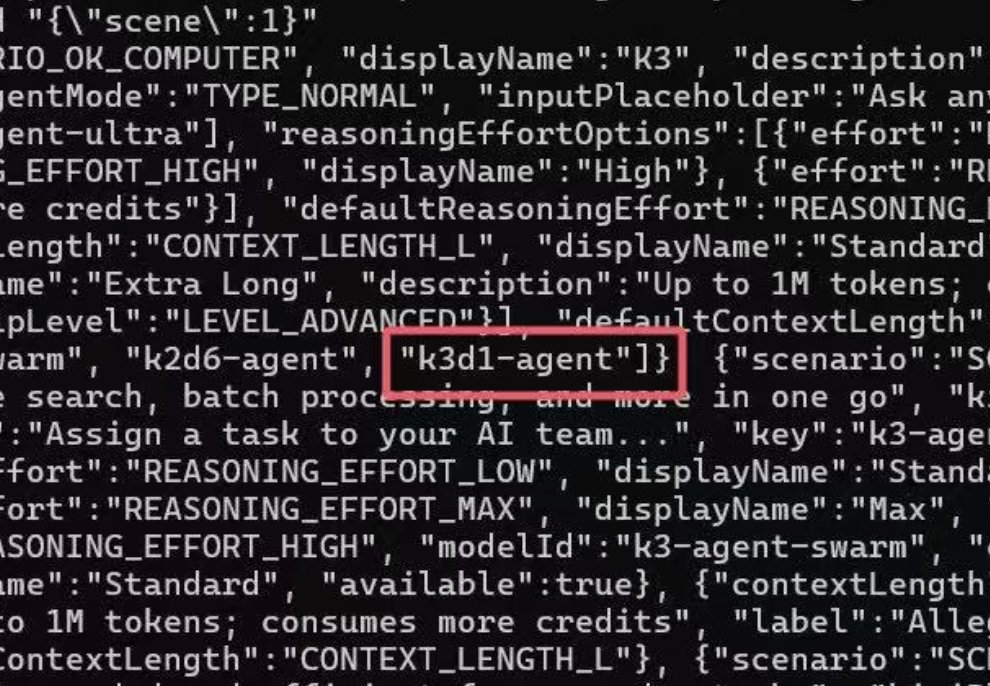
Image source: @MaxForAI’s original post. The image contains reasoning-effort and context settings alongside agent identifiers. Visible configuration strings do not prove that every option belongs to K3.1.
Wccftech’s September 23 report interprets the screenshot as a K3.1 development signal. IT Home’s September 24 follow-up repeats the reported options. These reports are secondary interpretations of the same leak, not independent confirmation of launch readiness.
Reported options point to reasoning and agent workflows
The reports describe Low / High / Max reasoning settings, an Extra Long option of up to 1M tokens, and Agent, Swarm, search and batch flags. These clues suggest possible workflow integration. They do not disclose a final architecture, validated performance gain or supported public API schema.
Media reports differ on the launch window
Wccftech describes a possible arrival before October, while IT Home says October 2026. That discrepancy limits the usefulness of either forecast. Neither report supplies a dated Moonshot release announcement.
A model identifier can represent a private checkpoint, an unfinished route, a staged deployment, or an access-controlled preview. It cannot independently establish a commercial API release. The precise meanings and availability of the leaked flags remain uncertain.
When Will Kimi K3.1 Be Released?
The sources reviewed do not establish an official Kimi K3.1 release date. IT Home reports October 2026, while Wccftech’s earlier coverage says before October. These are differing media forecasts, not a verified development schedule. A screenshot cannot establish rollout dates, account eligibility or deployment readiness.
Look for a dated Moonshot announcement, supported model IDs, developer documentation and access conditions before treating a launch date as confirmed. Pricing and reproducible K3.1-specific evaluations are separate evidence needed for deployment decisions.
What Specifications Could Kimi K3.1 Offer?
The strongest technical baseline is the existing Kimi K3, a July 2026 release with a 2.8-trillion-parameter sparse MoE architecture, native visual input, and a context window commonly described as 1M tokens. The cited sources do not establish K3.1 architecture, parameter counts, or model-specific evaluation results.
Moonshot's official model summary specifies 104B activated parameters and a 1,048,576-token context window. Its July 27 open-weight announcement confirms the K3 weight release. These specifications apply to K3, not the rumored K3.1.
| Specification | Kimi K3 | Kimi K3.1 |
|---|---|---|
| Release | July 2026 | Potentially October 2026 |
| Total parameters | 2.8 trillion | Not disclosed |
| Activated parameters | 104 billion (official model summary) | Not disclosed |
| Architecture | Sparse MoE, KDA, AttnRes | Not disclosed |
| Context | 1,048,576 tokens (approximately 1M) | Up to 1M suggested |
| Reasoning | Low / High / Max in current Kimi Code documentation | Low / High / Max flags |
| Vision | Native visual input | Not confirmed |
| Swarm | Existing Kimi Swarm capability | Swarm flag reportedly appears |
| API price | Published K3 tariff | No final pricing |
| Weights | K3 weights released | Unknown |
What Features Are Reported for Kimi K3.1?
The three themes below combine the reported K3.1 clues with documented K3 capabilities. They explain what the settings could mean without presenting rumored K3.1 features as confirmed specifications.
Three reasoning levels provide an effort trade-off
Low, High, and Max are reported K3.1 configuration labels. They describe an effort trade-off, not a new architecture. Current Kimi Code documentation supports low / high / max for K3, with high as its default. This is a Kimi Code setting; defaults and entitlements should not be assumed identical across every API or product.
Low may suit extraction, simple Q&A and routine classification when lower latency matters. High may offer a practical balance for multi-step development and document work. Max may allocate more reasoning budget to difficult coding or research, with higher latency and possible cost. These task mappings are interpretations to test, not verified K3.1 guarantees.
These workload examples are analytical interpretations, not verified K3.1 service guarantees. Developers should compare quality per unit of spend: a high-effort run may cost more per attempt but fewer retries could reduce overall workflow cost. The meaningful upgrade would be improved task success at a comparable token and tool budget.
A 1M-token option extends the long-context baseline
A million-token window can accommodate substantial code repositories, long technical documents, project histories, and extensive tool traces. But maximum context length is not the same as accurate use of distant information. A productive model must still retrieve the right facts, maintain cross-document consistency, and keep prefill latency manageable.
Evaluate long context by testing retrieval at different prompt positions, consistency across documents and time to first token. Measure cache reuse and the cost of retaining or compressing agent history as well. A nominal 1M-token limit is useful only if the model can recover distant evidence accurately within an acceptable latency and budget.
Moonshot reports a K3 BrowseComp score of 90.4 with a 1M-token context and no context management. This is a specific K3 evaluation condition, distinct from compacted-context results and from any K3.1 performance claim.
Agent and Swarm flags suggest coordinated task execution
The agent-related identifiers and Swarm flags are arguably more interesting than the context number. Kimi already supports multi-agent work; therefore, the rumored upgrade would need to improve routing, delegation, result aggregation, and cost control rather than merely add a Swarm label.
In a plausible orchestrated workflow, one coordinator breaks a complex request into research, coding, testing, and synthesis subtasks. Specialized workers run in parallel, return evidence, and are reconciled by the coordinator. Such parallelism can reduce elapsed time while increasing total model calls, so wall-clock speed and cost must be reported separately.
Kimi’s official Agent Swarm documentation describes existing parallel agent execution. The example below illustrates how such orchestration can divide work; it does not establish K3.1’s final configuration or a required Swarm topology.
A research worker can retrieve sources and verify citations; a coding worker can modify modules and return execution evidence; an analysis worker can compare alternatives with reproducible calculations. A coordinator assigns tasks, reconciles disagreements and caps the budget. Each worker’s output needs verification before the combined result is accepted.
For K3.1, developers should look for reproducible benchmarks of successful end-to-end agent tasks, failure recovery, agent-to-agent disagreement handling, tool-call count, and total spend. Configuration flags alone cannot establish improvement.
How Does Kimi K3.1 Compare with K3 on Benchmarks?
No verified K3.1-specific benchmark table is available. The following figures are from Moonshot’s official K3 evaluations, shown solely as the comparison baseline. Different model harnesses and assessment settings limit strict apples-to-apples inference.
| Benchmark | Kimi K3 | GPT-5.6 Sol | Claude Fable 5 |
|---|---|---|---|
| DeepSWE | 67.5 | 73.0 | 70.0 |
| Terminal-Bench 2.1 | 88.3 | 88.8 | 88.0 |
| FrontierSWE | 81.2 | 71.3 | 86.6 |
| Program Bench | 77.8 | 77.6 | 76.8 |
| Kimi Code Bench 2.0 | 72.9 | 64.8 | 76.9 |
| SWE Marathon | 42.0 | 39.0 | 35.0 |
Source discrepancy: the original visual shows Fable 5 at 84.6 on Terminal-Bench 2.1, while the official repository evaluation table reports 88.0. The table above follows the repository; the official image is reproduced without alteration.
The evaluation notes specify K3 max effort, temperature 1.0, and top-p 1.0. DeepSWE v1.1 uses Kimi Code here; the separately cited mini-SWE-agent result is 67.3. Terminal-Bench uses Kimi Code for K3, Terminus 2 for Fable 5, and Codex for Sol. FrontierSWE uses Kimi Code/Codex and July 16 dominance scores; ProgramBench uses Kimi Code for K3. KCB 2.0 uses Kimi Code/Claude Code for K3 and Claude Code/Codex for Fable/Sol. SWE Marathon uses an H20-calibrated v1.1 branch with Claude Code/Codex; Fable hit fallbacks on 35% of tasks. These are vendor-reported results under differing harnesses.
Consult the official evaluation notes for each benchmark's complete protocol; the figures do not establish a controlled K3.1 comparison.
K3 is particularly competitive on Program Bench and SWE Marathon in this set, while the comparative leaders vary by test. K3.1 cannot be declared faster or more accurate until tests with a documented agent harness, reasoning budget, and evaluation date have been published.
What Could Kimi K3.1 API Pricing Look Like?
The official K3 launch tariff is $0.30 cached input, $3 uncached input, and $15 output per million tokens. The following table records that reference schedule, not a verified current K3.1 tariff. K3.1 rates and any orchestration charges require separate confirmation.
| Meter | Kimi K3 API in CometAPI (official launch tariff reference) | Kimi K3.1 API in CometAPI (unconfirmed tariff) |
|---|---|---|
| Cached input | US$0.30 / 1M tokens | Unconfirmed |
| Uncached input | US$3.00 / 1M tokens | Unconfirmed |
| Output | US$15.00 / 1M tokens | Unconfirmed |
| Agent orchestration | Depends on actual usage | Unconfirmed |
At these K3 reference rates, 100,000 uncached input tokens plus 10,000 output tokens would cost US$0.45. This is an illustrative K3 arithmetic example, not K3.1 pricing. Enterprise planning should use cost per verified task rather than tokens alone.
How Can Developers Prepare for Kimi K3.1 API Access?
Access checks come before integration
Developers can follow Kimi K3.1 API in CometAPI for access updates. On October 9, 2026, the page's availability section still says Coming Soon, alongside generic endpoint and health text. Treat that inconsistent page as a discovery link; confirm an enabled model ID and successful account-level test before assuming production access.
A launch checklist guides the deployment decision
| Question | Evidence available now | Confirmation needed |
|---|---|---|
| Release? | September leak reports | Moonshot release announcement |
| New architecture? | No K3.1 model card | Technical report and parameters |
| Better reasoning? | Three familiar effort modes | Quality/cost vs K3 at each level |
| Better long context? | Reported 1M option | Accuracy and latency at 1M |
| Better multi-agent? | Agent/Swarm configuration flags | Agent success and cost benchmarks |
| API production access? | Coming Soon indicator | Supported IDs, docs, pricing |
Preparation can begin with portable evaluations and a capped test budget. Migration should wait for documented access and repeatable workload-level gains. The decision is whether K3.1 produces accepted results more reliably and economically, rather than whether a catalog page or configuration flag exists.
FAQs
How can developers verify Kimi K3.1 access?
Confirm the provider's supported model ID and account entitlement, then run a small request and inspect the returned model identifier, usage, and errors. A successful call verifies access for that account and route at that time; a catalog entry or health label alone does not establish a public launch or stable quota.
Can Kimi K3.1 replace K3 in an existing agent?
Treat migration as a compatibility change. Check tool schemas, reasoning-history handling, output formats, and timeout behavior before replaying representative tasks. Use a pinned baseline and retain rollback routing. A similar model name or context limit is insufficient evidence that long-running sessions will behave identically.
How should teams budget for a Kimi K3.1 pilot?
Start with a capped task set rather than extrapolating a rumored token price. Track uncached input, cache hits, reasoning/output tokens, tool calls, retries, and human correction time. Reserve a fixed evaluation budget and compare cost per accepted result after final rates are documented.
What would count as a meaningful Kimi K3.1 upgrade?
Require repeatable gains on your workload at comparable reasoning and tool budgets. Test distant-evidence retrieval, conflicting documents, agent recovery, and end-to-end task acceptance. Record failure rate, latency, and total spend together; a larger nominal window or extra configuration flag alone is insufficient.
Conclusion
Kimi K3.1 is best treated as a reported prospective release. The evidence reviewed identifies possible configuration work, while K3 already supplies long context, adjustable effort, and Swarm execution. The practical opportunity is better task quality at sustainable cost. Prepare portable evaluations now, and make migration decisions after official specifications, access conditions, pricing, and reproducible K3.1 results are available.