
TL;DR
Kimi K3.1 Pro is Moonshot AI's October 24, 2026 upgrade to Kimi K3. Additional post-training improves autonomous coding, financial research, and extended tool-using workflows while retaining the same approximately one-million-token context capacity.
Independent evaluations show stronger overall performance, and standard official input/output token rates fall by one-third. The upgrade still requires workload testing: deeper reasoning can raise task latency and total spending, while K3 retains a small lead on AA-LCR and currently available weights for self-hosting.
Key Takeaways
- The clearest gains are in agentic execution. Artificial Analysis reports Terminal-Bench 4.0 scores of approximately 67% for K3.1 Pro versus 13% for K3; Moonshot’s internal Financial Research scores rise from 58.8 to 70.4.
- Lower token prices do not guarantee lower task costs. Standard official input/output rates fall from $3/$15 to $2/$10 per million tokens, but additional reasoning, tool calls, and retries can offset the savings.
- The context window stays the same. Both models support up to 1,048,576 tokens. K3 remains slightly ahead in the cited AA-LCR v1.1 evaluation, so test long-context accuracy on your own documents.
- Weight availability can determine the choice. As of October 24, 2026, K3 weights are available; K3.1 Pro weights are scheduled for release by November 4. Teams needing immediate self-hosting should account for this difference.
Kimi K3.1 Pro vs Kimi K3: Overview and Specifications
Kimi K3.1 Pro builds on K3 through additional post-training, with improvements focused on coding, financial research, and extended agent workflows. Both retain approximately one million tokens of context. The main differences are task performance, token pricing, serving options, and weight availability.
| Specification | Kimi K3.1 Pro | Kimi K3 |
|---|---|---|
| Developer | Moonshot AI | Moonshot AI |
| Release date | October 24, 2026 | July 16, 2026 |
| Architecture | K3-derived MoE, further post-trained | MoE with KDA, AttnRes |
| Model size | 3T-class and 104B active parameters | 2.8T total and 104B active parameters |
| Context window | Up to 1,048,576 tokens | Up to 1,048,576 tokens |
| Standard API input / output price | $2 / $10 per million tokens | $3 / $15 per million tokens |
| Highspeed version | Available | No separate K3 Highspeed variant is listed |
| Weight availability | Release planned by November 4, 2026 | Available under the Kimi K3 License |
Weight availability reflects the information available as of October 24, 2026. API prices are in USD for regular input and output, excluding cache-write charges, taxes, and other applicable fees.
Architecture and Post-Training
K3 introduced a 2.8-trillion-parameter architecture combining Kimi Delta Attention, Attention Residuals, and Stable LatentMoE. It activates approximately 104 billion parameters per token.
Moonshot describes K3.1 Pro as a post-trained version of K3 developed with substantially greater post-training compute. The upgrade focuses on applying the model’s capabilities across multi-step tasks, including tool use, debugging, and result verification. The announcement does not introduce a separately named base architecture.
Shared Capabilities and API Requirements
Both models support multimodal inputs, tool calling, structured outputs, and context caching. Image and video input formats depend on the selected API route. Both always reason and support low, high, and max reasoning effort, with max as the default.
For multi-turn conversations and tool calls, integrations must preserve complete assistant messages, including reasoning content and tool calls, as required by the API. Actual context limits and feature availability should also be checked for the selected provider, product, and subscription tier.
Kimi K3.1 Pro vs Kimi K3: Performance
The evidence comes from Moonshot’s internal tests and reported comparisons, alongside independent third-party evaluations.
These should be interpreted separately because benchmark harnesses, test sets, reasoning settings, and scoring criteria can differ.
The Artificial Analysis launch evaluation reports an 11-point increase on its composite Intelligence Index, with particularly large improvements on terminal-based coding and agentic workflows.
| Independent Benchmark (Artificial Analysis) | Kimi K3 | Kimi K3.1 Pro | Difference |
|---|---|---|---|
| Intelligence Index | 44 | 55 | +11 |
| Terminal-Bench 4.0 | ~13% | ~67% | +54 percentage points |
| AutomationBench-AA | 58% | 73% | +15 pp |
| GDPval-AA Elo | 1,534 | 1,846 | +312 |
| AA-Omniscience Index | 20 | 30 | +10 |
| Humanity's Last Exam | ~47% | ~52% | +5 pp |
| AA-Omniscience hallucination rate | 53% | 44% | −9 pp |
| AA-LCR v1.1 | 88.7% | 86.3% | −2.4 pp |
These are independent evaluation results. Rounded values are used where the evaluator reports rounded scores. Lower hallucination rates are better.
The largest improvement occurs in terminal-based coding. K3.1 Pro performs substantially better on tasks that require command execution, environment interaction, debugging, and repeated validation.
AutomationBench-AA also shows a significant gain, suggesting stronger execution in software-as-a-service workflows.
Moonshot's release benchmarks focus on coding, science, 3D reconstruction, finance, knowledge work, and autonomous agents.
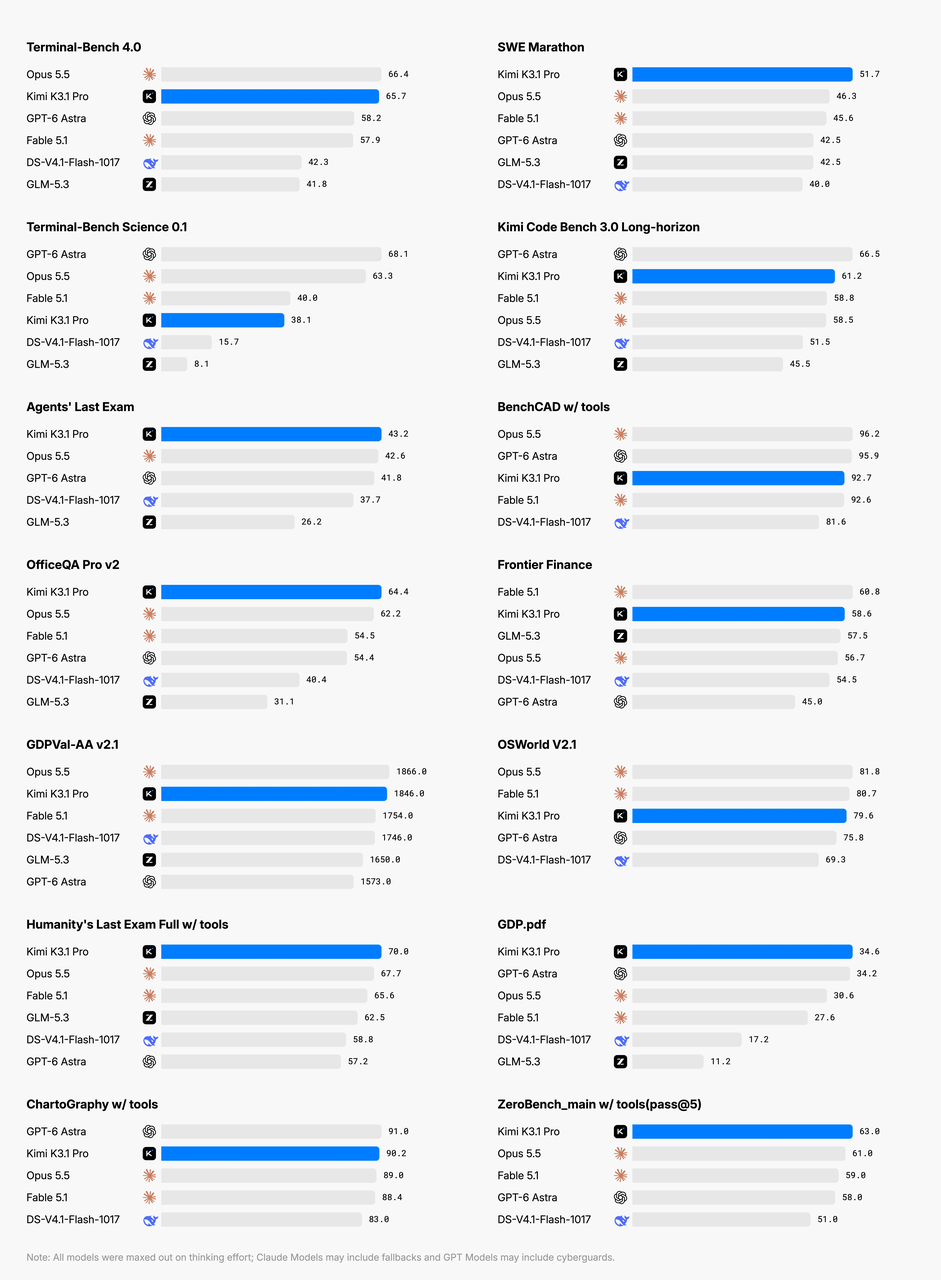
The selected comparisons include Claude Opus 5.5 and GPT-6 Astra. Compare each result within its named benchmark and stated configuration.
| Benchmark (Moonshot AI) | Kimi K3.1 Pro | Other Model | Comparison Model Score |
|---|---|---|---|
| Terminal-Bench 4.0 | 65.7% | Claude Opus 5.5 | 66.4% |
| Terminal-Bench 4.0 | 65.7% | GPT-6 Astra | 58.2% |
| SWE-Marathon | 51.7% | Claude Opus 5.5 | 46.3% |
| Kimi Code Bench 3.0 | 61.2% | GPT-6 Astra | 66.5% |
| BenchCAD with tools | 92.7% | Claude Opus 5.5 | 96.2% |
| OfficeQA Pro v2 | 64.4 | Claude Opus 5.5 | 62.2 |
| Frontier Finance | 58.6 | Claude Opus 5.5 | 56.7 |
| OSWorld 2.1 | 79.6% | Claude Opus 5.5 | 81.8% |
K3.1 Pro approaches or exceeds several leading proprietary models in selected tasks. But it does not dominate every category.
For example, it remains behind Claude Opus 5.5 in the vendor-reported BenchCAD and OSWorld comparisons, and the official chart shows a larger weakness in Terminal-Bench Science.
Evaluation setups differ: Artificial Analysis uses the mini-swe-agent harness for Terminal-Bench 4.0, while Moonshot uses Claude Code. Compare scores within the same test setup; harnesses, reasoning effort, and runtime limits can affect results.
Coding and Software Engineering
For complex autonomous coding, K3.1 Pro is generally the stronger choice.
Moonshot's internal Kimi Code Bench 3.0 Long-horizon results increase from 55.95% for K3 to 61.2% for K3.1 Pro, a gain of approximately 5.25 percentage points.
Independent Terminal-Bench results also show a substantial gain. These tests assess multi-step execution: understanding a repository, changing files, running commands, diagnosing errors, and verifying the result.
K3.1 Pro is the stronger candidate for multi-file development, autonomous terminal work, and extended debugging. For simple code generation, compare both models on your own tasks; K3 remains the immediate option when self-hosting is required.
One important distinction is that coding benchmark scores depend heavily on the agent framework. Tools, prompts, runtime limits, and test environments influence the outcome.
For production software development, the best evaluation is still a matched comparison on your own repositories.
Financial Research and Business Operations
Financial modeling provides some of the clearest direct comparisons between the two models.
Moonshot tested both K3 and K3.1 Pro on internal evaluations covering spreadsheet construction, research quality, and simulated business operations.
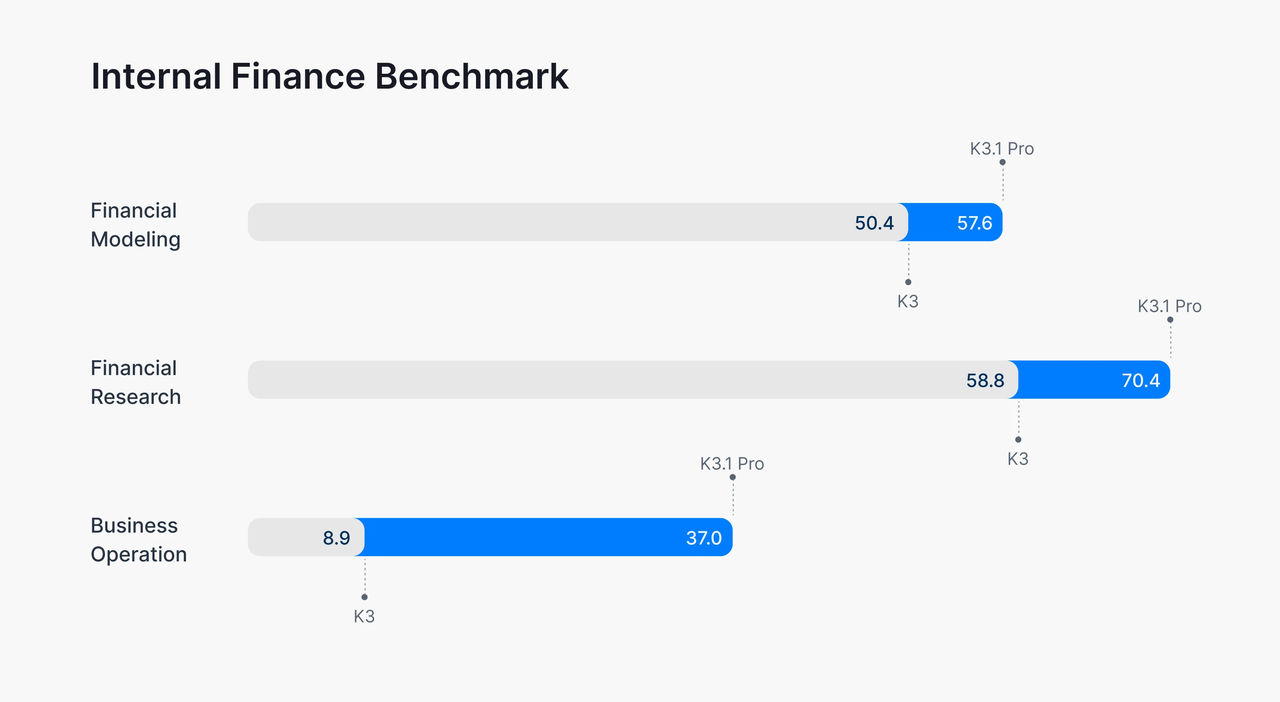
Moonshot's internal finance results cover financial modeling, research, and simulated business operations. These vendor-reported task scores are not measures of investment returns. Per-task settings should not be assumed identical to unrelated benchmarks.
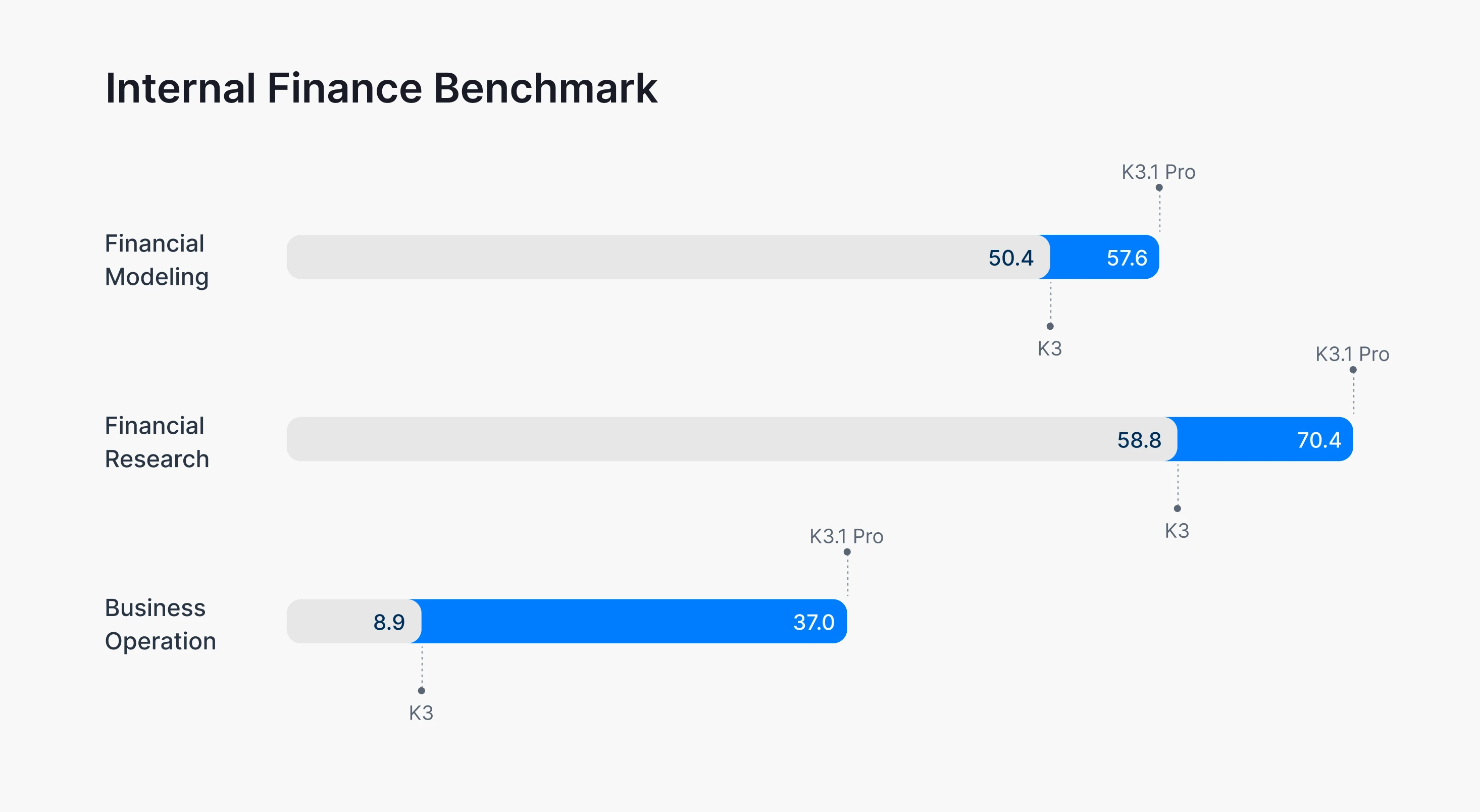
In Moonshot's internal tests, Financial Modeling rises from 50.4 to 57.6, a gain of 7.2 points, and Financial Research rises from 58.8 to 70.4, a gain of 11.6 points. Business Operation increases from 8.9 to 37.0, about 4.2 times the K3 score.
This benchmark evaluates long-horizon management and decision-making in a simulated business environment. It is therefore more closely related to agentic planning than to simple financial question answering.
Financial Research measures the ability to produce evidence-based research while respecting source requirements and information cutoffs. Financial Modeling focuses on mathematical relationships, spreadsheet logic, and workbook quality.
The pattern suggests that K3.1 Pro is particularly valuable when financial tasks require sustained reasoning, verification, and structured deliverables.
For investors, analysts, and business users, the practical benefit is potentially better handling of multi-document workflows. Neither model should be used as an unquestioned authority for financial decisions.
Long-Context Reasoning and Factual Reliability
However, the AA-LCR long-context results show K3 slightly ahead. This is a useful reminder that a newer model can improve substantially overall without winning every specialized task.
The reported evaluations show fewer factual errors on their respective test sets.
On Kimi Hallu Bench Hard with tools, Moonshot reports that the claim-level error rate decreased from 23.4% for K3 to 8.3% for K3.1 Pro.
That is about a 65% relative reduction on Moonshot's deliberately difficult stress test, rather than an estimate of everyday error rates. Separately, Artificial Analysis reports a decline in AA-Omniscience hallucination rate from 53% to 44%. The two evaluations use different methods, so their percentages are not directly comparable.
The practical lesson is that K3.1 Pro appears more reliable on the evaluated tasks, but factual improvements do not eliminate the need for retrieval, citations, calculation checks, and human review in consequential workflows.
Data Analysis: Evidence from Plotly’s Evaluation
Plotly evaluated standard K3.1 Pro through OpenRouter using a private 43-question test over a synthetic wind-energy data warehouse. It did not test Highspeed. The results illustrate the trade-off between answer quality, completion time, and cost in that specific SQL-based analytical workflow.
| Plotly Data Analytics Measure | Kimi K3 | Kimi K3.1 Pro |
|---|---|---|
| Correct answers | 35/43 | 42/43 |
| Accuracy | 81.4% | 97.7% |
| Hidden patterns discovered | 0/5 | 5/5 |
| Data-quality issues identified | 1/3 | 3/3 |
| Full evaluation cost | $5.01 | $13.47 |
| Median time per question | 43 seconds | 2.5 minutes |
In this evaluation, K3.1 Pro answered more questions correctly and identified more hidden patterns and data-quality issues, but incurred higher cost and longer median completion time.
The reported charges are observed evaluation costs, not estimates calculated from Moonshot’s standard API prices. The published setup does not establish that all provider settings were identical between the two model runs, so the differences cannot be attributed to the model alone.
These results support evaluating K3.1 Pro for analytical tasks where additional findings could justify more time and spending. They do not establish the same accuracy or cost advantag
Is Kimi K3.1 Pro Faster Than Kimi K3?
Distinguish output-token throughput from end-to-end task latency.
Artificial Analysis reports 73.5 output tokens per second for K3.1 Pro, compared with 38.5 for K3 at maximum reasoning effort, using Kimi's API. These are token-generation measurements, checked October 24, 2026; total task latency also depends on reasoning length and tool execution.
However, faster token generation does not guarantee faster task completion.
Moonshot also offers K3.1 Pro Highspeed, which is advertised as delivering approximately two to three times faster output than the standard variant. This is a serving-speed improvement, not a separate verified intelligence upgrade.
K3.1 Pro has higher reported output-token throughput, but it does not necessarily complete tasks faster. Distinguish the speed of generating tokens from the time required to reason, call tools, and finish the job.
Output Speed vs. Task Completion Time
Artificial Analysis reports output speeds of 73.5 tokens per second for K3.1 Pro and 38.5 for K3 at maximum reasoning effort, using Kimi’s API. These measurements were checked on October 24, 2026 and describe token-generation throughput rather than end-to-end task latency.
A model can generate tokens faster while taking longer overall if it produces more reasoning tokens or performs additional tool calls. In the Plotly evaluation discussed above, K3.1 Pro’s median completion time was 2.5 minutes per question, compared with 43 seconds for K3, alongside higher accuracy.
For interactive applications, measure time to first token and total task completion time on the actual provider route. Output throughput alone is not enough to predict responsiveness.
Consider K3.1 Pro Highspeed
Moonshot advertises K3.1 Pro Highspeed as delivering approximately two to three times the output speed of standard K3.1 Pro. That claim concerns serving speed; it should not be interpreted as a two-to-threefold reduction in total task completion time.
Consider Highspeed for interactive coding or assistants where users wait for responses. Compare end-to-end latency, task success, and total billed cost against the standard endpoint before choosing it. Highspeed has higher regular-input and output token prices, while its cached-input rate is the same.
Kimi K3.1 Pro vs Kimi K3: Cost
Official API and CometAPI Rates
Standard K3.1 Pro’s official input, output, and cache-hit rates are one-third lower than K3’s. The listed CometAPI input and output rates are a further 20% below the corresponding official rates.
| Model | Official Input / 1M | Official Output / 1M | Official Cached Input / 1M | CometAPI Input / 1M | CometAPI Output / 1M |
|---|---|---|---|---|---|
| Kimi K3.1 Pro | $2.00 | $10.00 | $0.20 | $1.60 | $8.00 |
| Kimi K3 | $3.00 | $15.00 | $0.30 | $2.40 | $12.00 |
| Kimi K3.1 Pro Highspeed | $4.00 | $20.00 | $0.20 | Check current quote | Check current quote |
USD per million tokens; rates checked October 24, 2026. Input columns show regular uncached-input rates. Taxes and separately billed charges are excluded.
Official Kimi pricing also lists cache-write charges: $2/$4 per million tokens for standard Pro with 5-minute/1-hour retention, and $4/$8 for Highspeed. Cache hits, cache writes, and regular input are separate, mutually exclusive billing categories.
Official Kimi and CometAPI are separate provider routes. Confirm current pricing and cache support for your selected route, including Highspeed availability. Compare total billed task cost as well as token rates.
Fixed-Token Cost Example
Consider a workload that consumes 100,000 uncached input tokens and 20,000 output tokens.
For this fixed workload, the official API cost is $0.60 with K3 and $0.40 with K3.1 Pro. At the listed CometAPI rates, the same token counts cost $0.48 and $0.32, respectively. These totals include the stated input and output tokens only.
But this is a fixed-token comparison. Complex agent workflows can consume different quantities of reasoning tokens and tool calls depending on the model.
Token Savings Disapears
Let I be the identical uncached input-token count, O be Kimi K3's billed output-token count, and P be Kimi K3.1 Pro's billed output-token count, all measured in millions. At the standard official rates in the pricing table, the charges are 3I + 15O and 2I + 10P dollars. They are equal when P = 1.5O + 0.1I.
For output-heavy requests, K3.1 Pro can therefore use approximately 50% more billed output tokens before losing its price advantage. This calculation assumes unchanged rates and excludes caching, tool fees, and other separately charged usage. Use actual billed token categories rather than visible answer length.
Cost per Successfully Completed Task
Calculate cost per successful task as the total billed cost of all evaluation attempts divided by the number of unique tasks that meet a predefined acceptance criterion. Include charges from unsuccessful attempts, retries, and timeouts when the provider bills them; dividing only the cost of successful runs by their count can understate cost per successful task.
Keep the task set, acceptance criteria, retry limit, and timeout policy fixed between Kimi K3 and K3.1 Pro. Report success rate alongside cost per success so that dropping difficult tasks cannot make a model appear artificially economical. If no task succeeds, cost per success is undefined, not zero.
Kimi K3.1 Pro vs Kimi K3: Comparison and Selection
For most hosted agentic workloads, K3.1 Pro is the stronger starting point. Nevertheless, the decision should reflect task complexity and deployment requirements.
| Use Case | Recommended Model | Reason |
|---|---|---|
| Autonomous coding | Kimi K3.1 Pro | Evaluate multi-file changes, terminal work, debugging, and final test outcomes. |
| Multi-document financial research | Kimi K3.1 Pro | Improved research and business-operation benchmarks |
| Complex data analysis | Kimi K3.1 Pro | Better problem discovery and data-quality testing |
| 3D creation and CAD workflows | Kimi K3.1 Pro | Strong specialized tool-assisted capabilities |
| Straightforward text tasks | Benchmark both | Compare routine text and simple coding tasks on both models; extra reasoning can add latency without improving an acceptable result. |
| Long-context retrieval accuracy | Benchmark both | K3 leads slightly on AA-LCR |
| Immediate self-hosting | Kimi K3 | Downloadable weights already available |
| Interactive high-capability agents | K3.1 Pro Highspeed | Faster serving, subject to cost validation |
| Cost-sensitive production workflows | Benchmark both | Lower token pricing may not mean lower task cost |
Hosted Automation and Professional Workflows
For hosted coding agents and analytical workflows, evaluate K3.1 Pro on the difficult parts of the actual job: multi-file changes, evidence gathering, calculation checks, and recovery after a failed tool call. Prefer measured reductions in failed tasks or corrective work over a higher headline score alone.
For established K3 applications, retain the existing route as a comparison baseline. Routine tasks may already meet the acceptance threshold, while specialized long-context tasks can behave differently from the aggregate benchmarks. Prioritize the workload segments where an upgrade has a measurable benefit.
Self-Hosting and Deployment Constraints
As of October 24, 2026, K3's full weights are available for deployment subject to the model's license and hardware requirements. K3.1 Pro's full weights have not yet been published.
Moonshot plans to release K3.1 Pro weights by November 4, 2026. This is an announced release plan, not an available checkpoint; confirm the published weights and applicable terms before scheduling self-hosting.
Production Evaluation Criteria
Compare K3 and K3.1 Pro on representative tasks using the same prompts, tools, acceptance criteria, retry limits, and timeouts. Record provider and reasoning settings, and preserve complete assistant messages as required by the API.
Measure task success, latency, token usage, and cost per successful task, including billed failures and retries. Review cases where K3 succeeds but K3.1 Pro fails. For human evaluation, hide model labels and randomize output order.
If K3.1 Pro meets your quality, latency, and cost thresholds, roll it out gradually with a tested K3 fallback.
Controlled Migration and Fallbacks
A practical approach is to begin with a small percentage of production traffic on K3.1 Pro.
Keep K3 available as a fallback during validation. Compare task quality, latency, failure rates, and spending before increasing K3.1 Pro usage.
Pay particular attention to tool-call schemas, reasoning-related message fields, multimodal inputs, and output parsing. API compatibility does not automatically guarantee identical application behavior.
Benchmark Gains and Regressions
If both models answered the same 43 questions and scored 35 and 42, K3.1 Pro could have corrected seven K3 failures with no regressions, or eight failures while losing one previously correct answer. The total score alone cannot distinguish these outcomes.
Inspect paired answers and classify them as both correct, only K3 correct, only K3.1 Pro correct, or both incorrect. Review the K3-only successes against your highest-impact tasks before migrating. The 42/43 result describes that test set; it does not guarantee a 97.7% success rate on a different workload.
Blind Evaluation of Model Outputs
Hide the model labels and randomize the order in which reviewers see outputs. Define the acceptance rubric before reviewing them: for code, use executable tests and regression checks; for research, check source support, calculations, and whether the requested deliverable is complete. Score correctness before considering presentation or writing style.
Reveal model identity, latency, and billed cost only after the quality assessment is recorded. This separates output quality from expectations about the newer model. Resolve reviewer disagreements against the same tests or source material, and retain the decisions so that a later model or prompt change can be evaluated consistently.
Where Can You Access Kimi K3.1 Pro and Kimi K3?
Official Provider Access
Use Moonshot's documented Kimi K3 API or Kimi K3.1 Pro API for direct provider integration. Check the selected endpoint's model identifier, supported request fields, and account limits. Public API access and downloadable model weights are separate deployment options.
Access Through CometAPI
Developers can access the Kimi K3.1 Pro API and Kimi K3 API through CometAPI's unified interface and compare both routes with the same application workload.
This makes K3-to-K3.1 Pro migration relatively straightforward, especially for applications already using an OpenAI-compatible chat interface.
To use CometAPI, create an account and API key, then configure your application with the endpoint and model identifier in the integration documentation. Select kimi-k3 for K3, kimi-k3.1-pro for standard K3.1 Pro, or kimi-k3.1-pro-highspeed for the Highspeed route where supported. Start with a small request, then compare the same workload across models while checking returned results, latency, and billed usage.
Conclusion
Kimi K3.1 Pro is the stronger candidate for demanding autonomous coding, financial research, and extended agent workflows in the evaluations reviewed here. Kimi K3 remains relevant for immediate self-hosting and workloads where its existing accuracy or latency profile already meets requirements.
Choose using representative tasks and the actual provider route. Compare successful outcomes, latency, and total spending, then migrate gradually. Lower token prices and higher aggregate benchmark scores are useful starting points, but they do not establish the best configuration for every application.