

TL;DR
MiniMax M3.1 Flash is a high-speed AI model designed for autonomous agents, software engineering, computer use, and complex workflow automation. Officially released on October 19, 2026, it combines a 1-million-token context window with configurable reasoning depth and lower inference costs.
MiniMax reports up to 200+ output tokens per second, a 70% reduction in agent workload costs compared with its predecessor, and competitive performance across Automation-Bench, DeepSWE, and OSWorld. At $0.15 per million input tokens and $0.60 per million output tokens, the model makes multi-step AI agent workflows more economical.
Key Takeaways
- MiniMax M3.1 Flash performance: Vendor-reported benchmarks include Automation-Bench 62.8, DeepSWE v1.1 73.7, and OSWorld 2.0 61.7, highlighting its capabilities in agent automation, coding, and computer use.
- MiniMax M3.1 Flash API pricing: Official rates are $0.15/M input, $0.60/M output, and $0.015/M cached input. CometAPI rates are $0.80/M input and $3.20/M output as of October 21, 2026, with no published cache rate on its model page.
- MiniMax M3.1 Flash inference speed: MiniMax reports 200+ tokens/s under favorable conditions and P50 throughput above 170 tokens/s, supporting responsive agent workflows.
- MiniMax M3.1 Flash agent efficiency: Five reasoning-effort levels allow developers to balance task completion, latency, and overall AI agent costs.
- MiniMax M3.1 Flash API access: Developers can access the released model through MiniMax or explore CometAPI integration using provider-specific model identifiers and pricing.
What Is MiniMax M3.1 Flash?
MiniMax M3.1 Flash is a next-generation language model optimized for agentic reasoning, coding, tool use, and autonomous workflow execution. MiniMax officially introduced M3.1 Flash on October 19, 2026.
Rather than focusing exclusively on conversational intelligence or isolated scores, it targets the total cost of completing tasks through repeated reasoning, tool calls, and multi-step execution. MiniMax also associated its early development with Space Bunny, an anonymously deployed model that it says processed more than 200 trillion tokens before the announcement; this is a reported usage figure, not a published training-token count.
For developers building autonomous coding assistants, enterprise AI coworkers, and browser-based agents, M3.1 Flash offers three relevant advantages: extensive context capacity, fast generation, and inexpensive token usage.
What Are MiniMax M3.1 Flash’s Specifications?
| API specifications | MiniMax M3.1 Flash |
|---|---|
| Developer | MiniMax |
| Official release | October 19, 2026 |
| Model family | MiniMax M3 |
| Context window | 1,000,000 tokens |
| Primary capabilities | Agent automation, coding, reasoning, computer use |
| Input modalities | Text, image, and video via MiniMax's OpenAI-compatible API; confirm support on other providers |
| Output modality | Text |
| Reasoning controls | Low, medium, high, xhigh, max |
| Reported output speed | Up to 200+ tokens/s |
| Reported P50 speed | 170+ tokens/s |
| Access channels | MiniMax API, M Plan, MiniMax Code |
| Open weights | Announced for future release |
| M3.1-specific parameter count | Not established in the announcement |
A large context window is valuable for repository-scale coding and document-heavy workflows, but does not guarantee perfect recall. Production agents should still use selective retrieval, structured tool responses, and context compression.
Five reasoning-effort settings let developers reserve intensive computation for complex planning and debugging instead of spending maximum effort on every classification, extraction, or simple tool-selection step. Because a single agent request may trigger dozens of model invocations, small savings across routine steps can materially lower total cost.
How Does MiniMax M3.1 Flash Perform on Benchmarks?
MiniMax reports benchmark results spanning business automation, software engineering, computer use, cybersecurity, and multimodal reasoning. These are vendor-reported evaluations, not a substitute for independent testing of a real deployment.
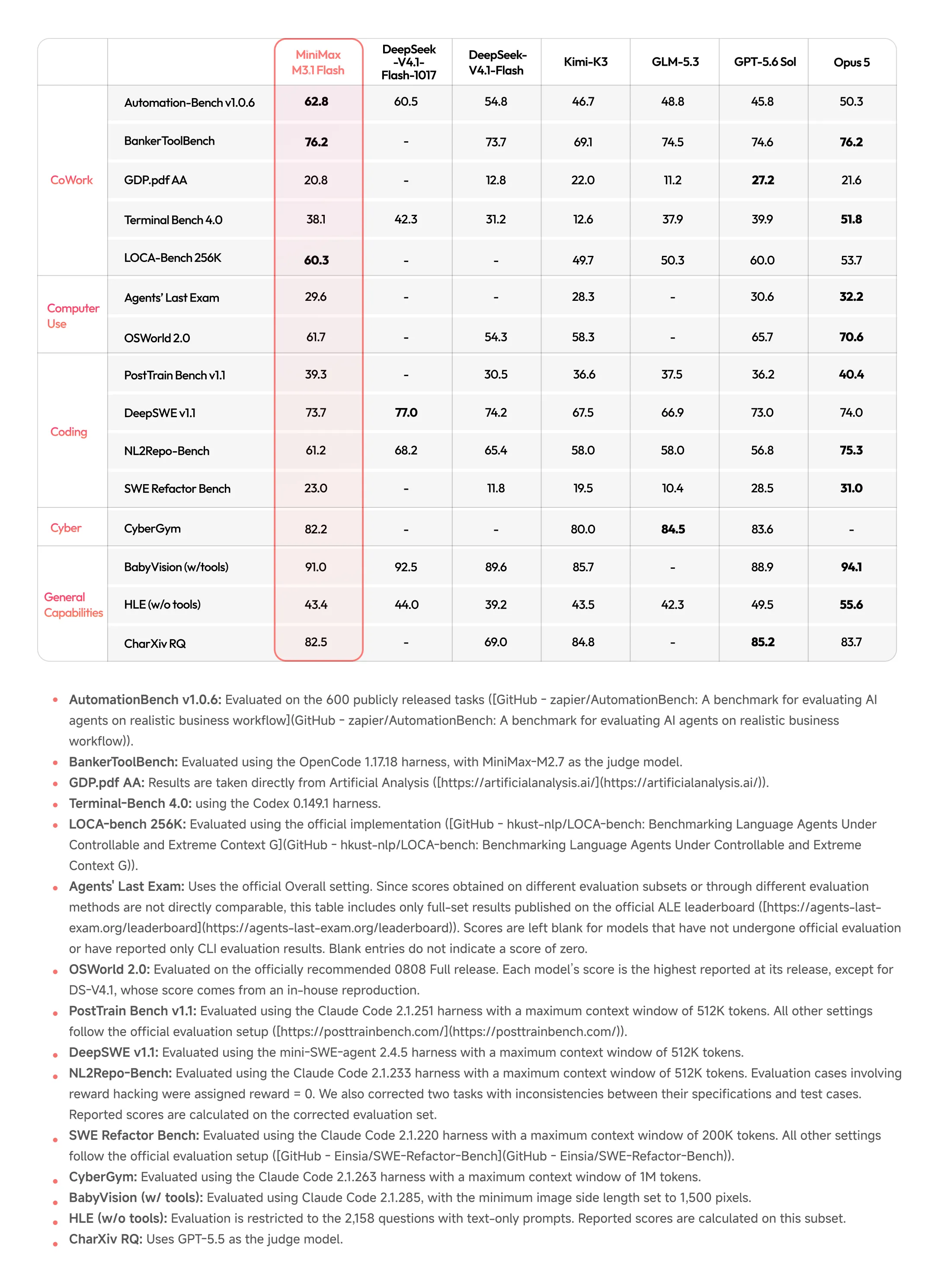
MiniMax's official benchmark comparison, including evaluation notes. Scores are vendor-reported and do not represent a uniform independent test.
| Official benchmark results | M3.1 Flash | What it measures |
|---|---|---|
| Automation-Bench v1.0.6 | 62.8 | Multi-step business automation |
| BankerToolBench | 76.2 | Financial reasoning and tools |
| LOCA-Bench 256K | 60.3 | Long-context agent execution |
| DeepSWE v1.1 | 73.7 | Autonomous software engineering |
| Terminal Bench 4.0 | 38.1 | Terminal-based problem solving |
| OSWorld 2.0 | 61.7 | Desktop / computer interaction |
| Agents’ Last Exam | 29.6 | Complex economic tasks |
| CyberGym | 82.2 | Cybersecurity problem solving |
| BabyVision with tools | 91.0 | Visual reasoning with tools |
| HLE without tools | 43.4 | Challenging knowledge and reasoning |
Automation-Bench v1.0.6 uses 600 public tasks. BankerToolBench uses OpenCode 1.17.18 with MiniMax-M2.7 as judge; Terminal Bench 4.0 uses Codex 0.149.1. DeepSWE v1.1 uses mini-SWE-agent 2.4.5 with a 512K context limit. OSWorld uses the 0808 Full release: the table combines each model's highest release score, except DeepSeek V4.1, which MiniMax reproduced internally. These differing setups limit direct cross-model conclusions.
For business automation, prioritize Automation-Bench and BankerToolBench; for coding agents, examine DeepSWE and terminal-based results. OSWorld evaluates interactions with a computer environment rather than merely generating instructions. A single aggregate score cannot replace task-specific analysis.
How Fast Is MiniMax M3.1 Flash?
Agent systems frequently make many sequential model calls, so throughput alone cannot describe responsiveness.
| Speed metric | Reported performance |
|---|---|
| Everyday peak output throughput | 200+ tokens/s |
| Median output throughput (P50) | 170+ tokens/s |
| Online inference improvement | Nearly 3× vs prior generation |
| Agent workload cost reduction | 70% vs predecessor |
These vendor-reported speed and workload-cost figures describe MiniMax's launch evaluation, not guaranteed throughput or savings for every application. Serving hardware, concurrency, prompt lengths, and repeat-run variability are not fully specified in the announcement.
End-to-end latency also includes first-token delay, reasoning overhead, tool time, retries, and dependencies between steps. A faster generator can lose its advantage if an agent needs more calls to complete the same task.
How Much Does MiniMax M3.1 Flash API Cost?
MiniMax announced flat standard rates for M3.1 Flash without a separate higher long-context tier in its initial pricing description. Meanwhile, the MiniMax M3.1 Flash Preview API in CometAPI offers a separate pricing structure with a 20% discount against its displayed reference rates.
| Pricing category | Official M3.1 Flash | CometAPI Preview (≤512K) | CometAPI Preview (>512K) |
|---|---|---|---|
| Input tokens / 1M | $0.15 | $0.24 | $0.48 |
| Output tokens / 1M | $0.60 | $0.96 | $1.92 |
| Cached input / 1M | $0.02 | $0.05 | $0.10 |
| Pricing structure | Flat rate | Short-context tier | Long-context tier |
The official MiniMax API pricing makes M3.1 Flash particularly attractive for agent workloads. Output tokens cost four times the standard input rate, while cached input costs one-tenth as much. Repeated instructions and tool histories can therefore become a major optimization target.
CometAPI's Preview pricing starts at $0.24 per million input tokens and $0.96 per million output tokens, representing a 20% discount relative to its displayed Preview reference prices. However, these rates remain higher than the newly announced official M3.1 Flash prices because the two offerings use different pricing baselines.
For developers, the key distinction is that CometAPI provides a unified integration experience, while the official release currently offers lower published token rates. Before deployment, verify the active model version, context-length tier, and billing rules to accurately estimate the cost of autonomous agent workflows.
MiniMax M3.1 Flash Cost per Agent Task
Estimated inference cost = (uncached input tokens × input rate + cached input tokens × cache rate + output tokens × output rate) / 1,000,000.
| Illustrative workload | Uncached input | Cached input | Output | Est. cost |
|---|---|---|---|---|
| Simple tool assistant | 10K | 0 | 2K | $0.0027 |
| Pull request review | 40K | 20K | 8K | $0.0111 |
| Multi-step coding agent | 100K | 200K | 30K | $0.0360 |
| Enterprise research | 300K | 700K | 80K | $0.1035 |
| Large autonomous workflow | 1M | 3M | 200K | $0.3150 |
Illustrative calculations, not observed billing. Assumes cached reads qualify for the announced cache rate; excludes tool, search, browser, infrastructure, and human-review charges.
Reasoning Effort and Task Cost
MiniMax’s Automation-Bench cost analysis connects reasoning effort with benchmark success and per-task inference spending.
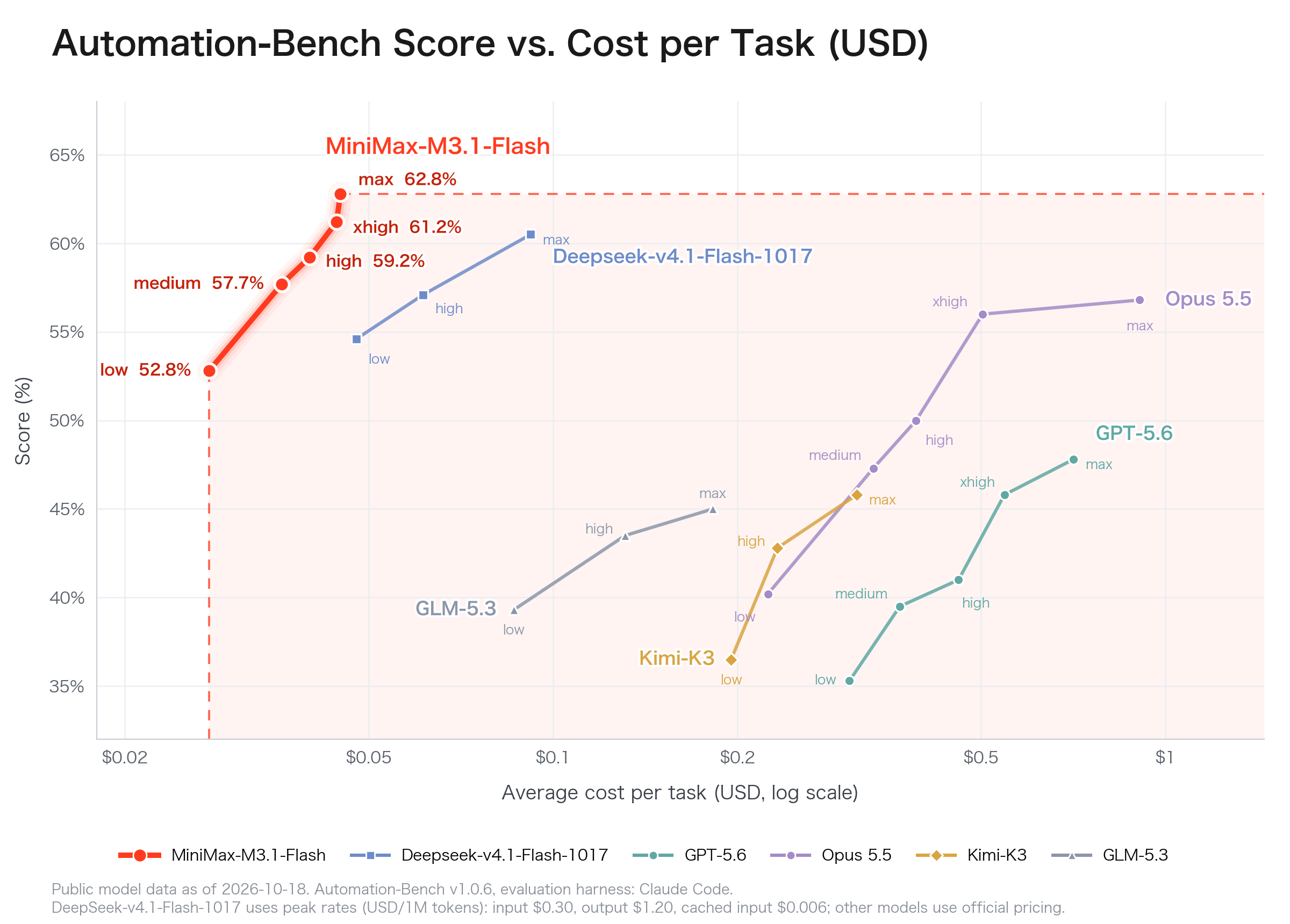
MiniMax's official Automation-Bench score-versus-cost chart. The horizontal axis is logarithmic; exact dollar costs are not printed for the individual MiniMax points.
The official chart's evaluation notes specify Automation-Bench v1.0.6 with the Claude Code harness and public model data as of October 18, 2026. DeepSeek uses peak token rates; the other models use official pricing. Hardware details and repeated-run confidence intervals are not specified.
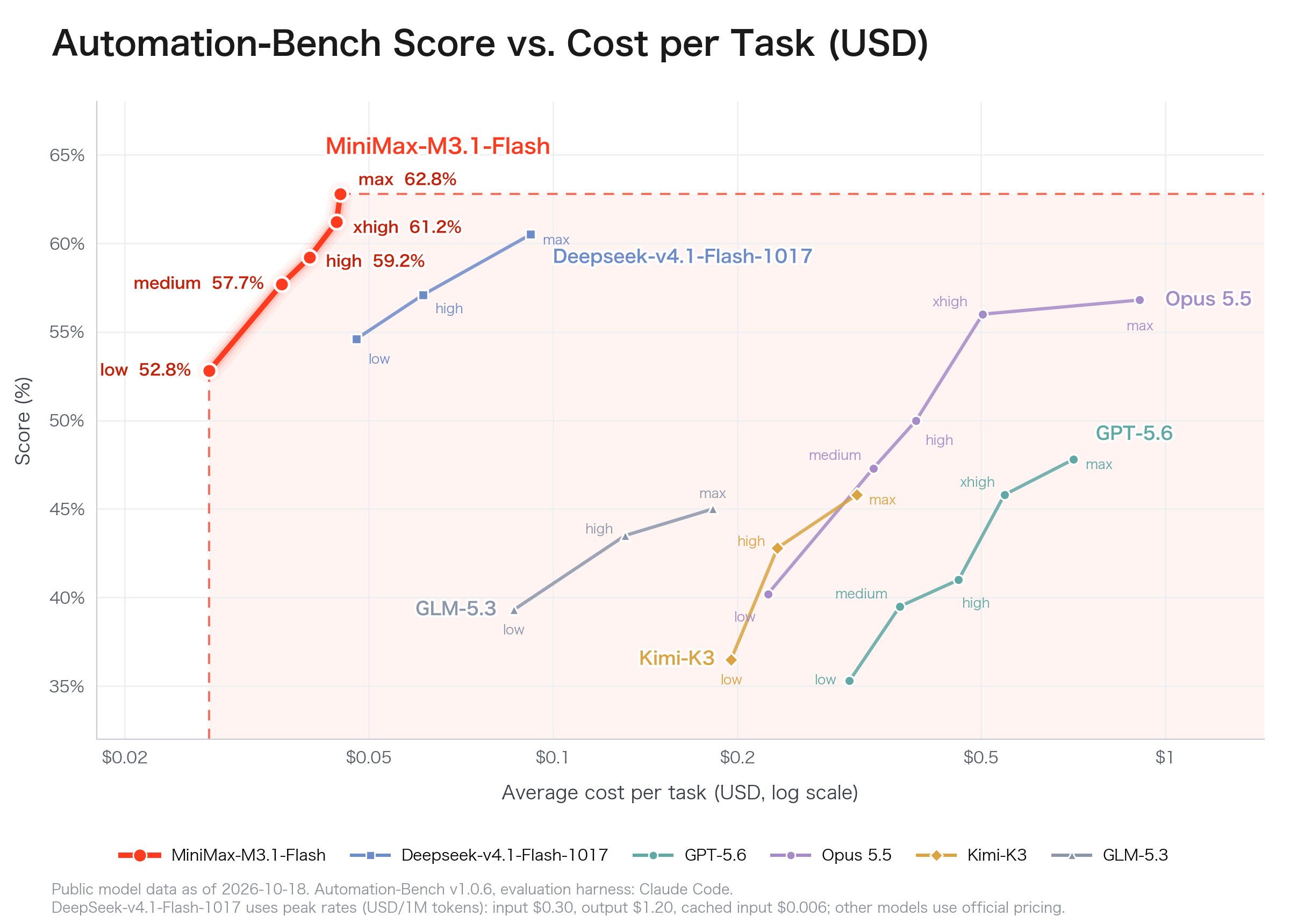
| Reasoning effort | Labeled Automation-Bench score |
|---|---|
| Low | 52.8% |
| Medium | 57.7% |
| High | 59.2% |
| Xhigh | 61.2% |
| Max | 62.8% |
The current official comparison table and the max-effort point both show 62.8. The cost curve compares effort settings within the vendor's setup; it does not establish a fixed dollar cost for a production agent.
The labeled score rises by 10 percentage points from low to max effort. For deployment, compare medium and higher effort on a fixed task set, counting failed attempts and retries in total spending. Choose the setting that meets the quality target at the lowest measured cost per accepted task.
How Can Developers Access MiniMax M3.1 Flash Through CometAPI?
Developers can access MiniMax M3.1 Flash API in CometAPI. The public catalog checked on October 20, 2026 displays the model ID minimax-m3.1-flash even though its URL retains a preview suffix. Use the model ID available to your account, rather than deriving an API identifier from the page URL.
Send a POST request to https://api.cometapi.com/v1/chat/completions with Authorization: Bearer YOUR_COMETAPI_KEY and Content-Type: application/json. In the JSON body, set model to minimax-m3.1-flash (if enabled for your account) and provide a messages array. See the CometAPI documentation for request details.
Why use CometAPI? Its unified API key, compatible request format, and usage dashboard can simplify working across model providers. For MiniMax M3.1 Flash, weigh that integration convenience against the provider-specific prices above and verify the features available to your account.
Which AI Agents Benefit Most From MiniMax M3.1 Flash?
| Use case | Why it may fit | Deployment consideration |
|---|---|---|
| Enterprise automation | Strong Automation-Bench results | Validate tools and retries |
| Coding assistants | Competitive DeepSWE performance | Execute tests and review patches |
| Customer support | Low input and cache prices | Monitor accuracy |
| Research agents | 1M context window | Check evidence and sources |
| Computer-use agents | OSWorld capability | Handle UI changes and recovery |
| Security code review | CyberGym result | Independent verification |
The benefits are strongest when an agent completes enough tasks correctly to offset retry, orchestration, and review costs. Production use should measure both model-level and workflow-level performance.
Is MiniMax M3.1 Flash the Best Value for AI Agents?
MiniMax M3.1 Flash is a strong option for cost-sensitive agents involving repeated context and structured tools, but the lowest token price does not always produce the lowest cost per successful task. Failed calls, additional retries, and human intervention can erase savings. Evaluate accepted completion rate, end-to-end time, total cost per successful task, and human intervention rate.
FAQ
Why can MiniMax M3.1 Flash return an empty answer?
On MiniMax's native OpenAI-compatible API, thinking tokens consume the generation budget. A limit that is too small can end a request with finish_reason set to length before visible answer text is produced. Inspect the finish reason and token usage, increase the completion budget when appropriate, and handle reasoning_content separately from the final answer. Confirm the same response semantics on a third-party route.
How should MiniMax M3.1 Flash tool-call history be stored?
Preserve the complete assistant message, including tool calls and reasoning content, before appending the matching tool results. Saving only the visible answer can remove information needed for the next step. Maintain tool-call IDs and message order, and validate the replay behavior using the actual provider endpoint. MiniMax's conversation-history guidance describes the native API requirements.
How can teams detect MiniMax M3.1 Flash routing changes?
Keep a small regression suite with fixed inputs, expected output structure, and tool-call assertions. Record the requested model ID, returned model identifier when present, provider, timestamp, and billed usage. Rerun it after provider updates; a stable alias alone does not demonstrate that the underlying checkpoint or behavior is unchanged.
How should a MiniMax M3.1 Flash migration be staged?
Start with read-only or replayed tasks, then route a small share of live traffic while retaining a tested fallback. Define rollback thresholds for invalid tool calls, timeouts, and unsuccessful tasks before increasing traffic. Review examples of regressions rather than relying only on average scores, because a small number of costly failures can outweigh lower token prices.
Conclusion
MiniMax M3.1 Flash improves the economics of autonomous AI agents through inexpensive tokens, configurable reasoning, a large context window, and strong reported automation and coding results. Its key advantage is the balance between performance, latency, and task cost—not absolute superiority on every benchmark.
Developers should validate real workflow completion rates and total agent costs, then choose the MiniMax M3.1 Flash route whose active configuration, supported features, and billing match their requirements.