

TL;DR
Muse Wonder, Claude Opus 5.5, and GPT-6 Sol are high-capability models positioned for coding and agent workflows. Meta's new Muse Wonder emphasizes persistent memory and sustained execution; Opus 5.5 leads the cited aggregate intelligence index; GPT-6 Sol has the lowest standard short-context input and output rates in this comparison, while its long-context tier is priced separately. Choose using representative task quality, reliability, and total cost, rather than a single leaderboard score.
Key Takeaways
- Overall intelligence: Claude Opus 5.5 scores 58 versus Muse Wonder's 52 on the reported Intelligence Index v4.3.
- Long-horizon coding: Muse Wonder posts 78.8 on DeepSWE 1.1 and 53.1 on SWE-Marathon; Opus 5.5 records 74.2 and 46.3 in Meta's table.
- Low-cost reasoning: GPT-6 Sol starts at $2 input / $10 output per million tokens through OpenAI's short-context standard API.
- Memory-focused agents: Muse Wonder introduces Active Memory and Active Focus.
- Availability matters: Muse Wonder Full is a separate, more restricted product than the developer-accessible standard Muse Wonder.
Muse Wonder vs Claude Opus 5.5 vs GPT-6 Sol at a Glance
Choose Muse Wonder for persistent agents and long-running engineering, Claude Opus 5.5 for broad coding and terminal-heavy work, and GPT-6 Sol for lower standard short-context token costs.
| Decision factor | Muse Wonder | Claude Opus 5.5 | GPT-6 Sol |
|---|---|---|---|
| Start testing with | Persistent agents and extended engineering | Terminal-heavy coding and professional workflows | Budget-sensitive coding and automation |
| Context window | 1,048,576 tokens | 1M tokens | 1,050,000 tokens |
| Published strength | DeepSWE 78.8; SWE-Marathon 53.1 | Intelligence Index 58; ProgramBench 70.5 | Standard input/output $2/$10 per 1M tokens |
| Standard input / output per 1M tokens | $4 / $20 | $4 / $20 | $2 / $10; short-context tier |
| Provider access | Meta Model API; Full is a separate subscription product | Anthropic API | OpenAI API |
| Selection metric | Accepted task quality and total cost | Accepted task quality and total cost | Accepted task quality and total cost |
| Developer | Meta | Anthropic | OpenAI |
| Release | October 12, 2026 | September 22, 2026 | September 16, 2026 |
| Input modalities | Text, image, audio, video; PDF inputs documented | Text, image | Text, image |
| Output | Text | Text | Text |
| Distinctive capability | Active Memory and Active Focus | Tool and subagent workflows | Configurable reasoning effort and API tools |
This overview summarizes the dated specifications and published results examined below. Benchmark rows use different evaluation methods, and low token rates do not establish lower cost per successful task. Standard Muse Wonder and Muse Wonder Full are distinct access choices.
Specifications were checked on October 13, 2026. Supported modalities and features depend on the selected endpoint and release surface, including audio availability. Model-level capabilities do not guarantee support on every gateway route.
Muse Wonder vs Claude Opus 5.5 vs GPT-6 Sol: Overview and Specifications
Muse Wonder: Persistent Agent Workflows
Meta introduced Muse Wonder and Muse Wonder Full on October 12, 2026. Standard Muse Wonder emphasizes long-running professional tasks, persistent agent memory, and recovery from obstacles. Active Memory is intended to retrieve useful prior context, while Active Focus is designed to sustain progress across multi-step work. Meta describes coding, research, financial analysis, and personal assistance as key scenarios.
Claude Opus 5.5: Professional Coding and Tool Use
Claude Opus 5.5 targets coding, reasoning, and multi-tool professional workflows. Anthropic released it on September 22, 2026. Its context window is one million tokens, while the reported coding results below show strengths that vary by benchmark.
GPT-6 Sol: Cost-Conscious Reasoning
GPT-6 Sol aims to combine strong reasoning and tool use with comparatively affordable inference. It supports programmatic workflows through OpenAI's API ecosystem. Its standard short-context rates are lower than the listed Claude Opus 5.5 rates, though end-to-end economics also depend on retries and reasoning-token use.
OpenAI describes GPT-6 Sol as a model for complex coding and agentic workflows; its release announcement provides the evaluation results used below. This article compares the specified model versions, not every newer model in each vendor's lineup.
Architecture and Reasoning Controls
The sources cited here do not provide a comparable parameter-count and architecture breakdown for all three models. No dense-versus-mixture-of-experts ranking is therefore justified. Active Memory and Active Focus describe Meta's agent capabilities; they are not substitutes for a disclosed neural architecture. GPT-6 Sol exposes configurable reasoning effort, while reported Meta and Claude scores also depend on effort and evaluation setup. Treat those settings as part of the configuration being compared, not as interchangeable measures of compute.
Comparison result: All three offer large context windows and developer APIs. Muse Wonder documents broader model-level input modalities; Opus 5.5 and GPT-6 Sol emphasize text and image workflows. Context capacity and feature availability still need to be checked on the selected endpoint.
Muse Wonder vs Claude Opus 5.5 vs GPT-6 Sol: Performance
Published Benchmarks and Source Boundaries
Meta's official model card offers direct Muse Wonder versus Claude Opus 5.5 comparisons. OpenAI publishes GPT-6 Sol results separately, so the three models cannot be placed on one fully controlled leaderboard without harmonizing evaluation harnesses, versions, and settings.
| Benchmark | Muse Wonder | Claude Opus 5.5 | Higher score |
|---|---|---|---|
| Artificial Analysis Intelligence Index v4.3 | 52 | 58 | Opus |
| Personal Superintelligence Index | 54.3 | 55.2 | Opus |
| Harvey LAB-AA | 10.0 | 4.2 | Muse |
| Vals Finance Agent V2 | 56.6 | 58.6 | Opus |
| AutomationBench-AA | 39.1 | 41.2 | Opus |
| JobBench | 70.5 | 75.4 | Opus |
| MemoryBench | 85.6 | 81.5 | Muse |
| Terminal-Bench 4.0-AA | 52.0 | 59.6 | Opus |
| DeepSWE 1.1 | 78.8 | 74.2 | Muse |
| SWE-Marathon | 53.1 | 46.3 | Muse |
| ProgramBench | 50.0 | 70.5 | Opus |
| HealthBench Pro | 60.5 | 65.6 | Opus |
The official model-card methodology distinguishes internal tests, third-party evaluations, and provider-reported competitor scores. The table reproduces the reported values; it does not establish a uniform, independently controlled trial across all rows.
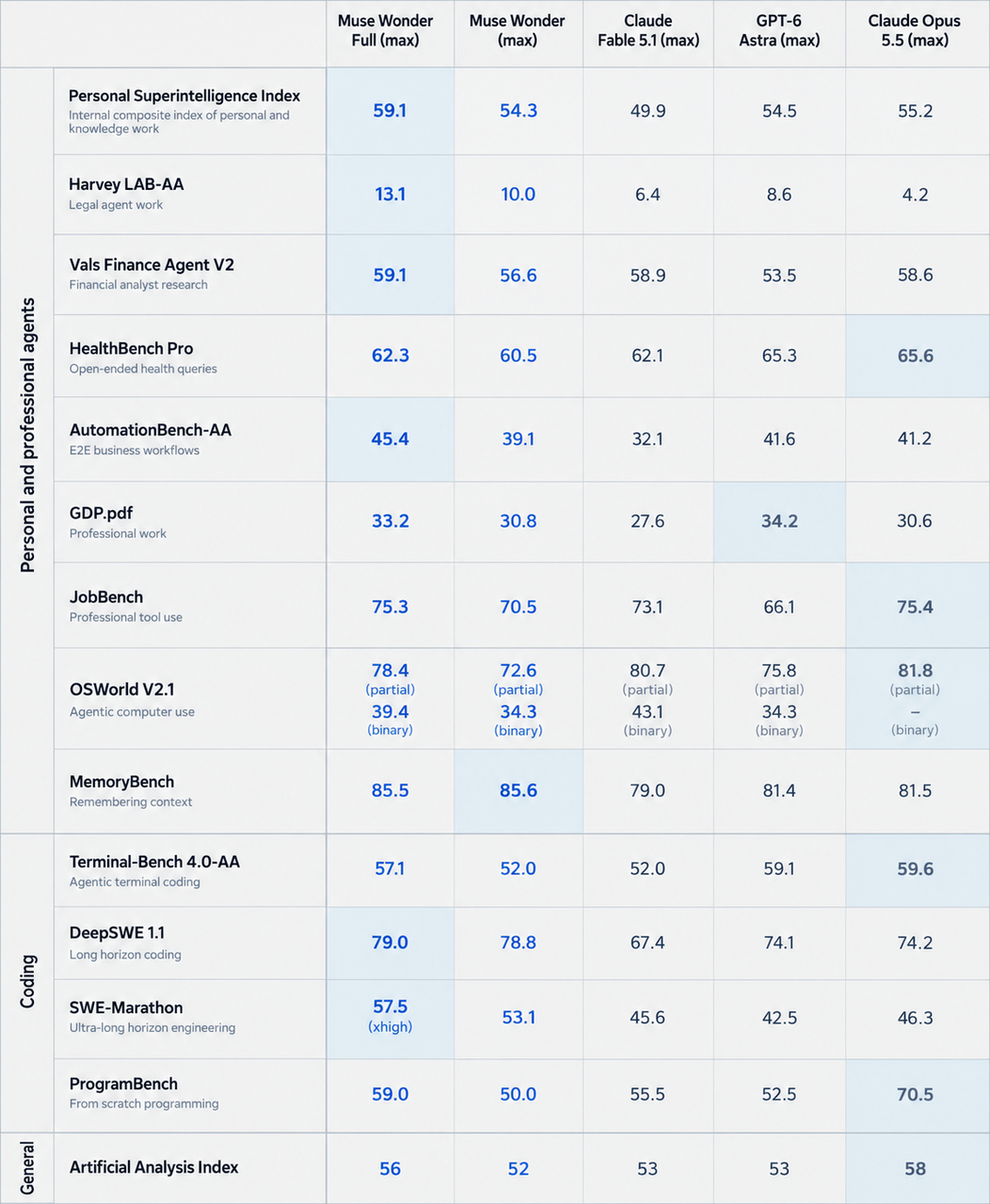
Original benchmark scorecard from Meta's Muse Wonder model card, reproduced without redrawing. The additional OpenAI model shown in this official image is GPT-6 Astra, not GPT-6 Sol. The surrounding tables identify the models relevant to this article.
Evaluation Conditions
DeepSWE v1.1 covers 113 tasks across 91 repositories and five languages, graded by functional and regression tests using pass@1; Meta's scorecard uses Datacurve results for Muse Wonder and Opus 5.5. SWE-Marathon uses project tests and reports pass@1 from Abundant AI; agent harnesses vary, and Wonder Full's score is marked xhigh. ProgramBench uses mini-swe-agent and measures rollouts passing at least 95% of hidden tests, with internet disabled after setup. MemoryBench is Meta's internal 64K–100K-token conversation test scored by an LLM judge. These environments and metrics should not be collapsed into one general accuracy score.
Coding and Software Engineering
Muse Wonder leads on the reported DeepSWE 1.1 and SWE-Marathon results. Claude Opus 5.5 leads on Terminal-Bench 4.0-AA and ProgramBench. This split suggests that long-horizon engineering, command-line tool use, and program reconstruction stress different skills.
GPT-6 Sol Results and Cross-Source Comparability
| Published OpenAI evaluation | GPT-6 Sol | Reported setting |
|---|---|---|
| DeepSWE 1.1 | 68.8% | Maximum reasoning |
| AutomationBench 1.0.6 | 33.2% | xhigh reasoning |
| Agents' Last Exam V1 | 56.4% | Maximum reasoning |
| OSWorld 2.0 offline | 60.5% | xhigh reasoning |
OpenAI's published evaluation results report the scores above. Its OSWorld result is partial reward on the offline v2026.08.08 set, rather than a strict task-completion rate. OpenAI notes that evaluations used its research environment or API; production configurations can differ.
The reported DeepSWE scores imply a 10.0-percentage-point gap between Muse Wonder and GPT-6 Sol, and a 5.4-point gap between Opus 5.5 and GPT-6 Sol. These are arithmetic differences between publications, not controlled estimates of a model-only advantage. Different agent setups, prompts, effort levels, and tool budgets can affect the result.
Memory and Long-Running Agents
Muse Wonder targets agents that must remember prior decisions, recover context, and continue interrupted work. Active Memory can help a research assistant remember project-specific facts, while Active Focus supports iterative action when an earlier plan does not succeed. These product capabilities do not replace state verification, permissions, audit trails, or mandatory human confirmation for sensitive actions.
Muse Wonder Full Performance
Muse Wonder Full is a separate product choice. Meta offers standard Muse Wonder through its API, while Full is restricted to Power Usage and Maximum Usage subscriptions in Muse Code. A higher score does not make Full an API replacement for the standard model.
Meta's reported Wonder Full results are 56 on the Intelligence Index, 59.1 on Personal Superintelligence, 13.1 on Harvey LAB-AA, and 45.4 on AutomationBench-AA. It also scores 79.0 on DeepSWE 1.1, 57.5 on SWE-Marathon, 85.5 on MemoryBench, and 75.3 on JobBench. These published results describe the separately accessed Full product; they are not new measurements from a common-harness comparison.
Compared with the standard Muse Wonder scores above, Full improves on seven of these eight reported measures; MemoryBench is slightly lower at 85.5 versus 85.6. Opus 5.5 still leads the reported Intelligence Index at 58.
Latency and Reliability
The cited evidence does not provide a matched three-model latency comparison. Measure time to first useful output, median and 95th-percentile end-to-end task time, timeout frequency, and completion without intervention. Hold task inputs, tool permissions, concurrency, and acceptance criteria fixed; record effort settings and retry budgets. Faster token generation alone does not establish faster completion of a multi-step task.
Comparison result: Muse Wonder leads the cited sustained-engineering tests, while Opus 5.5 leads the cited terminal and program-reconstruction tests. GPT-6 Sol remains a lower-token-price candidate, but the available publications do not prove an equal-environment quality or speed ranking across all three.
Muse Wonder vs Claude Opus 5.5 vs GPT-6 Sol: Cost
Official API Token Prices
| Price per 1M tokens | Muse Wonder | Claude Opus 5.5 | GPT-6 Sol |
|---|---|---|---|
| Standard input | $4 | $4 | $2 |
| Standard output | $20 | $20 | $10 |
| Cached input | $0.20 | $0.20 | $0.20 |
| Long-context input | $4 | $4 | $4 |
| Long-context output | $20 | $20 | $15 |
| Long-context cached input | $0.20 | $0.20 | $0.40 |
Meta publishes $4 input, $20 output, and $0.20 cached input per million tokens. Anthropic lists Opus 5.5 at $4 input, $20 output, and $0.20 cache hits per million tokens. OpenAI's pricing table lists GPT-6 Sol at $2/$10 for short-context input/output and $4/$15 for long context; cached-input rates also vary by tier. Apply the relevant per-request context tier, processing mode, and endpoint conditions before estimating a workload.
For GPT-6 Sol, requests containing more than 272,000 input tokens are billed at higher rates:
- Input tokens: 2× the standard rate, increasing from $2 to $4 per million tokens.
- Cached input tokens: 2× the standard rate, increasing from $0.20 to $0.40 per million tokens.
- Output tokens: 1.5× the standard rate, increasing from $10 to $15 per million tokens.
These higher rates apply to the entire request, not just the tokens exceeding 272,000. A request with 272,001 input tokens therefore enters the long-context pricing tier for all its input, cached input, and output tokens.
By comparison, Muse Wonder and Claude Opus 5.5 do not impose an equivalent long-context pricing premium under their standard API rates.
This distinction is particularly important for large-document analysis, repository-wide coding, and long-running AI agents, where GPT-6 Sol's short-context pricing advantage may narrow as requests become larger.
CometAPI Pricing and Billing Conditions
At review time, CometAPI listed Opus 5.5 at $3.20 input / $16 output and GPT-6 Sol at $1.60 input / $8 output per million tokens. These are CometAPI's independent rates and must not be conflated with the official provider prices above. Confirm the applicable route, context tier, and account billing conditions before estimating cost; prices and conditions may change.
Cost per Accepted Task
Calculate cost per accepted task as total billed model and tool spend, including charged retries and fallbacks, divided by the number of outputs that meet predefined acceptance criteria. Record human review time separately or convert it using an explicit labor rate. Track failed requests and actual charges independently: failure alone does not establish whether a request was billed.
Comparison result: GPT-6 Sol has the lowest listed standard short-context input and output rates, while Muse Wonder and Opus 5.5 share the same listed base rates. Actual cost per accepted task depends on the selected billing route, cache use, context tiers, tool fees, retries, and review effort.
Muse Wonder vs Claude Opus 5.5 vs GPT-6 Sol: Comparison and Selection
Capability and Workload-Based Selection
- For broad coding and terminal workflows, start with Claude Opus 5.5 because it leads the cited Intelligence Index, Terminal-Bench, and ProgramBench results. Validate it on refactoring, tool execution, and program-level consistency.
- For extended engineering projects, start with Muse Wonder because its reported DeepSWE and SWE-Marathon results are stronger than those of Opus 5.5. Measure task completion, recovery from obstacles, and total task cost.
- For persistent personal agents, start with Muse Wonder because it offers Active Memory and Active Focus and has a higher reported MemoryBench score than Opus 5.5. Test recall, corrections, continuity, and project isolation.
- For multi-step tool workflows, evaluate all three models. Muse offers Active Focus, Opus emphasizes tool orchestration, and GPT-6 Sol supports Responses API tools. Compare the complete agent stack, including tool permissions, retries, and state handling.
- For professional documents and analysis, evaluate Muse Wonder or Claude Opus 5.5. Muse has specialized strengths, while Opus has the stronger cited aggregate index. Use representative documents and task-specific acceptance criteria.
- For high-volume, cost-sensitive automation, start with GPT-6 Sol because it has the lowest listed standard short-context input and output rates. Check accepted-task cost, context tiers, latency, and retries.
- For Meta’s highest-end option, evaluate Muse Wonder Full if it is accessible. It has higher reported scores on several specialized tasks, but it is separate from the standard API model. Confirm subscription access and suitability before testing.
Professional Coding
Claude Opus 5.5 is a good default for teams requiring a broad engineering assistant, particularly where tool execution, refactoring, and program-level consistency matter. Its reported Terminal-Bench and ProgramBench advantages strengthen that case, although teams should validate the full agent stack rather than only the model.
High-Volume Automation
GPT-6 Sol is appealing when requests are numerous and cost sensitivity is high. Even a modest quality deficit can be acceptable for low-risk, easily checked tasks such as drafting documentation, extracting structured fields, or explaining code. For long autonomous runs, track quality, tokens, latency, and retries together.
Production Evaluation Checklist
Production evaluation should track six metrics: correctness, measured by accepted answers or passing tests; reliability, measured by tasks completed without human rescue; latency, measured by end-to-end task duration; token use, measured by total billed input and output; agent efficiency, measured by tool invocations and corrective retries; and effective cost, calculated as total spend divided by accepted tasks.
Comparison result: Shortlist Muse Wonder for persistent-agent and extended-engineering tasks, Opus 5.5 for broad coding workflows with strong terminal demands, and GPT-6 Sol when token cost is a major constraint. Promote a candidate only after it meets task-specific quality and reliability thresholds.
Where Can You Access Muse Wonder, Claude Opus 5.5, and GPT-6 Sol?
Official Provider Access
Use Meta Model API for standard Muse Wonder, Anthropic API for Opus 5.5, or OpenAI API for GPT-6 Sol. Muse Wonder Full is available through the specified Muse Code subscription plans rather than as a drop-in replacement for the standard API model. Check account access, usage limits, and supported request features for the route you select.
CometAPI Access
A unified gateway can simplify authentication, billing, and routing. Use a higher-performance model for complex architecture review and a cheaper model for repetitive, low-risk drafting. The model identifier and supported request format should always be checked against the target API endpoint.
Developers can access Claude Opus 5.5 API in CometAPI and GPT-6 Sol API in CometAPI to evaluate representative workloads. Confirm the supported API surface for each model rather than assuming that a shared gateway makes all request formats interchangeable.
The CometAPI routes cited in this article cover Opus 5.5 and GPT-6 Sol. This article does not establish a CometAPI route for Muse Wonder or Wonder Full; use the confirmed provider route when evaluating those products.
Conclusion
No single model wins across every workload. Muse Wonder is the strongest candidate to test for persistent-agent behavior and long-running engineering tasks. Claude Opus 5.5 is a strong candidate for broad coding, terminal-heavy workflows, and knowledge work, and it leads the Artificial Analysis Intelligence Index value reported by Meta. GPT-6 Sol offers the lowest standard short-context token prices and is attractive for cost-sensitive automation. Production teams should make the final choice using accepted-task quality, reliability, latency, retries, tool usage, and total cost on representative workloads.
FAQ
How can teams fairly test Muse Wonder, Opus 5.5, and GPT-6 Sol?
Use a held-out set of real tasks with fixed acceptance criteria, identical input artifacts, and documented tool permissions. Record each model version, effort setting, agent harness, timeout, and token budget. Run repeated trials where outputs vary, report failures as well as successes, and separate a common-harness comparison from a best-configured-system comparison. This produces evidence that applies to your workflow rather than another team's benchmark setup.
Can an API gateway preserve agent state when switching models?
A shared gateway address does not by itself guarantee portable conversation state, tool-call identifiers, or stored-response references. Keep a canonical application-side record of messages, tool outputs, and validated task state. Test each route's state and tool semantics before routing an in-progress job to another model; otherwise a cheaper fallback may lose information needed to finish correctly.
How should teams budget for retries and human review?
Define an accepted result before testing, then divide total billed model and tool spend by accepted results. Report review labor separately or include it using a stated hourly rate. Count failed attempts, corrective calls, and fallback models, and compare both typical and high-cost tasks. This avoids treating a lower token price as a guaranteed reduction in the cost of useful work.
What should a memory-sensitive agent evaluation include?
Test whether the agent recalls relevant facts, incorporates corrections, ignores obsolete instructions, and keeps separate projects isolated. Include delayed follow-ups and contradictory updates rather than only a single long prompt. Check memory behavior at the application level as well as the model level, because persistence, retrieval, and deletion depend on the deployed system.