
TL;DR
Meta launched Muse Wonder and Muse Wonder Full on October 12, 2026. Wonder is available through Meta Model API and Muse Code, while Full is available in Muse Code through the Power Usage and Maximum Usage subscriptions. Full leads on several published benchmarks, but the practical choice depends on API access, task quality, and cost. This comparison reviews published sources and does not include independent hands-on testing.
Key Takeaways
- Wonder supports API integration; Full is available through Muse Code Power Usage and Maximum Usage subscriptions.
- Meta’s launch chart reports Artificial Analysis Intelligence Index scores of 52 for Wonder and 56 for Full. The four-point gap does not represent a universal percentage improvement in task performance.
- Wonder supports a 1,048,576-token context window and text, image, audio, video, and PDF input, with text output.
- Meta standard API rates are $4 input, $0.20 cached input, and $20 output per million tokens; Full has no public per-token Model API rate.
- Maximum reasoning effort does not select Full. Start with Wonder for applications; evaluate Full for demanding interactive work in Muse Code.
Muse Wonder vs Muse Wonder Full: Overview and Specifications
Start with Wonder when you need a callable model for a product or automated workflow. Evaluate Full if you use Muse Code and its benchmark strengths are relevant to your tasks. Access requires a Power Usage or Maximum Usage subscription and remains subject to plan limits. The practical difference is access first, benchmark performance second.
| Decision factor | Muse Wonder | Muse Wonder Full |
|---|---|---|
| Start testing with | Production APIs, custom agents, and batch processing | Difficult interactive coding and professional work in Muse Code |
| Provider access | Meta Model API and Muse Code | Muse Code Power Usage or Maximum Usage |
| Public Meta API model ID | muse-wonder-1.0 | No public Model API identifier |
| Context window | 1,048,576 tokens | 1M tokens at inference in the model card |
| Input and output | Text, image, audio, video, PDF input; text output | Text, image, audio, video input and text output at model-card level; check Muse Code support |
| Meta API input / cached input / output per 1M tokens | $4 / $0.20 / $20 | No public per-token Model API price |
| CometAPI access status | Available; confirm account route and billing | Coming soon as of October 16, 2026 |
| Primary selection criterion | Accepted-task quality, reliability, and total task cost | Accepted-task quality within the supported product and subscription allowance |
The table summarizes the specifications, published results, and commercial terms discussed below. Model-level modalities do not guarantee identical support on every endpoint. he context limit stated in Full’s model card is not a public API contract.
Both variants target complex coding and personal and professional agentic work. The main documented differences are their published performance and access options: Wonder is available through Meta Model API and Muse Code, while Full is available through eligible Muse Code subscriptions.
Muse Wonder for Programmable Workflows
Meta introduced the Muse Wonder model family as frontier AI systems for personal and professional agentic workflows, with an emphasis on sustained reasoning, tool use, software engineering, and difficult knowledge work.
Muse Wonder is the standard model accessible through Meta’s Model API and Muse Code. It is suitable for developers designing coding assistants, document analysis, multimodal systems, and long-running agents. Its API interface enables direct workload measurement, usage billing, and integration into production software.
Muse Wonder Full for Demanding Interactive Work
Muse Wonder Full is a more capable variant optimized for especially demanding workflows. Meta’s own launch materials associate it with professional analysis and long-horizon coding. At launch, access is tied to eligible Muse Code subscription plans rather than a separately priced public API.
The API specification documents Wonder’s multimodal inputs, exact context limit, and reasoning controls. Full has a family-level model-card description, but no equivalent public API contract. Shared family capabilities do not establish identical endpoint parameters or product upload limits.
Active Memory, Active Focus, and Reasoning Settings
Meta describes Active Memory and Active Focus as two mechanisms designed to preserve useful context and maintain goal-directed progress through difficult tasks. They do not eliminate the need for application-level verification, permissions, or human oversight.
Setting Wonder to its maximum reasoning-effort level does not turn it into Wonder Full. The distinction is a model-access distinction, not merely a toggle within a request.
Muse Wonder vs Muse Wonder Full: Performance
Published Benchmarks and Source Boundaries
Wonder Full leads on the reported composite index, but benchmark scores measure performance on selected evaluations, not a universal percentage improvement. Compare the same benchmark version, inference settings, and evaluation date before drawing deployment conclusions.
| Evaluation | Muse Wonder | Muse Wonder Full | Metric / reported setting |
|---|---|---|---|
| AA Intelligence Index v4.3 | 52 | 56 | Composite index; Artificial Analysis; max effort |
| AutomationBench-AA | 39.1 | 45.4 | Strict pass@1; simulated business workflows; Artificial Analysis |
| SWE-Marathon | 53.1 | 57.5 | Pass@1; project tests; Abundant AI; Full at xhigh |
| Terminal-Bench 4.0-AA | 52.0 | 57.1 | Accuracy; isolated terminal tasks with executable verification; Artificial Analysis |
| DeepSWE 1.1 | 78.8 | 79.0 | Pass@1; functional and regression tests; Datacurve results |
| MemoryBench | 85.6 | 85.5 | Internal conversation-memory benchmark; LLM-judged recall |
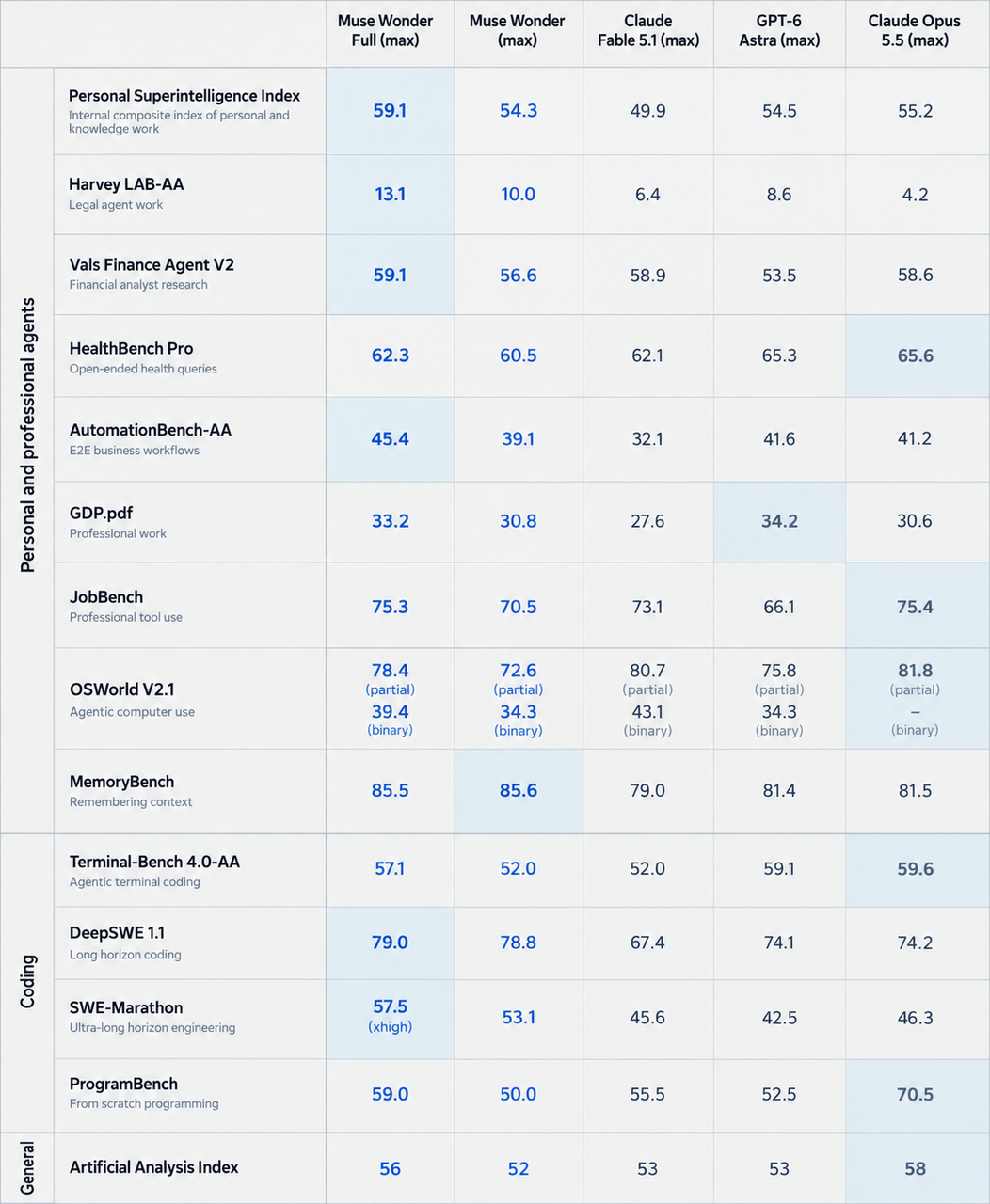
Official Meta model-card scorecard, reproduced without redrawing. The accompanying methodology identifies result sources and settings.
Evaluation Conditions
Meta’s evaluation methodology uses max reasoning unless otherwise noted. SWE-Marathon uses vendor-reported environments rather than a controlled common harness across all models. These are third-party results summarized by Meta; they are not four uniformly controlled internal tests. The release snapshot is October 12, 2026, rather than a live leaderboard.
DeepSWE measures long-horizon repository work using functional and regression tests. MemoryBench measures recall in 64K–100K-token conversations with an LLM judge. These scores assess different behaviors and use different grading systems. The reported 0.1-point MemoryBench gap is too small to support a practical ranking without information about evaluation variability.
Coding and Software Engineering
Full is ahead on the cited coding results, but the size of the gap varies: DeepSWE differs by 0.2 points, SWE-Marathon by 4.4, and Terminal-Bench by 5.1. That pattern supports testing Full on difficult extended work; it does not show that every code review or short implementation needs Full. API availability remains a separate deployment constraint.
Memory and Long-Running Agents
Full does not lead every reported measure. MemoryBench is 85.5 for Full and 85.6 for Wonder in the official scorecard. Treat that near tie as a reason to test actual memory behavior, including corrected facts, obsolete instructions, and project isolation. Evaluate Active Focus through end-to-end completion and recovery from failed steps rather than assuming that a higher composite score guarantees better persistence.
Latency and Reliability
The cited materials do not establish a matched latency ranking between Wonder API and Full in Muse Code. Measure time to useful output, median and 95th-percentile task duration, timeout frequency, retries, and completion without human rescue. Record the tools, reasoning setting, runtime, and task limits for each surface so that a product-level comparison is not presented as a model-only experiment.
Muse Wonder vs Muse Wonder Full: Cost
Official API Prices and Subscription Units
Meta publishes standard Wonder API rates of $4 input, $0.20 cached input, and $20 output per million tokens. Full uses a subscription access model, so the same token-price calculation does not apply to it.
Meta’s Power Usage and Maximum Usage plans include both Wonder and Full in Muse Code. Benefits and availability can vary by region, so check the current offer and account allowance before budgeting. These subscriptions provide limited interactive usage; they do not include unlimited production API calls.
Token-cost example: 100,000 uncached input tokens cost $0.40, and 20,000 output tokens cost $0.40, for a total of $0.80. A multi-step agent run may incur additional token usage across requests, plus tool charges.
Meta lists web search grounding at $2.50 per 1,000 search queries, in addition to token charges.
CometAPI Billing Conditions
Muse Wonder is available through CometAPI, with account-specific, route-level pricing. Confirm input, output, cached-input, and other billing terms separately from Meta’s list prices before sending production traffic. As of October 16, 2026, Wonder Full is marked Coming soon, so that listing is neither an available API route nor a price quote or release commitment.
Cost per Accepted Task
Define an accepted deliverable before measuring cost. Divide total billed model and tool spend, including charged retries and fallbacks, by accepted deliverables. Record review labor separately or apply an explicit hourly rate. For Full, also track useful work completed within the subscription allowance. Monthly fees and per-token rates are different units, so comparing their headline prices alone cannot identify the cheaper workflow.
Muse Wonder vs Muse Wonder Full: Comparison and Selection
Capability and Workload-Based Selection
Choose Muse Wonder for production API integration, batch document processing, custom agents, and reproducible A/B tests. Its callable API and usage-based billing let you automate workflows, inspect tool behavior, run regression tests, and measure cost per accepted task. Start here when deployment control and repeatability are central requirements.
Choose Muse Wonder Full for complex interactive refactoring and professional analysis within Muse Code, provided you have a qualifying subscription. Its reported benchmark strengths make it a candidate for difficult, extended assignments; test whether it reduces corrections and review time on your own work, and confirm that the subscription allowance fits your workload.
Application and Automation Workflows
Muse Wonder is a sensible choice for repository Q&A, scripted code review, document extraction, retrieval-based assistants, and custom agents. Its API access lets teams monitor latency, trace tool behavior, automate regressions, and establish cost ceilings.
For a service or batch pipeline, evaluate the supported Wonder API route first. It gives the application explicit control over requests, tool execution, retries, and metering. If the task depends on capabilities available only within Muse Code, evaluate it as a separate interactive workflow with its own operating constraints.
Interactive Coding and Professional Analysis
Full is worth evaluating for long coding sessions, multi-file refactoring, and complex professional analysis in Muse Code, given its higher scores on several published benchmarks. Access constraints mean those advantages cannot automatically be transferred to production API applications.
Use representative refactors, investigations, and finished artifacts to test whether Full reduces corrective iterations or review effort. Confirm the actual subscription allowance before making it a dependency for recurring work. If the improvement is small on your tasks, the standard variant may already meet the acceptance threshold.
Production Evaluation Criteria
For a practical evaluation, collect at least three types of evidence: end-to-end task completion, quality of the finished artifact, and total effort consumed including retries and human review. A four-point composite lead can matter for a complex agent while producing little observable difference in a simple classification task.
Where Can You Access Muse Wonder and Muse Wonder Full?
Official Provider Access
Use Meta Model API for standard Wonder or access it within Muse Code. Full requires a qualifying Muse Code subscription; setting the standard model to max effort does not change the selected variant. Confirm the exact account entitlement, supported request features, and usage limits before testing.
CometAPI integration is distinct from access to Wonder Full through Muse Code. A Muse Code subscription should not be assumed to provide a reusable production API credential or unlimited throughput.
CometAPI Access
Developers can access Muse Wonder API in CometAPI. The Muse Wonder Full API in CometAPI is marked Coming soon as of October 16, 2026; that status does not establish a launch date or a callable endpoint. Confirm account pricing and supported fields before deployment.
For CometAPI requests, use the model identifier documented for your selected route. Before starting a multi-step job, check supported message formats, tool semantics, and state handling. Preserve validated task state in the application so that a routing change does not silently discard information needed to finish the work.
Conclusion
Muse Wonder and Muse Wonder Full are closely related but commercially and operationally different. Wonder offers a documented, multimodal, long-context API for building applications; Full offers stronger reported performance but narrower interactive access. Treat the composite score as useful evidence, not a universal decision rule. Test the version you can actually deploy against your own tasks, constraints, latency, and costs.
FAQ
How should teams compare Muse Wonder API with Full in Muse Code?
Use the same repository snapshot, task instructions, acceptance tests, and review rubric. Record each surface’s tool access, reasoning setting, elapsed time, retries, and human intervention. Treat the result as a workflow comparison: the API agent and Muse Code may provide different tools and execution loops, so a quality difference cannot automatically be attributed to model weights alone.
What happens when a Muse Wonder Full subscription reaches its limit?
Meta’s subscription rules require users to upgrade or wait for a refresh after reaching a limit; Maximum Usage subscribers must wait for the reset. Additional API keys are billed separately on pay-as-you-go, and Full is not offered through the public Model API. Plan interactive work around the account’s actual allowance rather than assuming a subscription provides unlimited throughput.
Can Muse Wonder API persist business records across independent requests?
Do not use a family-level memory capability as a substitute for an application data store. If a task needs durable records, preserve them explicitly, retrieve the relevant material, and pass it through the supported request interface. Test isolation, retention, and retrieval behavior on the actual provider route; the model’s context capacity alone does not establish cross-request persistence.
How should teams estimate the cost of a Muse Wonder agent task?
Measure input, cached input, and output usage across the complete tool loop, including failed attempts and retries. Add tool fees and human review time, then compare cost per accepted deliverable. For Full, track completed work and time spent against the subscription allowance. Token prices and monthly subscription fees describe different purchasing units, so neither alone establishes the cheaper workflow.