
TLDR OpenAI Bel is an unconfirmed internal pretraining run (codename) first reported on X on August 25, 2026 by @synthwavedd. The claim describes a finished base model with more than 10 trillion total parameters—successor to an earlier run called Doug—intended as a foundation for post-GPT-6 systems and potentially an “AGI-threshold” model after further reinforcement learning.
As of October 13, 2026, OpenAI has never used the name Bel (or Doug in public product materials), published no parameter count, release date, benchmarks, or system card, and Bel is not available via API or ChatGPT.
Key Takeaways
- Bel originates from a single X post by @synthwavedd on August 25, 2026; OpenAI has never confirmed it.
- Claimed scale: >10T total parameters, similar in size class to GPT-4.5 per the original post.
- Positioned in the rumor as successor to “Doug” and base for post-GPT-6 / Astra systems after RL.
- GPT-6 Astra has been publicly available since early September 2026 and is OpenAI’s current flagship.
- No independent benchmarks, release date, API, pricing, or weights exist for Bel.
- Claude Fable 5.5 remains unannounced; current high-end Claude is Fable 5.1.
- For production use today, route GPT-6 Astra / Sol / Luna and Claude models through one key on CometAPI for lower cost and zero vendor lock-in.
What Is OpenAI Bel?
OpenAI Bel (sometimes styled “BEL”) is the codename circulating in AI community discussions for an alleged large-scale pretraining run that OpenAI supposedly completed in the second half of August 2026. According to the original report, Bel is a raw foundation model—not a finished product—with more than 10 trillion total parameters. It is framed as the successor to an earlier internal project called Doug and as the intended base that, after additional reinforcement learning and post-training, could power systems beyond GPT-6 Astra, potentially reaching what some insiders reportedly call an “AGI-threshold” capability level.
Importantly, Bel is not GPT-7, not a ChatGPT model users can talk to, and not something available via the OpenAI API. It is described strictly as a pretraining artifact—the enormous neural network trained on text (and possibly other data) that still requires extensive fine-tuning, alignment, and safety work before it becomes a shippable product.
Bel is the reported codename of an OpenAI foundation-model effort. The claim is attributed to @synthwavedd’s August 25, 2026 post about a completed pretraining run. The reproduced post alleges more than 10 trillion total parameters and a successor relationship to Doug. Those details remain single-source claims: the screenshot records an allegation, not an authenticated OpenAI training result.
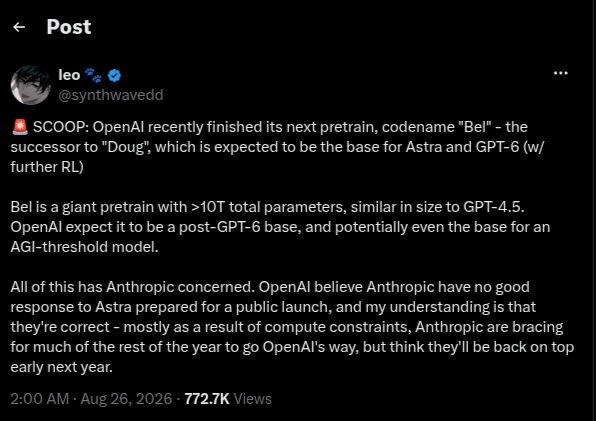
The screenshot is reproduced from Mukhtada’s capture of the attributed X post. It displays August 26 at 2:00 a.m. in the source’s Jakarta-time context, corresponding to August 25 at 19:00 UTC. It is a third-party capture, not independent confirmation of the parameter count, training status, or private competitive claims.
The Doug–Bel Evidence Timeline
The Doug backdrop is separate: SemiAnalysis’s August 7 publication reproduces a July 9 note mentioning a larger OpenAI model called Doug. This predates the Bel post, but does not authenticate Doug → Bel or connect either codename to a released product.
- July 9, 2026: A research note mentioning a larger OpenAI model called Doug was later reproduced in the SemiAnalysis article published on August 7. The note date and publication date are different milestones; this is background on Doug, not confirmation of Bel.
- August 7, 2026: SemiAnalysis published the article reproducing the Doug reference. It predates the Bel allegation but does not establish a Doug-to-Bel lineage or a public product name.
- August 25, 2026: The attributed @synthwavedd post alleged completed Bel pretraining and more than 10 trillion total parameters. A third-party capture reproduces the claim; it is not independent verification.
- September 1, 2026: The Path to Astra report cited in this article provides background on a separate model-development program. It does not establish the identity of Bel, its parameter count, or a connection to GPT-7 or a possible GPT-6 Bel name.
- September 23, 2026: A circulating account attributes a wait of months to a follow-up post from the same account. As the original text was not directly accessible in the source review, this remains unverified timing guidance and supplies no launch commitment.
- October 12, 2026 — article review checkpoint: The attributed Bel post, Doug reporting, and separate official report cited here do not establish a commercial identity for Bel. Neither GPT-7 nor GPT-6 Bel is confirmed by this evidence chain; this date records the article review, not a model announcement.
Around the same period, OpenAI publicly discussed an unnamed internal model “significantly more capable than GPT-6 Astra” in connection with mathematical work (including results related to Navier-Stokes equations).
Two Naming Hypotheses: GPT-7 or GPT-6 Bel?
Pretraining and product release are different milestones. A foundation checkpoint may still require instruction tuning, reinforcement learning, safety evaluation, tool-use training, and serving optimization. Multiple products can derive from one foundation, and a public version number does not identify a training run. OpenAI’s Path to Astra report supplies official reinforcement-learning background, without establishing Bel’s identity.
Hypothesis 1 — GPT-7: If Bel represents a materially new foundation beyond the GPT-6 generation, OpenAI could commercialize a model derived from it as GPT-7. This interpretation depends on a new generation of capabilities and a public naming decision; neither the alleged parameter count nor reported completion of pretraining establishes that outcome.
Hypothesis 2 — GPT-6 Bel: OpenAI could instead keep a Bel-derived product within the GPT-6 family, potentially using a label such as GPT-6 Bel for an upgraded or specialized offering. This is an editorial naming scenario for comparison, not an announced product or a separately sourced leak. An internal codename does not necessarily appear in the commercial name.
What remains unresolved: The same training effort could support multiple products, another name, or no public release. The timeline provides context for both interpretations but cannot choose between them. Confirmation would require documentation linking the Bel training effort to an actual public model and its name.
OpenAI Bel Compare to Previous Generation: What Improve?
Because concrete technical details for Bel are absent, any discussion of improvements must be grounded in (1) the leak’s high-level claims, (2) the known trajectory of GPT-4o → GPT-5.x → GPT-6 Astra, and (3) the capabilities demonstrated by the unnamed internal model used for Navier-Stokes-scale scientific work. Each potential improvement area is treated separately below.
Scale and Pretraining Compute
The central claim is a jump past previous internal runs into the >10T-parameter regime. If accurate, this would represent continued adherence to scaling laws on data, parameters, and compute. Confirmed: OpenAI has continued large training runs and has publicly referenced models more capable than Astra. Not confirmed: any specific parameter count, training FLOPs, data mixture, or architecture changes (dense vs. mixture-of-experts, novel attention, etc.). Realistic expectation based on history: better sample efficiency and broader knowledge coverage, but diminishing returns without corresponding advances in post-training and data quality.
Post-Training and Alignment for Long-Horizon Agency
GPT-6 Astra already improved substantially on multi-step workflows, computer use, and staying within task boundaries. A stronger base plus further RL could push reliable agentic operation from hours toward multi-day or multi-week horizons with less human steering. The Navier-Stokes multi-agent experiment (thousands of coordinating agents) demonstrates that OpenAI is already operating at large agent-swarm scale on hard problems. Confirmed capability direction: yes. Specific Bel contribution: unconfirmed.
Scientific and Mathematical Reasoning
Astra itself contributed to mathematical progress; the stronger internal model produced a formalized result on a Millennium Prize problem. A larger, better-trained base could further compress the time and cost of exploring hard STEM search spaces. Confirmed: OpenAI is investing heavily here. Bel-specific: not confirmed.
Computer Use, Tool Use, and Multimodal Reliability
Astra set new marks on computer-use and browser-use benchmarks. Future bases would be expected to reduce error rates on long trajectories, improve visual grounding, and handle more complex software environments. Speculative but directionally consistent with the product roadmap.
Efficiency, Inference Speed, and Cost
Even if the base is larger, distillation, better architectures, and custom silicon (OpenAI has discussed its own ASICs) could still deliver usable cost/performance. No specific efficiency claims exist for Bel.
When Might OpenAI Bel or GPT-7 Be Released?
No official launch date for Bel or a Bel-derived GPT-7 is established by the reviewed sources. A circulating account of @synthwavedd’s September 23 follow-up describing a wait of months is attributed to the same unofficial source as the original leak. Its full text was not directly accessible during this review, so it should not be used to forecast a launch window. Completed pretraining, if true, could still be followed by post-training, evaluations, serving work, and staged deployment.
| Scenario | What would happen | What it implies |
|---|---|---|
| Faster completion | Remaining evaluations and deployment succeed relatively quickly | A successor could arrive sooner |
| Extended development | More training, mitigation, and serving work is required | Timing shifts further out |
| Alternate deployment | Foundation powers specialized or differently branded systems | No product necessarily named Bel |
The hypothetical Fable 5.5 has no verified schedule in the reviewed sources, so a release-order prediction is unsupported.
Could Bel Shift the Balance Between OpenAI and Anthropic?
Three credible outcomes remain open. First, Bel could introduce a broad pretraining leap and improve subsequent coding and reasoning systems. Second, the advantage could be narrow, with other providers retaining wins in agent reliability, latency, or cost. Third, the enormous reported scale could fail to translate into proportional practical gains. Until reproducible evidence exists, the correct framing is a possible competitive response rather than a declared winner.
Practical Recommendations for Developers and Teams (CometAPI)
While the industry watches for any official confirmation of Bel or the next major OpenAI base model, production systems need reliable access to the models that actually exist today. CometAPI provides a single OpenAI-compatible endpoint (https://api.cometapi.com/v1) and one API key that reaches 500+ models, including the full current GPT-6 family (Astra, Sol, Luna, and updates) and Anthropic’s Claude lineup (Fable 5.1, Opus 5.5, Sonnet 5.5, etc.).
Conclusion
The AI frontier continues to move quickly. Bel may ultimately prove to be an important internal milestone, a misreported codename, or something in between. Until OpenAI publishes concrete information, the responsible stance is to treat the claims as unverified while extracting maximum value from the models that are already available—and to keep infrastructure flexible enough to incorporate the next generation the moment it becomes real. For many teams, that flexibility is most easily achieved today through a unified platform such as CometAPI.