
TLDR Google's latest Gemini release is not the long-awaited Gemini 3.5 Pro. Instead, Google shipped three efficiency-focused models: Gemini 3.6 Flash, Gemini 3.5 Flash-Lite, and Gemini 3.5 Flash Cyber. The practical message is clear: Google is prioritizing agent economics, latency, token efficiency, and specialized security automation while its flagship Pro model is still being tested.
For Developers, the best move is not to wait passively for Gemini 3.5 Pro. Use Gemini 3.6 Flash as the default upgrade candidate for complex agents and coding workflows, use Gemini 3.5 Flash-Lite for high-volume extraction and routing, and keep a cross-model fallback strategy for frontier reasoning tasks. CometAPI provides unified access to 500+ models through one OpenAI-compatible API key, so Gemini can be tested alongside GPT, Claude, DeepSeek, Kimi, Qwen, and other models without rebuilding your integration.
Key Takeaways
- Google announced Gemini 3.6 Flash, Gemini 3.5 Flash-Lite, and Gemini 3.5 Flash Cyber on July 21, 2026.Gemini 3.5 Pro was not released in this launch. Google says it is testing with partners and will be broadly available when ready.
- Gemini 3.6 Flash is generally available in the Gemini API, Google AI Studio, Gemini Enterprise Agent Platform, Gemini app, and Google Antigravity. Gemini 3.5 Flash-Lite is generally available in the Gemini API and targets high-throughput, low-cost workflows.
- Gemini 3.5 Flash Cyber is limited access, designed for vulnerability detection, validation, and patching inside CodeMender.
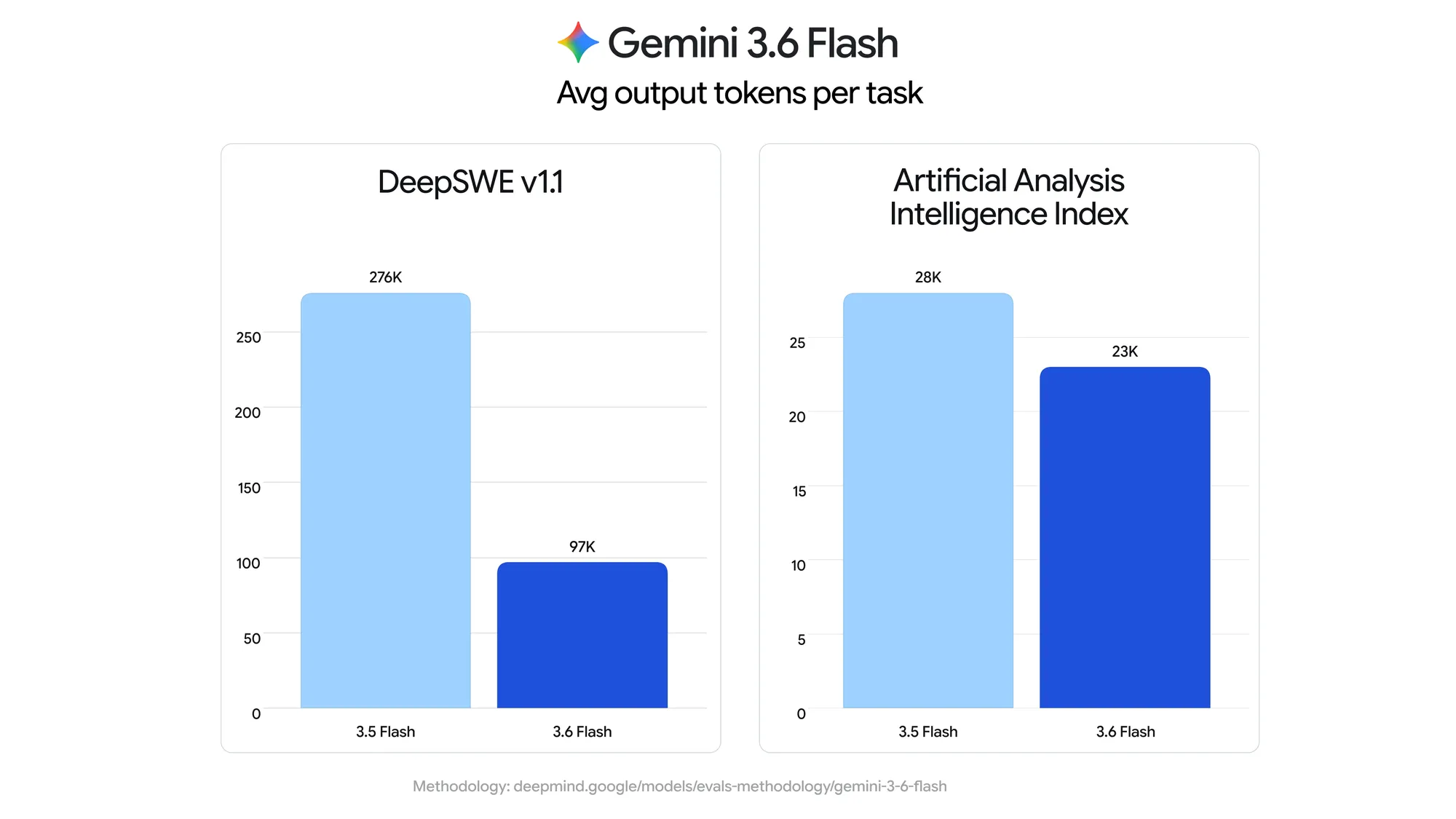
- Google reports Gemini 3.6 Flash uses 17% fewer output tokens than 3.5 Flash on Artificial Analysis and up to 65% fewer output tokens in DeepSWE-style tests.
- Artificial Analysis independently reports Gemini 3.6 Flash at an Intelligence Index score of 50, 251.3 output tokens/s, and an average task cost reduction from $0.59 to $0.50 versus Gemini 3.5 Flash.
- DeepSWE lists Gemini 3.6 Flash at 49% pass@1 with $3.53 average cost per task, compared with Gemini 3.5 Flash at 37% pass@1 and $7.34 average cost per task.
- CometAPI currently lists Gemini 3.6 Flash at $1.20/M input and $6.00/M output, and Gemini 3.5 Flash-Lite at $0.24/M input and $2.016/M output. Check the live dashboard before publishing prices inside product UI.
What Did Google Release?
Gemini 3.6 Flash
Gemini 3.6 Flash is the most important model in the release for general developers. It is a stable Flash-tier model built for production agents, coding, multimodal workflows, document analysis, long-context reasoning, and knowledge work.
Google describes Gemini 3.6 Flash as a workhorse model that delivers better coding, knowledge work, and multimodal performance than Gemini 3.5 Flash while improving token efficiency. The official Gemini API page says the model is designed for the agentic era and is especially effective for rapid coding and iteration loops.
The model's public ID is:
gemini-3.6-flash
Core specifications see Gemini 3.6 Flash model page.
Gemini 3.5 Flash-Lite
Gemini 3.5 Flash-Lite is the efficiency model in the release. Google positions it as the fastest and most cost-effective 3.5-class model, optimized for high-throughput execution, document parsing, translation, classification, routing, and simple data extraction.
The model's public ID is:
gemini-3.5-flash-lite
Core specifications see Gemini 3.5 Flash-Lite model page.
The key distinction is not the context window. Flash-Lite keeps the same 1M input and 64K output profile as 3.6 Flash. The difference is routing intent: Flash-Lite is for throughput and cost control; 3.6 Flash is for harder tasks where quality and tool reliability matter more.
Gemini 3.5 Flash Cyber
Gemini 3.5 Flash Cyber is a specialized cybersecurity model built on top of Gemini 3.5 Flash and fine-tuned for vulnerability discovery, validation, and patch generation.
This is not a normal public API model. Google says it will be available to governments and trusted partners through CodeMender as part of a limited-access pilot program. That limitation matters for developers: do not design a public SaaS roadmap around direct access to Flash Cyber unless you are part of that pilot or a vetted defensive-security program.
The model is still important because it shows where Google is taking Gemini: efficient specialist models coordinated by agent infrastructure. Instead of making one frontier model do everything, Google is building smaller specialized systems that can run repeated scans, combine reports, and patch code at lower cost.
Should You Skip Gemini 3.5 Pro?
The Practical Answer
For most production teams, yes: start evaluating Gemini 3.6 Flash and Gemini 3.5 Flash-Lite now instead of waiting for Gemini 3.5 Pro or Gemini 4 Pro.
That does not mean Gemini 3.5 Pro will be unimportant. It means the latest available models already cover a large share of high-volume AI workloads: coding agents, retrieval agents, document workflows, multimodal parsing, data extraction, prompt routing, UI automation, long-context review, and agent subtask execution.
Google's own announcement says Gemini 3.5 Pro is still testing with partners and will be released broadly when ready. No public gemini-3.5-pro API model page, final pricing table, or model card is needed to start improving production economics today.
When Waiting for Gemini 3.5 Pro Still Makes Sense
You should still watch Gemini 3.5 Pro or Gemini 4 Pro if your workload needs frontier reasoning more than throughput. Examples include advanced research synthesis, highly complex multi-file engineering, difficult math, scientific reasoning, high-stakes enterprise analysis, and tasks where a Flash model still fails after careful prompt and tool design.
The strongest model strategy is not "wait for Pro" or "replace everything with Flash." It is tiered routing:
- Use Gemini 3.5 Flash-Lite for low-cost, high-volume subtasks.
- Use Gemini 3.6 Flash for coding, multimodal analysis, document review, long-context synthesis, and agentic workflows.
- Route the hardest or highest-risk requests to a frontier reasoning model through CometAPI.
- Add Gemini 3.5 Pro to the benchmark suite when Google and CometAPI make it available.
Gemini 3.6 Flash Benchmarks: What Improved?
Google DeepMind Benchmark Table
Google DeepMind's Gemini 3.6 Flash page lists the following comparisons against Gemini 3.5 Flash:
| Benchmark | What It Measures | Gemini 3.6 Flash | Gemini 3.5 Flash | Change |
|---|---|---|---|---|
| SWE-Bench Pro | Diverse agentic coding tasks | 58.7% | 55.1% | +3.6 pts |
| DeepSWE v1.1 | Long-horizon software engineering | 49% | 37% | +12 pts |
| Terminal-Bench 2.1 | Agentic terminal coding | 78.0% | 76.2% | +1.8 pts |
| MLE-Bench | Machine learning engineering | 63.9% | 49.7% | +14.2 pts |
| GDPval-AA v2 | Knowledge work Elo | 1421 | 1349 | +72 Elo |
| OSWorld-Verified | Agentic computer use | 83.0% | 78.4% | +4.6 pts |
| CharXiv reasoning, no tools | Chart and information synthesis | 85.2% | 84.2% | +1.0 pt |
| CharXiv reasoning, with tools | Chart and information synthesis | 89.4% | 84.9% | +4.5 pts |
| GDM-MRCR v2, 128K average | Long-context retrieval | 91.8% | 77.3% | +14.5 pts |
| GDM-MRCR v2, 1M pointwise | Long-context retrieval | 54.0% | 26.6% | +27.4 pts |
The largest gains are in exactly the areas that matter for agents: long-horizon coding, machine learning engineering, long-context retrieval, and computer use. The smaller gains in Terminal-Bench and CharXiv show that this is not a uniform "everything doubled" release. It is a targeted improvement in reliability, token efficiency, and difficult multi-step execution.
Independent Data From Artificial Analysis
Artificial Analysis provides a useful counterweight to vendor benchmark tables. Its July 2026 write-up says Gemini 3.6 Flash maintains the same Intelligence Index score as Gemini 3.5 Flash: 50. That is important because it suggests Gemini 3.6 Flash is not necessarily a raw-intelligence leap.
The big improvement is efficiency:
| Metric | Gemini 3.6 Flash | Gemini 3.5 Flash |
|---|---|---|
| Artificial Analysis Intelligence Index | 50 | 50 |
| Average time per task | 1.3 minutes | 2.7 minutes |
| Average cost per task | $0.50 | $0.59 |
| Output speed | 251.3 tokens/s | Not in this table |
| Time to first token | 14.00s | Not in this table |
This is why the best headline is not "Gemini 3.6 Flash is smarter than everything." A more accurate headline is: Gemini 3.6 Flash makes agent workloads cheaper and faster without sacrificing the Gemini 3.5 Flash intelligence level.
DeepSWE: Long-Horizon Coding Data
DeepSWE by Datacurve is especially relevant because it focuses on original, long-horizon software engineering tasks. Its leaderboard describes 113 tasks across 91 repositories and 5 languages.
On the July 21, 2026 leaderboard:
| Model | Pass@1 | Average Cost | Output Tokens | Agent Steps |
|---|---|---|---|---|
| Gemini 3.6 Flash high | 49% ±5 | $3.53 | 97K | 108 |
| Gemini 3.5 Flash medium | 37% ±2 | $7.34 | 276K | 86 |
The most interesting number is not just the 12-point pass@1 gain. It is the output-token drop: 97K versus 276K. That is roughly 65% fewer output tokens, matching Google's launch claim. For coding agents, fewer output tokens can mean less drift, fewer rambling repair loops, less context pollution, and lower cost per completed issue.
Source: Gemini
Gemini 3.5 Flash-Lite Benchmarks: Why It Matters
Flash-Lite Is the Throughput Model
Gemini 3.5 Flash-Lite is designed for high-volume execution. It is the model to test when your system needs to process thousands or millions of small or medium tasks:
- receipt extraction,
- product catalog parsing,
- document chunk labeling,
- translation,
- classification,
- search result synthesis,
- query rewriting,
- tool-call routing,
- lightweight coding tasks,
- agent subtask execution,
- multimodal data extraction.
Google says Flash-Lite reaches 350 output tokens per second according to Artificial Analysis and is priced at $0.30/M input tokens and $2.50/M output tokens on the standard Gemini API tier.
Flash-Lite Versus Gemini 3.1 Flash-Lite
Google DeepMind's model card shows major gains over Gemini 3.1 Flash-Lite:
| Benchmark | Gemini 3.5 Flash-Lite | Gemini 3.1 Flash-Lite | Change |
|---|---|---|---|
| SWE-Bench Pro | 54.2% | 38.3% | +15.9 pts |
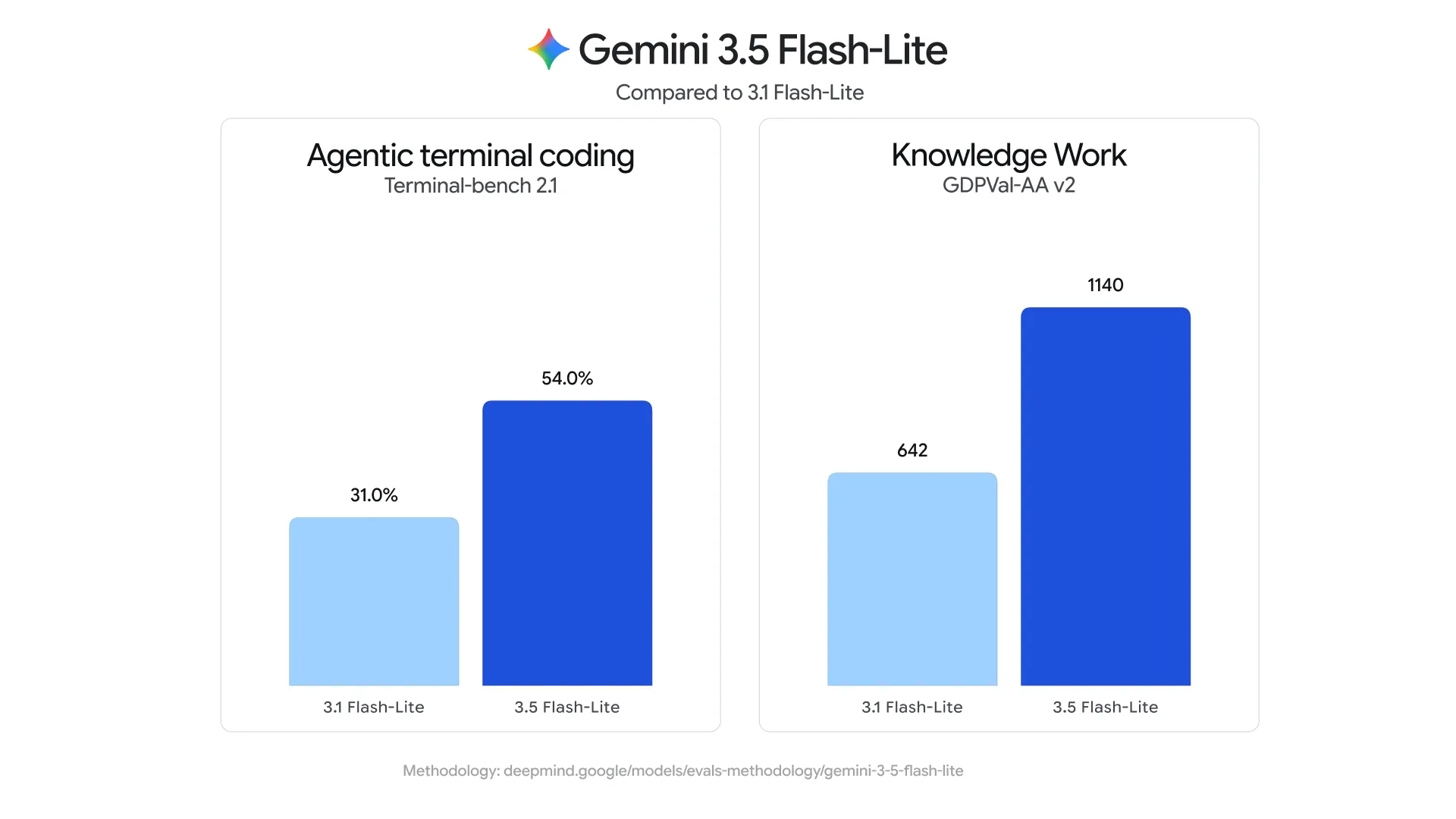
| Terminal-Bench 2.1 | 54.0% | 31.0% | +23.0 pts |
| MLE-Bench | 39.2% | 22.0% | +17.2 pts |
| GDPval-AA v2 | 1140 | 642 | +498 Elo |
| OSWorld-Verified | 74.0% | 54.3% | +19.7 pts |
| CharXiv, no tools | 74.5% | 73.2% | +1.3 pts |
| CharXiv, with tools | 76.5% | 75.6% | +0.9 pts |
| GDM-MRCR v2, 128K average | 72.2% | 60.1% | +12.1 pts |
| GDM-MRCR v2, 1M pointwise | 21.3% | 12.3% | +9.0 pts |
Artificial Analysis also reports an Intelligence Index jump from 25 for Gemini 3.1 Flash-Lite to 36 for Gemini 3.5 Flash-Lite, while time per task drops from 1.0 minute to 0.6 minutes. The tradeoff is that cost per task increased from $0.04 to $0.09 in that benchmark set because the new model is priced higher than 3.1 Flash-Lite.
Source: Gemini
That tradeoff is acceptable if the improved quality reduces downstream retries, human review, or escalation to a more expensive model. It is less attractive if your workload is already solved perfectly by Gemini 3.1 Flash-Lite. Test before migrating all traffic.
The Significance of the Gemini Release
It Confirms the Shift From "Biggest Model" to "Best Workhorse"
The AI market often focuses on frontier flagship models. Gemini 3.6 Flash points in a different direction: production AI systems need reliable, fast, cost-efficient models that can complete many real tasks without waste.
That is why the release emphasizes token efficiency, fewer tool calls, lower latency, and fewer revision loops. For developers, these are not secondary metrics. They determine whether an AI agent can run at scale without surprising the finance team.
It Gives Google a Stronger Production Model While Gemini 3.5 Pro Waits
Gemini 3.5 Pro is still in partner testing. Instead of waiting for Pro, Google released a stronger Flash model and a cheaper Flash-Lite model. That gives developers two immediate options:
- Gemini 3.6 Flash for stronger workhorse intelligence.
- Gemini 3.5 Flash-Lite for cheaper, faster high-volume execution.
This is a practical product strategy. Many businesses do not need the most expensive model on every request. They need a model portfolio and routing logic.
It Makes Model Routing More Important
Gemini 3.6 Flash should not be used everywhere. Neither should Flash-Lite. The best 2026 AI systems will route dynamically:
- Start cheap when the task is simple.
- Use Gemini 3.6 Flash when reasoning, multimodal understanding, or tool use matters.
- Escalate only when a request fails confidence thresholds.
- Cache repeated long context.
- Monitor cost per successful task, not only cost per token.
This is the strongest CometAPI recommendation in the article: do not pick one model as your entire AI strategy. Build a router and make each model earn its traffic.
FAQs
Is Gemini 3.5 Pro available now?
Not as a public generally available Gemini API model at the time of writing as of July 2026. Google says Gemini 3.5 Pro is testing with partners and will be released broadly when ready.
Is Gemini 3.6 Flash better than Gemini 3.5 Flash?
For many production agent and coding workflows, yes. Google reports better benchmark results and lower output-token usage. Artificial Analysis reports similar Intelligence Index quality but lower time per task and lower cost per task.
What is Gemini 3.5 Flash-Lite best for?
Gemini 3.5 Flash-Lite is best for high-volume, latency-sensitive, cost-sensitive workloads such as extraction, classification, translation, search, routing, and subagent execution.
Can I use Gemini 3.5 Flash Cyber through the public Gemini API?
Google describes Gemini 3.5 Flash Cyber as a limited-access model available to governments and trusted partners through CodeMender. It is not positioned as a standard public API model.
How much does Gemini 3.6 Flash cost?
Google's standard Gemini API pricing lists Gemini 3.6 Flash at $1.50 per 1M input tokens and $7.50 per 1M output tokens. CometAPI currently lists it at $1.20/M input and $6.00/M output. Always verify live pricing before production rollout.
How much does Gemini 3.5 Flash-Lite cost?
Google's standard Gemini API pricing lists Gemini 3.5 Flash-Lite at $0.30 per 1M input tokens and $2.50 per 1M output tokens. CometAPI currently lists it at $0.24/M input and $2.016/M output. Always verify live pricing before production rollout.
Should developers wait for Gemini 3.5 Pro?
Most teams should not wait. Start testing Gemini 3.6 Flash for complex workflows and Gemini 3.5 Flash-Lite for high-volume subtasks now. Add Gemini 3.5 Pro to your benchmark suite when public specs, pricing, and availability are confirmed.
Final Verdict
Google's July 2026 Gemini release is best understood as an efficiency release, not a flagship-Pro release. Gemini 3.6 Flash does not erase the need for a future Gemini 3.5 Pro, but it gives developers something immediately useful: a generally available model with strong coding, multimodal, long-context, and agentic performance at lower output-token cost than Gemini 3.5 Flash.
Gemini 3.5 Flash-Lite fills the other half of the production stack. It is the cheap, fast model for subtasks that do not need maximum reasoning depth. Gemini 3.5 Flash Cyber points toward a future of specialist defensive-security agents, but its limited access makes it more relevant as a strategic signal than a general developer tool today.