Choose your path
Claude Sonnet 4 Blog

How to add Claude to an Alexa skill
Voice assistants are increasingly powered by large language models. If you want to bring Anthropic’s Claude API into an Alexa skill you maintain or build, this guide walks you through the practical architecture, concrete code patterns, and operational considerations you’ll need — from quick proof-of-concept to a production-grade skill.
Gemini 3 Pro vs Claude 4.5 Sonnet for Coding: Which is Better in 2025
Both Gemini 3 Pro (Google/DeepMind) and Claude Sonnet 4.5 (Anthropic) are 2025-era flagship models optimized for agentic, long-horizon, tool-using workflows —
GPT-5.1 vs Claude Sonnet 4.5 — Which one leads the frontier in 2025?
OpenAI’s GPT-5.1 is an incremental but product-focused update that introduces two usage-flavored variants (Instant and Thinking), extended prompt caching, and

Agentic Coding with Claude Haiku 4.5: A Guide For Developer in 2025
With the October 2025 arrival of Claude Haiku 4.5, Anthropic delivered a model explicitly optimized for agentic workloads: fast, cost-efficient, and tuned for sub-agent orchestration and “computer use” tasks (i.e., driving tools, editors, CLIs).
How Much Does Claude Sonnet 4.5 Cost?
Anthropic’s Claude Sonnet 4.5 (often shortened to Sonnet 4.5) arrived as a performance-focused successor in Anthropic’s Claude family. For teams deciding

How to use Claude Sonnet 4.5 with Cursor
Anthropic’s Claude Sonnet 4.5 arrived as a focused update for coding, agentic workflows, and “computer use” — the kinds of tasks that require long context,
Claude Sonnet 4.5 API
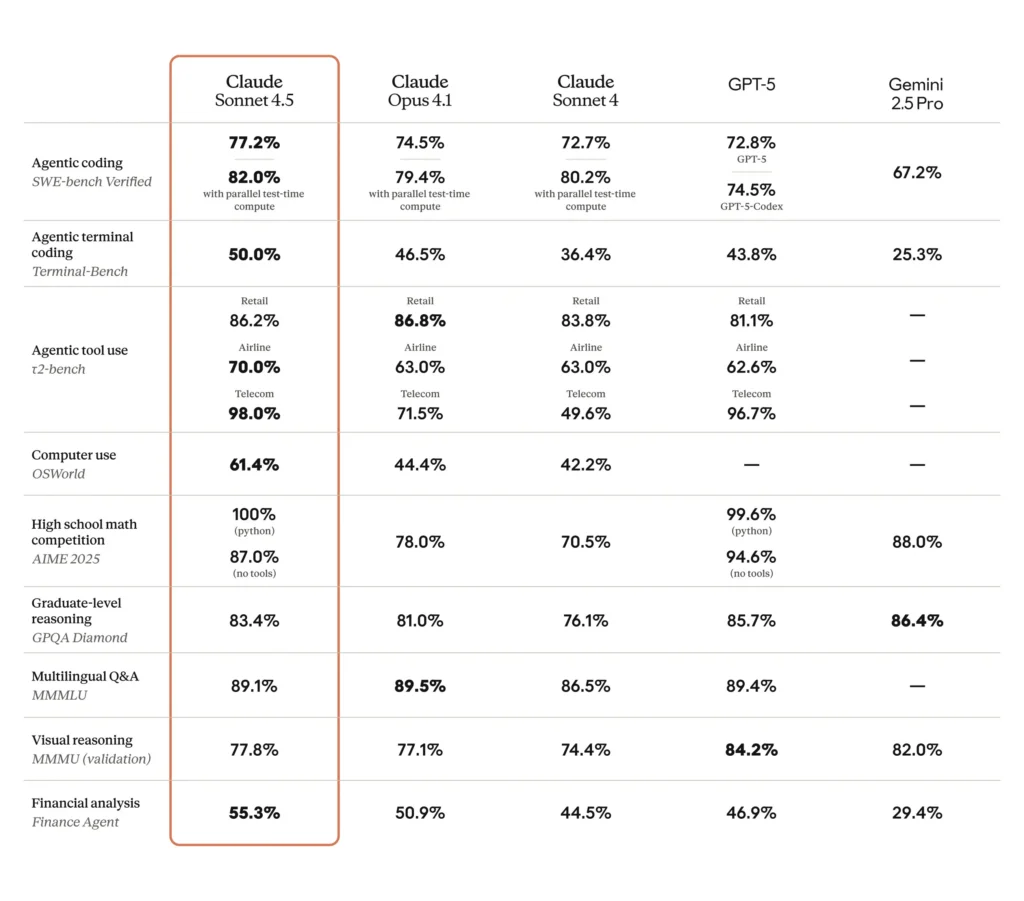
Anthropic’s Claude Sonnet 4.5 is a 2025 update focused on long-duration autonomous work, stronger tool/computer use, tighter safety/alignment, and richer developer features (context editing, memory, in-chat code execution and file creation). Benchmarks and vendor tests emphasize large gains on coding and “agentic” tasks (e.g., Anthropic reports ~30 hours of continuous autonomous coding in internal tests and big jumps on OS/tool-use benchmarks).
Claude Sonnet 4.5 — what’s new, how it performs, and why you might pick it
Claude Sonnet 4.5 (commonly shorted to Claude 4.5) is Anthropic’s September 29, 2025 frontier release focused on long-horizon agentic work, coding, and