
Wan 2.7 and Vidu Q3 target the same broad problem—turning prompts and references into production-ready short video—but they are optimized around different creative workflows. Wan 2.7 behaves more like a broad video-production suite, combining generation, reference control, continuation and editing. Vidu Q3 is more tightly positioned around narrative clips with native audio, multi-shot pacing and camera-aware storytelling.
The practical choice is therefore not “which model is universally better?” It is which model produces the most usable clip for your specific brief at an acceptable cost, with the controls your production pipeline actually needs.
TL;DR
For public blind-preference quality, Wan2.7-260612 reaches 1,161 Elo in Artificial Analysis' Text-to-Video With Audio leaderboard, versus 1,078 for Vidu Q3 Pro. In Image-to-Video With Audio, Wan 2.7 also leads 1,094 to 1,065. That makes Wan 2.7 the stronger starting point when benchmarked visual quality, reference consistency, 0continuation or editing matter most.
Vidu Q3 remains compelling for story-first generation. Its official product materials emphasize up to 16 seconds per generation, native dialogue/voiceover, sound effects and music, detailed camera-language control, and English/Japanese/Chinese output. Through CometAPI, the displayed starting price is currently lower than Wan 2.7, which makes Q3 attractive for dialogue-heavy short-form content and cost-sensitive iteration.
Key Takeaways
- Public benchmark signal: Wan 2.7 currently leads Vidu Q3 Pro in both audio-enabled T2V and I2V blind-preference Elo.
- Workflow breadth: Wan 2.7 spans T2V, I2V, R2V and dedicated video editing.
- Story-first design: Vidu Q3 puts native audio, multi-shot pacing and camera control at the center of the product.
- Duration: Wan 2.7 supports 2–15 seconds, while Vidu Q3 reaches 16 seconds depending on route.
- Resolution: Both reach 1080p; Vidu also offers a 540p tier for lower-cost generation.
- Current CometAPI starting price: Wan 2.7 is displayed at $0.08/s; Vidu Q3 is displayed at $0.056/s.
- Best overall rule: Use Wan 2.7 when control and workflow coverage dominate; test Vidu Q3 first when native audiovisual storytelling and cost dominate.
What Is Wan 2.7?
Wan 2.7 is Alibaba’s multimodal short-video suite for controllable creation rather than a single text-to-video endpoint. Alibaba’s launch materials describe four main routes—Wan2.7-t2v, Wan2.7-i2v, Wan2.7-r2v and Wan2.7-videoedit—covering generation, continuation, referencing and editing with text, image, video and audio inputs.
The suite supports 2–15 second generation at 720p or 1080p. The current Model Studio T2V API also documents custom audio input and automatic dubbing, while the I2V route supports first-frame, first-and-last-frame and video-continuation tasks.
| Specification | Wan 2.7 |
|---|---|
| Provider | Alibaba / Tongyi Lab |
| Core routes | Text-to-Video, Image-to-Video, Reference-to-Video, Video Editing |
| Input modalities | Text, images, video, audio references |
| Output duration | 2–15 seconds |
| Resolution | 720p / 1080p |
| Native / generated audio | Yes; automatic audio generation plus custom audio workflows |
| First + last frame | Supported in I2V workflow |
| Video continuation | Supported |
| Dedicated editing | Yes — instruction-based video editing |
| CometAPI model ID | wan2.7 |
What Makes Wan 2.7 Different?
Reference and continuity control. Alibaba positions Wan 2.7 as a production system that can preserve subjects across shots, use multimodal references and continue an existing clip. Its I2V API accepts text, image, audio and video inputs and supports first-frame, first-and-last-frame, and continuation tasks.
Editing is a first-class workflow. The dedicated Wan2.7 video-editing API accepts text, image and video inputs for instruction-based editing and style transfer. That is a meaningful distinction for teams that already have footage and want to replace, restyle or reproduce visual elements without regenerating everything from scratch.
Audio can be supplied or generated. The T2V route accepts WAV/MP3 audio and can also generate audio automatically when no custom audio file is supplied. The current API supports 15-second multi-shot prompts and 1080p output, which is useful for short ads, storyboards and cinematic concept clips.
What Is Vidu Q3?
Vidu Q3 is Vidu’s third-generation video model family, designed around audiovisual storytelling. Instead of treating sound as a separate post-production step, the official product page emphasizes video, dialogue/voiceover, sound effects and music generated together so timing and narrative rhythm can be composed in one generation workflow.
Vidu’s public API documentation supports Q3 text-to-video, image-to-video, start-end and reference-to-video routes. Depending on the Q3 variant and route, output can reach 16 seconds and 1080p. The official product page also highlights camera-language control and multilingual output in English, Japanese and Chinese.
| Specification | Vidu Q3 |
|---|---|
| Provider | Vidu / ShengShu Technology |
| Core routes | Text-to-Video, Image-to-Video, Start-End-to-Video, Reference-to-Video |
| Input modalities | Text, image, first/last frame, reference images |
| Output duration | Up to 16 seconds (route / variant dependent) |
| Resolution | 540p / 720p / 1080p |
| Native audio | Yes — speech, sound effects and other generated audio |
| Multi-speaker storytelling | Officially emphasized for narrative use |
| Camera / pacing control | Detailed camera-language and rhythm control |
| Languages highlighted | English / Japanese / Chinese |
| CometAPI model ID | viduq3 |
Wan 2.7 vs Vidu Q3: Decision Snapshot
| Decision factor | Wan 2.7 | Vidu Q3 |
|---|---|---|
| Maximum clip duration | 15 s | 16 s |
| Maximum resolution | 1080p | 1080p |
| Lower-resolution tier | 720p | 540p / 720p |
| Text-to-video | Yes | Yes |
| Image-to-video | Yes | Yes |
| Reference-to-video | Yes | Yes |
| First/last-frame workflow | Yes | Yes |
| Video continuation | Strong native workflow | Not the central Q3 differentiator |
| Dedicated instruction editing | Yes | Not the core Q3 generation route |
| Native audiovisual storytelling | Strong | Core positioning |
| Public T2V with-audio Elo | 1,161 (June snapshot) | 1,078 (Q3 Pro) |
| Public I2V with-audio Elo | 1,094 | 1,065 (Q3 Pro) |
| CometAPI displayed starting price | $0.08/s | $0.056/s |
| Best starting point | Controlled production and editing | Dialogue-first narrative and lower-cost iteration |
The specification sheet shows the core trade-off: Wan 2.7 has the broader production footprint, while Vidu Q3 is more concentrated around finished audiovisual storytelling. That difference matters more than a one-second duration gap.
Wan 2.7 vs Vidu Q3: Benchmark Performance
Video-model benchmarks are less standardized than LLM evaluations, so this comparison uses the Artificial Analysis Video Arena as a neutral public signal. Its rankings are derived from blind user preferences between outputs generated from the same input. Elo is therefore useful for comparing perceived output quality, but it is not a guarantee that one model will win on every prompt or production style.
Text-to-Video With Audio
| Model / route | Elo | Rank | Samples |
|---|---|---|---|
| Wan2.7-260612 | 1,157 | #4 | 14,694 |
| Wan 2.7 | 1,109 | #7 | 5,276 |
| Vidu Q3 Pro | 1,076 | #16 | 16,578 |
Figure 1. Text-to-Video With Audio Elo comparison — Aug
In the August Artificial Analysis leaderboard, the June checkpoint of Wan 2.7 scores 1,157 Elo at #4, compared with 1,076 (#16) for Vidu Q3 Pro, giving it an 81-point lead. The original April Wan 2.7 checkpoint scores 1,109 Elo, still 33 points ahead of Vidu Q3 Pro. The practical reading is not that Vidu Q3 fails at storytelling; it is that the August blind-preference data still favors Wan 2.7’s overall audio-enabled T2V output more often.
Image-to-Video With Audio
| Model / route | Elo | Rank | Samples |
|---|---|---|---|
| Wan 2.7 | 1,090 | #7 | 4,712 |
| Vidu Q3 Pro | 1,062 | #17 | 13,421 |
The I2V gap is smaller—28 Elo points—but it still points in the same direction. For teams animating product stills, storyboards or character reference images, Wan 2.7 deserves the first test when output quality is the main acceptance gate.
Detailed Feature Comparison
Prompt Adherence and Storytelling
Wan 2.7 is well suited to prompts that mix shot descriptions, subject constraints and reference assets. Alibaba’s launch material emphasizes multi-shot direction and a broad creation-to-editing workflow, making it a strong choice when the prompt is part of a larger production plan rather than a single self-contained scene.
Vidu Q3 is more explicitly built around compact narrative arcs. Its official positioning centers on creators making comic/manga-style drama, cinematic scenes, short-form series and narrative ads, with camera language and rhythm treated as controllable storytelling elements.
Result: No universal winner. Wan 2.7 is the stronger production-oriented candidate; Vidu Q3 is the more story-native candidate.
Motion and Camera Control
Alibaba says Wan 2.7 can modify shooting methods through natural-language editing and reproduce complex camera movements. Vidu Q3’s official materials emphasize detailed camera-language and pacing control directly during generation. That makes the comparison less about whether camera control exists and more about where it sits in the workflow.
Result: Vidu Q3 has a slight edge for explicit story-time camera pacing; Wan 2.7 is stronger when camera control is combined with continuation, reference conditioning or later editing.
Character and Reference Consistency
Wan 2.7 has a dedicated R2V route and Alibaba describes cross-video consistency for multiple subjects, including voice and visual identity. The same suite also supports continuation and first/last-frame workflows, which gives production teams several ways to maintain identity across successive clips.
Vidu Q3 also supports reference-to-video. The official API allows Q3 reference generation with 1–7 reference images and up to 16-second output, so it should not be treated as a text-only or first-frame-only model.
Result: Wan 2.7 wins for reference-driven production flexibility. Vidu Q3 remains competitive for reference-based narrative generation.
Audio, Dialogue and Lip Sync
Both models can produce audio-enabled video. Wan 2.7 supports custom audio files and automatic audio generation; its I2V workflow can use audio as a driving source for lip sync and action timing. Vidu Q3, however, makes native audiovisual generation a defining product feature: dialogue/voiceover, sound effects and music are generated together with the visuals.
Result: Vidu Q3 wins for dialogue-first storytelling. Wan 2.7 is the more flexible choice when the production starts from a supplied audio reference or combines audio with other reference controls.
Editing and Continuation
This is the clearest Wan advantage. Wan 2.7 includes a dedicated video-editing route, and Alibaba documents instruction-based editing, style transfer, element replacement and movement/effect replication. Its I2V route also supports continuation from an input clip.
Vidu Q3 supports start-end and reference generation, but dedicated editing is not the central capability of the Q3 model being compared here. If your workflow starts with existing footage and asks the model to modify it rather than regenerate a scene, Wan 2.7 is the more natural fit.
Result: Wan 2.7 wins.
Duration and Resolution
| Capability | Wan 2.7 | Vidu Q3 |
|---|---|---|
| Maximum generation duration | 15 s | 16 s |
| Minimum typical generation duration | 2 s | Varies by Q3 route; 1–3 s minimum depending on variant |
| 720p | Yes | Yes |
| 1080p | Yes | Yes |
| 540p | No main Wan 2.7 tier | Yes |
Result: Vidu Q3 wins slightly on maximum single-run duration and offers a cheaper 540p tier. The difference between 15 and 16 seconds is rarely decisive by itself; workflow control and success rate usually matter more.
Pricing and Cost Efficiency
Video-generation pricing is route-, resolution- and platform-dependent, so this section separates direct provider pricing from the current CometAPI displayed route price.
Direct Provider Pricing
| Model / route | 540p | 720p | 1080p |
|---|---|---|---|
| Wan 2.7 | — | $0.10/s | $0.15/s |
| Vidu Q3 Pro | $0.045/s | $0.10/s | $0.12/s |
| Vidu Q3 Turbo | $0.035/s | $0.055/s | $0.065/s |
Alibaba Model Studio lists Wan 2.7 audio-video generation at $0.10/s for 720p and $0.15/s for 1080p in the international Singapore deployment. Vidu’s official API pricing lists Q3 Pro at $0.045/s for 540p, $0.10/s for 720p and $0.12/s for 1080p, with lower prices for Q3 Turbo.
CometAPI Pricing vs Direct Provider Pricing
| Model / resolution | Official direct API | CometAPI | Pricing takeaway |
|---|---|---|---|
| Wan 2.7 / 720p | $0.10/s | $0.08/s | CometAPI 20% lower |
| Wan 2.7 / 1080p | $0.15/s | $0.12/s | CometAPI 20% lower |
| Vidu Q3 Pro / 540p | $0.045/s | $0.056/s | CometAPI ~24% higher |
| Vidu Q3 Pro / 720p | $0.10/s | $0.1232/s | CometAPI ~23% higher |
| Vidu Q3 Pro / 1080p | $0.12/s | $0.1232/s | CometAPI ~2.7% higher |
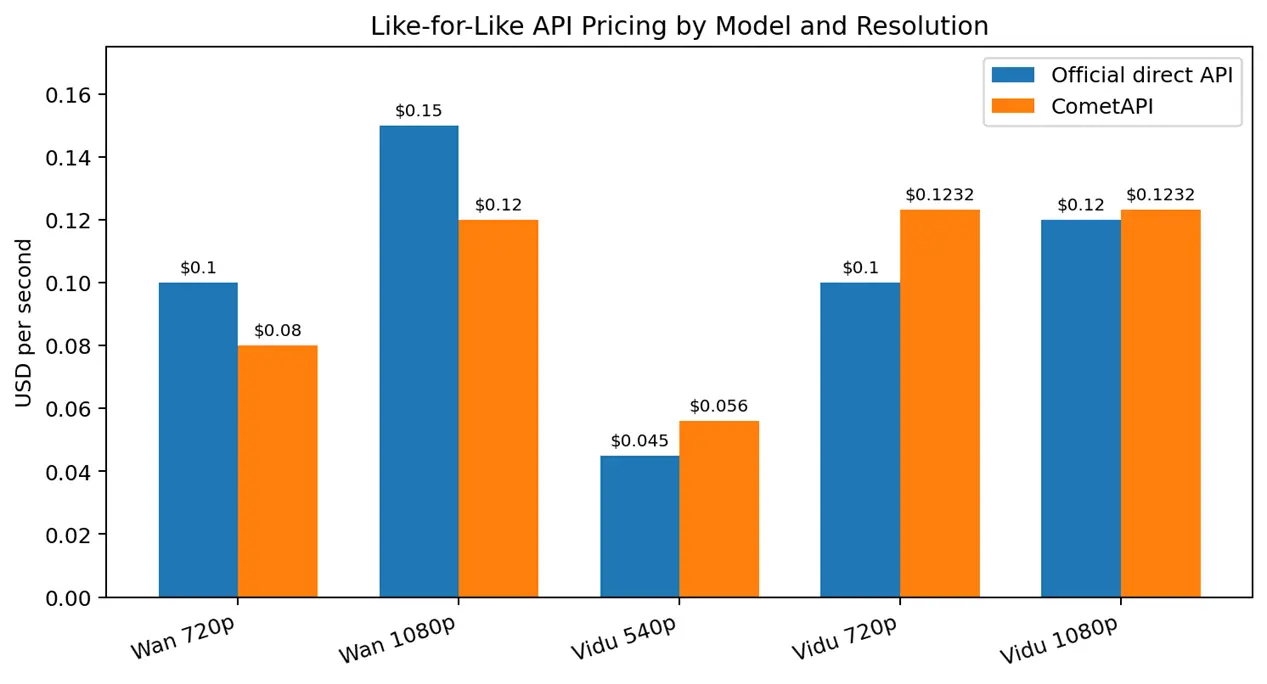
Figure 3. Like-for-like direct-provider vs CometAPI unit pricing by model and resolution.
Sources: Alibaba Model Studio, Vidu API pricing, and CometAPI model pages.
The like-for-like comparison shows why gateway pricing should not be generalized. For Wan 2.7, CometAPI currently lists a clear 20% discount versus Alibaba Cloud’s international rates at both 720p and 1080p. For Vidu Q3 Pro, the direct Vidu API is currently cheaper than CometAPI at 540p, 720p and 1080p. Therefore, CometAPI’s case for Vidu Q3 should be based on unified integration, model switching and account consolidation—not on a lower per-second price.
Strengths and Weaknesses
Wan 2.7 Strengths
- Stronger current public blind-preference benchmark signal in audio-enabled T2V and I2V.
- Broader production suite: T2V, I2V, R2V, continuation and dedicated video editing.
- Strong reference and identity-control workflow for multi-shot production.
- Supports both automatic audio generation and supplied audio references.
- Good fit for teams that need to iterate on existing footage rather than regenerate every shot.
Wan 2.7 Weaknesses
- 15-second maximum generation length is slightly shorter than Vidu Q3.
- Higher current CometAPI starting price in this comparison.
- Its broad workflow surface can require more route selection and production orchestration than a story-first single generation.
Vidu Q3 Strengths
- Up to 16-second output and a 540p tier for lower-cost experiments.
- Native audiovisual generation is central to the model’s storytelling workflow.
- Strong fit for dialogue, short drama, narrative ads and multi-shot scenes.
- Official positioning emphasizes camera language, pacing and multilingual output.
- Lower current CometAPI displayed starting price.
Vidu Q3 Weaknesses
- Current public audio-enabled T2V and I2V Elo trails Wan 2.7.
- The Q3 generation route is not as editing-centric as Wan 2.7’s dedicated videoedit workflow.
- Long-form video still requires multiple generations and editorial stitching beyond the 16-second clip limit.
Wan 2.7 vs Vidu Q3: Which Should You Choose?
| Workload | Recommended starting point | Why |
|---|---|---|
| Cinematic text-to-video quality | Wan 2.7 | Higher current public T2V with-audio Elo |
| Image-to-video quality | Wan 2.7 | Higher current public I2V with-audio Elo |
| Reference-driven character consistency | Wan 2.7 | Dedicated R2V plus continuation and multimodal controls |
| Editing existing footage | Wan 2.7 | Dedicated instruction-based video-editing route |
| Video continuation | Wan 2.7 | Native I2V continuation workflow |
| Dialogue-heavy short drama | Vidu Q3 | Native audiovisual storytelling focus |
| Multi-speaker narrative clips | Vidu Q3 | Dialogue and audio are core Q3 positioning |
| English/Japanese/Chinese narrative output | Vidu Q3 | Explicitly highlighted multilingual support |
| Lowest current CometAPI starting cost | Vidu Q3 | $0.056/s vs $0.08/s displayed |
| Longest single generation | Vidu Q3 | 16 seconds vs 15 seconds |
| Broadest production flexibility | Wan 2.7 | Generation + reference + continuation + editing |
For most professional evaluation pipelines, the best policy is to build a small prompt-and-reference test set and route each workload to the lowest-cost model that consistently passes the acceptance gate. A model with a lower unit price can still be more expensive if it needs more retries or manual correction.
Access Wan 2.7 and Vidu Q3 Through CometAPI
CometAPI exposes Wan 2.7 and Vidu Q3 through a unified OpenAI-compatible video-generation workflow. Instead of maintaining Alibaba Model Studio's Wan-specific API flow and Vidu's provider-specific generation endpoints separately, developers can submit both models through POST /v1/videos, receive an asynchronous video ID, poll GET /v1/videos/{id}, and then retrieve the completed MP4. The application-side job queue, polling logic, authentication, retry handling, and storage workflow can therefore remain the same when switching between the two providers.
Both routes support text-to-video and image-to-video generation. A text-to-video request uses the model ID, prompt, duration, and output size; an image-to-video request keeps the same video endpoint and adds an image reference. CometAPI exposes the simplified IDs wan2.7 and viduq3, so teams can change models without rebuilding the integration around two different provider schemas.
| Access / capability | Wan 2.7 through CometAPI | Vidu Q3 through CometAPI |
|---|---|---|
| CometAPI model ID | wan2.7 | viduq3 |
| Provider equivalent | Alibaba Wan 2.7 | Vidu Q3 Pro (viduq3-pro) |
| Unified endpoint | POST /v1/videos | POST /v1/videos |
| Text-to-video | Supported | Supported |
| Image-to-video | Supported | Supported |
| Task pattern | Asynchronous create → poll → retrieve | Asynchronous create → poll → retrieve |
| Pricing context | $0.08/s (720p), $0.12/s (1080p): below Alibaba direct | $0.056/s (540p), $0.1232/s (720p/1080p): above Vidu direct Q3 Pro |
The naming difference does not mean a lower model tier. CometAPI's viduq3 route corresponds to Vidu's official viduq3-pro model, the premium general-purpose Q3 route used for text-to-video, image-to-video, and start/end-frame generation. Likewise, wan2.7 exposes Alibaba's Wan 2.7 model family; Alibaba's own documentation separates task-specific names such as wan2.7-t2v and wan2.7-i2v. In other words, CometAPI normalizes model names and access patterns rather than substituting a reduced-quality derivative. Video generation is stochastic, so repeated requests are not expected to be pixel-identical, but the underlying model tier, capability envelope, and expected quality level remain aligned with the provider model.
For Wan 2.7, the current public price advantage is explicit: CometAPI lists $0.08/s at 720p and $0.12/s at 1080p, while Alibaba Cloud's international Model Studio pricing lists $0.10/s at 720p and $0.15/s at 1080p. That is a 20% reduction at both resolutions while keeping access to the same Wan 2.7 generation tier.
For Vidu Q3, price should not be the selling point. CometAPI’s viduq3 route maps to the official Q3 Pro tier, but the current public CometAPI rates are higher than Vidu’s normal direct Q3 Pro rates at the listed 540p, 720p and 1080p resolutions. The reason to use CometAPI for Vidu Q3 is operational simplicity: the same OpenAI-style video endpoint, authentication pattern, asynchronous job lifecycle and account can be used alongside Wan 2.7 and other supported video models.
The practical takeaway is that CometAPI changes how developers reach these models, not which quality tier they are using. For Vidu Q3 specifically, the value is reduced integration overhead: teams can A/B test Wan 2.7 and Vidu Q3 Pro behind one video API, reuse the same queue/polling/retry infrastructure, centralize credentials and billing, and switch models without maintaining separate provider-specific client code. That operational flexibility is the CometAPI advantage even when the direct provider has the lower unit price.
What About Wan 3.0?
This comparison needs one current-context note. Alibaba began public beta testing of Wan 3.0 on August 7, 2026. Alibaba says the beta supports up to 30-second video and broader multimodal inputs, which means Wan 2.7 is no longer the newest Wan generation.
That does not make this comparison obsolete. Wan 2.7 remains a mature, priced, documented production route with meaningful public benchmark coverage, while Wan 3.0 is still in beta. Teams choosing an API today can use this article as a stable Wan 2.7-versus-Q3 baseline, then separately evaluate Wan 3.0 as its API behavior, pricing and independent benchmark evidence mature.
How to Evaluate Both Models Yourself
- Create a 15–30 prompt test set covering the real content you produce: product shots, dialogue scenes, action, stylized animation and reference-driven clips.
- Use identical prompt intent, duration, aspect ratio and source assets wherever the two APIs allow equivalent parameters.
- Score visual quality separately from prompt adherence, character consistency, audio timing and camera composition.
- Track failed generations, retries and manual editing time rather than counting only successful demo clips.
- Calculate cost per accepted clip—not just cost per second—then route each workload to the model with the best quality/cost trade-off.
Conclusion
Wan 2.7 is the stronger all-round production candidate in this comparison. It leads the current public blind-preference benchmark signal and offers the broader creative workflow, especially for reference consistency, continuation and video editing.
Vidu Q3 is the more specialized storytelling and cost-efficiency candidate. Its 16-second ceiling, native audiovisual generation, camera-aware pacing and lower current CometAPI starting price make it particularly attractive for short drama, narrative ads and dialogue-centered content.
If you need one default starting point for controlled professional production, test Wan 2.7 first. If your product is built around fast narrative generation with synchronized dialogue and sound, test Vidu Q3 first. For a real deployment, the correct winner is the one that reaches your quality threshold with the fewest retries and the lowest cost per accepted clip.
FAQs
Is Wan 2.7 better than Vidu Q3?
Wan 2.7 currently has the stronger public blind-preference benchmark signal and a broader production workflow, but Vidu Q3 can be the better choice for dialogue-heavy storytelling, 16-second clips and lower-cost iteration.
Which model is cheaper?
At the time of writing, CometAPI displays Wan 2.7 from $0.08/s and Vidu Q3 from $0.056/s. Direct-provider pricing varies by resolution and Q3 variant.
Which model is better for image-to-video?
The current Artificial Analysis Image-to-Video With Audio leaderboard favors Wan 2.7 at 1,094 Elo versus 1,065 for Vidu Q3 Pro, so Wan is the stronger first candidate if I2V output quality is the primary acceptance metric.
Which model is better for AI short films with dialogue?
Vidu Q3 is especially well matched to this workload because native dialogue, voiceover, sound effects, music, camera rhythm and short-form storytelling are central to its product design. Wan 2.7 is still competitive when the short film requires stronger reference control or later editing.
Does Wan 2.7 still make sense after Wan 3.0?
Yes. Wan 3.0 entered public beta on August 7, 2026, while Wan 2.7 already has mature API documentation, established pricing and broader independent benchmark coverage. Evaluate Wan 3.0 separately rather than assuming beta availability immediately replaces a production-proven route.