Elorian Glimpse is a multimodal visual reasoning model announced on October 16, 2026. It can revisit images, inspect video frames, and refine visual evidence during reasoning. Its announced API pricing is $0.60 per million input tokens and $3.00 per million output tokens. Elorian reports competitive performance in object counting, robotics events, charts, and video captioning, although these vendor-reported results are not comprehensive independent validation.
Key Takeaways
Visual thinking allows renewed inspection of image and video evidence rather than only an initial visual pass.
Glimpse is reported to score 42.70 on WGO Bench, 92.90 on CharXiv-R, and 83.36 on FSC-147.
Published API rates are $0.60 input and $3.00 output per million tokens.
The model accepts text, image, and video inputs and generates text output.
Developers should compare accuracy, latency, and total task costs before adopting it.
Reviewed for clarity, source attribution and current API terminology.
What Is Elorian Glimpse?
Elorian Glimpse is a multimodal reasoning model for developers evaluating image and video understanding. Elorian announced its research preview on October 16, 2026. This article explains its visual reasoning approach, published benchmark results, launch pricing, and API access options.
Its visual thinking approach allows the model to re-examine visual evidence as an answer develops. Repeated inspection can help resolve ambiguity, but its value depends on task accuracy and the additional time and tokens consumed.
Elorian Glimpse Specifications
Specification
Elorian Glimpse
Developer
Elorian
Release date
October 16, 2026
Release status
Research preview
Inputs
Text, images, video
Output
Text
Context window
262,144 tokens (OpenRouter metadata)
Training background
Post-trained from undisclosed open-weight base
Parameter count
Not disclosed in the reviewed launch announcement
Public weights
No downloadable checkpoint identified in the reviewed launch material
API prices
$0.60 input / $3.00 output per 1M tokens
Availability
Elorian API/chat; third-party routing
OpenRouter reports a 262,144-token context window. This is a routing-provider specification, not a limit stated in Elorian’s launch announcement. OpenRouter shows October 17 as its release date; Elorian’s own announcement is dated October 16. The reviewed launch announcement does not name the base model or disclose a parameter count.
What Makes Elorian Glimpse Different?
Elorian describes Glimpse as bringing visual representations into the reasoning process itself, allowing it to revisit and refine those representations as thinking unfolds. Glimpse can inspect visual material again when uncertainty appears. In Elorian’s published examples, Glimpse zooms into image regions, revisits short video intervals at a higher sampling rate, and tracks features across time to resolve uncertainty.
Object Counting and State Recognition
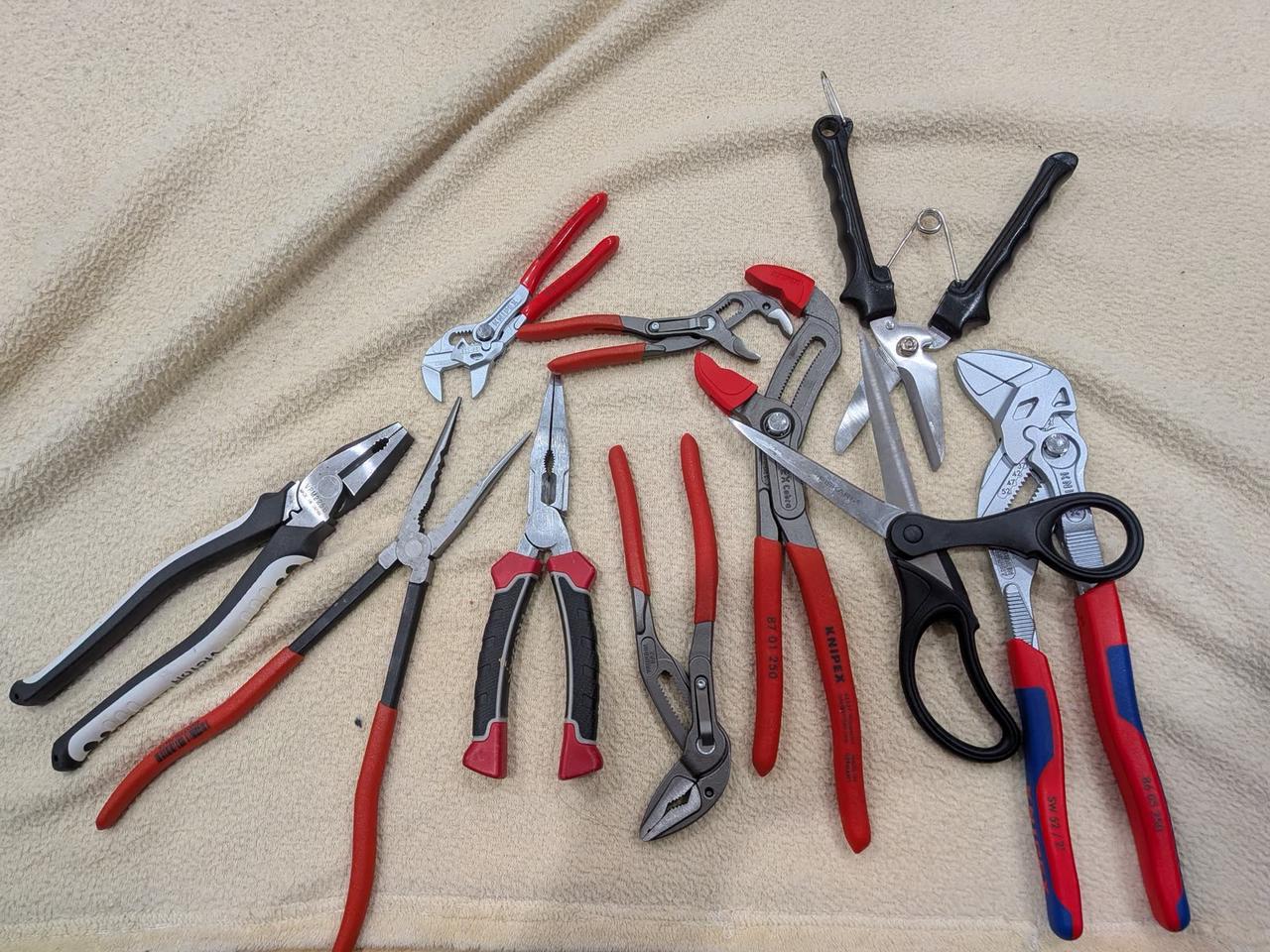
One Elorian example asks for a count of open pliers among similar tools. The reference answer is four. This distinction is important: recognizing “pliers” is different from deciding whether an individual pair is open. The example illustrates the task type rather than providing an independently verified live inference trace.
Physical Reasoning and Consequence Prediction
In Elorian’s tire example, the reviewed reference answer identifies the woman in the striped top as the person most immediately at risk. If she loses her grip before the tire reaches an upright position, the raised edge rotates downward around the edge resting on the ground and moves toward her.
This demonstrates the intended reasoning target, not a claim that Glimpse is a precise physics simulator.
Video Understanding and Agents
Glimpse may inspect selected video intervals at higher sampling density to resolve ambiguous temporal events, such as a moving camera versus a scene transition. Elorian additionally describes multimodal tools and cooperating subagents. For developers this suggests opportunities in video indexing, footage review, and visual agent workflows, but throughput and operational limits still require evaluation.
How Does Elorian Glimpse Perform on Benchmarks?
The launch evaluation table reports vendor results, not an independent head-to-head test. The table below selects the 11 evaluations shared with GPT-6 Astra; it omits E.T. Bench because no Astra result is supplied. Scores use benchmark-specific metrics and should not be averaged.
Benchmark
Glimpse
GPT-6 Astra
GPT-6.1 Sol
Claude Opus 5.5
Gemini 3.8 Flash
WGO Bench
42.70
39.42
38.91
12.34
33.99
ERQA
83.75
83.75
82.45
82.20
81.20
BabyVision
95.36
97.68
97.16
—
83.25
HSS
46.36
53.60
46.60
49.81
41.60
CharXiv-R
92.90
92.10
92.60
93.40
91.80
UGC-VideoCap
82.66
80.32
80.41
76.35
78.33
DREAM-1K
76.04
79.05
77.93
72.05
70.00
TOMATO
93.60
96.02
89.02
72.44
83.02
Elorian reports Glimpse at max effort; Astra, Sol, and Opus generally use max with Code Interpreter. Gemini uses high with Code Interpreter for images and Video Agent for video. For video, Sol and Opus use high with Code Interpreter, except Sol on Video-MME v2, which uses max. HSS also includes paper-reported results. These configurations differ, so the results do not isolate model quality at equal inference budgets.
Video-MME v2 uses subtitles and a grouped rubric score. Other rows retain their published benchmark score scales; a score should not automatically be read as percentage accuracy. The launch table does not provide a complete reproducibility package covering all hardware, inference budgets, and repeated-run uncertainty.
Across 11 shared benchmarks, Glimpse beats GPT-6 Astra on four, ties on one, and trails on six. It performs particularly well on WGO Bench and FSC-147, while Astra is stronger on HSS and Video-MME v2. The result indicates specialized strengths, not universal superiority.
Humanity’s Sixth Sense tests reasoning that extends beyond directly visible objects toward spatial relationships and physical consequences. Glimpse scores 46.36 on HSS, compared with GPT-6 Astra’s 53.60—a gap of 7.24 points. This result identifies a relative weakness on this evaluation, but does not explain the cause of the difference.
How Much Does Elorian Glimpse API Cost?
Elorian’s announced token rates are $0.60 per million uncached input tokens and $3.00 per million output tokens. The following table reproduces its October 16, 2026 launch comparison, including Gemini’s introductory rates. These figures reflect the launch comparison published on October 16, 2026. Check your chosen provider’s current rates before estimating a bill.
Model
Uncached input / 1M tokens (USD)
Output / 1M tokens (USD)
Token-rate multiple vs Glimpse
Elorian Glimpse
$0.60
$3.00
1×
Gemini 3.8 Flash (introductory)
$0.75
$3.75
1.25×
GPT-6.1 Sol
$2.00
$10.00
3.33×
Claude Opus 5.5
$4.00
$20.00
6.67×
GPT-6 Astra
$10.00
$50.00
16.67×
Multipliers compare the listed input and output token rates separately; they are not measured task-cost ratios. Provider discounts, caching, long-context tiers, reasoning usage, and subsequent price changes can alter an actual bill.
At the announced rates, a request with 10,000 input tokens and 2,000 output tokens would cost $0.012. This is an illustrative calculation; actual costs depend on billed image, video, and reasoning usage.
Check how your provider bills video frames, images, cached inputs, and reasoning tokens. Repeated visual inspection can add time and tokens, so compare cost per successful task as well as the token rate.
How to Access Elorian Glimpse?
You can try Glimpse through Elorian’s platform, which offers a chat interface and API access. For an application, use the provider’s current documentation to obtain credentials, select the model, and submit a small image or video request before expanding to your full workload.
If you prefer a unified API for multiple models, CometAPI offers an OpenAI-compatible integration. First check its current model catalog for Glimpse availability and supported image or video inputs. If available, create an API key, configure the base URL and exact model ID from its integration documentation, and test a request. Use the provider’s listed price and usage records to estimate costs.
What Can Elorian Glimpse Be Used For?
Industrial inspection: Review equipment images for object states and visible details.
Robotics footage: Identify manipulation events and summarize completed operations.
Video indexing: Track events over time and produce searchable annotations.
Construction monitoring: Interpret spatial relationships in site imagery and visual records.
Scientific analysis: Read charts and figures and describe relevant visual evidence.
Inventory counting: Count similar objects to support visual stock assessment.
Media analysis: Generate descriptions of events and changes across a clip.
For industrial deployments, establish precision and recall on real equipment, control false alarms, and evaluate data drift. The published benchmarks do not establish safety-critical fault-detection performance or robot-control reliability.
What Are the Limitations of Elorian Glimpse?
Vendor-reported evidence: Elorian’s launch results provide a starting point for evaluation. Test Glimpse on your own representative tasks, since differences in tools and reasoning effort make benchmark comparisons imperfect.
Efficiency and production readiness: Repeated visual inspection can increase token usage and latency. As Glimpse is a research preview, evaluate response quality, cost per successful task, data handling, service availability, and error behavior before relying on it in production.
Model transparency: The launch material describes post-training an open-weight base without naming that model or its parameter count. No downloadable Glimpse checkpoint was identified in the material reviewed as of October 20, 2026, so check directly with the provider if you need self-hosting or specific licensing terms.
FAQ
Can Glimpse return structured JSON and call tools?
OpenRouter documents support for tools, tool_choice, and JSON-schema structured output through response_format. These are routing-provider capabilities, so confirm support on the selected endpoint. Applications should validate returned data and execute tool calls through their own permission checks; a supported request parameter does not guarantee correct tool selection.
How should developers split long videos for Glimpse?
Use task boundaries and preserve timestamps when designing a chunking strategy. Keep enough overlap to retain events that cross a boundary, then deduplicate repeated events when merging results. This is an application-design approach, not an official Glimpse duration limit. Test it against whole-clip results where feasible, especially when identity tracking spans multiple segments.
Does Glimpse offer a cached-input price on OpenRouter?
The OpenRouter pricing and capability details list cache reads at $0.06 per million tokens as of October 20, 2026. That rate applies to eligible cache reads, not every repeated prompt. Confirm provider caching support and inspect actual usage records before applying the cached rate to a cost estimate.
What should a Glimpse production evaluation measure?
Use a representative labeled dataset, include ambiguous and failed examples, and apply the same acceptance criteria to every candidate. Record task accuracy, false positives, latency percentiles, token usage, and cost per accepted result. For counting or event extraction, inspect errors by object state or event boundary rather than relying on one aggregate score.
Conclusion
Glimpse is an interesting example of visual reasoning that revisits evidence rather than relying only on a first glance. Specialized strengths across robot events, chart interpretation, and counting combine with low advertised token rates. Independent validation, reasoning efficiency, and production maturity remain open considerations. Use a representative visual test suite to compare answer quality and end-to-end cost before deployment.