
TLDR: Gemini 3.6 Flash is Google's July 2026 production Flash model for coding, knowledge work, multimodal analysis, and agentic workflows. It keeps the 1,048,576-token input window and 65,536-token output limit of Gemini 3.5 Flash, but Google reports better coding, computer-use, knowledge-work, and token-efficiency results at a lower output-token price.
Gemini 3.6 Flash is best treated as the new first-choice Flash model for complex coding, multimodal reasoning, and multi-step agents. Keep Gemini 3.5 Flash only where you need output continuity or have not completed migration testing. Use Gemini 3.5 Flash-Lite for high-volume extraction, routing, classification, and other predictable tasks where the lowest cost matters more than maximum reasoning depth.
Key Takeaways
- Gemini 3.6 Flash is generally available as
gemini-3.6-flash; Google's Gemini API docs list its latest update as July 2026. - Gemini 3.6 Flash targets coding, knowledge work, multimodal analysis, computer-use tasks, and multi-step agent workflows.
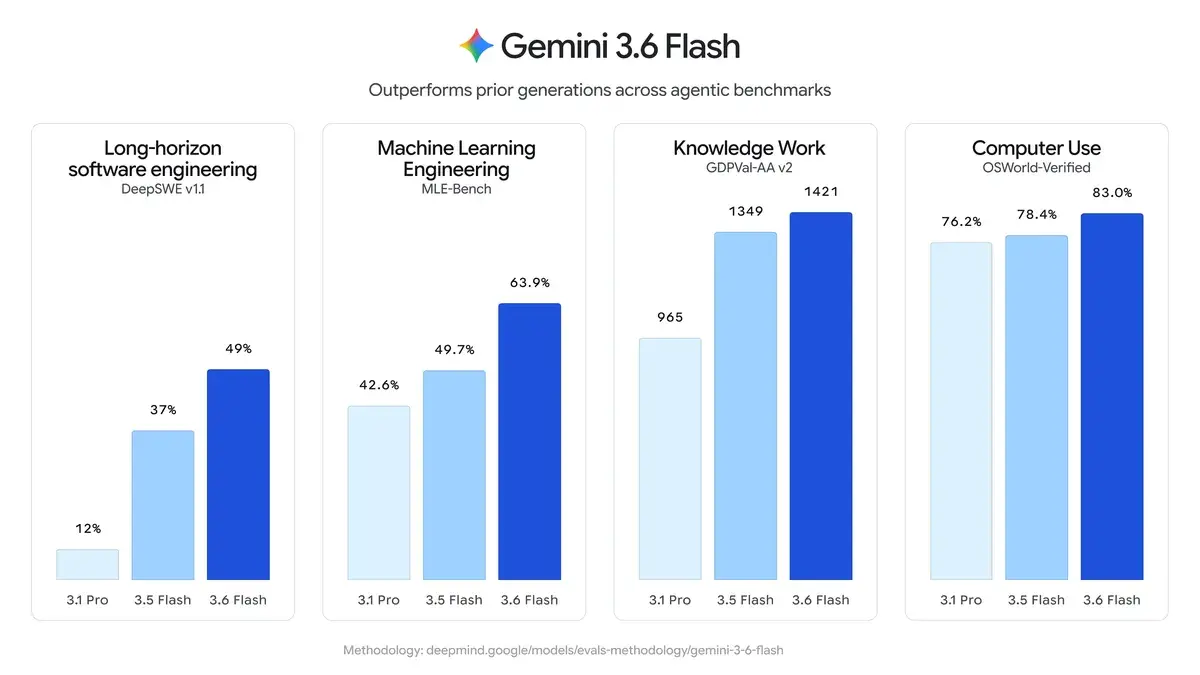
- Google reports better results than Gemini 3.5 Flash on DeepSWE, MLE Bench, OSWorld-Verified, and GDPval-AA v2. Google reports 17% fewer output tokens than Gemini 3.5 Flash on the Artificial Analysis Index and up to 65% fewer output tokens in DeepSWE-related coding evaluation.
- Official Gemini API Standard pricing is $1.50/M input tokens and $7.50/M output tokens, compared with $1.50/M and $9.00/M for Gemini 3.5 Flash. Batch and Flex pricing for Gemini 3.6 Flash are $0.75/M input and $3.75/M output; Priority pricing is $2.70/M input and $13.50/M output. CometAPI's Gemini 3.6 Flash model page lists $1.20/M input and $6.00/M output, 20% below Google's official Standard paid-tier pricing at the time checked.
- Gemini 3.6 Flash can replace Gemini 3.5 Flash for many new production workloads, but migration should include prompt, tool-calling, parameter, latency, cost, and regression tests.
- Gemini 3.5 Pro was not part of this launch; Google says it is still testing with partners and will be released broadly when ready.
What Is Gemini 3.6 Flash?
Gemini 3.6 Flash is the new default Flash-tier model to evaluate if you build AI agents, coding tools, document workflows, search-grounded assistants, or multimodal automation. Google released it on July 21, 2026 alongside Gemini 3.5 Flash-Lite and Gemini 3.5 Flash Cyber, framing the launch around production agent economics: higher token efficiency, lower latency, fewer tool loops, and lower cost per successful task.
The most important change is not the model name. The upgrade is quality and economics: Google says Gemini 3.6 Flash uses 17% fewer output tokens than Gemini 3.5 Flash on the Artificial Analysis Index and up to 65% fewer output tokens on DeepSWE-style coding work, while lowering standard output pricing from $9.00/M to $7.50/M.
Core Capabilities:
- Multimodal Input: Text, image, video, audio, PDF.
- Context Window: 1 million input tokens, 64k output tokens.
- Tool Use: Native function calling, search as a tool, and computer use for agentic UI automation.
- Best For: Everyday tasks, agentic coding, advanced reasoning, long-context understanding, and production-ready code generation.
Unlike larger “Pro” models focused on maximum intelligence, Flash variants emphasize speed, scale, and cost-effectiveness while delivering frontier-level performance in targeted areas. Gemini 3.6 Flash advances this by reducing output verbosity and improving precision.
Knowledge Cutoff: Updated to March 2026 (from January 2025 in prior versions), providing fresher real-world knowledge.
The model card adds an important architectural detail: Gemini 3.6 Flash is based on Gemini 3.5 Flash. That makes the release closer to a targeted, production-focused upgrade than a completely new family. Google appears to have concentrated on the problems developers found in real agent workflows: too many output tokens, too many unnecessary tool calls, unwanted edits during diagnostic tasks, coding revision loops, chart interpretation, document work, and UI-style multimodal reasoning.
Why Did Google Release Gemini 3.6 Flash Now?
The Latest News Behind the Release
Google's July 21 announcement did three things at once:
- It launched Gemini 3.6 Flash as a stronger workhorse model.
- It launched Gemini 3.5 Flash-Lite as the fastest and cheapest 3.5-class model for high-throughput workflows.
- It introduced Gemini 3.5 Flash Cyber in CodeMender for limited-access cybersecurity defense use cases.
The same announcement also clarified the status of Gemini 3.5 Pro: it is still testing with partners and Google plans to make it broadly available when ready. Google also said Gemini 4 pretraining has started.
That context matters. Gemini 3.6 Flash is not a Pro replacement. It is Google's answer to a different production problem: many AI systems are becoming too expensive, too verbose, and too unreliable when models repeatedly call tools, reason across long context, and retry actions. A faster, more efficient Flash model can have more immediate impact than a delayed flagship if it reduces the number of tokens, turns, and retries required to finish common tasks.
The Release Is About Cost per Successful Task
AI teams often compare models by token price. That is useful, but incomplete. Agentic workloads introduce extra cost variables:
- How many reasoning steps does the model take?
- How many tool calls does it make?
- How often does it make unnecessary edits?
- How often does it fail and require a retry?
- How many output tokens does it spend explaining instead of solving?
- How often must traffic escalate to a more expensive model?
Gemini 3.6 Flash is significant because Google is marketing it around these operational variables, not only around headline benchmark scores. If a model reduces output tokens by 17%, avoids unnecessary edit loops, and produces more correct code on the first attempt, the real savings can be larger than the price table suggests.
Benchmark Performance and Comparison
Google and third-party evaluations highlight 3.6 Flash's balanced improvements. It doesn't top every frontier leaderboard but excels in efficiency-adjusted performance for practical use.
Selected Benchmarks (Gemini 3.6 Flash vs. 3.5 Flash):
- DeepSWE (Datacurve – multi-step software engineering): 49% vs. 37% (significant precision gains, fewer loops/edits); token usage reduced up to 65% in some cases (e.g., 276k to 97k tokens).
- MLE-Bench (ML Research): 63.9% vs. 49.7%
- OSWorld-Verified (Computer Use): 83.0% vs. 78.4% (built-in computer use now standard)
- GDPval-AA v2 (Knowledge Work): 1421 vs. 1349
- Artificial Analysis Intelligence Index: Around 50 (solid, though behind some leaders like Claude variants at ~60); notable for token efficiency.
- Other: Improvements in Terminal-Bench, long-context (e.g., GDM-MRCR v2), SWE-Bench Pro, and multimodal tasks like document parsing and chart analysis.
Comparison Table: Gemini 3.6 Flash vs. Key Competitors (Approximate, based on July 2026 data)
| Feature/Model | Gemini 3.6 Flash | Gemini 3.5 Flash | GPT-5.6 Luna (est.) | Grok 4.5 | Claude Sonnet 5 |
|---|---|---|---|---|---|
| Output Token Efficiency | Excellent (17% better) | Good | High | Strong | Good |
| Coding (DeepSWE) | 49% | 37% | 67% | 54% | 54% |
| Computer Use (OSWorld) | 83% | 78.4% | 72.6% | - | 81.2% |
| Knowledge Work (Elo) | 1421 | 1349 | 1584 | 1535 | 1607 |
| Output Price ($/1M) | $7.50 | $9.00 | $6.00 | $6.00 | $10-15 |
| Best For | Efficient Agents | General Agents | High Intelligence | Reasoning | Creative |
Additional Notes:
- SWE-Bench Pro: 58.7% (vs. 55.1% for 3.5 Flash).
- Terminal-Bench 2.1: 78.0% (vs. 76.2%).
- The model excels in agentic and multimodal scenarios while maintaining Flash-tier speed.
Independent tests (e.g., Artificial Analysis, Reddit discussions) note strong speed and efficiency, though it may consume more tokens than some ultra-optimized rivals in certain settings. Real-world feedback praises it for document analysis, report drafting, and multimodal tasks (e.g., via customers like Hebbia and Harvey).
What's New vs Gemini 3.5 Flash?
1. Better Token Efficiency
Gemini 3.6 Flash is designed to use fewer output tokens than Gemini 3.5 Flash. Google cites a 17% output-token reduction on the Artificial Analysis Index and up to 65% on some DeepSWE coding workloads.
This matters because output tokens are usually more expensive than input tokens. In official Gemini API Standard pricing, Gemini 3.6 Flash input remains $1.50/M, but output falls to $7.50/M. Gemini 3.5 Flash output is $9.00/M. When lower output price and fewer output tokens combine, the cost per finished agent task can drop meaningfully.
2. Stronger Coding and Fewer Unwanted Edits
Google Cloud's Gemini Enterprise Agent Platform docs say Gemini 3.6 Flash improves code generation with lower compile-failure and revision rates across building, prototyping, and IDE agent environments. It also reduces "action bias," meaning it is better at handling read-only diagnostic tasks without making unsolicited edits.
- Workflow Improvements: Fewer reasoning steps, conversational turns, tool calls, and reduced execution loop spiraling. It prefers upfront diagnostic scripts before edits, improving accuracy.
- Code Generation: Higher-quality, production-ready code with fewer unwanted edits and debugging loops.
- Computer Use: Improved from 78.4% to 83.0% on OSWorld-Verified; native client-side tool support.
3. Quality Improvements and Speed
Agentic Enhancements: Fewer reasoning steps/tool calls; built-in computer use; stronger support for multi-agent orchestration and iterative workflows.
Speed & Reliability: Optimized latency for high-volume production; integrates with tools like Google Slides for generating editable presentations from docs/PDFs.
Safety: Enhanced safeguards against C
4. Lower Output Price
Google lowered the official Standard output price from $9.00/M on Gemini 3.5 Flash to $7.50/M on Gemini 3.6 Flash. Input pricing stayed at $1.50/M.
This is a direct price improvement even before accounting for token-efficiency gains.
5. Migration and Parameter Changes
Some behavior can differ from earlier Gemini models. Google Cloud's Agent Platform page lists potentially breaking changes: custom values for parameters such as temperature, top-K, and top-P are not supported in that surface, frequency and presence penalty custom values can error, and requests ending with a model role are not supported in certain APIs.
The migration lesson is simple: do not only change the model string. Review the exact API surface you use, remove unsupported generation parameters, retest multi-turn state handling, and check tool-calling behavior.
Can Gemini 3.6 Flash Replace Gemini 3.5 Flash?
Yes, for the majority of production scenarios. Google has effectively positioned 3.6 Flash as the new default workhorse, with 3.5 Flash likely deprecated or legacy in many interfaces.
Reasons to Switch:
- Cost Savings: Lower per-task expense due to pricing + efficiency.
- Better Outputs: Improved quality metrics across coding, agents, and knowledge tasks.
- Future-Proofing: New features like enhanced computer use and integrations.
When to Stick with 3.5 or Consider Alternatives:
- Extremely latency-sensitive high-volume tasks (consider 3.5 Flash-Lite companion model at even lower cost/speed).
- Need for maximum raw intelligence (wait for 3.5 Pro or use larger models).
- Specific legacy compatibility.
For most developers building agents, apps, or automation on Cometapi, migrating to 3.6 Flash via the proxy is straightforward and recommended for immediate ROI.
How to Access Gemini 3.6 Flash
- Google AI Studio / Gemini API: Get a free API key at aistudio.google.com. Use model
gemini-3.6-flash. Quickstart with official SDKs (Python, JS, etc.). - Vertex AI / Google Cloud: Enterprise-grade with higher quotas, grounding, and security.
- Gemini App & Integrations: Available in Android Studio, GitHub Copilot (with toggles), Google Slides, etc.
- Via Cometapi (Recommended for Ease): Cometapi provides a unified, OpenAI-compatible proxy for Gemini 3.6 Flash and other models. Benefits include higher rate limits, simplified auth, multi-provider switching, and reduced management overhead. Ideal for scaling apps without hitting individual provider limits. Visit Cometapi.com for setup guides and pricing that complements Google's tiers.
Example Python Call (Official or via Proxy):
import google.generativeai as genai
genai.configure(api_key="YOUR_KEY")
model = genai.GenerativeModel('gemini-3.6-flash')
response = model.generate_content("Your prompt here")
Test in AI Studio first, then integrate. Caching and batch APIs further optimize costs.
Conclusion & Recommendations
Gemini 3.6 Flash is a pragmatic, high-value upgrade that refines Google's Flash lineup for real-world demands. Its combination of intelligence, efficiency, and accessibility makes it a top choice for 2026 AI development.
CometAPI Recommendation: Integrate via Cometapi for the smoothest experience—unified API, better quotas, and easy A/B testing across models. Whether you're building agents, processing documents, or powering apps, start experimenting with 3.6 Flash today to cut costs and boost performance.
FAQs
What is Gemini 3.6 Flash?
Gemini 3.6 Flash is Google's July 2026 stable Flash model for coding, knowledge work, multimodal reasoning, and agentic workflows. It is based on Gemini 3.5 Flash but improves token efficiency, coding behavior, computer-use performance, and knowledge-work benchmarks.
How much does Gemini 3.6 Flash cost?
Google's official Gemini API Standard paid-tier pricing is $1.50 per million input tokens and $7.50 per million output tokens. Batch and Flex are $0.75/M input and $3.75/M output. Priority is $2.70/M input and $13.50/M output. CometAPI's model page lists $1.20/M input and $6.00/M output at the time checked.
Is Gemini 3.6 Flash cheaper than Gemini 3.5 Flash?
Yes for output tokens. Both models list $1.50/M input tokens on Google's Standard paid tier, but Gemini 3.6 Flash output is $7.50/M versus $9.00/M for Gemini 3.5 Flash. Google also reports fewer output tokens on many tasks, which can reduce total cost further.
Can Gemini 3.6 Flash replace Gemini 3.5 Flash?
For many workloads, yes. It is the better default candidate for coding agents, multimodal analysis, and complex tool workflows. However, production users should benchmark before replacing 3.5 Flash, especially if they depend on stable output style, exact JSON formatting, or legacy generation parameters.
What are the main benchmark improvements?
Google reports Gemini 3.6 Flash outperforming Gemini 3.5 Flash on DeepSWE (49% vs 37%), MLE Bench (63.9% vs 49.7%), OSWorld-Verified (83.0% vs 78.4%), and GDPval-AA v2 (1421 vs 1349). Google also reports 17% fewer output tokens on the Artificial Analysis Index.
How do I access Gemini 3.6 Flash through CometAPI?
Create a CometAPI key, use https://api.cometapi.com/v1 for OpenAI-compatible calls, and set the model to gemini-3.6-flash if it is available in your dashboard. For Gemini-native features, use the provider-native route documented on CometAPI's Gemini 3.6 Flash model page.