Gemini 4 Carbon is Google DeepMind’s frontier model for demanding engineering and defensive cybersecurity. Announced on October 28, 2026, it improves on Argon in published coding, security, and long-context evaluations. Introductory rates are $2 per million input tokens and $10 per million output tokens, but access is initially restricted to selected cyber defenders and trusted partners. For developers, the opportunity is stronger autonomous work; the immediate constraint is access.
Key Takeaways
Gemini 4 Carbon is Google’s next frontier model after Argon, optimized for sustained multi-day agentic engineering and cybersecurity defense.
Gemini 4 Carbon ranks #1 on Artificial Analysis Intelligence Index v5.0 (score 59), ahead of Claude Opus 5.5 (58) and GPT-6 Astra (57). Strong gains in coding, full-stack web development (+89 Elo on WebDev Arena to #4), scientific reasoning, multimodal understanding, and alignment (0.0% success on Gray Swan Indirect Prompt Injection Benchmark).
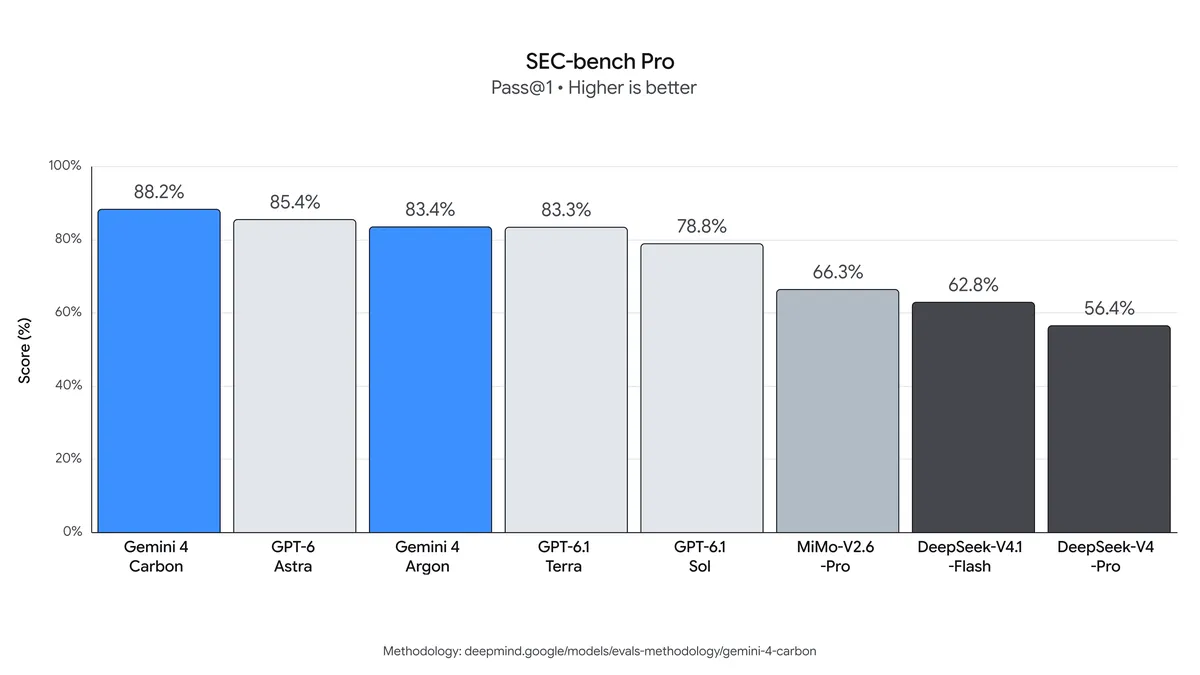
Standout cybersecurity scores (without guardrails): 88.2% on SEC-bench Pro (finding vulnerabilities), 54.8% on ExploitGym (exploitation), and 71.0% on CWE-bench (patching).
Reviewed for clarity, source attribution and current API terminology.
Limited initial access via Fairwind Program for cyber defenders; public API and wider rollout coming later.
Same introductory pricing as Argon; after the intro period, standard rates apply.
Platforms like CometAPI already support the broader Gemini family (including Argon) via a unified OpenAI-compatible API, making it easy to switch models and prepare for Carbon’s wider release. Public API details and a broad release date remain unannounced as of October 29, 2026.
What Is Gemini 4 Carbon?
Gemini 4 Carbon is Google's newest flagship frontier AI model, designed to handle complex software engineering, cybersecurity research, and autonomous workflows.
According to the official announcement, Carbon builds on the foundation established by Gemini 4 Argon, with substantial improvements in coding, agentic reasoning, and security-focused tasks.
Carbon is designed for work that involves investigation, execution, and verification across multiple steps. A defensive engineering agent might inspect a repository, validate a suspected vulnerability in an isolated environment, develop a patch, and test whether the change addresses the original defect.
Google reports that its internal teams have observed Carbon working through complex engineering tasks over multiple days. These are internal observations, not a published guarantee of a particular autonomous runtime. Google has not released a full technical report, parameter count, or detailed architecture details. Context window and output limits are expected to be similar to or improved upon Argon’s (reported in the multi-million-token range with high output capacity), and it supports multimodal inputs including text, images, video, audio, and PDFs.
What Are the Key Features of Gemini 4 Carbon?
Long-Horizon Software Engineering
Carbon is designed for engineering problems that cannot be completed reliably in a single reasoning step.
Examples include root-cause analysis across large repositories, dependency-related failures, low-level systems debugging, and complex refactoring.
Its improvements target the ability to continue working after an unsuccessful attempt.
An effective coding agent must recognize when its first solution fails, inspect new evidence, and revise its approach without drifting away from the original task.
Defensive Cybersecurity Workflows
Carbon’s security results span finding vulnerabilities, validating exploitability, and patching defects. The useful question for a security team is whether an agent can move from a suspected issue to a reproducible finding and a tested fix, while respecting the permissions and environment assigned to it.
Long-Context and Multimodal Understanding
Carbon records a GraphWalks BFS F1 score of 96.2% in the 256K–1M-token subset, up from Argon’s 84.2%. This is evidence about long-context graph reasoning, rather than a guarantee of correct retrieval from any million-token document.
The published Chartography and Blueprint-Bench 2 results also cover visual understanding. These tests can help identify promising document and chart workflows, but they do not establish the complete modality schema of a future public API.
How Does Gemini 4 Carbon Perform on Benchmarks?
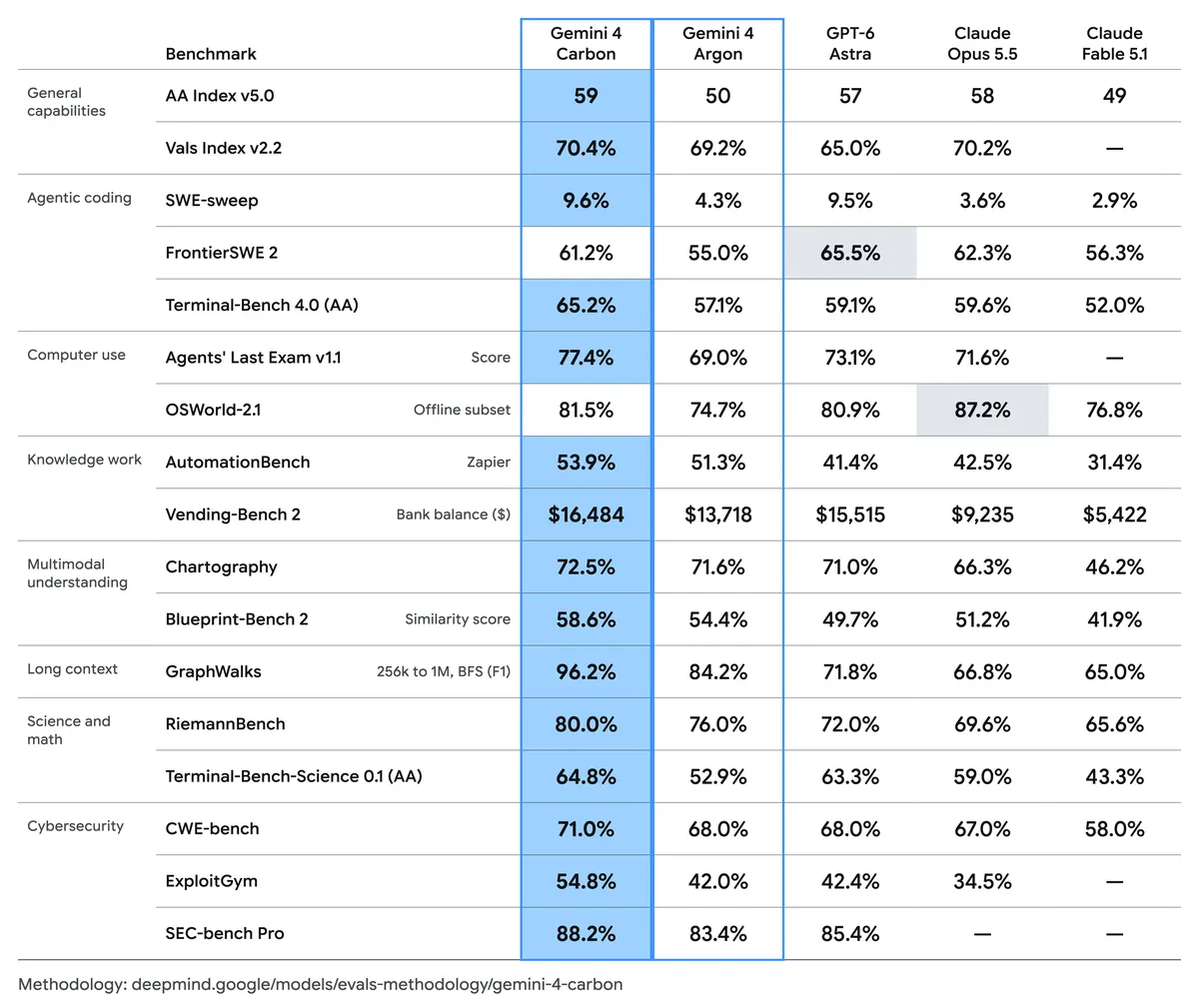
The published results highlight three reasons to evaluate Carbon: stronger coding performance, better long-context reasoning, and improvements across the cybersecurity workflow. The official announcement includes the original comparison chart below; the key results are summarized in the following section.
Choose benchmarks that resemble your own workload. A model that leads a general intelligence index may still trail another model on a particular engineering task.
Benchmark Results and Test Conditions
Overall reasoning: Carbon scores 59 on AA Intelligence Index v5.0, compared with 50 for Argon, 57 for GPT-6 Astra, and 58 for Claude Opus 5.5.
Coding: Terminal-Bench 4.0 rises from 57.1% to 65.2%, an 8.1-percentage-point improvement over Argon. SWE-sweep increases from 4.3% to 9.6%.
Long-context reasoning: Carbon scores 96.2% on the GraphWalks 256K–1M-token BFS F1 subset, up from Argon’s 84.2%.
Where alternatives lead: GPT-6 Astra scores 65.5% on FrontierSWE 2 versus Carbon’s 61.2%; Claude Opus 5.5 scores 87.2% on the OSWorld offline subset versus Carbon’s 81.5%. These comparisons refer to the models and evaluation settings in the published chart.
Across the 17 selected results in the original comparison, Carbon leads 15. That breadth makes it a promising candidate for complex workflows, but the two exceptions show why your own task mix matters. Compare models on accepted results, completion time, and cost rather than averaging unrelated benchmark scores.
The evaluation methodology generally uses the highest thinking setting and pass@1 unless noted otherwise. It combines Google-run results with external evaluators and provider-reported scores, so agent scaffolding and reasoning budgets are not identical across every entry.
GraphWalks: The cited subset uses 200 problems and reports BFS F1.
Agents’ Last Exam: The evaluation uses a 122-task v1.1 set, the ALE-Claw harness, a five-hour window, and enabled safety filters.
OSWorld: The reported result covers an 82-task offline subset and takes the maximum over three single-attempt runs.
Coding Performance in Practice
Carbon improves Terminal-Bench 4.0 from 57.1% to 65.2%, an 8.1-percentage-point gain. SWE-sweep rises from 4.3% to 9.6%, more than doubling the score while remaining below 10% in absolute terms. Those results support evaluating difficult repository work, while also showing why independent tests and review remain necessary.
How Strong Is Gemini 4 Carbon at Cybersecurity?
The largest gain is in exploit validation. For an authorized defensive team, reproducible evidence that a vulnerability is exploitable can improve prioritization; a plausible finding alone is not enough. Patches still need tests that confirm the original defect is fixed and existing functionality is preserved.
Google reports the external security evaluations without deployment guardrails. SEC-bench Pro uses a specific 183-task JavaScript-engine split; ExploitGym uses a single-attempt offline setup with mitigations off. These conditions do not establish unrestricted production behavior or a detection rate for arbitrary real-world software.
Is Gemini 4 Carbon Safer and More Reliable Than Argon?
Unsupported claims decreased by approximately 50% relative to Argon in internal testing.
Agent overreach decreased by 26%.
Under-service decreased by 29%.
High-severity misalignment alerts decreased by almost 80% in internal coding environments.
Successful cheating on Terminal-Bench 4.0 fell to 0.0% in Google's evaluation.
On the evaluated Gray Swan indirect prompt-injection benchmark, Carbon’s attack success rate is 0.0% versus Argon’s 0.7%. This means the evaluated attacks did not succeed under that setup; it does not establish immunity to new attacks or different tool environments.
These figures come from different evaluations and should not be combined into a single reliability score.
For a production agent, retain independent permission checks, execution logs, and validation of claimed results. A model’s improved behavior helps, but the application must still control which files, services, and actions it can access.
How Much Does the Gemini 4 Carbon API Cost?
Google has announced Carbon’s introductory and subsequent token rates. The cached-input figures below are calculated from the announced 95% discount; the public API implementation and eligibility details remain pending.
Billing category, USD per 1M tokens
Introductory rate
Subsequent rate
Input tokens
$2.00
Carbon’s introductory period has no announced end date. Argon’s published introductory pricing ends November 30, 2026; that deadline should not be applied to Carbon. Batch pricing, additional tool fees, and a free tier have not been announced for Carbon.
Example Request Cost
Assume a request uses 200,000 uncached input tokens and 10,000 total billable output tokens. At the announced introductory rates, input costs $0.40 and output costs $0.10, for a total of $0.50. The same token usage would cost $1.00 at the subsequent rates.
If all 200,000 input tokens qualify for the announced cached-input discount, the introductory estimate becomes $0.12 including output. This is a conditional illustration, not a promise that every repeated input will qualify.
The output allowance must include any thinking tokens billed as output under the final applicable rules. If 10,000 refers only to the visible answer, additional billable thinking tokens would increase the estimate. Tools, retries, and other services are excluded.
How Can Developers Prepare for the Gemini 4 Carbon API?
Current Gemini 4 Carbon API Availability
As of October 29, 2026, access begins with selected cybersecurity defenders and expands gradually to trusted partners. Google’s Fairwind Program describes a controlled access pathway. A broad developer release date and public Carbon model identifier have not been announced.
Announced pricing therefore does not mean that an application can call a generally available Carbon API today. Its final public context limit, maximum output, modality schema, tool compatibility, and operational limits still need documented production specifications.
As of October 29, 2026, Google has not yet launched a generally available Carbon API, so Carbon is not yet available through CometAPI. While you wait, you can use Gemini 4 Argon for an initial evaluation. Check the CometAPI Carbon page for availability and provider pricing when access opens.
Alternatives While You Wait for the Carbon API
You can begin evaluating your coding workflow before Carbon becomes broadly available. Build a baseline with a model you can access today, then compare Carbon on the same tasks when its API opens. Three options to consider are Gemini 4 Argon, GPT-6.1 Astra, and Claude Opus 5.5; confirm the exact model name, access, and price with your provider before choosing a route.
Gemini 4 Argon: Start here if you already use Gemini or want a direct baseline for Carbon. Try representative repository changes, code reviews, and bug fixes, and record which outputs pass your acceptance tests.
**GPT-6.1 Astra:** Include it as a cross-provider comparison for the same engineering tasks. Measure accepted fixes, completion time, and total cost. The GPT-6 Astra results discussed earlier apply to that benchmarked version and should not be treated as GPT-6.1 Astra scores.
**Claude Opus 5.5:** Add it as another candidate for repository analysis, refactoring, and review. Use the same task descriptions and validation criteria so you can compare the practical value of each result.
Keep your model selection configurable and save the prompts, test cases, and results from each run. That gives you a useful starting point for evaluating Carbon without committing your workflow to an unannounced API format.
Prepare a Model Evaluation Workflow
A practical evaluation framework should measure more than general answer quality.
For coding and security workflows, useful metrics include:
Task completion rate: How often does the agent satisfy predefined acceptance tests?
Patch correctness: Does the proposed change address the original defect without breaking existing behavior?
False-positive rate: How often does a reported issue fail validation?
End-to-end latency: How long does the full workflow take, including tool execution?
Total task cost: How much does each accepted result cost after retries and tool usage?
Does the agent stay within authorized files, tools, and actions?
Use a fixed set of real tasks and keep a record of each model, its settings, token use, and test results. Include retries and manual corrections in the cost. Once Carbon becomes available, run the same evaluation to see whether it delivers more accepted work for your time and budget.
Conclusion
Gemini 4 Carbon is a promising upgrade for demanding coding, long-context reasoning, and defensive security work. Its published results show clear gains over Argon, while initial access remains limited as of October 29, 2026. For now, establish a baseline with an available model and keep your integration flexible. When Carbon’s public API opens, compare the quality of completed work, time saved, and total cost before deciding whether to switch.
FAQ
Can Gemini 4 Carbon run without human supervision?
Reports of multi-day internal engineering work do not establish unattended reliability for arbitrary tasks. A team considering autonomous execution should define permitted actions, stopping conditions, and acceptance tests, then measure how often the agent completes work without correction. Runtime alone does not show that an agent’s output is correct.
Can an existing Argon integration switch directly to Carbon?
Not on the evidence available here. Keep provider selection configurable, but verify Carbon’s actual model identifier, supported schema, tools, limits, and account access before changing a deployment. Reusing a prompt can help with a controlled comparison; it does not prove API compatibility.
Which Gemini 4 Carbon tests matter for a private codebase?
Include representative bugs, repository changes, and security findings with known acceptance criteria. Check whether patches pass relevant tests, whether findings reproduce, and whether unrelated behavior changes. Include failed attempts and manual correction in the cost analysis so a strong public benchmark score does not hide operational work.
Benchmark and security task
Gemini 4 Carbon
Gemini 4 Argon
Difference
SEC-bench Pro — vulnerability discovery
88.2%
83.4%
+4.8 percentage points
ExploitGym — exploit validation
54.8%
42.0%
+12.8 percentage points
CWE-bench — vulnerability remediation
71.0%
68.0%
+3.0 percentage points
$4.00
Output tokens
$10.00
$20.00
Eligible cached input tokens
$0.10
$0.20
Benchmark
Gemini 4 Carbon
Gemini 4 Argon
GPT-6 Astra
Claude Opus 5.5
AA Intelligence Index v5.0
59
50
57
58
Vals Index v2.2
70.4%
69.2%
65.0%
70.2%
SWE-sweep
9.6%
4.3%
9.5%
3.6%
FrontierSWE 2
61.2%
55.0%
65.5%
62.3%
Terminal-Bench 4.0 (AA)
65.2%
57.1%
59.1%
59.6%
Agents' Last Exam v1.1
77.4%
69.0%
73.1%
71.6%
OSWorld-2.1, offline subset
81.5%
74.7%
80.9%
87.2%
AutomationBench, Zapier
53.9%
51.3%
41.4%
42.5%
Instruction compliance:
What Is Gemini 4 Carbon? Benchmarks, Features & Pricing - CometAPI