

TL;DR
Kimi K3.1 Pro brings stronger coding, CAD, and financial-research performance to Moonshot AI’s K3 foundation, with a one-million-token context window. Its published Terminal-Bench 4.0 score of 65.7% places it close to Claude Opus 5.5 in Moonshot’s comparison. The standard model suits cost-sensitive workloads; Highspeed offers approximately 2–3× faster output with the same advertised capabilities.
Both are available through CometAPI’s Kimi K3.1 Pro API.Standard CometAPI pricing is $1.60 per million input tokens and $8.00 per million output tokens. This guide explains the benchmarks, compares costs, and shows how to call either version. Figures and prices were checked on October 24, 2026.
Key Takeaways
- Kimi K3.1 Pro is a post-training upgrade: it builds on K3’s MoE foundation and supports a 1,048,576-token context window.
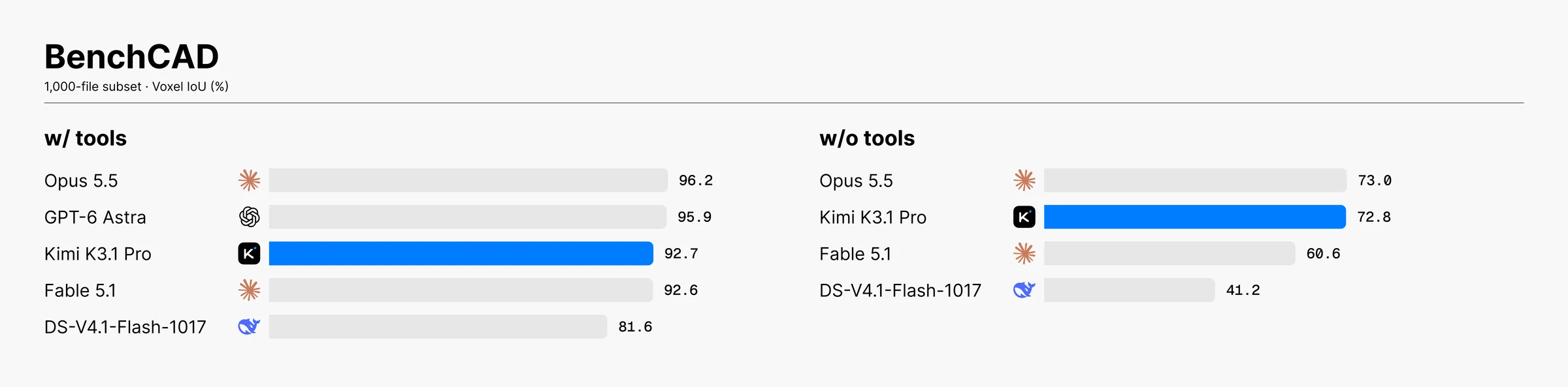
- Kimi K3.1 Pro strengthens agent workflows: Moonshot reports 65.7% on Terminal-Bench 4.0 and 92.7% Voxel IoU on BenchCAD with tools.
- Kimi K3.1 Pro Highspeed prioritizes response speed: its advertised output rate is approximately 2–3× the standard version, with the same model capabilities.
- Kimi K3.1 Pro API access is available through CometAPI: standard input and output rates are 20% below the published official USD rates; Highspeed pricing requires a separate account check.
- Kimi K3.1 Pro hosted access precedes the full weight release: Moonshot plans to publish the complete weights by November 4, 2026.
What Exactly Is Kimi K3.1 Pro?
Kimi K3.1 Pro is the flagship large language model from Beijing-based Moonshot AI (月之暗面), released on October 23, 2026. It is not a completely new base model. Instead, it is a heavily post-trained version of the earlier Kimi K3 (launched July 2026), using significantly larger post-training compute focused on joint reinforcement learning across hundreds of downstream domains.
Moonshot describes it as “our most capable 3T-class open-weight model to date.” The model retains the same core architecture as K3:
- 2.8 trillion total parameters
- 104 billion active parameters per token (sparse Mixture-of-Experts design)
- Native 1-million-token context window
- Multimodal support (text, images, and video input)
- Always-on reasoning (no non-thinking mode)
A companion variant, Kimi K3.1 Pro Highspeed, delivers 2–3× the inference speed of the standard Pro version at double the price, making it suitable for more interactive or latency-sensitive applications.
Full model weights are scheduled for public release by November 4, 2026, which would make K3.1 Pro one of the strongest open-weight models available.
Kimi 3.1 Pro Technical Specifications
| Specification | Details |
|---|---|
| Model Family | Kimi K3.1 series (first model) |
| Base | Post-trained Kimi K3 |
| Total Parameters | 2.8 trillion |
| Active Parameters | 104 billion (MoE) |
| Context Window | 1,048,576 tokens |
| Max Output | Up to ~944K–1M tokens (configurable) |
| Input Modalities | Text, Image, Video |
| Output | Text |
| Reasoning | Always on (low / high / max effort levels) |
| Tool Calling | Supported |
| Structured Output (JSON) | Supported |
| API Model IDs | kimi-k3.1-pro, kimi-k3.1-pro-highspeed |
| Open Weights | By November 4, 2026 |
imi K3.1 Pro Benchmarks: Coding, CAD, and Finance
The following table uses Moonshot’s release evaluations. These are provider-reported benchmark results, not an independently reproduced cross-provider test.
Hallucination rates dropped sharply: Moonshot reports false claims fell from 23.4% on K3 to around 8.3% (or lower on internal tests). Finance-related modeling and research also improved significantly.
| Benchmark | Kimi K3.1 Pro | Claude Opus 5.5 | GPT-6 Astra | Note |
|---|---|---|---|---|
| Terminal-Bench 4.0 | 65.7% | 66.4% | 58.2% | Coding agents on realistic terminal tasks |
| BenchCAD, with tools (Voxel IoU) | 92.7% | 96.2% | 95.9% | 3D reconstruction / CAD |
| OfficeQA Pro v2 | 64.4 | 62.2 | 54.4 | Document & office tasks |
| Frontier Finance | 58.6 | 56.7 | 45.0 | Finance |
| SWE-Marathon | 51.7% | 46.3% | 42.5% | Long-horizon software engineering |
| Humanity’s Last Exam (with tools) | 70.0% | 67.7% | 57.2% | Broad knowledge & reasoning |
| Kimi Hallu Bench Hard, with tools (lower is better) | 8.3% | 15.0% | 5.5% |
Coding benchmarks show frontier-level agent performance
On Terminal-Bench 4.0, the gap to Claude Opus 5.5 is 0.7 percentage points; the lead over GPT-6 Astra is 7.5 points. This makes K3.1 Pro a relevant candidate for terminal-based engineering agents, but the evaluation setup matters as much as the headline score.
Note that some independent coding agent tests show more mixed results depending on the exact harness and session length, with K3.1 Pro sometimes producing longer, more verbose reasoning traces.
Kimi K3.1 Pro improves 3D creation and vision
BenchCAD measures reconstruction quality from multi-view renders through generated CAD code. Its Voxel IoU score measures geometric overlap, so 92.7% should not be read as a 92.7% task pass rate. Moonshot’s with-tools comparison uses a 1,000-case subset and places K3.1 Pro below Opus 5.5 and GPT-6 Astra on this metric.
It also shows large gains over Kimi K3 in vision-language tasks (e.g., +0.11 mAP50 on Ultralytics auto-annotation leaderboard) and data-analytics exams (42/43 questions passed).
What’s New in Kimi K3.1 Pro Compared With Kimi K3?
The clearest reason to consider an upgrade is improved completion of multi-step work. The table below compares K3 and K3.1 Pro within Moonshot’s reported evaluations.
| Evaluation | Kimi K3 | Kimi K3.1 Pro | Improvement |
|---|---|---|---|
| Kimi Code Bench 3.0 Long-horizon | 55.95% | 61.2% | +5.25 points |
| Internal Financial Modeling | 50.4 | 57.6 | +7.2 points |
| Internal Financial Research | 58.8 | 70.4 | +11.6 points |
| Internal Business Operation | 8.9 | 37.0 | ~4.2× performance |
| Kimi Hallu Bench Hard with tools, claim-level errors | 23.4% | 8.3% | ~64.5% reduction |
However, these are individual benchmark comparisons. They should not be interpreted as a universal 4.2× improvement in agent performance.
Kimi K3.1 Pro reduces factual errors
The chart separates results without tools from the harder evaluation with tools; the 8.3% figure belongs to the latter.
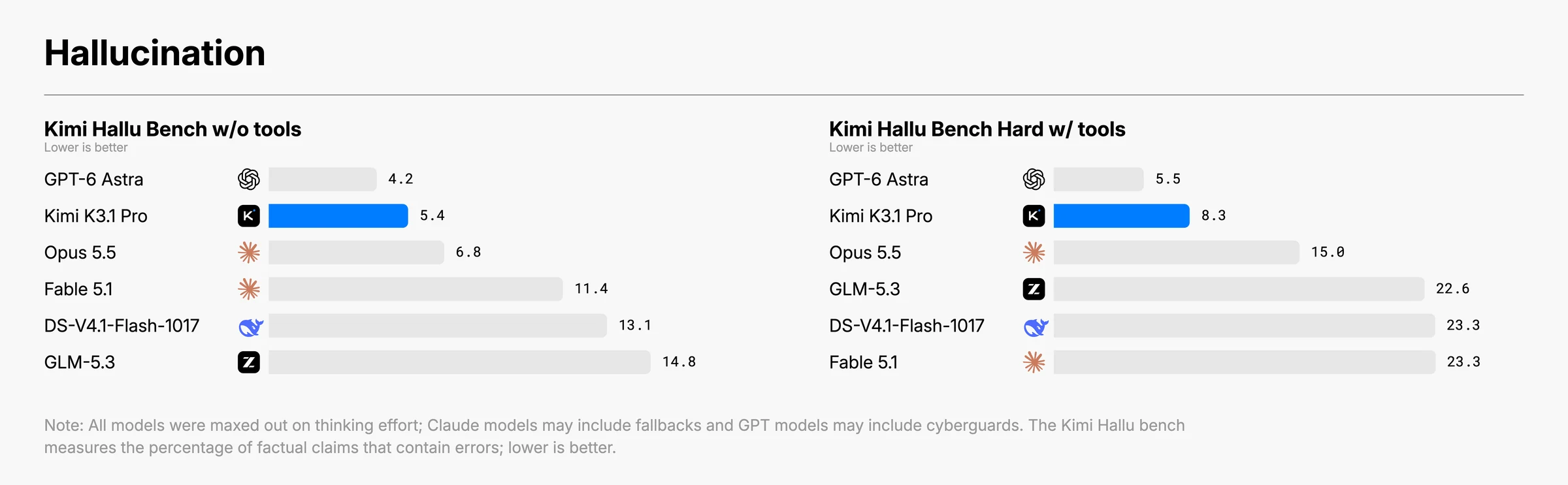
The distinction between benchmark accuracy and real-world reliability is important. This evaluation deliberately uses difficult prompts that are likely to expose factual errors. Its results do not represent the model’s average hallucination rate in everyday conversations.
Kimi K3.1 Pro introduces a deliberate cybersecurity trade-off
Moonshot AI removed selected cyber-related training data and reinforcement-learning tasks to reduce offensive cybersecurity capabilities while preserving general-purpose coding performance.
In Moonshot’s internal xdev-bench-hard evaluation at pass@3, the unrestricted checkpoint scored 90.5% and the release model scored 81.0%. That difference reflects a deliberate training choice, not a guarantee that the released model cannot be misused. See the official cybersecurity evaluation for its conditions and limitations.
Kimi K3.1 Pro vs Highspeed: Which Version Should You Choose?
| Decision factor | Kimi K3.1 Pro | Kimi K3.1 Pro Highspeed |
|---|---|---|
| Model capabilities | Standard flagship capabilities | Same advertised capabilities |
| Output speed | Baseline | Approximately 2–3× faster |
| Best starting workload | Batch analysis, long reports, background tasks | Interactive coding and research assistants |
| CometAPI model ID | kimi-k3.1-pro | kimi-k3.1-pro-highspeed |
Use the standard version when cost matters more than immediate output. Choose Highspeed when users are waiting for generation, then measure the effect on complete tasks rather than assuming output speed translates directly into the same overall time saving.
For example, if a coding agent spends most of its time running tests, installing dependencies, or waiting for external tools, accelerating model output may produce a relatively small end-to-end improvement.
Access Both Kimi K3.1 Pro Versions Through CometAPI
CometAPI provides access to Kimi K3.1 Pro and Kimi K3.1 Pro Highspeed through its OpenAI-compatible Chat Completions endpoint. The integration stays the same when you switch versions; change the model ID to select the variant.
- Create an API key in your CometAPI account and make it available to your application as the COMETAPI_API_KEY environment variable.
- Install the OpenAI Python SDK, then set the client’s base URL to
https://api.cometapi.com/v1. - Use kimi-k3.1-pro for the standard model or kimi-k3.1-pro-highspeed for Highspeed.
python -m pip install --upgrade openaiimport osfrom openai import OpenAIclient = OpenAI( api_key=os.environ["COMETAPI_API_KEY"], base_url="https://api.cometapi.com/v1",)response = client.chat.completions.create( model="kimi-k3.1-pro", # Or "kimi-k3.1-pro-highspeed" messages=[ { "role": "user", "content": "Suggest three tests for a CSV import feature.", } ],)print(response.choices[0].message.content)
The following shell example calls Highspeed directly. It uses the same COMETAPI_API_KEY environment variable.
Kimi K3.1 Pro API Pricing: Official Rates vs CometAPI
The table compares published USD rates per one million tokens for uncached input and generated output, checked on October 24, 2026. CometAPI’s standard K3.1 Pro rates are 20% below the official rates. Check your account’s current Highspeed rates before choosing that version.
| Model | Official input | Official output | CometAPI input | CometAPI output |
|---|---|---|---|---|
| Kimi K3.1 Pro | $2.00 | $10.00 | $1.60 | $8.00 |
| Kimi K3.1 Pro Highspeed | $4.00 | $20.00 | Check account pricing | Check account pricing |
The standard-version discount should not be assumed to apply to Highspeed. Cache reads and writes, tool charges, taxes, and retries are outside this comparison.
At official API rates, K3.1 Pro is approximately 33.3% cheaper than K3 for uncached input and output tokens.
For requests without caching or additional billable services, the cost is:
Cost = (Input tokens × Input rate + Output tokens × Output rate) / 1,000,000
For example, processing 100,000 uncached input tokens and generating 10,000 output tokens costs approximately $0.24 through CometAPI’s standard K3.1 Pro API, compared with $0.30 at the official provider rate.
Estimate production spending from successful tasks, including any retry or reasoning-token usage shown in your billing records. A lower token rate does not guarantee a lower total cost if a workflow produces more tokens or needs additional attempts.
Put Kimi K3.1 Pro to Work: Four Practical Starting Points
Choose a small workflow with an output you can inspect.
| Workflow | A practical first project | Acceptance checks |
|---|---|---|
| Software engineering | Fix a reproducible bug in a repository and add a regression check. | Relevant tests pass; the patch addresses the issue without unrelated changes. |
| CAD and 3D creation | Generate a parametric part from a dimensioned brief. | Check dimensions, valid geometry, editability, and export compatibility. |
| Financial research | Reconcile selected figures across annual reports and a workbook. | Verify each figure against its source and check formulas independently. |
| Long-context research | Compare requirements across a collection of technical documents. | Check evidence locations, document versions, and coverage of conflicting statements. |
For evaluation, completed-task success is more informative than the number of lines of code generated.
What Are the Limitations of Kimi K3.1 Pro?
- Reasoning stays enabled. K3.1 Pro supports low, high, and max reasoning effort, with max as the documented default. Do not assume that a non-reasoning mode is available.
- Long inputs have operating costs. A large context window can increase input processing time and token consumption. Select relevant material and evaluate caching rather than sending an entire archive by default.
- An API response does not complete an external workflow. Your application supplies tool execution, saved state, and output validation; a tool-enabled benchmark result does not mean those capabilities come with a bare API call.
- Hosted access and downloadable weights are different milestones. As of October 24, the full K3.1 Pro weight release remains planned for November 4, 2026; review the release and license before planning self-hosting.
API behavior is described in the Kimi API guide; weight availability is covered by the release announcement.
Conclusion
Kimi K3.1 Pro is worth evaluating when your application depends on multi-step coding, document research, or tool-assisted work. Its reported gains over K3 and lower standard API rates create a practical reason to test the upgrade. Begin with the standard model, measure accepted-task quality and cost, and choose Highspeed where faster generation materially improves the user experience. Use the CometAPI model to check access and current pricing before integrating the examples above.