
Qwen3.8-Flash explained: 1M context, 6B active MoE design, coding and multimodal benchmarks, price-performance, comparisons, and CometAPI access.
TL;DR Alibaba's Qwen3.8-Flash is a production model for high-volume coding, agents, long-context work, and multimodal tasks. It supports a 1M-token hosted context and combines strong benchmark results with low API pricing. An open-weight counterpart, Qwen3.8-Flash-Next, is available for local evaluation and deployment.
Key Takeaways
- Production vs. open-weight naming: Qwen3.8-Flash is the hosted production model; Qwen3.8-Flash-Next is the open-weight architecture release used to publish the model details and benchmarks.
- Extreme sparse activation: 125B main parameters + 51B N-gram embeddings, with only 6B active parameters per token.
- Long context: 262K native context for the open model, extensible to 1M with YaRN; the production QwenCloud route exposes 1M context by default.
- Strong agentic coding: Qwen reports 62.5 on SWE-bench Pro, 73.9 on CoWorkBench, 73.5 on Toolathlon Verified, and 91.9 on LiveCodeBench v6.
- Multimodal strength: Qwen reports 84.5 on AndroidWorld, 88.5 on RealWorldQA, and 90.6 on MathVision without a code interpreter.
- Efficiency: QSA reaches up to 7.6x prefill and 4.9x decode kernel speedups at 1M tokens, and Qwen reports 8.6x higher 1M-token prefill throughput than Qwen3.7-Plus under a high prefix-cache-hit serving setup.
- Pricing: Alibaba Cloud currently lists US$0.15/M input and US$0.47/M output for international deployment; CometAPI lists US$0.12/M input and US$0.376/M output.
Official Qwen3.8-Flash launch image — Alibaba/Qwen source
What Is Qwen3.8-Flash?
Qwen3.8-Flash is Alibaba Qwen’s efficiency-oriented production model for coding, agents, long-context knowledge work, and multimodal tasks. The model was announced together with an open-weight counterpart called Qwen3.8-Flash-Next. Alibaba describes it as an open-weight multimodal MoE model optimized for capability, latency, and cost, and says the architecture is an early preview of ideas intended for Qwen4.
The “Flash” label is important. Qwen3.8-Max is the larger flagship tier for maximum capability, while Qwen3.8-Flash is built to deliver much of the useful coding and agentic performance with dramatically less active compute. The release activates 6B parameters per token, compared with much larger active footprints in flagship MoE systems.
The production model is served under the model ID qwen3.8-flash. QwenCloud supports OpenAI-compatible Chat Completions and Responses APIs plus an Anthropic-compatible interface, which makes the model straightforward to integrate into existing agent and coding stacks.
Qwen3.8-Flash vs. Qwen3.8-Flash-Next: What Is the Difference?
Qwen3.8-Flash-Next is the open-weight model release. It exposes the architecture, model weights, deployment guidance, and benchmark suite. The weights are available on Hugging Face and ModelScope. The open model supports a 262,144-token native context and can be extended to 1M with YaRN.
Qwen3.8-Flash is the production API version. In the official release, Alibaba says the production version uses a 1M context by default and includes official built-in tools. In practice, developers evaluating the hosted model should use the Qwen3.8-Flash API behavior and pricing, while the Flash-Next release is the best public source for architecture and benchmark details.
Qwen3.8-Flash Specifications
| Specification | Qwen3.8-Flash / Flash-Next |
|---|---|
| Provider | Alibaba Qwen |
| Production model ID | qwen3.8-flash |
| Open-weight model | Qwen3.8-Flash-Next |
| Architecture | Multimodal Mixture-of-Experts; GDN + QSA hybrid attention |
| Main parameters | 125B |
| Activated parameters | 6B per token |
| N-gram embedding parameters | 51B |
| Native open-model context | 262,144 tokens |
| Extended / hosted context | Up to 1,000,000 tokens |
| Production input modalities | Text + image documented in official integration examples |
| Open-weight modalities | Text + vision; released as multimodal |
| Reasoning controls | low / medium / xhigh in QwenCloud examples |
| Parallel tool calls | Supported in official Codex model configuration |
| Open weights | Yes, for Qwen3.8-Flash-Next |
| Launch date | August 26–27, 2026 release window |
The key efficiency number is 6B activated parameters per token. The additional 51B N-gram embedding parameters are lookup-based capacity; Qwen notes that they do not enter the per-token matrix-multiplication budget in the same way as transformer weights.
What Is New in the Qwen3.8-Flash Architecture?
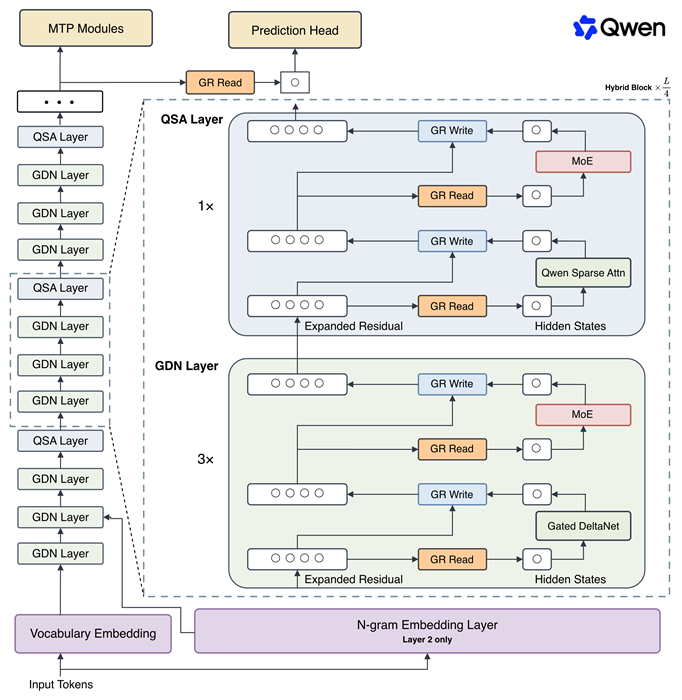
Official Qwen architecture diagram — Qwen3.8-Flash-Next
1. GDN + Qwen Sparse Attention (QSA)
The model mixes two mechanisms. Three out of every four layers use Gated DeltaNet (GDN) to compress historical information into a fixed-size state, while the remaining layer uses global attention for precise retrieval. The global-attention layer then uses Qwen Sparse Attention to reduce the amount of context that must be processed directly.
The practical goal is simple: GDN handles cheap memory, while QSA spends full attention only where retrieval matters. This is particularly valuable for long-context applications where ordinary full attention becomes expensive in both compute and KV-cache traffic.
2. Gated Residual with Four Information Paths
Gated Residual widens the residual stream into four parallel branches. A dynamic element-wise gate controls how much information is read from and written to each branch. This gives early information more ways to survive deep networks instead of being repeatedly mixed into one stream. Qwen also says the residual state can be stored in FP8 to reduce memory traffic.
3. N-gram Embeddings Add Capacity Without Proportional Compute
Qwen adds 51B N-gram embedding parameters that are addressed using local token context. Unlike normal transformer weights, these parameters are retrieved through lookup operations and can be offloaded to host memory with asynchronous prefetching. The design expands model capacity while keeping per-token arithmetic low.
4. Muon Optimizer and Training Co-design
Qwen trains the model with the Muon optimizer for core 2D linear-map weights while retaining AdamW for embeddings, routers, and selected low-rank parameters. The team also refit the scaling law for the new architecture and reports that batch-size warmup was unnecessary, avoiding 18.8% additional optimizer steps in its experiments.
5. Ultra-sparse MoE and Multi-Token Prediction
The model keeps a large expert pool but routes only a small number of experts per token. It also uses multi-token prediction, which helps speculative decoding by increasing acceptance rates while improving the backbone during training. Together, these choices reinforce the same design objective: more capacity and throughput without paying flagship-model compute on every token.
Qwen3.8-Flash Benchmark Performance
Coding Benchmarks
Alibaba publishes the benchmark suite under Qwen3.8-Flash-Next, the open-weight counterpart of the production Qwen3.8-Flash. The following tables use Qwen’s reported release scores and focus on peers that are also available through CometAPI.
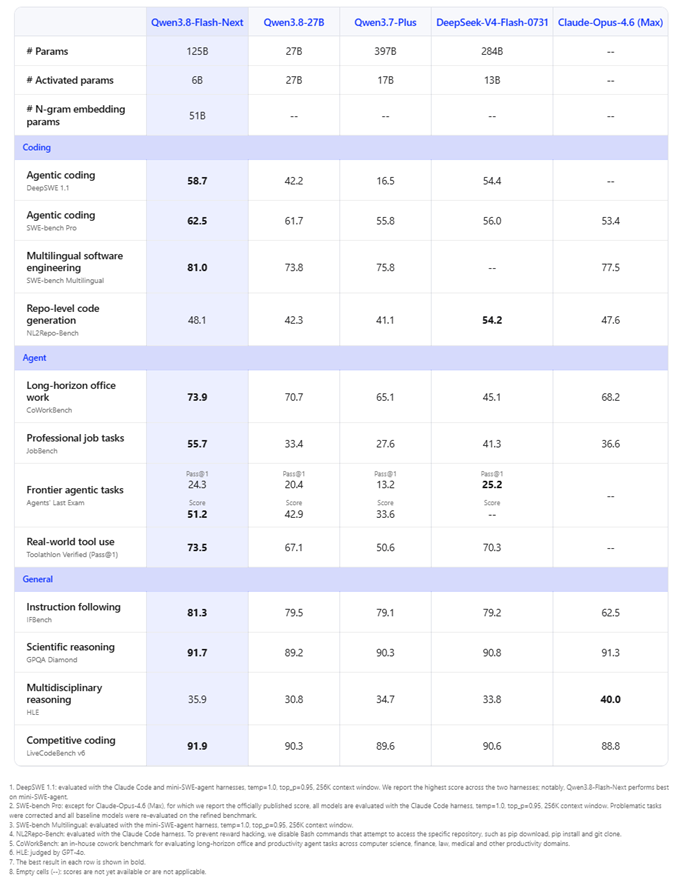
Official Qwen language benchmark chart
| Benchmark | Qwen3.8-Flash | DeepSeek V4 Flash | Claude Opus 4.6 |
|---|---|---|---|
| DeepSWE 1.1 | 58.7 | 54.4 | — |
| SWE-bench Pro | 62.5 | 56.0 | 53.4 |
| SWE-bench Multilingual | 81.0 | — | 77.5 |
| NL2Repo-Bench | 48.1 | 54.2 | 47.6 |
| CoWorkBench | 73.9 | 45.1 | 68.2 |
| JobBench | 55.7 | 41.3 | 36.6 |
| Toolathlon Verified | 73.5 | 70.3 | — |
| IFBench | 81.3 | 79.2 | 62.5 |
| GPQA Diamond | 91.7 | 90.8 | 91.3 |
| HLE | 35.9 | 33.8 | 40.0 |
| LiveCodeBench v6 | 91.9 | 90.6 | 88.8 |
Coding result: Qwen3.8-Flash leads the selected peers on SWE-bench Pro (62.5), SWE-bench Multilingual (81.0), and LiveCodeBench v6 (91.9). The major exception is NL2Repo-Bench, where DeepSeek V4 Flash scores 54.2 versus 48.1.
Agent result: Qwen3.8-Flash posts 73.9 on CoWorkBench and 55.7 on JobBench, materially above the selected peers in Qwen’s release table. It also edges DeepSeek V4 Flash on Toolathlon Verified, 73.5 to 70.3.
Reasoning result: The field is tighter. Qwen3.8-Flash scores 91.7 on GPQA Diamond, near Claude Opus 4.6 at 91.3 and DeepSeek V4 Flash at 90.8. On HLE, Claude Opus 4.6 leads with 40.0 versus Qwen’s 35.9.
Multimodal Benchmarks
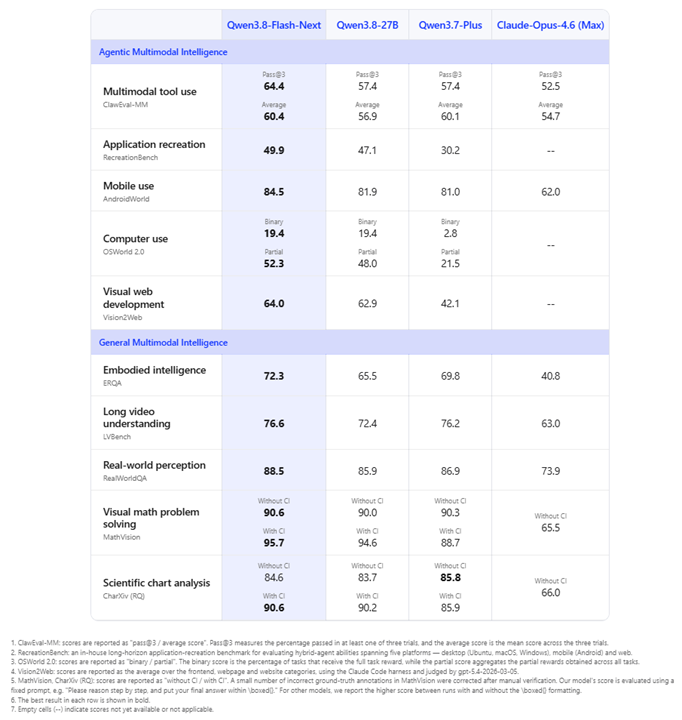
Official Qwen vision-language benchmark chart
| Benchmark | Qwen3.8-Flash | Claude Opus 4.6 |
|---|---|---|
| ClawEval-MM (Pass@3 / Avg) | 64.4 / 60.4 | 52.5 / 54.7 |
| AndroidWorld | 84.5 | 62.0 |
| ERQA | 72.3 | 40.8 |
| LVBench | 76.6 | 63.0 |
| RealWorldQA | 88.5 | 73.9 |
| MathVision (no CI / with CI) | 90.6 / 95.7 | 65.5 / — |
| CharXiv RQ (no CI / with CI) | 84.6 / 90.6 | 66.0 / — |
The multimodal release results are one of the strongest arguments for Qwen3.8-Flash. Qwen reports 84.5 on AndroidWorld, 88.5 on RealWorldQA, and 90.6 on MathVision without a code interpreter. These scores suggest that the model is intended for agents that must read screens, understand visual state, and continue acting rather than merely answer image questions.
Benchmark note: These are vendor-reported release results, not a neutral head-to-head lab test. Several benchmarks use different harnesses or tool configurations, and some are in-house. Treat the numbers as directional evidence, then validate the model on your own prompts, tools, latency target, and acceptance criteria.
Why Qwen3.8-Flash Is Fast and Cost-Efficient
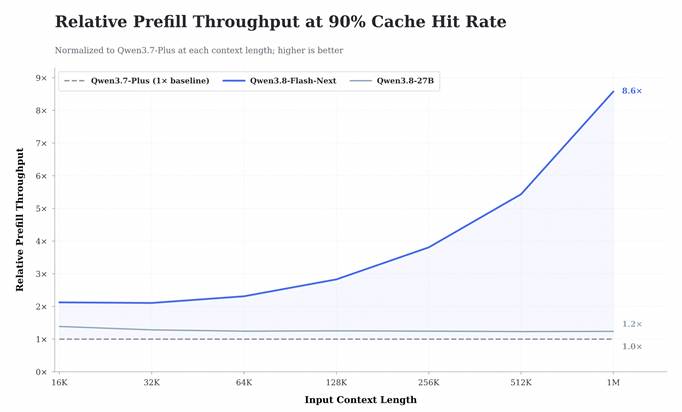
Official Qwen long-context efficiency chart
At a 1M-token context, Qwen reports up to 7.6x faster prefill and 4.9x faster decode for the QSA attention kernel. In a serving experiment with a 90% prefix-cache hit rate, Qwen3.8-Flash-Next reached 8.6x the prefill throughput of Qwen3.7-Plus.
The bigger system-level story is active compute. A 125B main model normally sounds large, but only 6B parameters are activated per token. That active footprint is less than half the 13B activated parameters reported for DeepSeek V4 Flash and far below the approximately 95B active parameters reported for Qwen3.8-Max. Parameter counts do not translate linearly to speed, but the design gives Qwen3.8-Flash a clear efficiency target.
Alibaba also reports that training required about one-ninth the resources of Qwen3.7-Plus while improving coding and office-task performance. Separately, the QwenWork Standard mode powered by the model is reported to cut token consumption per task by 75% and roughly double generation speed versus the prior mode. Those product-level numbers should not be treated as universal API latency guarantees, but they show how Alibaba expects the model to be used.
Qwen3.8-Flash Pricing
Alibaba’s launch announcement lists QwenCloud pricing at $0.16 per million input tokens and $0.47 per million output tokens. Pricing may vary by region, product surface, caching, or later updates, so production teams should always check the live provider page before estimating a large workload.
At the time this article was prepared, CometAPI lists Qwen3.8-Flash at $0.12 per million input tokens and approximately $0.376 per million output tokens. The CometAPI model page labels this as a 20% discount relative to its listed reference price.
| Route | Input / 1M tokens | Output / 1M tokens | Example: 10M input + 2M output |
|---|---|---|---|
| QwenCloud launch rate | $0.16 | $0.47 | $2.54 |
| CometAPI listed rate | $0.12 | ~$0.376 | ~$1.95 |
For a workload with 10 million input tokens and 2 million output tokens, the launch-rate arithmetic is about $2.54 on QwenCloud versus about $1.95 at the currently listed CometAPI rate. Real agent bills can be higher because tool calls, retries, long reasoning, repeated context, and external services add cost. Compare cost per accepted result rather than token price alone.
Qwen3.8-Flash vs. Qwen3.8-Max vs DeepSeek V4 Flash
| Dimension | Qwen3.8-Flash | Qwen3.8-Max | Gemini 3.7 Flash | DeepSeek V4 Flash |
|---|---|---|---|---|
| Positioning | Efficiency-first Qwen production model | Flagship Qwen model | Google workhorse Flash model | Efficiency-first text MoE |
| Total / active params | 125B + 51B lookup / 6B | 2.4T / ~95B | Not disclosed | 284B / 13B |
| Context | 1M hosted | 1M | 1,048,576 | 1M |
| Multimodal | Text + vision documented | Text + image + video | Text + image + video + audio + PDF | Text-focused |
| Reasoning controls | low / medium / xhigh | Advanced reasoning / fast modes | low / medium / high | Non-think / Think / Think Max |
| CometAPI input price | US$0.12/M | US$1.60/M | US$0.60/M | US$0.176/M |
| Official provider price (input / output) | US$0.15 / US$0.47 (Alibaba Cloud international) | US$2 / US$6 (Alibaba Cloud international) | US$0.75 / US$3.75 through Dec. 31, 2026 | Peak: US$0.44 / US$1.32; off-peak: US$0.22 / US$0.66 |
| Best fit | High-volume coding, agents, cowork | Hardest Qwen tasks, long-horizon autonomy | Google-tool ecosystem, broad multimodal agents | High-throughput text reasoning and coding |
Where Qwen3.8-Flash Wins
- Active-compute efficiency: 6B activated parameters is exceptionally small for a model that posts strong agentic coding and multimodal scores.
- Qwen ecosystem value: Qwen3.8-Flash is dramatically cheaper than Qwen3.8-Max for workloads that do not need the flagship tier.
- Agent + office balance: The release is unusually strong on CoWorkBench, JobBench, Toolathlon, SWE-bench Pro, and multimodal agent tasks rather than only academic QA.
- Open-weight path: Qwen3.8-Flash-Next provides weights for teams that need local deployment, independent evaluation, or fine-tuning.
Where Another Model May Be Better
- Use Qwen3.8-Max for peak Qwen capability. The Max tier has a much larger active compute budget and is designed for the hardest long-horizon work.
- Use Gemini 3.7 Flash when broad input modality support matters. Google’s Flash model explicitly covers audio, video, PDF, and deep Google tool integrations.
- Use DeepSeek V4 Flash when text-first efficiency is the priority. It wins NL2Repo-Bench in Qwen’s comparison and remains a strong cost-focused coding alternative.
- Use Claude Opus 4.6 when premium reasoning and enterprise workflow maturity justify the price. In Qwen’s release table it still leads HLE and remains extremely competitive on GPQA.
Best Use Cases for Qwen3.8-Flash
Coding Agents and Repository Work
Qwen3.8-Flash is a strong fit for issue resolution, refactoring, code review, repository navigation, test generation, debugging, and tool-driven coding loops. Its high LiveCodeBench and SWE-bench Pro results suggest that it is not merely a low-latency chat model; it is designed to do multi-step software work.
Long-Context Enterprise Knowledge Work
A 1M-token production context can hold large document collections, codebases, logs, meeting transcripts, or long-running agent history. The CoWorkBench and JobBench results make the model particularly interesting for document synthesis, spreadsheet/slide workflows, research support, compliance review, and operational analysis.
Multimodal Agents
The AndroidWorld, RealWorldQA, ERQA, and MathVision scores point toward agents that must understand screenshots, visual documents, interfaces, diagrams, and real-world images as part of a workflow. This makes the model relevant to browser agents, UI testing, visual QA, document agents, and screen-aware automation.
High-Volume Routing
Because Qwen3.8-Flash is much cheaper than flagship models, a practical architecture is to route most production traffic to Flash and escalate only ambiguous, high-risk, or exceptionally difficult requests to Qwen3.8-Max or another premium model. Unified gateways such as CometAPI make this routing pattern easier because the application can switch providers behind one API contract.
Limitations and Caveats
- The benchmarks are self-reported. Some use Qwen-selected harnesses, in-house tasks, or tool-enabled settings. Independent verification is still important.
- Not every benchmark is a win. DeepSeek V4 Flash leads NL2Repo-Bench in the official comparison, and Claude Opus 4.6 leads HLE.
- Computer use remains hard in absolute terms. The release reports an OSWorld 2.0 binary score of 19.4 even though partial-credit performance is much higher.
- Hosted and open-weight behavior can differ. System prompts, tools, context management, quantization, serving stack, and provider updates can move real-world results away from the published Flash-Next benchmark setup.
- Pricing is dynamic. The launch announcement and current aggregator pages can show slightly different reference prices. Use the live endpoint price when budgeting.
How to Use Qwen3.8-Flash API with CometAPI
CometAPI exposes Qwen3.8-Flash through an OpenAI-compatible endpoint, So existing OpenAI SDK integrations can typically switch by changing the API key, base URL, and model ID.
Why Use CometAPI for Qwen3.8-Flash?
CometAPI gives developers a unified API endpoint for testing Qwen3.8-Flash alongside other models without maintaining separate provider integrations. This is particularly useful for benchmark comparisons, fallback routing, and cost-based model selection.
- Create a CometAPI API key. Generate a key in the CometAPI dashboard and store it in an environment variable rather than source code.
- Use the unified base URL. Set the SDK base URL to
https://api.cometapi.com/v1. - Select the model. Use qwen3.8-flash as the model ID.
Python
from openai import OpenAI
import os

client = OpenAI(
    api_key=os.environ["COMETAPI_KEY"],
    base_url="https://api.cometapi.com/v1",
)

response = client.chat.completions.create(
    model="qwen3.8-flash",
    messages=[
        {"role": "system", "content": "You are a precise coding assistant."},
        {"role": "user", "content": "Review this API design and identify reliability risks."},
    ],
)

print(response.choices[0].message.content)
cURL
curl "https://api.cometapi.com/v1/chat/completions" \
  -H "Authorization: Bearer $COMETAPI_KEY" \
  -H "Content-Type: application/json" \
  -d '{
    "model": "qwen3.8-flash",
    "messages": [
      {"role": "user", "content": "Summarize the main risks in this migration plan."}
    ]
  }'
For production, add timeout handling, retry policy, token limits, structured output validation, and model-routing telemetry. If your workflow is agentic, track tool-call failures and accepted-task rate in addition to raw model latency.
FAQs
Is Qwen3.8-Flash open source?
The production Qwen3.8-Flash route is a hosted API. Its open-weight counterpart, Qwen3.8-Flash-Next, has weights released on Hugging Face and ModelScope. “Open-weight” is the more precise term because usage rights depend on the model license.
What is the Qwen3.8-Flash context window?
The open model supports 262,144 tokens natively and can be extended to 1,000,000 tokens with YaRN. Alibaba says the production Qwen3.8-Flash service uses a 1M-token context by default.
How many parameters does Qwen3.8-Flash have?
The release has a 125B-parameter main model, 51B N-gram embedding parameters, and 6B activated parameters per token. The low activated count is central to its efficiency design.
Does Qwen3.8-Flash support images?
Yes. The release is multimodal, the open-weight deployment stack supports text and vision, and official integration examples list text and image inputs for the hosted model. Provider-specific surfaces may expose different modality combinations, so check the current API capability page before deployment.
Is Qwen3.8-Flash better than Qwen3.8-Max?
Not universally. Qwen3.8-Flash is the better choice when latency, active compute, and price matter. Qwen3.8-Max is the flagship choice for the hardest long-horizon and high-value tasks. A routing system can use both.
How much does Qwen3.8-Flash cost?
Alibaba announced $0.16/M input and $0.47/M output tokens for QwenCloud at launch. CometAPI currently lists approximately $0.12/M input and $0.376/M output. Check live prices because provider and aggregator rates can change.
Conclusion
Qwen3.8-Flash is one of the clearest examples of the current shift from “bigger model” to “better system economics.” Its 125B main backbone looks large on paper, but the model activates only 6B parameters per token and adds capacity through lookup-style N-gram embeddings. QSA, Gated Residual, ultra-sparse MoE routing, and a long-context-oriented serving design all push in the same direction: deliver agentic coding and multimodal capability without flagship-level inference cost.
The release results are particularly compelling for software engineering, office agents, tool use, and visual workflows. At the same time, the model is not uniformly superior: DeepSeek V4 Flash wins at least one repo-generation benchmark in Qwen’s own table, Claude Opus 4.6 remains stronger on HLE, and Qwen3.8-Max is still the higher-capability Qwen tier.
For developers, the most practical next step is to evaluate Qwen3.8-Flash on real tasks and compare accepted-result cost against Gemini 3.7 Flash, DeepSeek V4 Flash, and the premium models in your routing stack. CometAPI provides one OpenAI-compatible interface for that kind of multi-model testing and deployment.