
TLDR Claude Opus 5 remains unreleased as of mid-July 2026, Rumors and leaks (e.g., "Honeycomb") point to Opus 5 arriving soon—potentially July-August 2026—with massive capability jumps in agentic coding, 1M+ context, and efficiency. Expected to bridge or exceed Fable 5 performance at Opus-like pricing.
For developers and businesses seeking immediate access to the latest Claude models (including Opus 4.8, Fable 5, and Sonnet 5) without managing multiple providers, CometAPI offers unified API access to 500+ models at competitive rates—ideal for seamless integration, cost optimization, and rapid prototyping.
Key Takeaways
- Current State: No official Claude Opus 5 yet; Fable 5 (Mythos-class) is Anthropic’s most capable generally available model, excelling in long-horizon agentic work, coding, and complex reasoning.
- Rumored Opus 5: Crypto Briefing reported an unconfirmed Claude Opus 5 launch rumor for the week of July 14, 2026 Crypto Briefing
- "Claude Honeycomb EAP" model had briefly appeared in Cursor and was interpreted by some community watchers as a potential Opus 5 signal.
- Expected Opus 5 Strengths: Enhanced reasoning, tool use, coding reliability, potentially lower inference costs, building on 1M context and adaptive effort controls.
- Comparisons:From anthropic's new, Sonnet 5 narrows the gap with Opus 4.8 at lower cost; Fable 5 leads in frontier tasks but with safety trade-offs.
- Pricing Expectations: Opus-tier models remain premium ($5–$15+/MTok input); CometAPI provides cost-effective alternatives with unified billing.
- Practical Advice: Use CometAPI today for production-ready access to the full Claude family while preparing for Opus 5.
What Is Claude Opus 5?
Claude Opus 5 would represent the next generational leap in Anthropic’s Opus-tier models, following the incremental 4.x series (Opus 4.8 being the latest as of May 28, 2026). The Opus line has historically delivered Anthropic’s most capable models for complex reasoning, long-context understanding, advanced coding, and agentic workflows.
For context on the evolution:
- Claude Opus 4 series focused on autonomous work (up to 7+ hours), advanced coding, and tool use.
- Recent point releases (4.6–4.8) emphasized honesty, reliability (e.g., 4x fewer overlooked code flaws in 4.8), dynamic workflows, and effort control.
Opus 5 rumors position it as a major upgrade, potentially aligning or surpassing Fable 5 in raw power while maintaining broader usability without heavy fallbacks. Leaks mention codenames like "Honeycomb" and sightings in tools like Cursor, with features such as 1M token context (standard), "xhigh" effort modes, and superior SWE (Software Engineering) benchmarks.
Rumored Performance and Specifications
Details are speculative but drawn from consistent leaks and community analysis as of July 2026:
- Context Window: Expected 1M tokens standard (matching recent Opus and Sonnet models), with potential expansions.
- Output Tokens: Up to 128K or more, supporting long-form generation and complex agent trajectories.
- Reasoning & Effort: Adaptive thinking on by default, with multi-level effort controls (including xhigh) for trading compute against quality. Builds on dynamic workflows and parallel sub-agents from Opus 4.8.
- Agentic & Coding Capabilities: Strong emphasis on reliability (e.g., 4x fewer unremarked code flaws vs. prior versions), computer use, browser agents, and multi-step planning. Leaks claim superior SWE-Pro performance vs. GPT-5.6.
- Multimodal: Continued vision input; potential improvements in high-resolution or sustained visual reasoning.
- Safety: Enhanced constitutional AI safeguards, with possible Mythos-like classifiers for sensitive domains (cyber, bio).
- Tokenizer: Likely an updated version (similar to Sonnet 5’s ~30% token increase for better performance).
Supporting data from prior models shows steady gains: Opus 4.8 achieved 84% on Online-Mind2Web for browser agents and strong Terminal-Bench results. Sonnet 5 closes much of the gap at lower cost. Opus 5 is anticipated to push these further.
When Will Claude Opus 5 Be Released?
No official date from Anthropic. Release patterns for Opus 4.x show intervals of 42–73 days between minors. From Opus 4.8 (May 28, 2026), a July–August 2026 window is frequently speculated.
- Leaks: Honeycomb in Cursor (July 9, 2026); Vertex AI signals around July 14.
- According to leaked information about X, Opus 5 is ready and will be released next week, at the end of July.
- Historical Context: Anthropic often spaces major generational jumps, with Sonnet 5 and Fable 5 landing in June 2026.
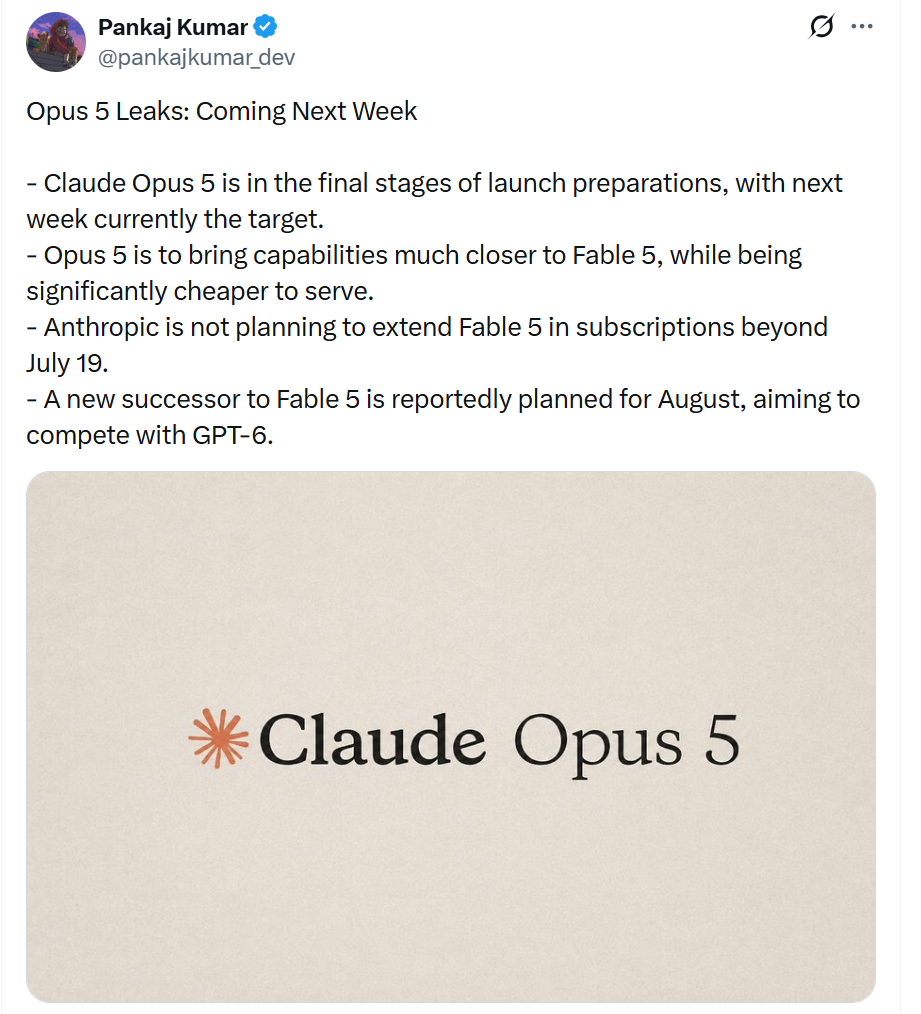
Source: Pankaj Kumar
Expected Price for Claude Opus 5
Current patterns:
- Opus 4.x: $5 input / $25 output.
- Fable 5: $10 / $50 (2x Opus).
- Sonnet 5: $3 / $15 (intro pricing lower).
Opus 5 is expected to launch around Opus pricing or slightly higher, emphasizing efficiency gains (e.g., better token usage or lower effective costs via improved reasoning). Prompt caching and batch discounts will likely apply. For cost optimization today, platforms like CometAPI often provide competitive rates and unified billing.
Claude Opus 5 vs Claude Fable 5 vs Opus 4.8
Comparison Table (Based on available data; Opus 5 estimated from rumors/leaks):
| Aspect | Opus 4.8 | Fable 5 (Mythos) | Opus 5 (Rumored) |
|---|---|---|---|
| Tier | Opus (Flagship) | Mythos (Above Opus) | Next Opus / Potential Bridge |
| Release | May 28, 2026 | June 9, 2026 | Expected July-Aug 2026 |
| Pricing (Input/Output per M tokens) | $5 / $25 (Fast: $10/$50) | $10 / $50 | Likely $5–8 / $25–40 (est.) |
| Intelligence | High (e.g., strong agentic) | Highest (e.g., 92.9 overall scores; leads indexes) | Expected to match/exceed Fable |
| Safety/Fallbacks | Standard safeguards | Auto-fallback to Opus 4.8 for cyber/bio | Enhanced, possibly lighter |
| Best For | Complex coding, enterprise agents | Frontier research, heavy multi-day tasks | Balanced frontier performance |
| Cost Efficiency | Excellent value | Premium (2x Opus) | Anticipated strong value |
| Benchmarks (Examples) | 84% Online-Mind2Web; High Terminal-Bench | Leads Artificial Analysis Index; Strong physics/coding | Leaks claim SWE-Pro wins |
Key Insights from Comparisons:
- Opus 4.8 remains the practical default for most workloads—high capability at better value than Fable 5. Many users report 90-95% of tasks handled without needing the premium tier.
- Fable 5 excels in extreme scenarios but incurs higher costs and safety routing (falls back to Opus 4.8 for flagged content).
- Sonnet 5 offers near-Opus performance on many agentic tasks at $3/$15 (intro $2/$10), making it ideal for scale.
- Opus 5 is rumored to deliver Fable-level power with fewer restrictions and better economics.
What We Know (and Don’t Know) About Claude Opus 5
What We Know:
- Anthropic’s rapid iteration (Opus 4.6–4.8 in early-mid 2026) shows commitment to continuous improvement in agentic AI, coding, and safety.
- Mythos-class (Fable 5) previews higher capabilities, with autonomous behaviors like factory-building in games.
- Focus areas: Reliability (4x better flaw detection), multi-agent systems, and economic accessibility.
What We Don’t Know:
- Exact benchmarks, architecture details, or release window.
- Full multi-modal scope or new features like advanced memory/recall.
- Regulatory impacts (e.g., export controls on powerful models).
- Precise pricing and availability tiers.
Speculation is informed by patterns, but official sources are key. Anthropic emphasizes transparency via system cards and reports.
CometAPI Recommendations: How Developers Should Prepare
CometAPI users can prepare for Claude Opus 5 without waiting passively for the final announcement. The goal is to make the integration layer flexible now, then swap or route models based on live evaluation later.
1. Build a Model-Routing Ladder
Do not route every request to the most expensive Claude model. A practical ladder might look like this:
| Workload | Recommended current model | Future Opus 5 role |
|---|---|---|
| Basic summaries, classification, light extraction | Claude Sonnet 5 or cheaper alternatives | Usually unnecessary |
| Interactive coding assistant tasks | Claude Sonnet 5 | Escalate only for hard failures |
| Complex enterprise research | Claude Opus 4.8 or Fable 5 | Test as premium final-pass model |
| Multi-file repository migrations | Fable 5 or Opus 4.8 | Strong candidate if benchmarks justify cost |
| Legal, finance, or compliance-heavy analysis | Opus 4.8 or Fable 5 with human review | Use for high-value review and synthesis |
| Long-running autonomous agents | Fable 5 today | Test for reliability, cost, and safety behavior |
2. Use CometAPI's Unified Endpoints
CometAPI supports both OpenAI-compatible and Claude-style integration patterns. The CometAPI quick start shows OpenAI-compatible usage through:
https://api.cometapi.com/v1
For Claude-family models, CometAPI model pages also expose Anthropic-style /v1/messages routes. This matters because teams can benchmark Claude Opus 4.8, Claude Fable 5, Claude Sonnet 5, and future Claude Opus 5 routes without rebuilding authentication, billing, observability, or app-level model selection. For integration and evaluation examples, see the CometAPI Cookbook on GitHub
3. Prepare Your Evaluation Suite Before Launch
The worst time to design an evaluation is launch day. Before Claude Opus 5 becomes callable, collect 50 to 200 representative tasks from your actual product:
- Real customer prompts.
- Long-context documents.
- Coding tasks with tests.
- Retrieval tasks with known citations.
- Agent workflows with tool traces.
- Failure cases where existing models struggle.
- Budget-sensitive tasks with known token usage.
When Opus 5 becomes available, compare it against Fable 5, Opus 4.8, and Sonnet 5 on success rate, latency, total tokens, output quality, refusal behavior, and cost per successful task. Do not judge only by a benchmark headline.
CometAPI Recommendations: Access the Best Claude Models Today
Claude Opus 5 is on our launch watchlist. While waiting for Opus 5, leverage CometAPI (cometapi.com) for one API key access to 500+ models, including all current Claude variants: Opus 4.8, Fable 5 / Mythos 5, Sonnet 5, and more.
Benefits:
- Unified OpenAI-compatible endpoints—switch models effortlessly.
- Competitive pricing, often lower effective costs.
- No need for multiple provider keys or billing setups.
- Enterprise-ready with high uptime and support for coding agents, vision, etc.
- Free credits on signup for testing.
How to Get Started:
- Visit CometAPI.com and sign up.
- Generate your API key.
- Integrate with familiar SDKs (e.g., Anthropic or OpenAI compatible) and start building with top Claude models immediately.
This approach future-proofs your stack for Opus 5 and beyond while optimizing costs and developer velocity.