
TL;DR: Which GPT-6 Astra API alternative should you choose?
Choose the model according to the workload: Claude Opus 5 for the closest premium substitute, Claude Fable 5.1 for the hardest sustained reasoning, GPT-5.6 Sol for the lowest-friction OpenAI migration, Claude Sonnet 5 for high-volume production, Gemini 3.8 Flash for low-cost multimodal work, and DeepSeek V4.1 Flash when token cost is the primary constraint.
Keep GPT-6 Astra for workloads where its stronger computer use, autonomous execution, scientific reasoning, or cybersecurity performance materially reduces retries and human intervention.
Key Takeaways: What matters when replacing GPT-6 Astra?
- GPT-6 Astra is difficult to replace on its strongest agentic tasks. The official GPT-6 Astra benchmark table records 57.9% on Terminal-Bench 4.0, 97.6% on FrontierMath Tier 4, and 96.0% on GPQA Diamond.
- Claude Opus 5 is the most balanced direct alternative to test first. Anthropic prices Opus 5 at $5/$25 per million input/output tokens, half Astra's base token rates.
- Claude Fable 5.1 is not a budget alternative. Its $10/$50 input/output pricing matches Astra's headline rate, while selected knowledge and long-horizon reasoning evaluations favor Fable 5.1.
- GPT-5.6 Sol is the easiest downgrade rather than a true platform switch. The 1.05M context window, 128K maximum output, and $4/$20 pricing reduce migration friction for OpenAI applications.
- Gemini 3.8 Flash offers a strong hosted price/performance case. Its 2026 introductory rate is $0.75/$3.75 per million input/output tokens.
- DeepSeek V4 Flash is in a different cost class. Its official peak and off-peak rates are far below premium-model pricing, but lower token cost does not establish equivalent agent success rates.
- The best production metric is usually cost per accepted completed task. Include retries, tool failures, latency, output-token usage, and human rework.
What is GPT-6 Astra API?
OpenAI positions GPT-6 Astra as its flagship model for complex end-to-end work. The API specification includes a 1,050,000-token context window and 128,000-token maximum output, text and image input, reasoning-token support, and five reasoning-effort settings: low, medium, high, xhigh, and max.
Astra differs from a conventional chatbot because it is designed for long-running execution. The official capability overview emphasizes computer use and professional work, alongside software engineering, browsing, science, cybersecurity, and complex reasoning.
| GPT-6 Astra specification | Value |
|---|---|
| API model ID | gpt-6-astra |
| Provider | OpenAI |
| Context window | 1,050,000 tokens |
| Maximum output | 128,000 tokens |
| Input | Text, images |
| Output | Text |
| Knowledge cutoff | April 30, 2026 |
| Reasoning effort | Low, medium, high, xhigh, max |
| Standard input price | $10 / 1M tokens |
| Cached input | $1 / 1M tokens |
| Standard output price | $50 / 1M tokens |
| Long-context threshold | More than 272K input tokens |
Long-context pricing note:
requests above 272K input tokens
are repriced for the entire request at $20/M input and $75/M output. Budget these requests separately.
Why teams look beyond GPT-6 Astra
Astra is most compelling when its additional capability eliminates failed attempts, tool errors, manual intervention, or repeated calls to weaker models. Its premium pricing is harder to justify for summarization, extraction, classification, routine RAG, ordinary chat, and standard code generation.
Teams therefore evaluate alternatives to reduce cost, stay within an existing provider ecosystem, improve cache economics, add multimodal support, or use a faster model for routine traffic while reserving Astra for escalation.
Benchmark comparison and limitations
Evidence note: the table uses OpenAI’s published comparison framework to place several alternatives under a common setup. These vendor-reported scores can change with model snapshots, prompts, tools, and evaluation methodology; use them to shortlist candidates, then validate the finalists on representative production tasks.
| Benchmark | GPT-6 Astra | GPT-5.6 Sol | Claude Fable 5.1 | Claude Opus 5 | Gemini 3.8 Flash |
|---|---|---|---|---|---|
| Terminal-Bench 4.0 | 57.9% | 37.3% | 55.8% | 52.6% | 19.1% |
| DeepSWE v1.1 | 74.1% | 72.7% | 67.4% | 73.7% | 73.8% |
| FrontierCode 1.1 Extended | 64.5% | 60.6% | 63.6% | 63.6% | 56.3% |
| GPQA Diamond | 96.0% | 94.6% | 93.7% | 93.7% | 95.3% |
| FrontierMath Tier 4 | 97.6% | 83.0% | 87.8% | 73.2% | — |
| Humanity’s Last Exam, with tools | 57.2% | — | 65.0% | 63.6% | — |
The results show why calling any model a universal “Astra replacement” is misleading. Astra has a clear lead on several agentic and scientific evaluations, while Fable 5.1 performs better on Humanity’s Last Exam and several alternatives remain extremely close on DeepSWE.
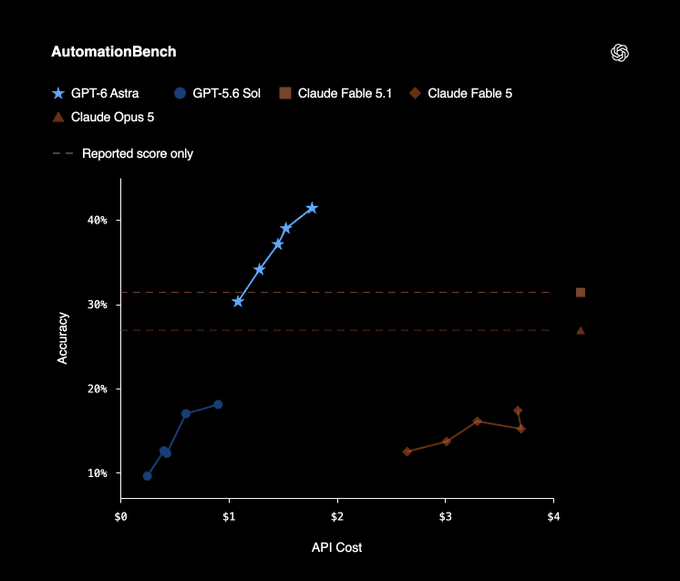
Official OpenAI AutomationBench benchmark graphic.
Public benchmark indexes can also change as methodology and model snapshots are revised. Use them to shortlist candidates, not as a substitute for workload-specific evaluation.
GPT-6 Astra alternatives
No single model replaces Astra across every workload. The most practical choice depends on the capability you need, the provider ecosystem you already use, and the cost of failed or repeated runs.
| Alternative | Official input / output price per 1M tokens | Context | Best reason to choose it |
|---|---|---|---|
| Claude Opus 5 | $5 / $25 | 1M | Closest overall premium substitute |
| Claude Fable 5.1 | $10 / $50 | 1M | Hardest reasoning and long-running agents |
| GPT-5.6 Sol | $4 / $20 | 1.05M | Lowest-friction OpenAI migration |
| Claude Sonnet 5 | $2 / $10 | 1M | High-volume production work |
| Gemini 3.8 Flash | $0.75 / $3.75 promotional | 1M | Low-cost multimodal and batch workloads |
| DeepSeek V4.1 Flash | $0.22–$0.44 / $0.66–$1.32 | 1M | Lowest token cost and high-volume processing |
Claude Opus 5
Why consider it
Claude Opus 5 is the first alternative to test when a product needs premium reasoning, coding, or professional-work performance at a lower list price than Astra.
Price, context, and cache
Anthropic lists Claude Opus 5 at $5/M input and $25/M output with a 1M-token context window. Confirm the current cache terms before production budgeting.
Where it performs well
It is competitive on coding, analysis, professional writing, and agent workflows; the cited benchmark table places it close to Astra on DeepSWE and FrontierCode.
Limitations
It does not consistently outperform Astra. Astra remains the stronger candidate when computer operation, advanced autonomous execution, cybersecurity, or OpenAI-native tools are central to the product.
Best for / Avoid when
Best for: premium coding agents, complex analysis, and professional writing. Avoid when: the workflow depends heavily on Astra-specific tools or computer-use capability.
Claude Fable 5.1
Why consider it
Claude Fable 5.1 is a competing flagship for the hardest reasoning, research, coding, and long-running agent tasks rather than a low-cost replacement.
Price, context, and cache
Its $10/M input and $50/M output rates match Astra’s headline pricing. The 1M-token context window and $0.25/M cache-read price can improve economics when large prompts are reused frequently.
Where it performs well
It is particularly attractive for sustained reasoning and cache-heavy agents; in the cited comparison, it leads Astra on Humanity’s Last Exam with tools.
Limitations
It does not reduce the headline token rate, and Astra retains advantages on several agentic and scientific benchmarks as well as OpenAI-native tooling.
Best for / Avoid when
Best for: maximum reasoning quality and repeated long-context workflows. Avoid when: the primary goal is a large reduction in standard token pricing.
GPT-5.6 Sol
Why consider it
GPT-5.6 Sol offers the lowest-friction migration for applications already built around OpenAI-compatible behavior and tooling.
Price, context, and cache
The cited model specification lists $4/M input and $20/M output, a 1.05M-token context window, and 128K maximum output. Verify current cached-input terms before final budgeting.
Where it performs well
It remains close to Astra on DeepSWE and GPQA Diamond while costing substantially less under the standard short-context tier.
Limitations
The gap widens on tasks represented by Terminal-Bench and FrontierMath, so savings may disappear if weaker task completion creates retries or manual repair.
Best for / Avoid when
Best for: existing OpenAI applications and general workloads that do not need Astra’s strongest agentic capabilities. Avoid when: the workload repeatedly benefits from Astra’s large benchmark gains.
Claude Sonnet 5
Why consider it
Claude Sonnet 5 is a practical production default for competent, repeatable knowledge work that does not require a frontier flagship on every request.
Price, context, and cache
Its cited permanent rate is $2/M input and $10/M output with a 1M-token context window. Confirm current cache terms for prompt-reuse-heavy deployments.
Where it performs well
It suits ticket classification, document extraction, standard RAG, content transformation, code explanation, routine function calling, and structured generation.
Limitations
It cannot reliably substitute for Astra on every long-horizon or frontier reasoning problem.
Best for / Avoid when
Best for: high-volume production traffic and routine business automation. Avoid when: failure on a difficult agentic task is more expensive than the flagship-model premium.
Gemini 3.8 Flash
Why consider it
Gemini 3.8 Flash combines multimodal input, large context, and low hosted-API cost for document, media, coding, and batch pipelines.
Price, context, and cache
The cited introductory rate is $0.75/M input and $3.75/M output through December 31, 2026, with a 1M-token context window and discounted caching during the promotional period.
Where it performs well
It is well suited to multimodal extraction, PDFs, audio, video, images, large document collections, batch analysis, and cost-sensitive coding workloads.
Limitations
Promotional pricing is time limited, and the hardest autonomous-agent or computer-use tasks still require workload-specific validation against Astra.
Best for / Avoid when
Best for: low-cost multimodal and high-volume batch processing. Avoid when: the application requires the strongest autonomous execution regardless of token cost.
DeepSeek V4.1 Flash
Why consider it
DeepSeek V4.1 Flash is the cost-first option for high-throughput reasoning, coding, summarization, extraction, classification, and offline processing.
Price, context, and cache
The cited peak and off-peak schedule lists cache-hit input at $0.007–$0.014/M, cache-miss input at $0.22–$0.44/M, and output at $0.66–$1.32/M, with a 1M-token context window. Recheck the current V4.1 pricing page before publication.
Where it performs well
It is attractive when token cost dominates and the application can use routing, validation, or offline quality checks to manage variability.
Limitations
A much lower token price does not establish equivalent autonomous task success. Reliability, tool behavior, latency, and acceptance rate must be measured on the target workload.
Best for / Avoid when
Best for: large-scale, cost-sensitive processing with validation. Avoid when: a failed high-value autonomous run would outweigh the token savings.
GPT-6 Astra vs alternatives: Which model wins in each category?
Putting pricing, architecture, context, and benchmark evidence together gives a more useful decision table than simply ranking models from first to sixth.
| Category | Best choice | Why |
|---|---|---|
| Overall Astra alternative | Claude Opus 5 | Strong near-frontier performance at half Astra’s list price |
| Maximum reasoning | Claude Fable 5.1 | Flagship reasoning and strong long-horizon performance |
| Stay inside OpenAI | GPT-5.6 Sol | Similar API ecosystem with 60% lower token prices |
| High-volume production | Claude Sonnet 5 | Strong quality at $2/$10 |
| Multimodal price/performance | Gemini 3.8 Flash | 1M context plus very low 2026 introductory pricing |
| Lowest API cost | DeepSeek V4.1 Flash | $0.22–$0.44 input and $0.66–$1.32 output |
| Computer-use-heavy agents | GPT-6 Astra | One of Astra’s clearest differentiators |
| Scientific and difficult mathematical workflows | GPT-6 Astra | Very strong FrontierMath and science-agent results |
| Cache-heavy long agents | Claude Fable 5.1 | $0.25/M cache reads |
The most important result is that GPT-6 Astra still wins some categories. An alternatives article should not imply that a cheaper model universally replaces it. Astra becomes expensive when deployed everywhere; it can still be economical when its higher task-completion rate replaces several weaker-model attempts.
How much can you actually save by replacing GPT-6 Astra API?
Consider a workload that consumes 1 million uncached input tokens and 200,000 output tokens. Ignoring cache discounts, tool fees, retries, batch pricing, and long-context surcharges:
| Model | Approximate API cost |
|---|---|
| GPT-6 Astra | $20.00 |
| Claude Fable 5.1 | $20.00 |
| Claude Opus 5 | $10.00 |
| GPT-5.6 Sol | $8.00 |
| Claude Sonnet 5 | $4.00 |
| Gemini 3.8 Flash promotional rate | $1.50 |
| DeepSeek V4.1 Flash off-peak | $0.35 |
The basic calculation is:
total_cost =
(input_tokens / 1,000,000 * input_rate)
+
(output_tokens / 1,000,000 * output_rate)
This simple example also demonstrates why token pricing cannot be the only metric. If a $20 Astra request succeeds once while a $4 model requires six attempts, multiple tool retries, and human repair, Astra was actually cheaper.
A better production metric is:
cost_per_accepted_task =
total_model_and_tool_cost
/
number_of_tasks_accepted_without_rework
Track that number alongside latency, task success, retry rate, tool-call errors, and escalation-to-human rate.
How can you test GPT-6 Astra alternatives through CometAPI?
A practical benefit of a multi-model API layer is that evaluation does not have to become a provider-integration project. CometAPI provides GPT-6 Astra API, GPT-5.6, Claude Fable 5.1, Claude Sonnet 5, Gemini 3.8 Flash, and DeepSeek V4.1 Flash through one model catalog.
With an OpenAI-compatible client, the model can be made configurable rather than hard-coded:
import os
from openai import OpenAI

client = OpenAI(
    api_key=os.environ["COMETAPI_KEY"],
    base_url="https://api.cometapi.com/v1",
)

model = "claude-fable-5-1"

response = client.chat.completions.create(
    model=model,
    messages=[
        {
            "role": "user",
            "content": "Review this migration plan and identify the three highest-risk assumptions.",
        }
    ],
)

print(response.choices[0].message.content)
You can rerun the same evaluation set using model IDs such as:
gpt-6-astra
gpt-5.6
claude-fable-5-1
claude-sonnet-5
gemini-3.8-flash
deepseek-v4-flash
This is generally more informative than choosing an alternative from a benchmark leaderboard alone. Take 100–500 representative production prompts and record task success, human acceptance, retries, tool errors, total tokens, latency, and total API cost.
Should you replace GPT-6 Astra with one model or use model routing?
For many applications, replacing Astra with one universal model is the wrong optimization. A more efficient architecture looks like this:
- Routine traffic → Claude Sonnet 5, Gemini 3.8 Flash, or DeepSeek V4.1 Flash
- Difficult reasoning → Claude Opus 5 or GPT-5.6 Sol
- Very difficult long-horizon tasks → Claude Fable 5.1 or GPT-6 Astra
- Computer-use or Astra-specific agent workflows → GPT-6 Astra
This turns Astra into an escalation model rather than the default model. If only 10% of requests genuinely require frontier-agent performance, routing 100% of traffic through Astra means paying its premium on the other 90% too.
Which GPT-6 Astra API alternative should you pick?
Choose Claude Opus 5 if you want the closest overall balance of quality and price.
Choose Claude Fable 5.1 if maximum reasoning matters more than reducing headline token rates.
Choose GPT-5.6 Sol if you already use OpenAI and want the smallest integration change.
Choose Claude Sonnet 5 if most of your production traffic is competent but ordinary knowledge work.
Choose Gemini 3.8 Flash if multimodality, scale, and low hosted-API cost matter.
Choose DeepSeek V4.1 Flash if token cost is the dominant constraint and your workload can tolerate more evaluation and validation.
And choose GPT-6 Astra itself when your application genuinely benefits from stronger computer use, difficult autonomous software work, scientific reasoning, or other agentic capabilities.
The main mistake is not choosing the “wrong” frontier model. It is paying frontier-model prices for requests that never needed a frontier model in the first place.
FAQ
What is the best overall alternative to GPT-6 Astra API?
Claude Opus 5 is one of the strongest general-purpose substitutes. It offers a 1M context window, strong coding and agent capabilities, and $5/$25 list pricing—half Astra’s standard token rates.
What is the cheapest GPT-6 Astra alternative?
Among the models covered here, DeepSeek V4.1 Flash has the lowest first-party token pricing. Its current off-peak rate is $0.22/M uncached input and $0.66/M output. It should not, however, be assumed to match Astra’s autonomous task success simply because it is cheaper.
Is Claude Fable 5.1 better than GPT-6 Astra?
Neither model wins every workload. OpenAI’s comparison gives Astra significant advantages on FrontierMath Tier 4 and Terminal-Bench 4.0, while Fable 5.1 scores higher on Humanity’s Last Exam with tools.
Is GPT-5.6 Sol still worth using after GPT-6 Astra?
Yes. Its $4/$20 standard API pricing is substantially below Astra’s $10/$50 while it retains a 1.05M context window. It can therefore be a better default for workloads where Astra’s gains do not materially improve task completion.
Is Gemini 3.8 Flash good enough to replace GPT-6 Astra?
For some coding, multimodal, document, and batch-processing workloads, yes. It is dramatically cheaper and has a 1M context window. For the hardest autonomous agent and computer-use tasks, Astra remains the stronger choice.
Does GPT-6 Astra have a pricing disadvantage for very long prompts?
Yes. OpenAI applies a higher pricing tier when input exceeds 272K tokens, so long-context requests should be budgeted separately.
Should I compare models using token price or benchmark scores?
Use both only as screening metrics. The production metric that matters most is usually cost per accepted completed task, including reasoning tokens, retries, tool calls, latency, and human rework.
Can I use several GPT-6 Astra alternatives in the same application?
Yes. In many applications, model routing is preferable to committing every request to one model. A low-cost model can handle routine requests while stronger models handle increasingly difficult escalations.