TL;DR: Claude Mythos 5.2 is Anthropic's advanced AI model for demanding technical work, with documented improvements in cybersecurity engineering and scientific research. It can help identify, reproduce, and fix software vulnerabilities, and support complex computational research.
Access is restricted to organizations approved through Anthropic's cybersecurity and life sciences verification programs. Developers outside those programs can choose publicly available alternatives for coding, reasoning, and technical analysis.
Key Takeaways
Access requires approval. Mythos 5.2 is available through Anthropic's Cyber Verification Program and Life Sciences Verification Program.
Cybersecurity performance improves over Mythos 5.1. It scores 89.6% on CVE Rediscovery and 76.3% on CyScenarioBench.
Scientific applications extend beyond security. Anthropic has demonstrated its use in complex protein structure prediction.
Reviewed for clarity, source attribution and current API terminology.
Claude Mythos 5.2 standard API pricing is $8 per million input tokens and $40 per million output tokens. Optional Fast Mode costs $16 and $80, respectively.
Public alternatives cover many everyday needs. Developers can use available models for software engineering, analysis, and research without waiting for Mythos access.
What Is Claude Mythos 5.2?
Claude Mythos 5.2 is an Anthropic model designed for ambitious technical projects, including cybersecurity engineering and biomedical research.
Compared with Mythos 5.1, it offers stronger capabilities, clearer communication, and up to 30% faster output generation. Its documented strengths include discovering software vulnerabilities, reproducing issues, developing fixes, and carrying out computational scientific work.
Why Isn't Claude Mythos 5.2 Publicly Available?
Mythos 5.2 provides capabilities in cybersecurity and biology that have both beneficial and harmful applications. Anthropic uses a verification process to make those capabilities available to approved organizations.
The main access routes are:
Cyber Verification Program: For organizations seeking approval to use Mythos 5.2 for cybersecurity work.
Life Sciences Verification Program: For organizations conducting qualifying life sciences research.
Claude Security: For Claude Enterprise customers using code security workflows powered by Anthropic's models, including Mythos 5.2.
Claude Enterprise customers also have a product-based route. Anthropic says Claude Security uses its model family, including Mythos 5.2, to scan codebases. Access through Claude Security provides the product's security workflow rather than a general-purpose Mythos API entitlement.
Claude Mythos 5.2 Performance and Pricing
Anthropic's published evaluations show gains over Mythos 5.1 in cybersecurity and scientific research. The results below cover benchmark performance, output speed, and official API pricing.
Cybersecurity Benchmarks
Mythos 5.2 outperforms Mythos 5.1 on two cybersecurity evaluations reported in Anthropic's announcement:
Benchmark
Mythos 5.2
Mythos 5.1
Improvement
CVE Rediscovery
89.60%
78.30%
CVE Rediscovery measures whether a model can independently identify published vulnerabilities from project snapshots taken before those vulnerabilities were fixed. Anthropic's October 2026 evaluation covered 1,829 CVEs, with Mythos 5.2 outperforming Mythos 5.1 and Opus 5.5 at every effort level tested.
CyScenarioBench evaluates performance on cybersecurity scenarios. Its results provide an additional measure of improvement over the previous Mythos generation.
Scientific Research Performance
Mythos 5.2 scored 75.3% on Terminal-Bench-Science 0.1, a benchmark of 70 scientific research tasks. The evaluation combines reasoning with computational execution, requiring agents to work from natural-language instructions and produce results assessed against task-specific tests.
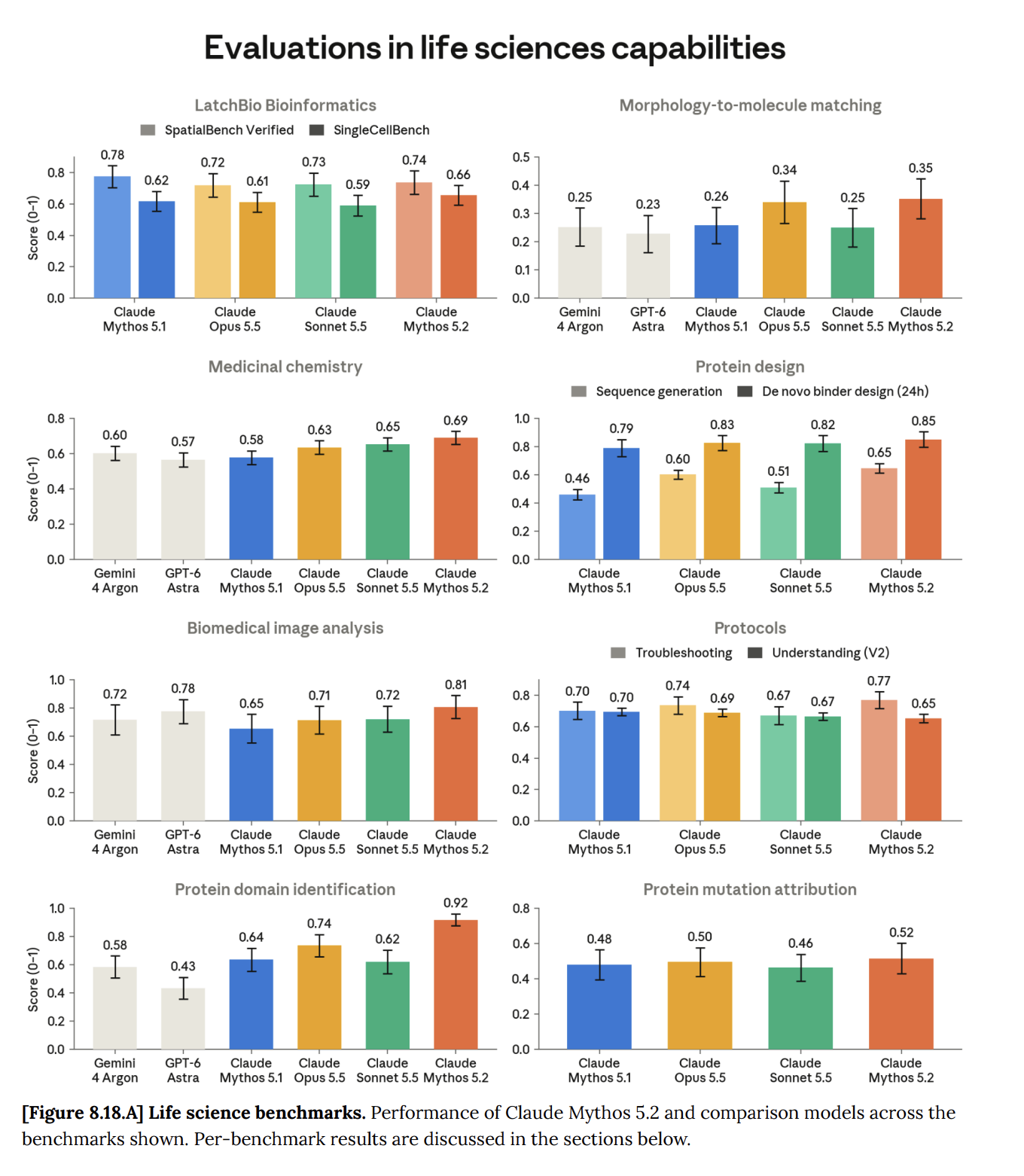
Its life sciences evaluations provide a more detailed picture of its research capabilities:
These evaluations cover single-cell RNA sequencing analysis, reasoning about drug-like molecules, identifying problems in laboratory protocols, and recognizing protein domains from amino acid sequences. Anthropic evaluated Mythos 5.2 with biology safeguards disabled for these capability tests.
Output Speed and API Pricing
Anthropic reports that Mythos 5.2 generates outputs up to 30% faster than Mythos 5.1. Its optional Fast Mode speeds up token generation by up to 2.5 times.
Official Mythos 5.2 API pricing is:
Mode
Input price per million tokens
Output price per million tokens
Standard
$8
$40
Fast Mode
$16
$80
Standard mode suits workloads where controlling cost takes priority. Fast Mode is worth considering when faster generation meaningfully reduces waiting time. Complete task duration also depends on tool execution, tests, and external computations.
What Can Claude Mythos 5.2 Actually Do?
Anthropic's reported applications show how Mythos 5.2 supports security investigations and computational scientific research.
Find, Validate, and Help Fix Security Vulnerabilities
In prerelease testing, one security company found that one in six confirmed bugs identified by Mythos 5.2 had been missed by all the other frontier models it tested. This supports using it as an additional reviewer for difficult codebases and unresolved security concerns.
Once a potential vulnerability is identified, Mythos 5.2 can help reproduce the issue, explain its cause, and develop a fix for engineers to review and test. Prerelease testers also reported clearer output, making findings easier to inspect.
For ongoing repository review, Mythos 5.2 is included among the models powering Claude Security. Anthropic says the product can monitor code changes, track findings through remediation, and incorporate additional project context. Enterprise teams can use that workflow to follow security issues from discovery through resolution.
Assist With Computational Scientific Research
Anthropic documents Mythos 5.2's work on predicting the structure of viral protein shells, known as capsids—a computational problem relevant to gene therapy research.
The model developed an approach that combined existing protein-folding tools with known structural symmetries. It wrote code to process overlapping groups of protein chains and combine the results into complete structures.
In Anthropic's tests, the method accurately modeled 28 of the 34 structures attempted. The example demonstrates Mythos 5.2's ability to develop and implement a computational method for a specific scientific problem.
What Are the Best Claude Mythos 5.2 Alternatives?
For developers without Mythos access, the best alternative depends on the complexity of the work. Claude's publicly available models cover demanding technical projects, daily coding, and lightweight automation.
Model
Recommended starting use
Claude Fable 5.2
Difficult engineering projects and extended technical reasoning
Claude Opus 5.5
Claude Fable 5.2: The Closest Public Alternative
Claude Fable 5.2 is the most direct public alternative for demanding technical work. Anthropic states that it shares the same underlying model as Mythos 5.2, with stronger cybersecurity and biology safeguards.
It suits complex software migrations, repository-wide refactoring, difficult debugging, mathematical reasoning, and long-running agent workflows. Its safeguards restrict many cybersecurity and biology requests, so it cannot replace Mythos for every specialized task.
Claude Opus 5.5: For Daily Coding and Knowledge Work
Anthropic recommends Claude Opus 5.5 as the starting point for most coding and knowledge tasks. It is a practical choice for everyday development, document analysis, and research synthesis. Consider moving to Fable 5.2 when a project requires more extensive technical reasoning or sustained execution.
Claude Sonnet 5.5 and Haiku 5.5: For Lighter Tasks
Claude Sonnet 5.5 is worth evaluating for routine coding and assistant workflows where response speed matters. Claude Haiku 5.5 suits simpler, repeatable operations such as classification, information extraction, and supporting subtasks within a larger workflow.
Explore Available Alternatives Through CometAPI
CometAPI provides access to multiple AI models, including Claude Fable 5.2. Visit the model page to review current availability, pricing, and API details, then evaluate it on your project's coding, reasoning, or technical analysis tasks.
Conclusion
Mythos 5.2 is relevant to approved organizations working on advanced cybersecurity and life sciences applications. Its documented improvements make it particularly useful for vulnerability research, remediation, and computational scientific work.
For developers outside those programs, select an available model around the project's requirements. Explore the alternatives on CometAPI and compare them on the work you need to finish.
11.3 percentage points
CyScenarioBench
76.30%
61.70%
14.6 percentage points
Evaluation
Mythos 5.2
Mythos 5.1
Opus 5.5
SingleCellBench
65.60%
61.80%
61.20%
Medicinal chemistry
69.00%
57.70%
63.50%
Laboratory protocol troubleshooting
77.10%
70.20%
73.70%
Protein domain identification
91.80%
63.50%
73.60%
Daily coding and knowledge work
Claude Sonnet 5.5
Routine assistant and development workflows
Claude Haiku 5.5
Simple, repeatable operations and lightweight subtasks
Claude Mythos 5.2 Released: Capabilities, Access, and the Best Alternatives - CometAPI