

TL;DR
Claude Opus 5.5 is a strong starting candidate because it offers substantially lower token pricing while matching or exceeding Fable 5.1 on several published evaluations while charging $4 per million input tokens and $20 per million output tokens, compared with Fable 5.1 at $10 and $50.
Fable 5.1 still has a role when a task is unusually difficult, long-running, expensive to retry, or expected to operate without close supervision. The practical rule is simple: start with Opus 5.5, then escalate only when representative production tests show that Fable 5.1 reduces failure, correction, or retry costs enough to justify its premium.
Claude Opus 5.5 vs Claude Fable 5.1 at a Glance
| Dimension | Claude Opus 5.5 | Claude Fable 5.1 |
|---|---|---|
| Release date | Sep. 22, 2026 | Sep. 1, 2026 |
| API model ID | claude-opus-5-5 | claude-fable-5-1 |
| Context / max output | 1M / 128K | 1M / 128K |
| Input / output per MTok | $4 / $20 | $10 / $50 |
| Cache read per MTok | $0.20 | $0.25 |
| Terminal-Bench 4.0 | 66.4% | 55.8% |
| FrontierCode v1.1 | 54.4% | 50.3% |
| CursorBench 4.0 | 57.8% | 51.8% |
| GDPval-AA v2.1 | 1846 Elo | 1735 Elo |
| HAProxy C-to-Rust migration | 9.5 hours; 51% lower task cost | 12 hours; baseline task cost |
| Speed option | Fast mode, up to 2.5× normal speed | No equivalent launch mode |
| Effort starting point | Medium-oriented | High |
| Best default use | Daily frontier coding, agents, supervised production, and high-volume API traffic | Highest-value, difficult, long-running, or unattended autonomous work |
| API access | Anthropic API and compatible providers including CometAPI | Anthropic API and compatible providers including CometAPI |
Reading note: Benchmark figures are Anthropic-reported and depend on effort level, harness, safeguards, task release, trial count, and standard error. They should be compared only under matched evaluation conditions.
Key Takeaways
- Opus 5.5 standard input and output rates are 60% below Fable 5.1 rates.
- Both models support a 1M-token context window and up to 128K output, so cost, effort settings, and workload fit matter more than nominal context size.
- Anthropic's published results favor Opus 5.5 across many coding and agentic evaluations, but benchmark settings materially affect the result.
- Independent evaluation supports Opus 5.5's frontier position while reporting different absolute scores, reinforcing the need for matched testing.
- For most supervised production work, Opus 5.5 is the stronger starting point. Fable 5.1 is an escalation tier, not the automatic default.
What Is Claude Opus 5.5?
Claude Opus 5.5 is Anthropic's first Claude 5.5 model. It is positioned for agentic coding, long-running agents, professional knowledge work, enterprise workflows, financial analysis, vision, and computer use.
Its API model ID is claude-opus-5-5. Adaptive thinking is always enabled, while developers control reasoning intensity through low, medium, high, xhigh, and max effort settings. Anthropic also offers Fast mode, which can run at up to 2.5 times normal speed for $8/M input and $40/M output.
What Is Claude Fable 5.1?
Claude Fable 5.1 is positioned for demanding, long-running projects such as multi-hour coding, complex research, browser interaction, autonomous agents, and workflows spanning multiple applications.
Its API model ID is claude-fable-5-1. It uses adaptive thinking, starts from a higher API effort setting, and is best treated as the premium option when the expected cost of failure or repeated retries exceeds the additional inference cost.
A simplified reading would be that Opus 5.5 offers almost the same envelope for 40% of Fable's standard token price. But this is precisely where a simple specification table becomes misleading.
Code and Benchmark Comparison
Anthropic reports Opus 5.5 ahead of Fable 5.1 on Terminal-Bench 4.0, FrontierCode v1.1, CursorBench 4.0, GDPval-AA v2.1, AutomationBench, Humanity's Last Exam with tools, Terminal-Bench-Science, OSWorld 2.0, and Chartography.
How to Read the Benchmark Results
Anthropic reports Opus 5.5 ahead of Fable 5.1 on Terminal-Bench 4.0, FrontierCode v1.1, CursorBench 4.0, GDPval-AA v2.1, AutomationBench, Humanity's Last Exam with tools, Terminal-Bench-Science, OSWorld 2.0, and Chartography. These figures are evaluation results, not configuration-independent model constants.
Most headline Opus 5.5 scores used max effort, while Terminal-Bench 4.0 used xhigh effort. Harness design, tool configuration, safeguards, trial count, standard error, fallback behavior, and cost ceilings can all change the result. Anthropic itself cautions that benchmark margins may overstate the practical gap between frontier models.
Coding Performance
| Benchmark | Claude Opus 5.5 | Claude Fable 5.1 | Interpretation |
|---|---|---|---|
| Terminal-Bench 4.0 | 66.4% | 55.8% | 10.6-point reported lead for terminal-based agent tasks |
| FrontierCode v1.1 | 54.4% max; 54.6% medium | 50.3% | Medium-effort Opus 5.5 remains competitive for production economics |
| CursorBench 4.0 | 57.8% max; 52.5% medium | 51.8% | Medium effort slightly exceeds the reported Fable result |
| GDPval-AA v2.1 | 1846 Elo | 1735 Elo | Reported advantage on professional agentic work |
These figures are Anthropic-reported benchmark results. The table should be read together with the evaluation-setting caveats in the following sections and the official Claude Opus model page.
The first three results stand out because they cover the workload where Claude is increasingly important commercially: software-engineering agents. Terminal-Bench 4.0 shows an absolute difference of 10.6 percentage points; FrontierCode shows 4.1 points; CursorBench 4.0 shows 6 points.
GDPval-AA, which measures professional agentic work, also reports 1846 Elo for Opus 5.5 versus 1735 for Fable 5.1. If these figures were the entire story, the product hierarchy would appear inverted. It is not that simple.
Independent Evaluation
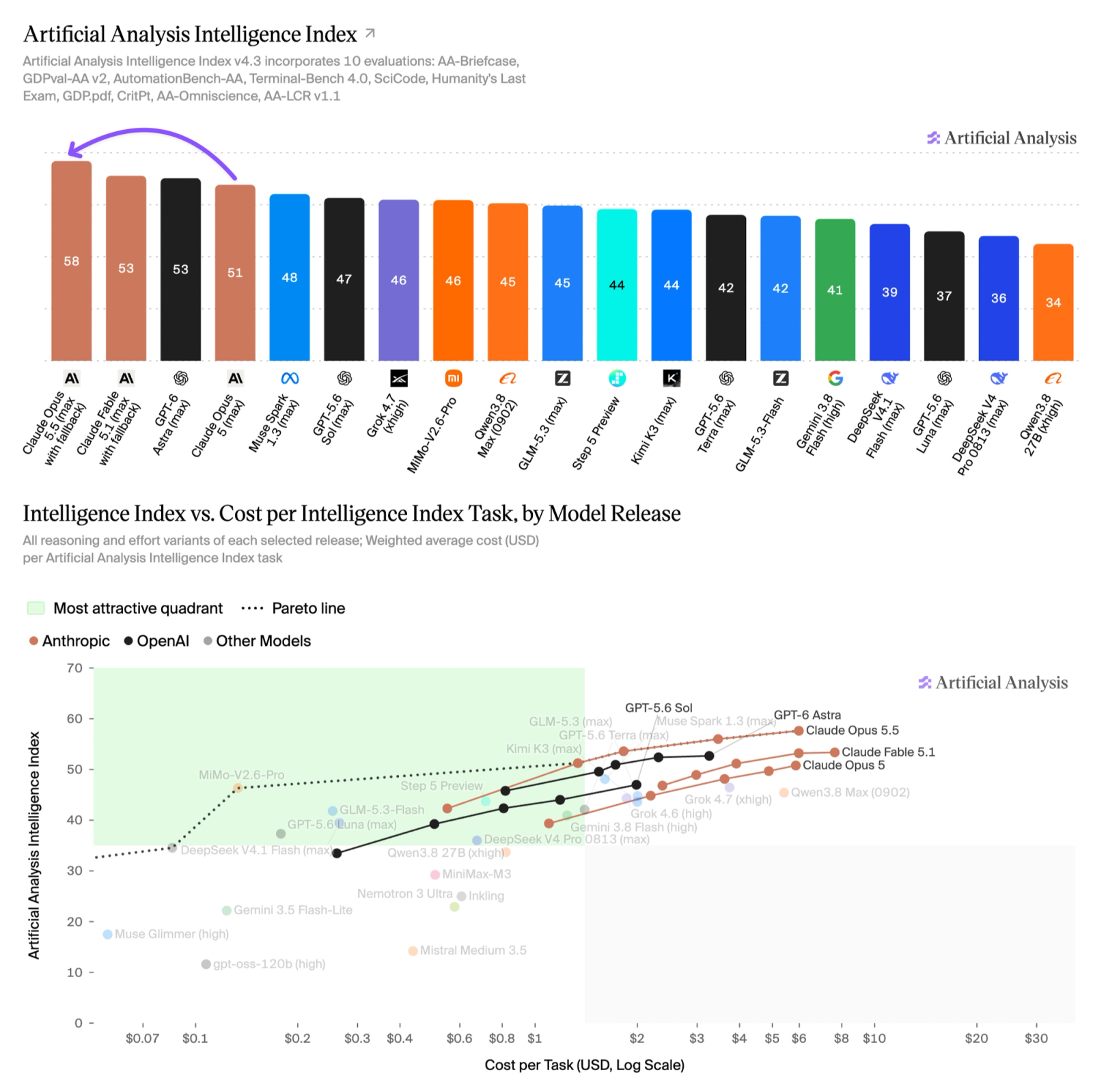
Artificial Analysis placed Opus 5.5 Max at 58 on its Intelligence Index and reported strong results across AA-Briefcase, GDPval-AA, AutomationBench-AA, Terminal-Bench 4.0, SciCode, and Humanity's Last Exam. Its Terminal-Bench 4.0 result was 59.6%, below Anthropic's 66.4%, demonstrating why teams should document the model version, effort setting, harness, tools, trial count, and cost limit whenever scores disagree.
Price and Complete-Task Cost Comparison
CometAPI offers token prices lower than the official rates, allowing developers to achieve the same performance as the official API using the standard message request format.
Token Pricing
| Pricing | Claude Opus 5.5 | Claude Fable 5.1 |
|---|---|---|
| Input | $4 | $10 |
| Output | $20 | $50 |
| 5-min cache write | $5 | $12.50 |
| 1-hour cache write | $8 | $20 |
| Cache read | $0.20 | $0.25 |
| Batch input/output | 50% discount | 50% discount |
Suppose a workload consumes 10 million fresh input tokens and 2 million output tokens. With no cache effects:
10 × $4 + 2 × $20 = $80
10 × $10 + 2 × $50 = $200
Under those assumptions, Opus 5.5 costs 60% less. However, this number should not be confused with Anthropic's statement that Opus 5.5 costs around 40% less to run than Opus 5.
Those are two completely different comparisons. The 40% figure includes Opus 5.5's lower Opus-tier prices and reduced token consumption per task relative to Opus 5. The 60% figure comes directly from comparing the standard Opus 5.5 and Fable 5.1 list prices.
Cost per Completed Task
A model API does not really sell tokens. Developers buy completed work.
A coding team does not care that a model consumed 6.2 million tokens. It cares whether the model fixed the bug, completed the migration, passed the test suite, or finished the research task.
Anthropic makes this point directly in its What a task costs on Opus 5.5 analysis: two models with similar prices can have very different task costs if one needs more turns, rereads more context, retries more often, or generates more thinking tokens.
Task Cost = Fresh Input Cost
          + Cache Read Cost
          + Cache Write Cost
          + Output / Thinking Cost
          + Retry Cost
That last item is often overlooked. A cheaper model that fails twice can become more expensive than a pricier model that completes the task in one run. Likewise, a high-effort setting that avoids ten retry turns may actually lower total cost.
Prompt-Caching Economics
Cache-heavy agents repeatedly reuse tool definitions, repository context, system instructions, conversation history, and test output. Because cache-read pricing is $0.20/M for Opus 5.5 and $0.25/M for Fable 5.1, the gap is much smaller than the $6/M difference in fresh-input pricing. Teams should therefore track fresh input, cache reads, cache writes, output, tool turns, and retries separately.
Effort-Level Economics
Potentially, yes. Artificial Analysis tested five Opus 5.5 effort settings and found a clear capability-cost curve.
| Opus 5.5 effort | Artificial Analysis Intelligence Index | Cost per Index task |
|---|---|---|
| Low | 42 | $0.55 |
| Medium | 51 | $1.34 |
| High | 54 | $1.82 |
| Xhigh | 56 | $3.46 |
| Max | 58 | $5.98 |
Medium effort is a sensible starting point for routine code changes, known refactors, and supervised debugging. High or xhigh may be justified for ambiguous system failures, overnight migrations, or tasks in which a wrong plan creates substantial rework.
Safety and Reliability Comparison
Neither model should be labelled safer solely from capability benchmarks. A defensible comparison requires matched prompts, tools, permissions, effort settings, retry limits, and acceptance criteria. Higher capability can reduce accidental errors, but greater autonomy and longer execution also increase the impact of a bad plan, prompt injection, unsafe tool call, or unnoticed drift.
| Safety dimension | Practical comparison | Production control |
|---|---|---|
| Reasoning and effort | Opus 5.5 exposes multiple effort levels, while Fable 5.1 starts from a higher-effort posture. More reasoning is not a substitute for policy enforcement. | Pin the effort policy by workload and retest safety behavior whenever it changes. |
| Long-running autonomy | Fable 5.1 is positioned for difficult, unattended work; Opus 5.5 also supports agentic workflows. Risk grows with duration, permissions, and the number of irreversible actions. | Use checkpoints, approval gates, time and cost ceilings, and automatic rollback or shutdown conditions. |
| Tool and computer use | Both models can operate tools, so model choice alone does not control data exposure or destructive actions. | Apply least privilege, allowlists, sandboxing, secret isolation, and confirmation before external or irreversible actions. |
| Evaluation and auditability | Public benchmark scores do not establish refusal quality, prompt-injection resistance, or production incident rates. | Log tool calls and policy decisions; measure unsafe-compliance rate, false refusals, injection success, secret leakage, destructive attempts, and recovery quality. |
Practical safety rule: start with the least-privileged Opus 5.5 configuration that meets the task, and escalate to Fable 5.1 only after the same safety suite passes. For high-impact workflows, require human approval regardless of which model scores higher on capability tests.
- Run adversarial prompt-injection and data-exfiltration tests with the real production toolset.
- Separate read, write, publish, delete, and financial permissions instead of granting one broad tool role.
- Define rollback triggers for policy violations, repeated tool failures, unexpected scope expansion, and cost overruns.
- Revalidate after model, system-prompt, effort, tool, permission, or routing changes.
How to Choose Between Opus 5.5 and Fable 5.1
| Workload | Recommended starting point | Escalation condition |
|---|---|---|
| Daily coding and code review | Opus 5.5, medium effort | Escalate only for unusually difficult or high-risk cases |
| Multi-file feature work | Opus 5.5, medium or high | Use Fable when repeated planning failures dominate cost |
| Repository-wide migration | Test Opus 5.5 high or xhigh first | Escalate for the hardest unattended projects |
| Overnight autonomous runs | Opus 5.5 with strict checkpoints | Prefer Fable when the cost of an incorrect direction is extreme |
| High-volume API traffic | Opus 5.5 | Escalate only the failure-prone minority of tasks |
| Existing validated Fable deployment | Keep the current deployment during testing | Switch only after Opus meets the same acceptance thresholds |
A Practical Production Test
Run the same representative tasks, prompts, tools, effort policy, acceptance criteria, and retry limits through both models. Record accepted-task rate, latency, fresh and cached input, output and thinking tokens, tool calls, retries, human corrections, and total cost per accepted result. Include routine tasks and difficult failure cases.
Migration Guidance for Existing Claude Opus 5 Users
Existing Opus 5 users should test Opus 5.5 as a successor rather than assuming a model-ID swap is risk free. Compare planning depth, tool-call patterns, response length, format compliance, latency, prompt-cache behavior, recovery from failed tool calls, safety routing, and complete-task cost. Keep rollback criteria and the existing model available until Opus 5.5 passes production-like acceptance tests.
Existing Fable 5.1 users do not need a generic migration section. They should instead treat Opus 5.5 as a candidate optimization and evaluate it under the same production acceptance criteria before changing a validated deployment.
Access Through CometAPI
Developers evaluating either model can review the related CometAPI guides for Claude Opus 5.5 and Claude Fable 5.1. When integrating through any compatible API provider, confirm the exact model ID, supported effort parameters, caching behavior, rate limits, regional availability, and current price before production deployment.
Use claude-opus-5-5 for Opus 5.5 and claude-fable-5-1 for Fable 5.1 where those identifiers are supported. Avoid silently routing both workload classes through one fixed effort level; model selection and effort policy should be configured independently.
Python — Anthropic Messages API through CometAPI
import os
import anthropic

client = anthropic.Anthropic(
    api_key=os.environ["COMETAPI_KEY"],
    base_url="https://api.cometapi.com",)

message = client.messages.create(
    model="claude-opus-5-5",
    max_tokens=2048,
    messages=[{"role": "user","content": ("Analyze this codebase and propose a safe migration plan."),}],)print(message.content[0].text)
Conclusion
Claude Opus 5.5 changes the practical boundary between Anthropic's daily frontier model and its premium escalation tier. It is substantially cheaper at standard token rates, leads many published coding and agentic benchmarks, and offers enough effort flexibility to cover a broad production range.
Claude Fable 5.1 remains relevant when the task is difficult, high-value, long-running, or unattended and the cost of failure outweighs the higher inference bill. For most teams, the best policy is to start with Opus 5.5, measure complete-task outcomes, and escalate selectively.
FAQ
How should teams design a production A/B test for Opus 5.5 and Fable 5.1?
Use the same representative tasks, prompts, tools, effort policy, acceptance criteria, and retry limits for both models. Record accepted-task rate, latency, fresh and cached input, output and thinking tokens, tool calls, retries, human corrections, and total cost per accepted result. Run enough tasks to capture routine work as well as difficult failure cases.
When can lower token pricing fail to reduce total task cost?
A lower-priced model can still cost more if it takes additional turns, rereads context, produces more thinking tokens, or needs repeated retries. Cache behavior also matters: the input-price gap narrows in long sessions dominated by cache reads. Compare complete-task cost rather than list price alone.
What should be documented when benchmark results disagree?
Record the model version, effort level, harness, fallback and safety settings, number of trials, task release, standard error, and cost ceiling. Label each result as official or independent and avoid combining scores from unmatched configurations in a single ranking.
What migration risks should existing Fable 5.1 users monitor?
Watch for changes in planning depth, tool-call patterns, response length, format compliance, latency, prompt-cache behavior, failure recovery, and safety routing. Keep the existing deployment available during evaluation, establish rollback criteria, and migrate only after Opus 5.5 meets the same acceptance thresholds on production-like tasks.
SEO Metadata
Meta title:Claude Opus 5.5 vs Fable 5.1: Code, Cost, and Benchmarks
Meta description:Compare Claude Opus 5.5 and Claude Fable 5.1 across coding benchmarks, API pricing, speed, caching, effort settings, complete-task cost, and workload fit.
Keywords:Claude Opus 5.5 vs Claude Fable 5.1, Claude Opus 5.5, Claude Fable 5.1, Claude coding benchmarks, Claude API pricing, CometAPI, AI coding models
URL slug:claude-opus-5-5-vs-claude-fable-5-1