TLDR
As of November 25, 2026, Claude Opus 5.6 has not been officially released by Anthropic. Community reports from November 24 describe gray-box / canary routing of a newer model (commonly called Opus 5.6) to a subset of Claude Code and web chat users. Testers claim noticeable gains in visual generation (3D, SVG), richer output, music composition, and overall quality versus Opus 5.5, though with higher latency.
No official model ID, system card, pricing, or announcement exists. The current flagship remains Claude Opus 5.5 (released September 22, 2026 at $4 input / $20 output per million tokens). This article aggregates all major leaks, explains how to self-check routing, details confirmed vs unconfirmed claims, and recommends production-ready alternatives available today via unified gateways such as CometAPI.
Key Takeaways
- Claude Opus 5.6 is not released. Anthropic’s models page, pricing page, and release notes list no such model.
- November 24 X posts (notably @synthwavedd / leo and related coverage) report gray-box testing with canary routing to some users.
- Claimed improvements: stronger 3D/SVG generation, richer outputs, better music composition, “quite a jump” over Opus 5.5.
- Detection method circulating: offline question about Andrej Karpathy’s location in May 2026 (knowledge cutoff of current models is June 2026, so results are inconclusive alone).
- Rumored launch window: late November or first week of December 2026 (unconfirmed).
- Claude Opus 5.5 (current) released September 22, 2026; priced at $4 / $20 per 1M tokens.
- Best immediate alternatives: Claude Opus 5.5, Claude Fable 5.2, Gemini 4 Neon, GPT-5.6 / GPT-6 series — all accessible through CometAPI for unified billing and model switching.
What Is Claude Opus 5.6?
Claude Opus 5.6 is the community-assigned name for a rumored next iteration in Anthropic’s Opus line of frontier models. Opus models have historically served as Anthropic’s high-capability, agentic, long-context workhorses optimized for complex coding, knowledge work, computer use, and multi-step reasoning.
Unlike a full public launch, the current discussion centers on gray-box (canary) testing: a limited, silent rollout in which a small percentage of user sessions are routed to the new checkpoint while the UI or API still displays the previous model name (Opus 5.5). This pattern previously occurred during the Opus 5.5 testing phase. No official model ID such as claude-opus-5-6 appears in the Claude API, OpenRouter, or Anthropic documentation as of November 25, 2026.
What Do We Know About Claude Opus 5.6
Primary Leak Source – @synthwavedd (leo) on X, November 24, 2026
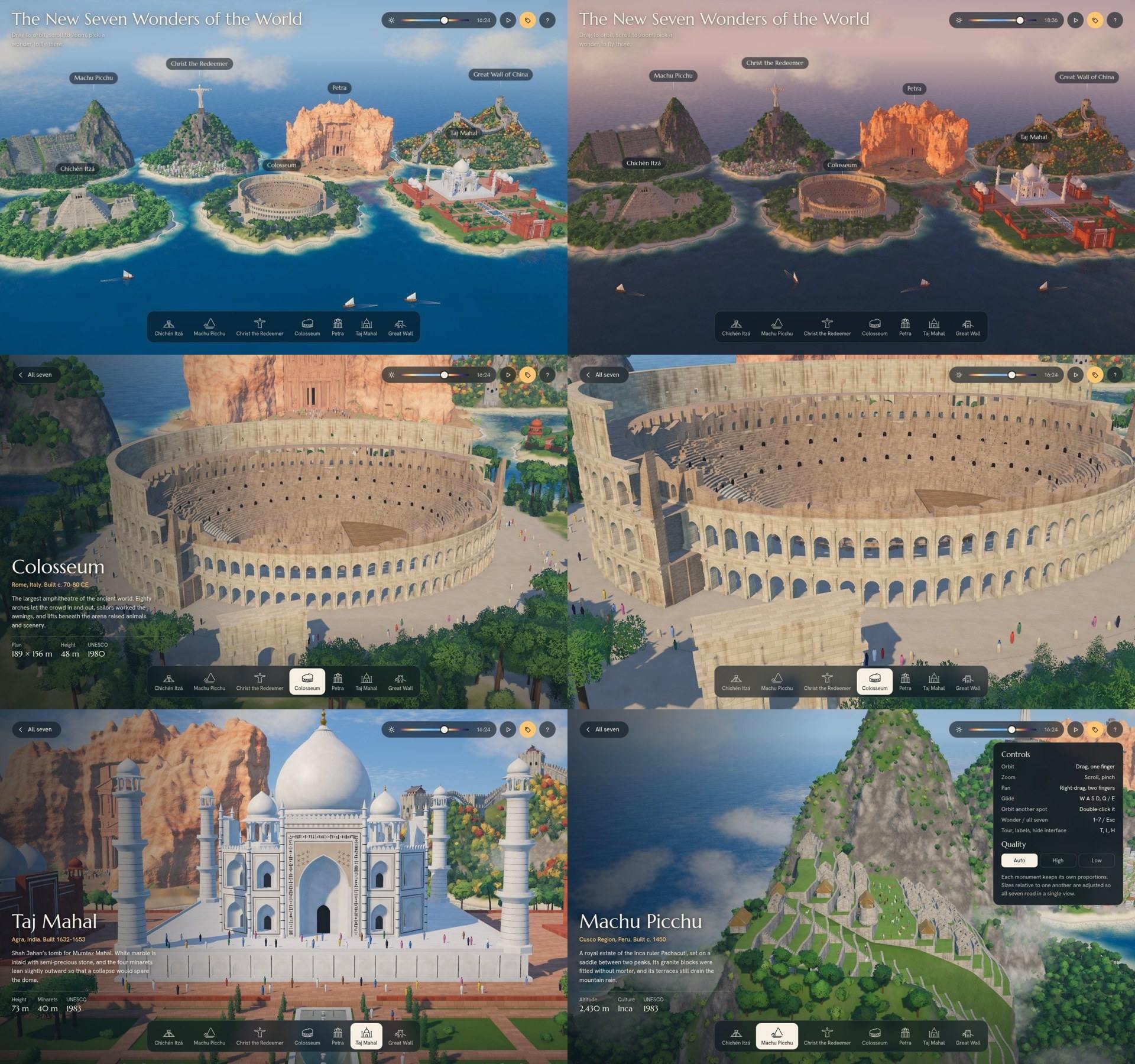
In the opening post, leo says the testing resembles the earlier Opus 5.5 testing process and calls the apparent improvement “quite a jump.” The attached image is a six-panel collage of a Seven Wonders experience, with an overview, alternate lighting, and close-up views. The news value comes from the combination of a reported model change and inspectable output, rather than from the deployment claim alone.
The first comparison reply, published one second after the opening post, introduces “Opus 5.5’s attempts on the same prompts.” It also says the main-post outputs “weren’t even fully finished” because the model was still iterating. The attached eight-panel collage provides a concrete visual baseline.
Below-up reply adds “A pagoda for good measure!” Its screenshot shows an experience titled Garden Above the Clouds, featuring a multistory pagoda, floating terrain, waterfalls, flowering trees, smaller buildings, and birds. The interface includes season and time-of-day controls. This broadens the evidence beyond the landmark scene and shows a distinct visual style.
A Pelican SVG Demonstrates Detailed Illustration
At 00:26:45 UTC, leo posts a pelican SVG example, describing it as one of the most impressive pelican SVGs the author has seen. The screenshot displays SVG markup beside a detailed illustration of a pelican riding a red bicycle on a seaside boardwalk. It adds a different output format and a different kind of visual complexity to the thread.
Secondary Reporting – TechFlow, TokenPost, COINOTAG and Aggregators
TechFlow (November 24) amplified reports that the model was being secretly routed inside Claude Code and some web interfaces. It highlighted claimed strengths in music composition and richer visual output, while noting longer generation times due to heavier reasoning. Multiple Chinese-language and English tech outlets (TokenPost, COINOTAG, Apiyi.com, DEV Community) republished the same core claims within hours, consistently noting that Anthropic had issued no confirmation.
Earlier October Routing Signals
Routing rumors first appeared in mid-October 2026 (Pankaj Kumar and others on X), with some users reporting that Opus 5.5 requests felt different. At that time the community guessed Opus 5.6, Fable 5.5, or even Opus 6. Those earlier signals did not produce a public model and largely quieted until the November 24 wave.
Self-Check Method Circulating in the Community
A popular offline test prompt is: “Where did Andrej Karpathy go in May 2026?” (without web search). Some testers claim that answers attributing knowledge to Anthropic internal sources suggest routing to the newer model. Independent analysis notes this is insufficient for confirmation because the knowledge cutoff of current official models is June 2026.
Performance and Capability Claims from Early Testers
Testers who believe they are routed report:
- Noticeably richer and more detailed visual generation (3D scenes, complex SVG).
- Stronger music composition ability.
- Higher overall quality and coherence.
- Increased latency / reasoning overhead (speed still being optimized).
- Possible future parity or advantage versus Fable 5.x on many benchmarks once fully released.
None of these claims have independent, reproducible public benchmarks attached to a confirmed model ID.
What Could Actually Improve? / Performance on Tests
Visual and Creative Generation
Early gray-box reports consistently highlight superior 3D scene construction and highly detailed SVG output compared with Opus 5.5. Interactive demos shared on X (New Seven Wonders, complex illustrations) are cited as qualitative evidence of a meaningful jump in multimodal generation fidelity.
Music Composition
Multiple reports specifically call out stronger music composition capability, with some testers predicting that a full release could match or exceed Fable-class models in creative audio-related tasks.
Agentic Coding and Long-Horizon Reasoning
While no public leaderboard scores exist for a confirmed Opus 5.6, the pattern of Anthropic’s prior Opus upgrades (Opus 5 → 5.5) showed gains on Terminal-Bench, FrontierCode, CursorBench, and SWE-bench-style agentic coding. Community expectation is continued progress in multi-file refactoring, tool use reliability, and sustained agent loops.
Latency and Reasoning Overhead
A consistent observation is longer generation time attributed to heavier internal reasoning. Testers note that Anthropic appears to be optimizing speed during the gray-box phase.
Claude Opus 5.6 vs Opus 5.5: What the Posted Comparison Shows
| Dimension | Reported Opus 5.6 output | Opus 5.5 comparison output | Practical reading |
|---|---|---|---|
| Subject | Modern Seven Wonders arranged across islands | Ancient Seven Wonders arranged across a landscape | The displayed subjects differ despite the author’s same-prompts statement |
| Architecture | Detailed Colosseum interior, Taj Mahal facade, terraces and landscaping | Recognizable pyramids, temples, gardens, statue and lighthouse with generally simpler displayed forms | Stronger visual richness is apparent in selected newer examples |
| Scene presentation | Overview and close-ups with dense landmark detail | Overview and close-ups of ancient landmarks | Both show organized multi-view experiences |
| Lighting | Day and evening states are displayed | Golden-hour control is visible | Neither collage provides a measured rendering benchmark |
| Interaction surface | Monument navigation, information cards, detailed control panel | Landmark navigation, information cards, tour and light controls | The advance concerns finish and integration, not the first appearance of controls |
| Additional examples | Voxel garden and pelican SVG | No matching public baseline for these in the retrieved replies | These extend capability evidence but are not paired comparisons |
| Music composition | TechFlow reports stronger composition | No matched musical example in the supplied summary | A reported creative strength with no published numerical margin in the supplied material |
| Generation time | TechFlow reports longer generation, attributed to heavier reasoning | No timed baseline supplied | Treat this as a reported quality/latency tradeoff |
| Time, tokens and cost | Not reported | Not reported | No efficiency percentage can be calculated |
Alternatives and Recommendations While You Wait
| Model | Provider | Input / Output (per 1M tokens) | Context | Best For | Notes |
|---|---|---|---|---|---|
| Claude Opus 5.5 | Anthropic | $4 / $20 | 1M | Agentic coding, long-horizon work | Current official Opus flagship |
| Claude Fable 5.2 | Anthropic | Higher (typically $8 / $40) | 1M | Maximum capability | Strongest Anthropic model on many tasks |
| Gemini 4 Neon | Competitive | Large | Multimodal, speed, cost efficiency | Frequently leads independent indexes | |
| GPT-6 series | OpenAI | Varies (~$4–5 / $20–30) | ~1M | Broad capability, tool use | Strong coding and reasoning |
| Claude Sonnet 5.5 | Anthropic | $2 / $10 | 1M | Everyday tasks, cost-sensitive | Faster, cheaper complement to Opus |
CometAPI Recommendation
Rather than managing separate API keys, rate limits, and billing across Anthropic, Google, and OpenAI, route all of the above models through a single unified endpoint. CometAPI (cometapi.com) provides OpenAI-compatible access to 500+ models—including the full Claude family, Gemini 4 series, and GPT-6 variants—with competitive pay-as-you-go pricing, free credits on signup, and zero vendor lock-in. You can switch from Opus 5.5 to Gemini 4 Neon or a GPT model by changing only the model name string while keeping the same base URL and key. This is the practical way to stay productive while waiting for any official Opus 5.6 release and to A/B test new models the moment they appear.
Closing Outlook
The November 24–25, 2026 wave of gray-box testing reports is consistent with Anthropic’s historical pattern of limited real-user exposure before full launches. Until Anthropic publishes a model card, pricing, and official model ID, treat “Claude Opus 5.6” as an unverified community hypothesis. Pin production systems to Claude Opus 5.5 (or the appropriate confirmed alternative), monitor official Anthropic channels, and use a flexible gateway such as CometAPI so that the moment a new model does become available you can adopt it with minimal disruption.