
TL;DR
DeepSeek V4.1 Flash replaces the earlier V4 Flash generation with a 552B-parameter causal encoder–decoder MoE model, native image understanding, a 1M-token context window, and substantially lower serving cost. In DeepSeek’s official comparison, it improves most coding, terminal, security, and agent benchmarks over V4 Pro 0813, while V4 Pro remains ahead on GPQA Diamond and HLE without tools.
DeepSeek’s current API pricing page once again lists deepseek-flash and deepseek-v4-pro as separate routes, serving V4.1 Flash and V4-Pro-0813 respectively. They have different prices, concurrency limits, and vision support. New integrations should therefore select the model ID that matches the intended workload rather than relying on historical alias behavior.
Key Takeaways
- V4.1 Flash and V4 Pro are currently distinct official API choices: use deepseek-flash for V4.1 Flash and deepseek-v4-pro for V4-Pro-0813.
- The largest comparable gains appear in terminal tasks, coding agents, automation, and security-oriented execution—not in every closed-book reasoning benchmark.
- V4.1 Flash is materially cheaper than the currently listed V4 Pro route across cache-hit input, cache-miss input, and output tokens.
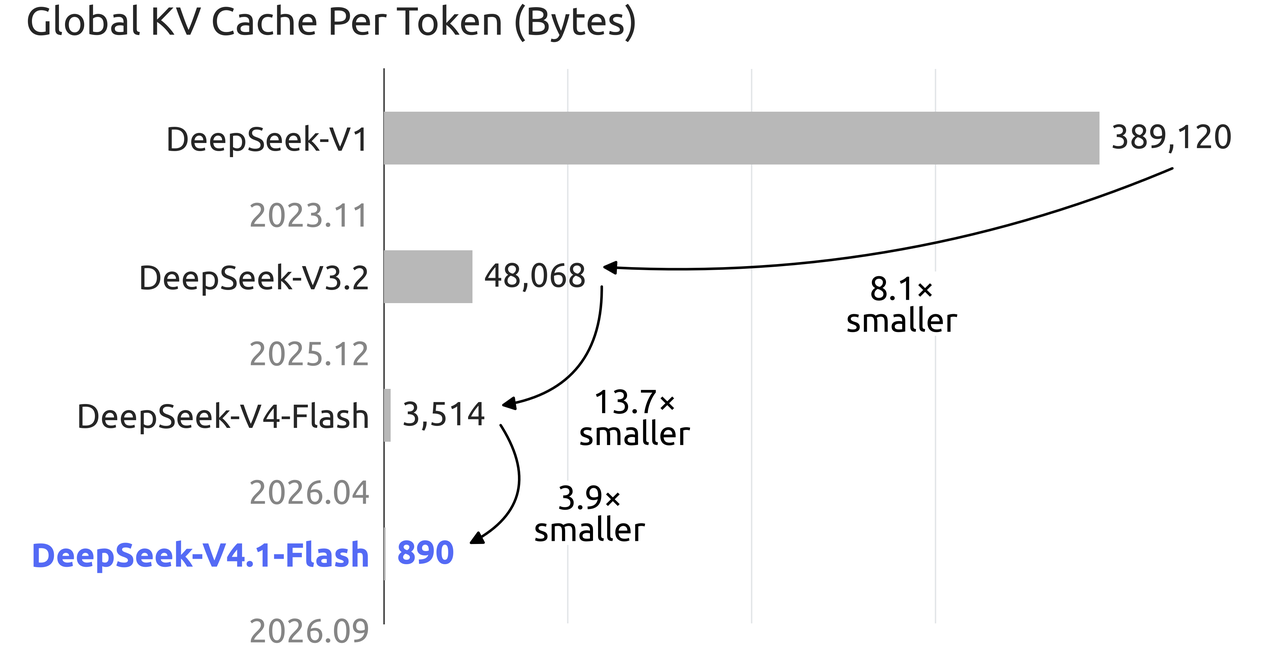
- V4.1 Flash adds native vision, raises documented concurrency from 500 to 2,500, and reduces global KV-cache storage to 890 bytes per token.
- Migration should be explicit even though aliases work: update model IDs, validate thinking and non-thinking behavior, retest tool calls and image inputs, and monitor token usage and latency.
Current routing note: the official pricing page identifies deepseek-v4-pro as V4-Pro-0813, separate from V4.1 Flash.
How Do DeepSeek V4.1 Flash and V4 Pro Specifications Compare?
The architecture changed from a very large sparse MoE design in V4 Pro to an asymmetric causal encoder–decoder design in V4.1 Flash. The newer model activates fewer parameters for input processing than for output generation, which helps reduce prefill cost while preserving stronger generation capacity.
| Specification | DeepSeek V4.1 Flash | DeepSeek V4 Pro 0813 |
|---|---|---|
| Architecture | Causal encoder–decoder MoE | Sparse MoE |
| Total parameters Backbone parameters / repository weight count | 552B backbone parameters; Hugging Face lists 763B model size | 1.6T backbone parameters; Hugging Face lists about 1.7T model size |
| Active parameters | 8B for input; 16B for output | 49B per token |
| Context window | 1M tokens | 1M tokens |
| Maximum output | 384K tokens | 384K tokens |
| Thinking and non-thinking modes | Supported | Supported |
| Native image understanding | Supported | Not supported |
| Documented concurrency | 2,500 | 500 on the current configuration |
| Current official API status | Active as deepseek-flash | Active as deepseek-v4-pro (V4-Pro-0813) |
Parameter-count clarification: DeepSeek’s V4.1 Flash model card describes 552B backbone parameters, while the Hugging Face repository reports a 763B model size. These figures describe different accounting scopes and should not be presented as interchangeable totals.
Output-length clarification: the V4.1 Flash model card recommends max_tokens ≥ 256K for local inference, whereas DeepSeek’s current API pricing page explicitly states a 384K maximum output for both API models. A recommended inference setting is not the same as an API-enforced maximum.
Where Does DeepSeek V4.1 Flash Improve on V4 Pro?
DeepSeek’s official benchmark table shows the clearest improvements in execution-heavy workloads. The percentage column below is calculated from the published scores; percentage comparisons are omitted where the metric is a rating or where a simple percentage would be misleading.
| Benchmark | V4.1 Flash | V4 Pro 0813 | Difference | Interpretation |
|---|---|---|---|---|
| Terminal-Bench 2.1 | 90.6 | 87.9 | +2.7 points; +3.1% | More reliable terminal execution |
| Terminal-Bench 3.0 | 30.0 | 11.8 | +18.2 points; +154.2% | Large gain on harder terminal tasks |
| Terminal-Bench 4.0 | 31.2 | 12.4 | +18.8 points; +151.6% | Large gain on newer terminal tasks |
| DeepSWE v1.1 | 74.2 | 62.7 | +11.5 points; +18.3% | Stronger repository-level software work |
| ProgramBench | 20.3 | 15.5 | +4.8 points; +31.0% | Improved program synthesis |
| NL2Repo-Bench | 64.0 | 61.5 | +2.5 points; +4.1% | Better natural-language-to-repository work |
| CyberGym | 88.1 | 83.3 | +4.8 points; +5.8% | Stronger cyber task execution |
| HLE with tools | 63.9 | 60.0 | +3.9 points; +6.5% | Better tool-augmented reasoning |
| Automation-Bench | 54.8 | 43.2 | +11.6 points; +26.9% | Material automation gain |
| Agents’ Last Exam | 31.8 | 25.7 | +6.1 points; +23.7% | Stronger general agent behavior |
| Codeforces rating | 3,471 | 3,348 | +123 rating points | Improved competitive coding |
| GPQA Diamond | 90.9 | 92.4 | −1.5 points | V4 Pro retains an edge |
| HLE without tools | 36.8; 39.1 on text subset | 42.7 on text subset | −3.6 points on comparable text subset | V4 Pro retains an edge |
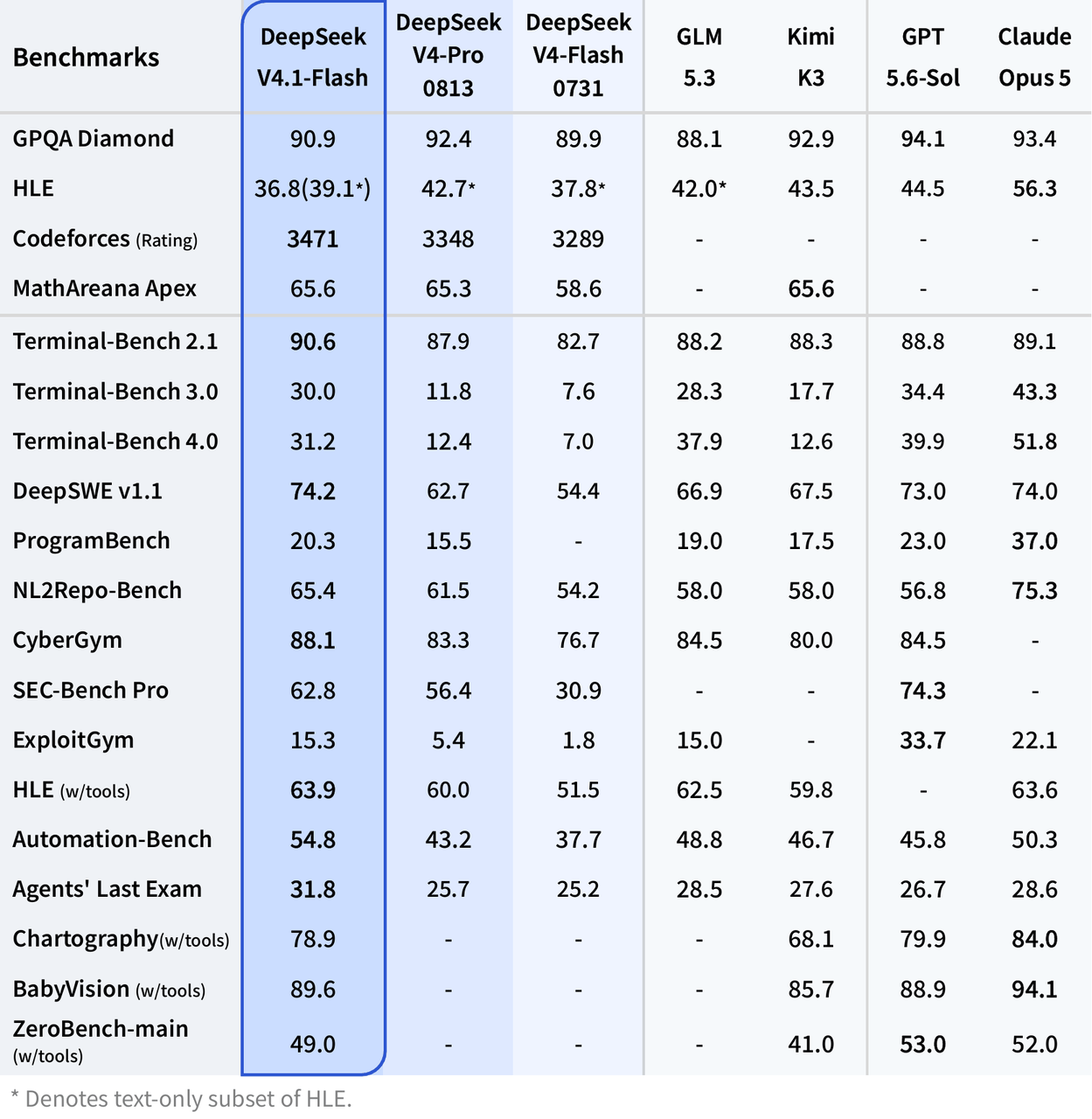
The result is multidimensional: V4.1 Flash is decisively better for coding agents, terminal operation, automation, security tasks, tool use, vision, concurrency, and cost. V4 Pro’s remaining advantage is concentrated in selected pure-reasoning tests. Workloads should therefore be judged by task mix rather than by a single aggregate claim.
Why Is DeepSeek V4.1 Flash More Efficient Than V4 Pro?
Asymmetric input and output compute
V4.1 Flash activates 8B parameters while processing input and 16B while generating output. This asymmetric design targets the different compute needs of prefill and decoding, reducing cost without forcing both stages through the same active-parameter budget.
Smaller KV-cache footprint
DeepSeek reports that V4.1 Flash uses one quarter of the HBM and one eighth of the SSD capacity required by the preceding generation’s KV cache. The published chart places global KV cache at 890 bytes per token, compared with 3,514 bytes for V4 Flash.
Native multimodal input and higher concurrency
V4.1 Flash can interpret images natively and exposes a documented concurrency limit of 2,500, five times the current V4 Pro figure of 500. Those changes matter for screenshot-based agents, document extraction, visual troubleshooting, and high-volume production queues.
What Does DeepSeek V4.1 Flash Cost Compared with V4 Pro?
The current official API schedule prices the two routes separately. Per 1M tokens, V4.1 Flash costs $0.003/$0.006 for cache-hit input, $0.15/$0.30 for cache-miss input, and $0.60/$1.20 for output (off-peak/peak). V4 Pro costs $0.022/$0.044, $0.66/$1.32, and $1.98/$3.96 respectively. Prices can change, so production budgets should reference the live pricing page.
How Should You Migrate from DeepSeek V4 Pro or V4 Flash to V4.1 Flash?
Use the explicit production model ID
Use deepseek-flash when you want V4.1 Flash. The older deepseek-v4-flash and deepseek-v4-flash-vision-exp names still resolve to V4.1 Flash, but explicit naming makes monitoring and future rollbacks easier to audit. Use deepseek-v4-pro when you intentionally want the currently listed V4-Pro-0813 backend.
from openai import OpenAI

client = OpenAI(
    api_key="YOUR_DEEPSEEK_API_KEY",
    base_url="https://api.deepseek.com",
)

response = client.chat.completions.create(
    model="deepseek-flash",  # or "deepseek-v4-pro"
    messages=[{"role": "user", "content": "Review this migration plan."}],
)

print(response.choices[0].message.content)
Retest behavior, not only endpoint compatibility
- Run representative prompts in both thinking and non-thinking modes; compare task success, token counts, and latency.
- Retest tool schemas, JSON output, Responses API behavior, prefix completion, and FIM where used.
- Add image-input tests if the product will use the new native visual capability.
- Re-baseline budgets using peak and off-peak rates rather than carrying forward V4 Pro assumptions.
- Track prompt-cache hit rate because it can dominate input cost at scale.
Choose the intended backend explicitly
The current deepseek-v4-pro route selects V4-Pro-0813. Teams should record the resolved model version, evaluation date, prompt set, and pricing window so comparisons remain reproducible if routing changes again.
Which Workloads Fit DeepSeek V4.1 Flash Best?
| Workload | Recommended choice | Reason |
|---|---|---|
| Coding agents and repository maintenance | V4.1 Flash | Higher DeepSWE, ProgramBench, NL2Repo, and terminal scores |
| Tool-driven automation | V4.1 Flash | Higher Automation-Bench, HLE-with-tools, and agent scores |
| Image-aware assistants | V4.1 Flash | Native image understanding |
| High-throughput or cost-sensitive serving | V4.1 Flash | Higher concurrency and much lower token prices |
| Historical V4 Pro reproductionCurrent V4 Pro access and evaluation | V4 Pro | The official route currently identifies V4-Pro-0813 |
| Pure closed-book reasoning | Validate on domain data | V4 Pro remains higher on GPQA Diamond and HLE without tools |
DeepSeek V4.1 Flash vs V4 Pro FAQ
Is DeepSeek V4.1 Flash better than V4 Pro?
For most production dimensions—coding agents, terminal tasks, automation, tool use, vision, throughput, and price—yes. V4 Pro still has stronger published scores on GPQA Diamond and HLE without tools, so pure-reasoning workloads should be tested with domain-specific prompts.
Can I still call deepseek-v4-pro?
Yes. The current official API page lists deepseek-v4-pro as V4-Pro-0813, with its own pricing and concurrency limit.
What model ID should a new integration use?
Use deepseek-flash for V4.1 Flash, or deepseek-v4-pro for V4-Pro-0813. Do not treat the two IDs as aliases.
Do old V4 Flash model IDs still work?
DeepSeek states that deepseek-v4-flash and deepseek-v4-flash-vision-exp requests are automatically routed to V4.1 Flash and billed at the new Flash price. Updating the configured model ID is still recommended for clarity.
Does DeepSeek V4.1 Flash support images?
Yes. Native image understanding is part of V4.1 Flash; the historical V4 Pro API did not provide this capability.
Is DeepSeek V4.1 Flash cheaper than the current V4 Pro?
Yes. The current official schedule lists lower cache-hit input, cache-miss input, and output prices for V4.1 Flash than for V4 Pro.
Should I expect identical outputs after migration?
No. Endpoint compatibility does not guarantee identical reasoning paths, tool selection, token use, or formatting. Re-run production evaluations before relying on previous thresholds.