Gemini 4 Hydrogen Prediction: Release Date, Features, and Pricing
Explore Gemini 4 Hydrogen leaks, release date predictions, expected features, and API pricing, what early tests suggest about Google's next Flash model.
SEO Title
Gemini 4 Hydrogen: Release Date, Features & Pricing Predictions
Meta Description
Explore Gemini 4 Hydrogen leaks, release date predictions, expected features, and API pricing, plus what early tests suggest about Google's next TL;DR: Gemini 4 Hydrogen is the reported codename for Google's next Flash-tier model. Early demonstrations point to stronger interactive coding and shorter completion times. A November 2026 preview is plausible. Its value for frequent use will depend on how its final pricing and output quality compare with Gemini 3.8 Flash.
Key Takeaways
Positioning: Hydrogen is expected to bring Gemini 4 capabilities to a faster, more affordable Flash tier.
Public examples concentrate on 3D scenes, interactive applications, and code-driven graphics.
Reviewed for clarity, source attribution and current API terminology.
Strongest capability signal:
Speed: One Reddit comparison reported a roughly 5.5× task-completion speedup over Gemini 3.8 Flash.
Pricing outlook: Retaining Flash-level pricing would make Hydrogen particularly attractive for workflows requiring frequent generation and revision.
Main evaluation priority: Successful outputs, completion time, and cost per usable result will matter more than isolated demonstrations.
What Is Gemini 4 Hydrogen?
Hydrogen is the reported internal codename for a new Gemini model expected to join Google's Flash lineup. Its likely role is to bring Gemini 4 capabilities to fast, cost-sensitive workloads, complementing Carbon's focus on complex coding and reasoning.
Business Insider reported that Google employees had gained access through Jetski, an internal development platform. The outlet reviewed an internal message describing Hydrogen as “very capable, fast and efficient,” while an employee who had used it compared it with previous Flash models.
Separately, community testers reported encountering a new checkpoint in Arena under the gemini-3.8-flash label and linked it to Hydrogen. Those reports provide context for the demonstrations below; the connection to Hydrogen rests on testers' accounts rather than an explicit model label.
What Do the Leaks Actually Show?
The available evidence is concentrated in visual and interactive coding. These examples help identify likely improvements, while the reported generation times offer an early indication of their practical value.
Interactive 3D and Engineering Visualizations
The most informative examples involve several requirements working together: geometry, presentation, animation, controls, and application state.
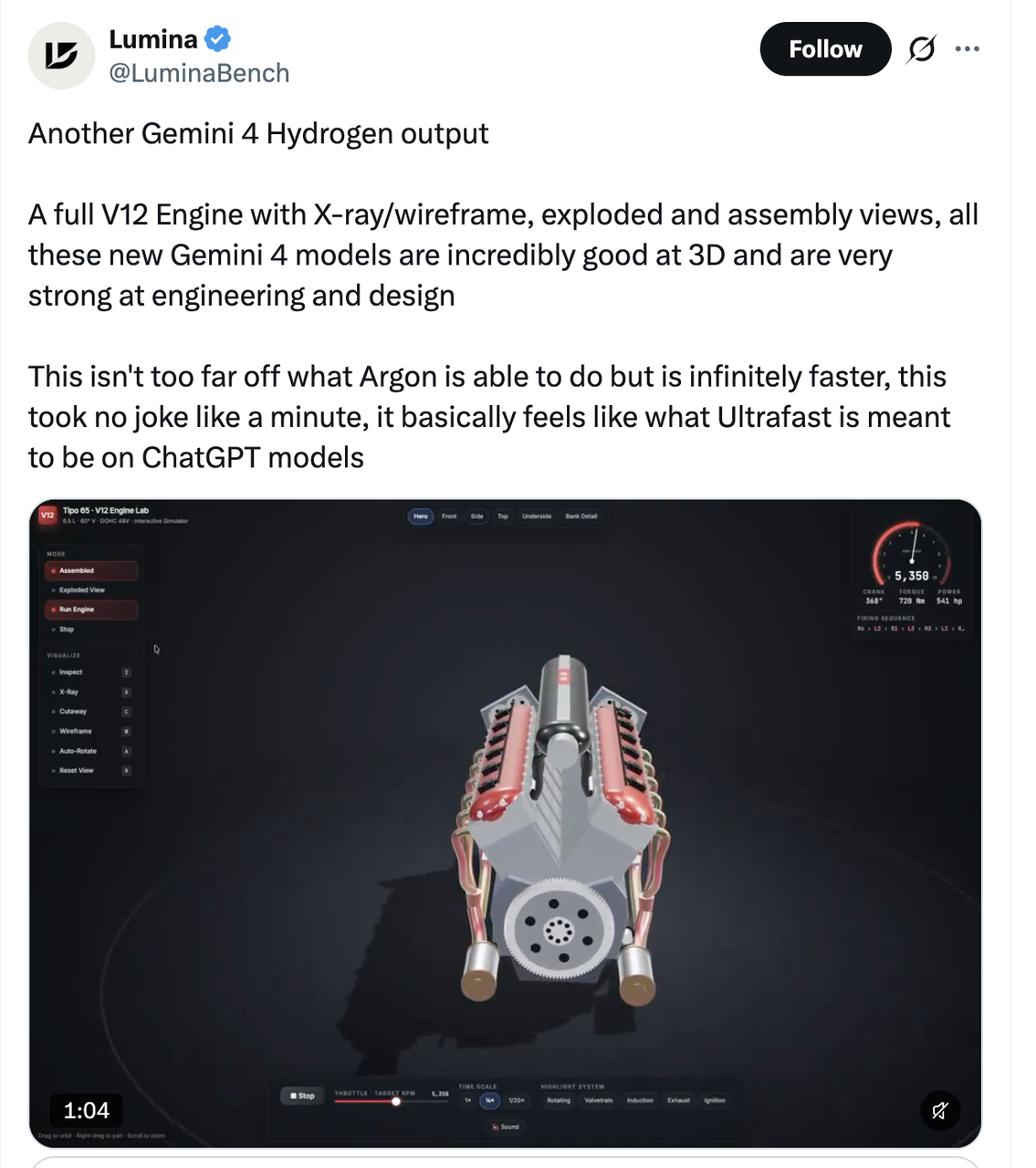
LuminaBench's V12 engine demonstration reportedly took about one minute and included X-ray, wireframe, exploded, and assembly views. Another example showed a drivable F1 car with driving metrics and multiple visualization modes.
Harshith's voxel comparisons add a second line of evidence, showing outputs attributed to Hydrogen alongside Gemini 3.8 Flash High on detailed scene prompts.
A Motion-Graphics Task Completed in About Two Minutes
The author encountered Hydrogen in Arena battle mode and also ran Gemini 3.8 Flash separately in direct mode. The post includes output links and an additional Opus 5.5 comparison.
The reported difference represents a 5.5× speedup for that task. Because the runs involved different access modes and potentially different reasoning settings and output lengths, it is evidence of a workflow advantage rather than a general throughput measurement.
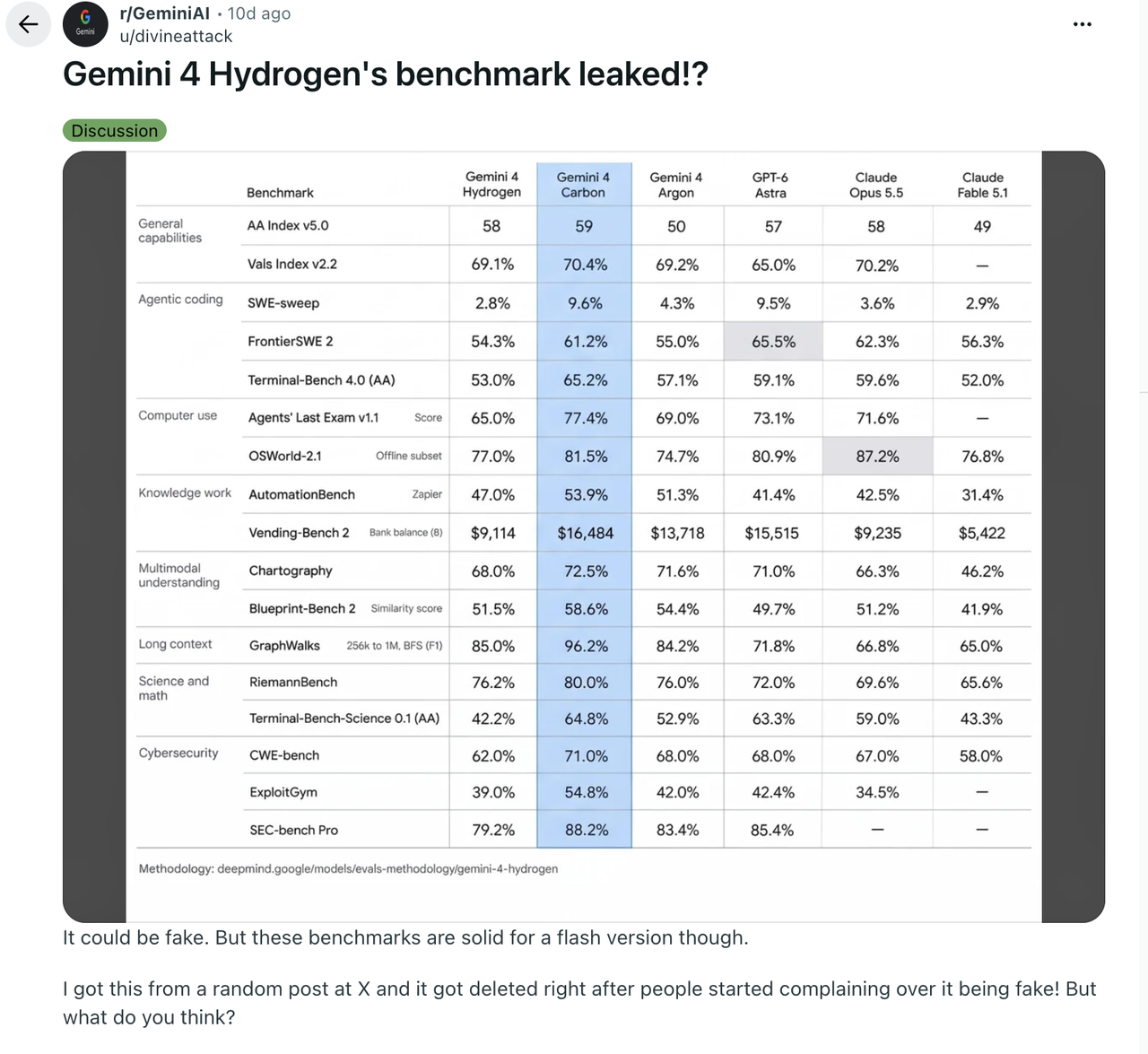
The circulating benchmark image lists Hydrogen at 58 on AA Index v5.0 and includes coding, computer-use, multimodal, and science results.
However, the Reddit author who shared it explicitly said it came from a random X post that was deleted after authenticity complaints. Those numbers do not provide a sound basis for ranking Hydrogen against Carbon, Argon, or competing models.
The demonstrations offer a stronger foundation for predicting specific improvements.
What Could Improve Over Gemini 3.8 Flash?
The early demonstrations point toward improvements in application completeness, development speed, and visual quality. The practical question is how these changes could reduce the work between an initial prompt and a usable result.
More Complete Visual Applications
The engine and racing examples suggest better coordination between scene structure, animation, controls, and application state. Hydrogen could become more effective at translating a detailed prompt into an application whose visual and functional elements work together.
For interactive explainers, product demonstrations, and lightweight games, that would reduce the need to assemble separately generated components. A meaningful upgrade should also preserve those connections during revisions—for example, changing a scene's layout while keeping its controls and animations working.
Faster Iteration
The reported completion-time advantage suggests that Hydrogen could shorten the feedback loop between generating an application and deciding what to change. This matters during prototyping, when developers frequently compare layouts, adjust interactions, and explore alternative implementations.
The practical gain depends on how quickly each attempt reaches a usable state. Faster generation becomes especially valuable when it also reduces repair work: developers can spend more of the session testing ideas and refining the experience. End-to-end completion time, including corrections, will therefore be the most useful comparison with Gemini 3.8 Flash.
Higher Quality Within the Flash Tier
LuminaBench's assessment of the V12 demonstration suggests that Hydrogen may approach Argon on selected visual coding tasks. That raises the prospect of handling richer scenes and more sophisticated interactions within the Flash tier.
The strongest upgrade case would be consistent quality across different prompts: readable visual hierarchies, coherent spatial relationships, and controls that behave as requested. If Hydrogen can deliver those results reliably, developers could assign more visual prototyping work to Flash while reserving higher-cost models for tasks that benefit from additional reasoning.
When Could Gemini 4 Hydrogen Launch?
As of November 12, Google's public model guide still recommends Gemini 3.8 Flash for everyday applications and agents, and its release changelog has no Hydrogen announcement. Employee access suggests that testing is progressing, making a November preview plausible, but Google has not announced a release date.
Availability may also arrive in stages. A Gemini app rollout, an AI Studio preview, Gemini API access, and a Vertex AI release should be tracked separately. For developers, the decisive milestone is a documented API model ID with usable quotas and pricing.
Gemini 4 Hydrogen Pricing: What Should Developers Expect?
Gemini 3.8 Flash provides the clearest pricing benchmark for Hydrogen, but that benchmark is changing. Google's official pricing lists the following standard API rates per million tokens:
Gemini 3.8 Flash
Through December 31, 2026
From January 1, 2027
Input
$0.75
$1.50
Output, including thinking
$3.75
$7.50
A community prediction that Hydrogen could match Flash pricing therefore needs a specific reference point: today's promotional rates or the scheduled January rates. Google has not published Hydrogen's pricing.
For developers, the stronger value proposition would be better application quality at a comparable cost per completed task. If Hydrogen requires fewer retries and repairs, it could justify a higher token price; faster generation alone would not establish that advantage.
What Can You Use While Waiting for Gemini 4 Hydrogen?
Gemini 4 Carbon is the main alternative to consider for demanding work today. Gemini 3.8 Flash and Argon also provide useful options, depending on your budget and workload.
Gemini 4 Carbon: For Complex Coding and Reasoning
Google made Gemini 4 Carbon generally available on November 10, positioning it for sustained agentic coding, multimodal knowledge work, scientific reasoning, and cybersecurity defense. For projects involving complex code changes or extended reasoning, Carbon is already an available option while Hydrogen's public release remains pending.
Developers can explore Gemini 4 Carbon through CometAPI and compare it with other models through a unified API. This is useful if you want to start building with Carbon now and evaluate Hydrogen against the same application requirements when it becomes available. Check CometAPI's model page for its current pricing and access details.
Gemini 3.8 Flash and Argon: Other Options
Gemini 3.8 Flash remains a useful baseline for everyday generation and workloads where speed and cost matter. Argon is worth considering for visual coding and interactive applications—the tasks featured most prominently in Hydrogen's early demonstrations.
Should You Wait for Hydrogen?
If your current model meets your requirements, continue building. Hydrogen becomes worth evaluating when generation time or repeated corrections limit your workflow.
Save representative tasks and record first-pass usability, completion time, repair effort, and total cost. Repeat the evaluation when Hydrogen becomes accessible to determine whether switching delivers a measurable benefit.
Conclusion
Gemini 4 Hydrogen's strongest promise is more capable visual coding at Flash speed and cost. Internal-testing reporting supports that positioning, while community demonstrations provide specific reasons to expect improvements in interactive generation and turnaround time.
If the released API reproduces those results consistently, Hydrogen could make complex prototypes practical for a much wider range of applications. Its most meaningful achievement would be reducing the time and expense required to reach a usable result.