
TL;DR
GLM-5.3 Flash is the better default for most production workloads: it adds native visual input and a 1M-token context window, while its standard list price is dramatically lower. GLM-5.3 remains the stronger choice when maximum coding depth, difficult long-horizon reasoning, or cybersecurity performance matters more than unit cost.
This is not a small-model-versus-large-model story. Flash is a 320B-total/18B-active MoE trained from a new multimodal base with hybrid sparse and linear attention. The flagship is a 744B-total/40B-active MoE whose GLM-5.3 gains come from scaled post-training on the GLM-5.2 base.
Key Takeaways
- Choose Flash for multimodal coding, document understanding, browser or GUI agents, high-volume automation, and cost-sensitive applications.
- Choose the flagship for the hardest repository-scale engineering tasks, deeper tool-assisted reasoning, and defensive security research.
- Both models support 1M-token context, always-on reasoning, function calling, streaming, and open-weight deployment.
- On matched Z.ai-reported benchmarks, the flagship leads DeepSWE, NL2Repo, HLE with tools, and Agents’ Last Exam; Flash leads AutomationBench, Toolathlon, and GDPval-AA v2.
- Independent testing gives the flagship a higher Intelligence Index and faster output, while Flash has slightly better time to first token and far lower blended cost.
GLM-5.3 Flash vs GLM-5.3 at a Glance
| Dimension | GLM-5.3 Flash | GLM-5.3 | Practical result |
|---|---|---|---|
| Positioning | Efficient native-multimodal coding and agent model | Flagship text reasoning, coding, long-horizon agents, cybersecurity | Workload dependent |
| Model size | 320B total / 18B active | 744B total / 40B active | Flash activates 55% fewer parameters |
| Base model | Newly trained 30T-token multimodal base | Same base as GLM-5.2; gains from post-training | Different development paths |
| Input / output | Text + visual inputs / text output | Text input / text output | Flash for visual workflows |
| Context / max output | 1M / 128K | 1M / 128K | Tie |
| Reasoning effort | low, high, max; reasoning always enabled | low, high, max; reasoning always enabled | Tie |
| Independent Intelligence Index | 57 | 60 at max effort | GLM-5.3 |
| Independent output speed | 50.2 tokens/s | 76.6 tokens/s | GLM-5.3 in tested API |
| Official list input/output price | $0.15 / $0.50 per 1M tokens | $1.40 / $4.40 per 1M tokens | Flash |
| Best fit | Default routing, multimodal agents, scale | Highest-stakes complex text and security tasks | Use selective routing |
Sources: Z.ai model documentation and Artificial Analysis comparison.
What Is GLM-5.3 Flash?
Z.ai positions Flash as the first native multimodal model in the GLM-5 series. It has 320B total parameters and 18B active parameters, but “Flash” should not be read as “small.” The full checkpoint remains a very large model; its efficiency comes from activating a smaller expert subset and redesigning the attention stack.
Its base model was trained on a 30-trillion-token multimodal corpus. Native vision is integrated into the coding loop, allowing the model to inspect screenshots, rendered interfaces, charts, page layouts, and other visual feedback before refining its next action.
GLM-5.3 Flash Specifications
| Specification | GLM-5.3 Flash |
|---|---|
| Developer | Z.ai / Zhipu AI |
| Model ID | glm-5.3-flash |
| Model type | Native multimodal Mixture-of-Experts |
| Total / active parameters | 320B / 18B |
| Layers | 45 |
| Architecture | Hybrid sparse attention + linear attention; mHC; MTP |
| Training corpus | 30T-token multimodal pre-training corpus |
| Input modalities | Text and visual inputs, including images and supported video/file workflows |
| Output modality | Text |
| Context / max output | 1M / 128K tokens |
| Reasoning | Always enabled; low, high, max effort |
| Tools | Function calling, streaming tool calls, structured workflows |
| Weights / license | Open weights; Apache-2.0 in the official repository |
Sources: Z.ai Flash documentation and the official GLM-5 repository.
What Is GLM-5.3?
The flagship model is optimized for complex software engineering, long-horizon agents, and cybersecurity. Z.ai says it uses the same base model as GLM-5.2; the upgrade comes from scaled post-training rather than a new pre-training run.
The official repository lists the checkpoint at 744B total parameters with 40B active. Compared with Flash, it activates more than twice as many parameters per token and allocates more capacity to difficult multi-step reasoning.
GLM-5.3 Specifications
| Specification | GLM-5.3 |
|---|---|
| Developer | Z.ai / Zhipu AI |
| Model ID | glm-5.3 |
| Model type | Flagship text Mixture-of-Experts model |
| Total / active parameters | 744B / 40B |
| Base model | GLM-5.2 base; all GLM-5.3 gains from post-training |
| Input / output | Text / text |
| Context / max output | 1M / 128K tokens |
| Reasoning | Always enabled; low, high, max effort |
| Tools | Function calling, streaming tool calls, context caching, structured output |
| Primary focus | Complex coding, long-horizon agents, engineering, cybersecurity |
| Weights / license | Open weights under the separate GLM-5.3 License; supporting repository code under Apache-2.0. |
Sources: Z.ai flagship documentation and the official GLM-5 repository.
Architecture: Why Flash Is Cheaper Without Being Small
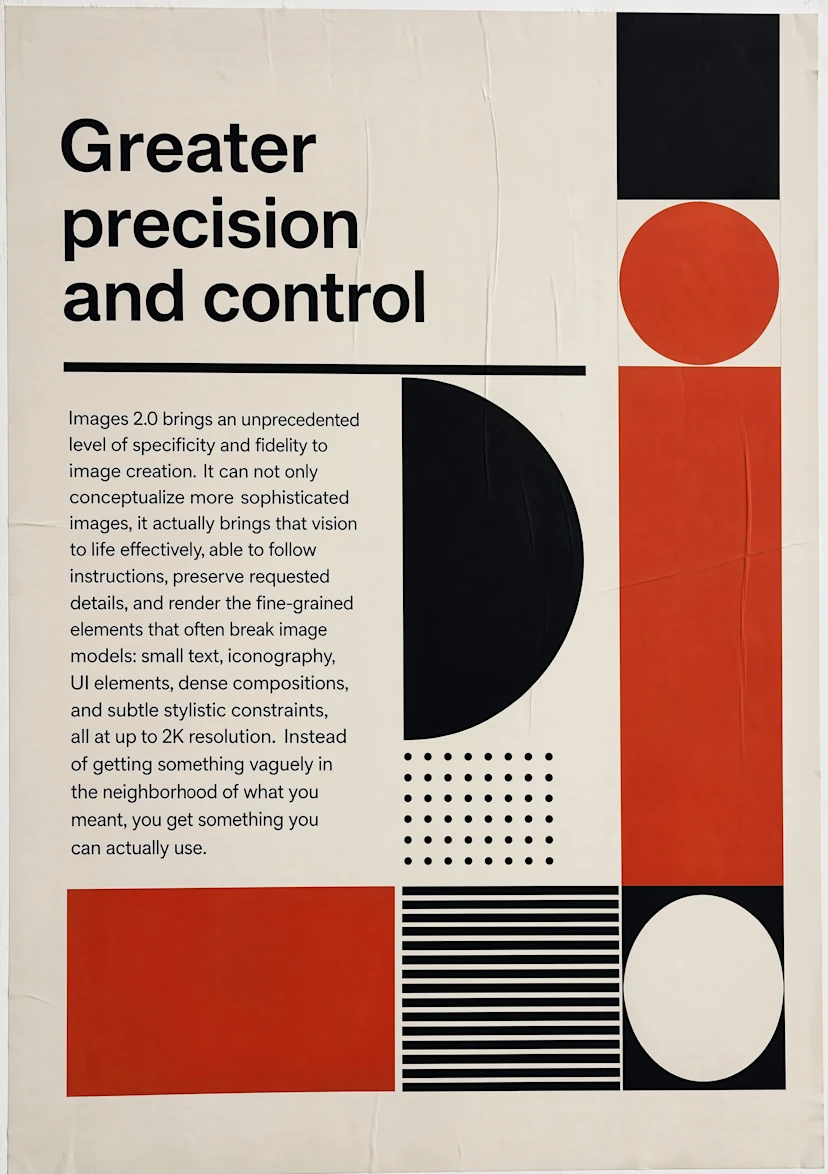
Flash alternates linear-attention blocks with sparse-attention blocks and uses mHC around attention and MoE components. Its IndexPool mechanism compresses four indexer key vectors into one. Z.ai reports 3.01× lower per-layer attention compute and a 4.44× smaller per-layer KV cache than the flagship at a 1M-token sequence length.
These are architecture-level comparisons, not guaranteed end-to-end latency multipliers. Real API speed also depends on hardware, quantization, batching, reasoning length, serving software, and provider load.
GLM-5.3-Flash hybrid attention architecture and long-context compute/cache comparison.
Source: Z.ai official architecture documentation
Benchmark Performance: Where Each Model Wins
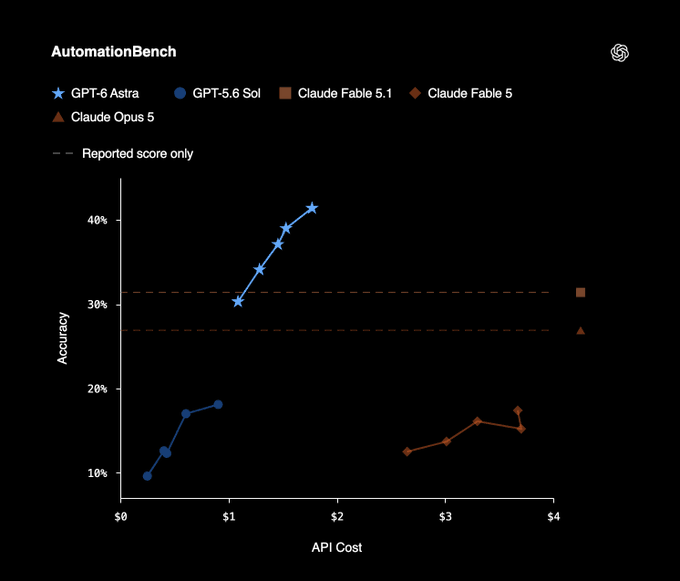
The cleanest comparison separates vendor-reported task benchmarks from independent API measurements. Even when benchmark names match, harness versions, tool configurations, context management, and reasoning effort can differ. The table below uses the closest matched values in the flagship evaluation and Flash evaluation, treating small gaps as directional rather than definitive.
| Benchmark | GLM-5.3 Flash | GLM-5.3 | Higher score | What it tests |
|---|---|---|---|---|
| Terminal-Bench 2.1 | 84.3 | 88.2 | GLM-5.3 | Terminal and agentic coding |
| DeepSWE v1.1 | 63.4 | 66.9 | GLM-5.3 | Software engineering |
| NL2Repo | 56.3 | 58.0 | GLM-5.3 | Repository generation |
| Toolathlon Verified | 78.4 | 73.0 | Flash | Tool use |
| AutomationBench | 48.8 | 48.2 | Near tie / Flash | Computer-use automation |
| Agents’ Last Exam | 26.3 | 28.5 | GLM-5.3 | Long-horizon agent reasoning |
| HLE with tools | 55.3 | 62.5 | GLM-5.3 | Difficult tool-assisted reasoning |
| GDPval-AA v2 | 1773 Elo | 1769 Elo | Near tie / Flash | Professional knowledge work |
Sources: flagship evaluation and Flash evaluation. Compare directionally because evaluation setups may differ.
Coding and Repository Engineering
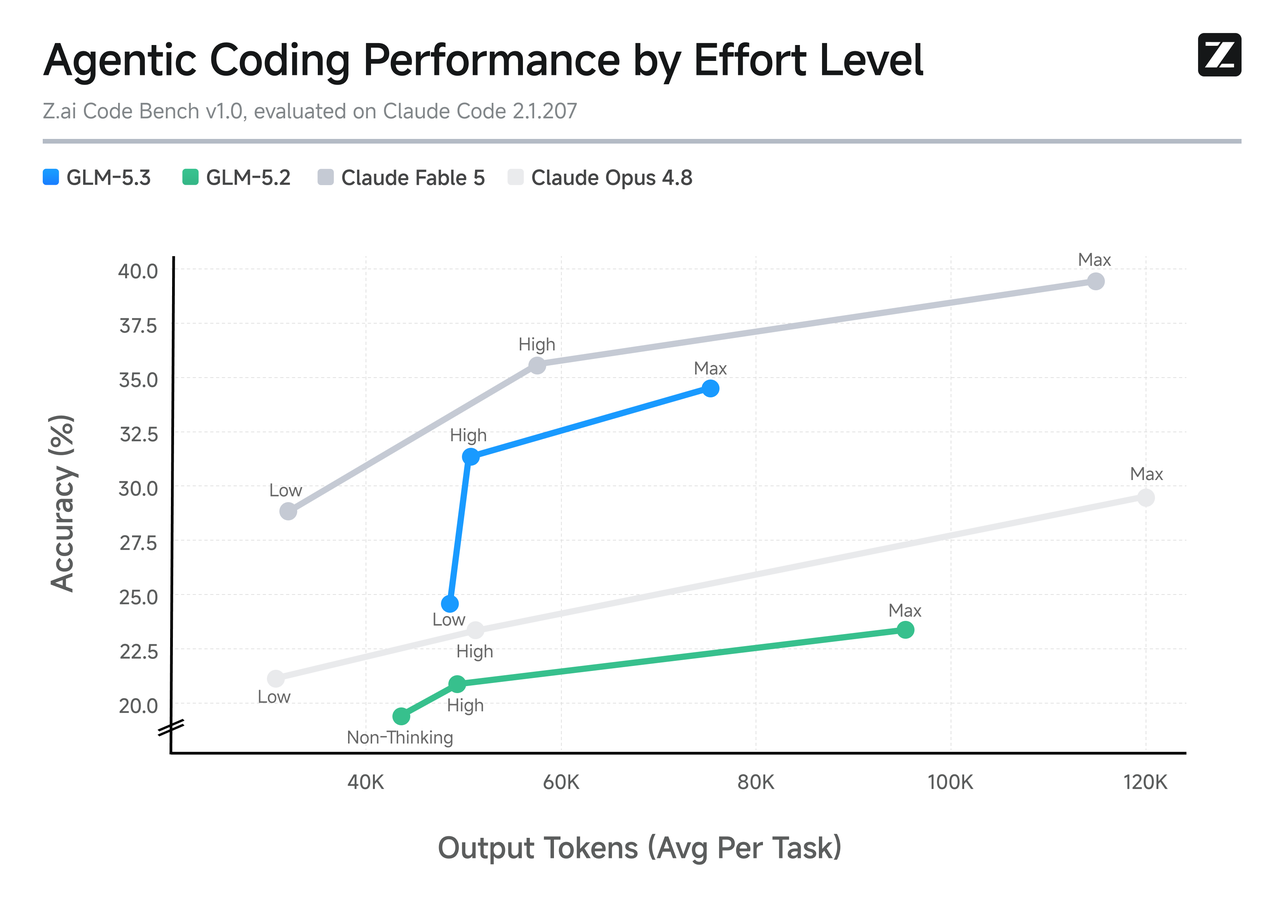
The flagship has the higher performance ceiling. It leads Flash by 3.5 points on DeepSWE and 1.7 points on NL2Repo. On Z.ai Code Bench v1.0, with both models evaluated using Claude Code 2.1.207, the flagship reaches 34.5% at max effort, while Flash reaches 29.0% — a 5.5-point advantage.
Flash is still competitive enough to be the first model tested for routine repository maintenance, test generation, debugging, refactoring, and high-volume coding agents. Escalate only the hardest tasks or failed trajectories to the flagship.
Z.ai's six-benchmark evaluation of GLM-5.3-Flash and other coding/agent models.
Source: Z.ai official Flash documentation
GLM-5.3 agentic coding accuracy and output-token use across reasoning effort levels.
Source: Z.ai official flagship documentation
Tool Use, Automation, and Knowledge Work
Flash is not uniformly weaker. It scores 78.4 on Toolathlon Verified versus 73.0 for the flagship, and edges AutomationBench 48.8 to 48.2. It is essentially tied on GDPval-AA v2. This makes Flash particularly attractive when the task is less about one extremely hard reasoning chain and more about reliably coordinating tools across many inexpensive requests.
Independent Intelligence, Speed, and Latency
| Independent measurement | GLM-5.3 Flash | GLM-5.3 (max) | Result |
|---|---|---|---|
| Artificial Analysis Intelligence Index | 57 | 60 | GLM-5.3 |
| Output speed | 50.2 tokens/s | 76.6 tokens/s | GLM-5.3 |
| Time to first token | 1.49 s | 1.61 s | Flash |
| Context window | 1M | 1M | Tie |
| Blended price in AA comparison | $0.10 / 1M tokens | $0.90 / 1M tokens | Flash |
Source: Artificial Analysis matched API comparison.
The independent result adds an important correction to the “Flash means faster” assumption. Flash responds slightly sooner, but the tested flagship endpoint generates tokens faster once output begins. Treat these measurements as provider-specific snapshots, not immutable model properties.
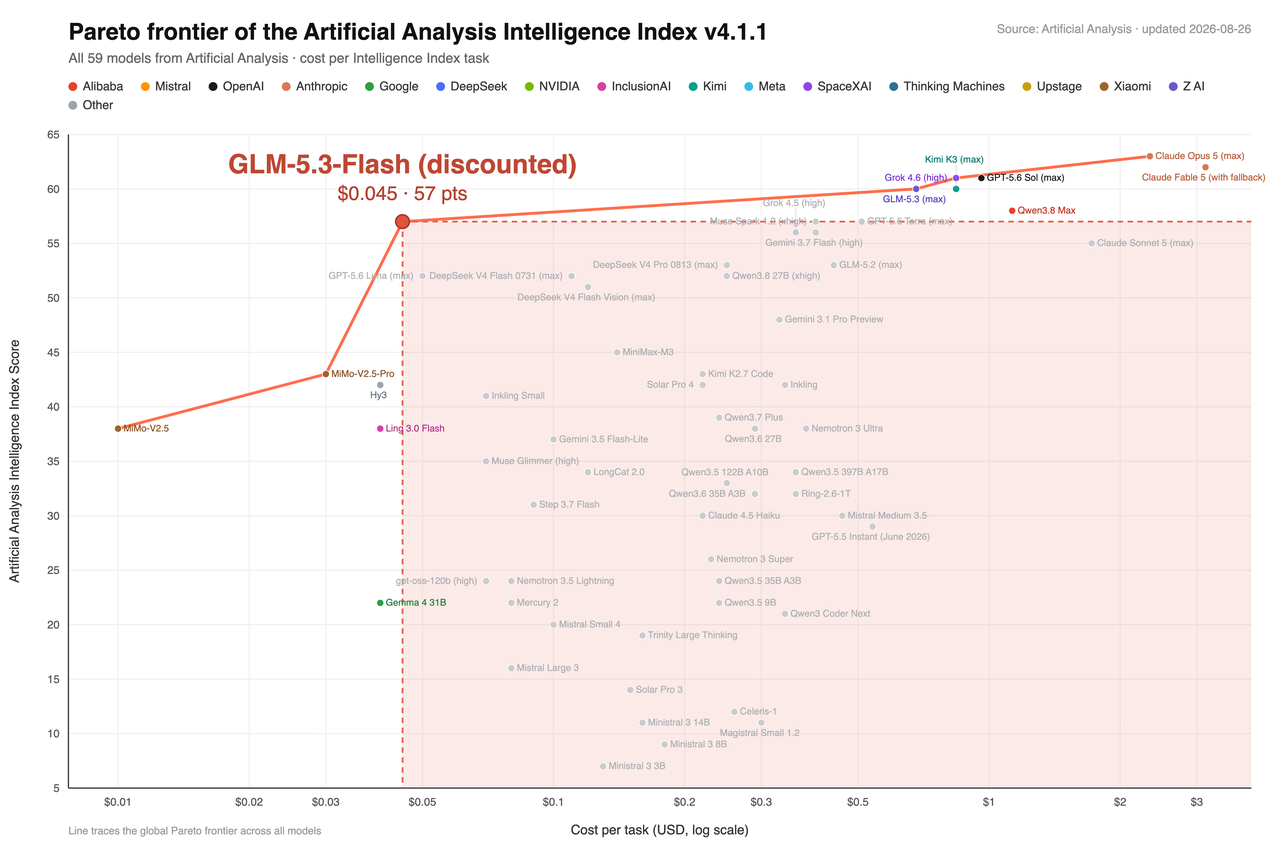
Artificial Analysis cost–intelligence frontier reproduced in Z.ai’s official Flash documentation.
Source: Z.ai official Flash documentation
Multimodality: Flash Has the Clear Advantage
Flash accepts visual inputs and integrates them into agentic workflows. It can inspect screenshots, page images, charts, interface states, screen recordings, and supported files, then use the visual evidence while coding or operating tools. The flagship currently supports text-only input.
- Frontend and design-to-code: Flash can inspect a reference screenshot and validate the rendered implementation.
- Document and Office workflows: Flash can reason about page structure, charts, layout, and image placement.
- Browser and computer use: Flash can combine visual state with tool calls and iterative corrections.
- Text-only repository work: the flagship remains preferable when the input is code and text and the task requires maximum reasoning depth.
Long Context and Reasoning Controls
GLM-5.3 Flash supports a 1M-token context window and up to 128K output tokens; GLM-5.3 provides the same limits. Both keep reasoning enabled and accept low, high, and max effort levels. Z.ai recommends max for difficult coding and benchmark reproduction.
Context capacity is therefore not the primary differentiator. The difference is how economically each model serves long sequences and how much reasoning capacity it can bring to the hardest tasks. Flash is architecturally cheaper at long context; the flagship has the stronger quality ceiling.
Cybersecurity: GLM-5.3 Is the Specialist
Cybersecurity is the flagship’s most distinctive capability. Z.ai reports 84.5 on CyberGym and 54.4 on ExploitBench. Under normalized two-hour and six-hour budgets, it completed 105 and 130 ExploitGym tasks.
Flash does not have an equivalent launch emphasis or matched public cyber suite. For code review, secure development, and authorized vulnerability discovery, use the flagship as the primary model and keep human approval, isolated tooling, audit logs, and disclosure controls in the workflow.
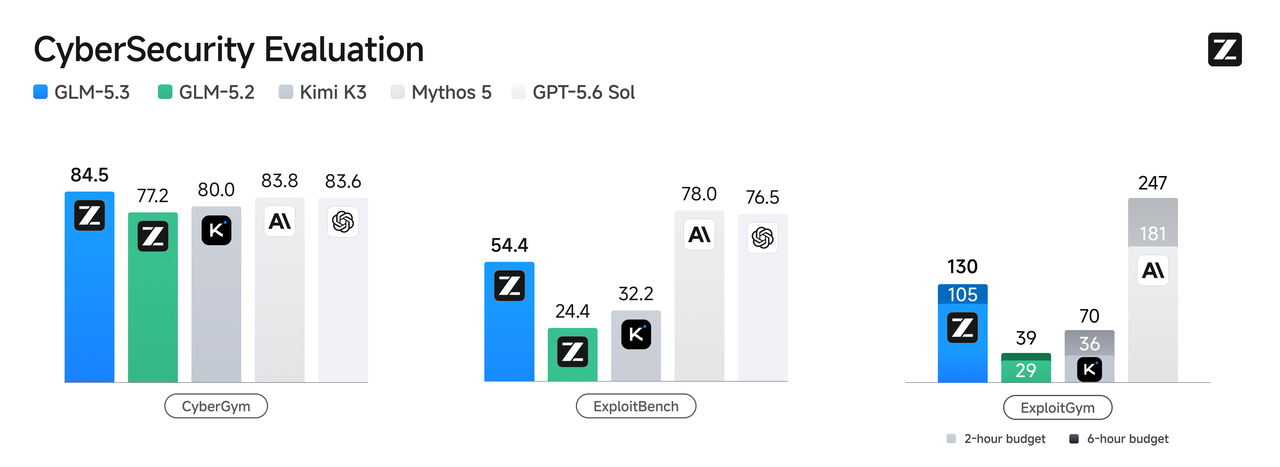
GLM-5.3 performance across vulnerability discovery and exploitation benchmarks.
Source: Z.ai official cybersecurity documentation
Cost and Deployment
API Pricing
Z.ai lists Flash at $0.15 per million input tokens and $0.50 per million output tokens before promotions, compared with $1.40 and $4.40 for the flagship.
| Access route | Flash input | Flash cached | Flash output | 5.3 input | 5.3 cached | 5.3 output |
|---|---|---|---|---|---|---|
| Z.ai standard list | $0.15 | $0.03 | $0.50 | $1.40 | $0.26 | $4.40 |
| Z.ai promotional Flash rate | $0.075 | $0.015 | $0.25 | $1.40 | $0.26 | $4.40 |
| CometAPI route | $0.06 | Check live route | $0.20 | $1.12 | Check live route | $3.528 |
Prices are USD per 1M tokens. Sources: Z.ai pricing, Flash route, and GLM-5.3 route. Promotions can change.
Example Monthly Cost
For a workload using 100M input tokens and 20M output tokens, the current CometAPI rates produce an estimated $10.00 for Flash versus $182.56 for the flagship, before cache effects or tool charges. Flash reduces the token bill by about 94.5% in this example.
| Cost component | GLM-5.3 Flash | GLM-5.3 |
|---|---|---|
| Input cost | 100 × $0.06 = $6.00 | 100 × $1.12 = $112.00 |
| Output cost | 20 × $0.20 = $4.00 | 20 × $3.528 = $70.56 |
| Total | $10.00 | $182.56 |
Open Weights and Self-Hosting
Both models have downloadable FP8 and BF16 checkpoints. GLM-5.3 Flash weights are released under the MIT License. GLM-5.3 uses the separate GLM-5.3 License, which requires security review before commercial use by Model-as-a-Service operators whose aggregate revenue exceeds US$10 billion over any consecutive 12 months. The supporting GLM-5 GitHub repository is licensed under Apache-2.0.
Flash is easier to serve than the flagship, but it is not a consumer-GPU model. The 320B checkpoint, multimodal components, KV cache, and 1M context still require serious infrastructure. Self-hosting is most attractive when data control, custom serving, or sustained high utilization justifies the operational cost.
Which Model Should You Choose?
Choose GLM-5.3 Flash if?
- You need image, screenshot, chart, document, browser, or GUI understanding.
- You run high-volume coding agents, research workflows, or business automation.
- You want strong tool use and knowledge-work performance at the lowest token cost.
- You need a 1M context window but do not want flagship economics on every request.
- You plan to self-host and 320B/18B is more practical than 744B/40B.
Choose GLM-5.3 if?
- You are solving the hardest repository-scale coding or long-horizon engineering tasks.
- Your evaluation rewards deeper reasoning more than low unit cost.
- You need the stronger result on DeepSWE, HLE with tools, or Agents’ Last Exam.
- You are building authorized defensive-security or vulnerability-discovery workflows.
- A higher success rate can offset a roughly order-of-magnitude token premium.
Decision Matrix by Use Case
| Workload | Recommended starting model | Why |
|---|---|---|
| High-volume chat and automation | GLM-5.3 Flash | Much lower cost; strong tool use |
| Visual coding and UI debugging | GLM-5.3 Flash | Native visual input |
| Document, chart, and Office analysis | GLM-5.3 Flash | Multimodal professional workflows |
| Routine repository maintenance | Start with Flash | Escalate failed or unusually hard tasks |
| Difficult repository-scale engineering | GLM-5.3 | Higher coding ceiling |
| Long-horizon research with tools | GLM-5.3 | Stronger HLE-with-tools result |
| Defensive security and vulnerability discovery | GLM-5.3 | Dedicated cyber training and benchmarks |
| Cost-sensitive self-hosting | GLM-5.3 Flash | Smaller active and total footprint |
| Uncertain mixed workload | Hybrid routing | Flash default; flagship escalation |
A Better Production Strategy: Route, Do Not Replace
For most teams, the strongest design is not an exclusive choice. Use Flash as the default route, then escalate only tasks with high complexity, failed validation, security sensitivity, or an expected economic value that justifies the flagship premium.
- Send visual, routine, and high-volume tasks to Flash.
- Measure acceptance rate, tokens, latency, tool failures, and human intervention.
- Escalate failed or high-risk text tasks to the flagship.
- Route security-sensitive work through additional authorization and sandbox controls.
- Optimize for cost per accepted result rather than benchmark rank or price alone.
How to Test Both Models Through CometAPI
CometAPI lists the GLM-5.3 Flash route and GLM-5.3 route behind the same OpenAI-compatible base URL. Create an API key, then run the same text task through both model IDs. For a fair test, keep the prompt, reasoning effort, tool definitions, maximum output, and acceptance rubric fixed.
Python
from openai import OpenAI
import os

client = OpenAI(
    api_key=os.environ["COMETAPI_KEY"],
    base_url="https://api.cometapi.com/v1",
)

models = ["glm-5.3-flash", "glm-5.3"]

for model in models:
    response = client.chat.completions.create(
        model=model,
        messages=[
            {
                "role": "user",
                "content": "Review this migration plan and identify its three highest-risk assumptions.",
            }
        ],
    )
    print(model, response.choices[0].message.content)
For multimodal evaluation, use the live Flash route documentation to verify the supported image content schema. The flagship comparison should use a text-only equivalent because it does not accept visual input.
Limitations of This Comparison
- Several coding and agent scores are vendor-reported. Independent reproduction may use different tools, prompts, and inference settings.
- Matched benchmark names do not always guarantee identical harness versions or context-management strategies.
- Architecture-level reductions in attention compute and KV cache do not directly predict API latency.
- Prices, promotions, model availability, rate limits, and route capabilities can change; verify live model pages before deployment.
- Open weights do not make either checkpoint inexpensive to self-host at full context.
- Cybersecurity capability is dual-use and requires authorization, sandboxing, logging, expert review, and responsible disclosure.
Conclusion
GLM-5.3 Flash is the practical default. It preserves long context, adds native vision, performs strongly on tool use and professional work, and changes the economics enough to support much broader deployment. GLM-5.3 is the specialist escalation model: more expensive, text-only, but stronger on the hardest coding, reasoning, and cybersecurity tasks.
The final verdict is therefore workload-based: start with Flash, measure real acceptance rate, and route to the flagship only when its extra reasoning capacity produces enough additional successful outcomes to justify the premium.
Frequently Asked Questions
Is GLM-5.3 Flash better than GLM-5.3?
Not universally. Flash is better for price, multimodality, and several tool/automation benchmarks. The flagship is stronger on the hardest coding, tool-assisted reasoning, and cybersecurity workloads.
Is GLM-5.3 Flash a small model?
No. It has 320B total parameters and activates 18B per token. It is more efficient than the 744B/40B flagship, but still requires substantial hardware for self-hosting.
Which model is cheaper?
Flash is dramatically cheaper. Z.ai’s standard list price is about one-tenth of the flagship price, and current CometAPI routes show an even larger gap while promotional pricing is active.
Which model is faster?
It depends on the metric and provider. Artificial Analysis measured slightly lower time to first token for Flash but higher output speed for the flagship.
Which model supports images?
Flash supports native visual input. The flagship currently supports text-only input.
Do both models support a 1M-token context?
Yes. Flash supports 1M context and up to 128K output; the flagship provides the same limits.
Which model is better for coding?
Use Flash for routine and high-volume coding agents. Use the flagship for the most difficult repository-scale engineering tasks or when failure costs more than the price difference.
Which model is better for cybersecurity?
The flagship. Z.ai specifically trained and evaluated it for vulnerability discovery and exploitation-chain reasoning. Use it only in authorized, controlled environments.
Can both models be self-hosted?
Yes. Z.ai’s repository lists downloadable checkpoints and supported serving frameworks, but both remain large infrastructure projects.
What is the best deployment strategy?
Use Flash as the default route and escalate difficult, failed, or security-sensitive text tasks to the flagship. Measure cost per accepted result.