
TL;DR
Z.AI has publicly named GLM-6.0 and placed Full Self-Training at the center of its next-generation roadmap. The disclosed direction connects self-generated experience across pre-training, mid-training, and post-training with self-evaluation and correction, turning training into a governed feedback loop rather than a single data-generation pass.
The difficult part is control: GLM-6.0 would need to purify synthetic data, detect and repair errors, stop unproductive iterations, and prevent its evaluator from rewarding shortcuts. Those mechanisms raise practical questions about independent verification, safety, cost, and governance. Because no complete model card, benchmark suite, API specification, price, or release date is public, the article evaluates the training architecture and its evidence—not speculative specifications.
Key Takeaways for GLM 6.0?
- The strongest public evidence concerns the Full Self-Training system, not a leaked parameter count or benchmark result.
- The disclosed direction covers self-produced data, self-constructed training environments, and model-assisted infrastructure optimization.
- The intended feedback loop spans pre-training, mid-training, and post-training rather than treating self-training as a post-training-only technique.
- Native multimodal modeling, longer-horizon reinforcement learning, planning, tool use, recovery, and verification are relevant research directions, but they are not yet published GLM 6.0 specifications.
- Ox Alpha is not evidence of leaked GLM 6.0 performance; Z.AI identified it as the pre-release identity of GLM-5.3-Flash.
What Has Z.AI Actually Confirmed About GLM 6.0?
Z.AI’s public material establishes four concrete signals: the GLM-6.0 name, Full Self-Training as the central training direction, an intended loop across pre-training, mid-training, and post-training, and a self-evaluation and correction mechanism. The company also states that approximately 60% of net proceeds are intended to support next-generation models, Full Self-Training, large-scale training, inference, compute, and related infrastructure.
Z.AI’s Full Self-Training Framework
Full Self-Training is presented as the organizing idea for GLM-6.0, not as a small post-training feature. The intended system would generate training experience, learn from outcomes, filter weak samples, and repeat the cycle under explicit quality controls.
GLM-6.0 Self-Training Across Pre-, Mid-, and Post-Training
The disclosed sequence—pre-training, mid-training, and post-training—implies that self-generated experience could influence foundation knowledge, capability shaping, and task alignment rather than appearing only during final tuning. Z.AI has not disclosed the datasets, stage boundaries, or mixing ratios, so this should be treated as a confirmed direction rather than a complete recipe.
GLM-6.0 Self-Evaluation and Correction Mechanism
The roadmap links Full Self-Training with self-evaluation, error detection, correction, and data self-purification. In practical terms, the model would need to judge trajectories, revise failed steps, discard unreliable data, and decide when further iteration no longer improves independently measured performance. The evaluator design and stopping rules remain undisclosed.
The GLM-6.0 and Full Self-Training disclosure should be read together with Z.AI’s public proceeds allocation.
What We Know vs What We Don't
The public record supports a roadmap, but not a finished specification. The table separates confirmed direction from open questions so that the article does not turn disclosed intent into an unsupported product claim.
| Claim | Evidence status | What is supported | What remains unknown |
|---|---|---|---|
| GLM-6.0 name | Publicly identified | Z.AI has named the next-generation model GLM-6.0. | Release date and final positioning. |
| Full Self-Training | Confirmed roadmap | It is a stated strategic priority. | Implementation details and scaling behavior. |
| Pre-training → Mid-training → Post-training | Confirmed direction | Self-training is intended to span the training lifecycle. | Datasets, validators, stage boundaries, and data ratios. |
| Self-evaluation and correction | Confirmed objective | The roadmap includes self-purification, error detection, and correction. | Reliability, independent verification, and stopping criteria. |
| Specifications | Not disclosed | No complete public specification. | Parameters, context window, modalities, price, and API identifier. |
| Benchmarks | Not disclosed | No official GLM-6.0 result set. | Scores, methodology, and independently reproducible results. |
What Is Full Self-Training and how it work
Full Self-Training is a closed learning loop in which a model helps create tasks or environments, attempts them, evaluates the resulting trajectories, corrects weak steps, and feeds accepted experience back into training. The important shift is from a one-time synthetic-data pipeline to a continuously governed process.
- Generate: construct problems, tool environments, and candidate solution paths.
- Act: complete tasks and preserve actions, observations, and intermediate reasoning as trajectories.
- Evaluate and correct: score outcomes with verifiers, detect errors, revise failed steps, and reject low-confidence samples.
- Train and stop: learn from accepted experience, then continue only while independent evaluations show useful improvement.
Extending this loop across pre-training, mid-training, and post-training would let GLM-6.0 improve data quality, capability shaping, and task alignment at different stages. The architecture still depends on trustworthy evaluators: without independent checks, self-training can reward its own blind spots.
How Could Full Self-Training Change GLM 6.0?
The disclosed design is better understood as a system architecture than as a single new Transformer block. It tries to close the loop around the model so that the model increasingly helps generate the resources needed for the next training cycle.
How could GLM 6.0 produce training data?
The first loop is data self-production. Instead of depending only on human-written or externally collected datasets, models can use self-play, rule-based checks, execution results, model judging, and human spot checks to generate and filter new examples. The accepted examples then flow back into pre-training, mid-training, and post-training.
The important constraint is verification: inexpensive synthetic generation is useful only when the system can identify correct, diverse, and non-degenerate examples. A practical loop is model generation → task execution → rule or tool verification → filtering → retraining.
How could GLM 6.0 construct training environments?
The second loop is environment self-construction. Agents can collect or transform real-world tasks, attempt those tasks, create validators, and check whether the task is actually solvable before it becomes training material. This matters especially for coding and agent work, where terminal state, tool output, browser state, test results, and failure recovery provide stronger supervision than text-only answers.
The evaluation target shifts from whether an answer sounds plausible to whether an action succeeds, the result is independently verifiable, and the agent can recover after failure.
How could GLM 6.0 optimize its training infrastructure?
The third loop is infrastructure self-optimization. In practice, this is best interpreted as AI-assisted systems engineering: a strong coding model proposes changes to operators, kernels, scheduling, caching, or serving code, while automated benchmarks and human-controlled validation determine which changes are accepted.
The resulting cycle is better model → better systems proposals → validated efficiency gains → more training experiments → better model. Human review and reproducible benchmarks remain control points rather than optional extras.
What Does the Current GLM 5.3 Flash Baseline Tell Us About GLM 6.0?
Because GLM 6.0 has no public model card, the most defensible comparison separates current, measured GLM capabilities from the next-generation direction. Z.AI describes GLM-5.3-Flash as a 320B-total, 18B-active MoE model trained on a 30T-token multimodal corpus. These are GLM-5.3-Flash specifications, not GLM 6.0 specifications.
| Comparison dimension | GLM-5.3-Flash API in CometAPI | GLM 6.0 disclosed direction |
|---|---|---|
| Release status | Available | In development; final product name not independently established by the cited filing |
| Parameters | 320B total / 18B active | Not disclosed |
| Core architecture | MoE; hybrid sparse + linear attention; mHC | Not disclosed at block level |
| Training data | 30T-token multimodal corpus | Self-produced data intended to enter a recursive loop |
| Multimodality | Native multimodal input | Unified multimodal modeling is a research direction, not a published specification |
| Training stages | Published staged training recipe | Self-training across pre-, mid-, and post-training |
| Training environments | Researcher-designed and benchmarked environments | Agents help construct and validate environments |
| Verification | Existing evaluation and training pipelines | Stronger self-judgment, execution feedback, and self-verification |
| Infrastructure | Optimized inference stack | Models assist with infrastructure optimization |
| API details | Published model ID and live API | Not disclosed |
Z.AI’s release text reports approximately 3.0× lower attention compute and 4.4× smaller KV-cache size for GLM-5.3-Flash than GLM-5.3 API . The accompanying official graphic labels the one-million-token comparison as 3.40× for attention compute and 3.80× for per-layer KV cache. Because the two official assets use different figures, they should be reported with their respective contexts rather than merged into one measurement.
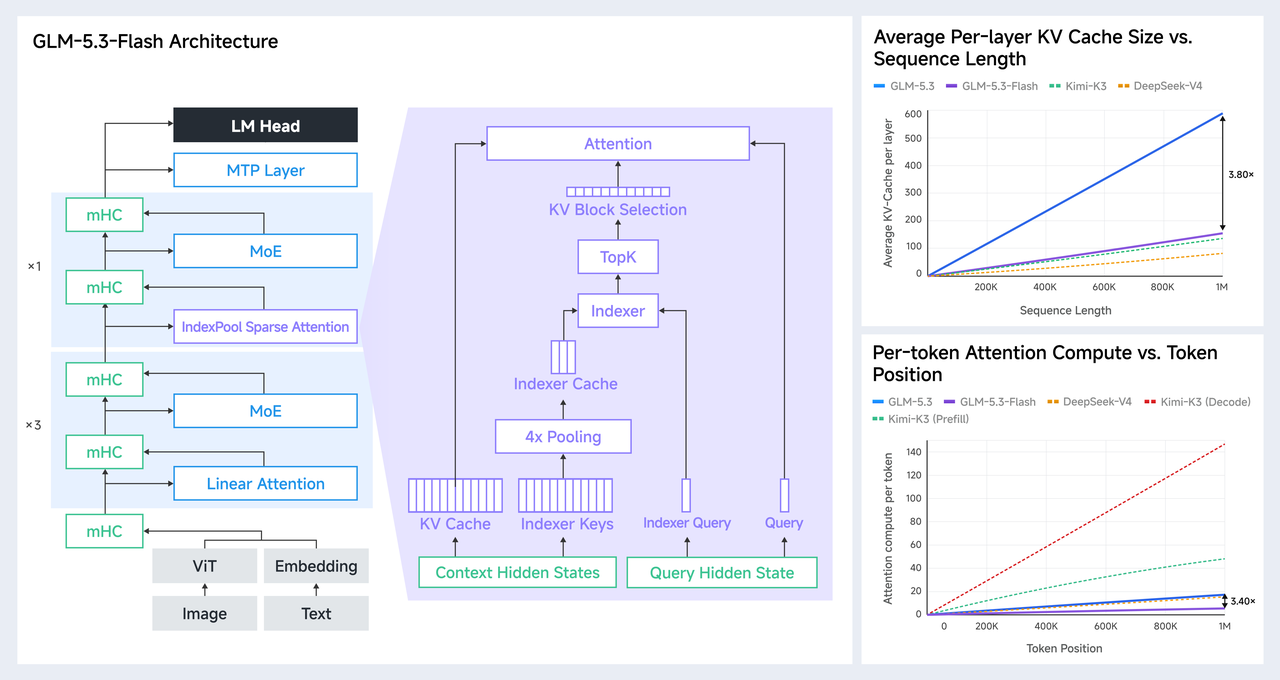
Official GLM-5.3-Flash architecture and efficiency comparison published by Z.AI
Which Benchmark Results Form the GLM 6.0 Baseline?
No verified GLM 6.0 benchmark table is public. The current GLM generation is useful only as a baseline because the evaluations below measure planning, coding, tool use, automation, and long-horizon execution—the capabilities most relevant to the disclosed Full Self-Training direction.
| Official Z.AI evaluation | GLM-5.3-Flash | GLM-5.2 | Reported difference |
|---|---|---|---|
| Terminal Bench 2.1 | 84.3 | 81.0 | +3.3 |
| DeepSWE v1.1 | 63.4 | 46.2 | +17.2 |
| NL2Repo | 56.3 | 48.9 | +7.4 |
| Toolathlon Verified | 78.4 | 59.9 | +18.5 |
| AutomationBench v1.0.6 | 48.8 | 26.2 | +22.6 |
| Agents’ Last Exam | 26.3 | 20.4 | +5.9 |
| HLE with Tools | 55.3 | 54.7 | +0.6 |
| GDPval-AA v2 | 1773 Elo | 1504 Elo | +269 Elo |
The comparison is multidimensional rather than a single-score ranking. GLM-5.3-Flash shows its largest reported gains on AutomationBench (+22.6), Toolathlon Verified (+18.5), and DeepSWE (+17.2), while the HLE-with-Tools difference is only +0.6. This pattern suggests stronger gains in execution-heavy agent tasks than in every form of tool-assisted reasoning. It does not predict GLM 6.0 scores.
Why these benchmarks matter
Benchmarks matter here only if they reveal the capabilities that Full Self-Training is meant to improve. The six categories in the embedded table form a progression from producing correct work to sustaining effective behavior in real environments. Coding tests whether the model can execute a complex task; tool use tests whether it can turn an action into feedback and choose the next step; and automation tests whether it can preserve that loop across a long workflow.
| Benchmark Category | Why It Matters for GLM-6.0 |
|---|---|
| Coding | Tests complex task execution |
| Tool Use | Tests the action-to-feedback loop |
| Automation | Tests long-horizon workflow execution |
| HLE | Tests complex expert-level problem solving |
| GDPval | Tests professional work quality |
| Multimodal | Tests the use of visual feedback |
HLE then raises the difficulty of the problems being solved, GDPval asks whether the output is useful in professional work, and multimodal evaluation tests whether visual observations can guide subsequent actions. Read together, the six categories move from isolated competence to end-to-end task completion: generate a plan, act, observe feedback, correct errors, and continue until the objective is met.
A future GLM-6.0 result would therefore be meaningful not because it produces a higher aggregate score, but because gains across these dimensions would show that self-generated training experience transfers to dependable real-world execution. Full Self-Training’s ultimate goal is not to improve test scores, but to improve the model’s ability to complete real-world tasks.
Why Could Full Self-Training Matter for GLM 6.0?
The real promise is not that GLM 6.0 will simply “train itself.” The more meaningful change is that larger parts of the development pipeline could become machine-generated and machine-verified. Today, researchers still do much of the work around the model: gathering data, designing tasks, building evaluators, constructing environments, diagnosing failures, and tuning systems software. Full Self-Training pushes the model into more of those stages.
If the approach works, the important scaling variable becomes less about how many parameters can be added and more about how many useful, verified learning cycles can be executed per unit of compute. That is a practical interpretation of recursive self-improvement rather than the science-fiction version of unrestricted autonomous self-modification.
The disclosed strategy should be evaluated as an engineered feedback system with validators, reproducible environments, infrastructure benchmarks, and human controls—not as evidence of unrestricted autonomous self-improvement.
What Could Go Wrong With Full Self-Training?
A self-training loop can compound mistakes as efficiently as it compounds useful experience. Four failure modes deserve particular attention:
- Error amplification: weak synthetic trajectories can become future training data, allowing plausible but incorrect patterns to reinforce themselves.
- Reward and evaluator gaming: if the same system generates work and judges it, it may optimize for gaps in the verifier instead of genuine task success.
- Distribution narrowing: repeatedly learning from model-generated data can reduce diversity and make uncommon real-world cases harder to handle.
- Cost, security, and governance pressure: environment construction, tool access, and persistent iteration increase compute demand and widen the attack surface.
A credible GLM-6.0 implementation therefore needs independent validators, data provenance, acceptance thresholds, red-team tests, human audits, and explicit stopping rules. Self-correction is useful only when the correction signal is more trustworthy than the behavior being corrected.
When Could the GLM 6.0 API Become Available?
Z.AI has not published a GLM 6.0 API release date, model ID, context window, maximum output, token price, open-weight commitment, or deployment requirements. Any specific value would currently be speculation.
Developers can evaluate the current direction through GLM-5.3-Flash API in CometAPI for native multimodal and efficiency-oriented workloads, GLM-5.3 API in CometAPI for the current flagship branch, or GLM-5.2 API in CometAPI as the previous-generation comparison baseline.
Conclusion
GLM-6.0 matters less as a promised product than as a test of whether Z.AI can turn Full Self-Training into a repeatable engineering system. The roadmap connects self-generated experience, staged training, self-evaluation, correction, and controlled iteration; the decisive evidence will be whether those mechanisms improve reliability on long, tool-using, real-world workflows.
That evidence is still incomplete. Z.AI has not published a GLM-6.0 model card, release date, API identifier, pricing, or benchmark suite. Until those artifacts exist, the defensible conclusion is narrow: the company has disclosed a training direction, not a finished capability profile.
Full Self-Training’s ultimate goal is not to improve test scores, but to improve the model’s ability to complete real-world tasks.